
Peak Oil is You

Donate Bitcoins ;-) or Paypal :-)


Page added on February 1, 2015

Why we are at Peak Oil Right Now
In this life nothing is certain. Therefore I am not declaring, absolutely, that we are at peak oil, only that it is a near certainty. But I am putting my reputation on the line in making the claim that the period, September 2014 through August 2015 will be the year of Peak Oil. Below are my reasons for making this claim.
First of all, Peak Oil is not a theory. The claim that Peak Oil is a theory is more than a little absurd. Fossil hydrocarbons were created from buried alga millions of years ago and they are finite in quantity. And as long as we keep extracting them in the millions of barrels per day, it is only common sense that one day we will reach a point where their extraction starts to decline. In fact most countries where oil is extracted are already in decline. So obviously if individual countries can experience peak oil then the world as a whole can also experience peak oil.
All charts below are in thousand barrels per day of Crude + Condensate with the last data point September 2014.
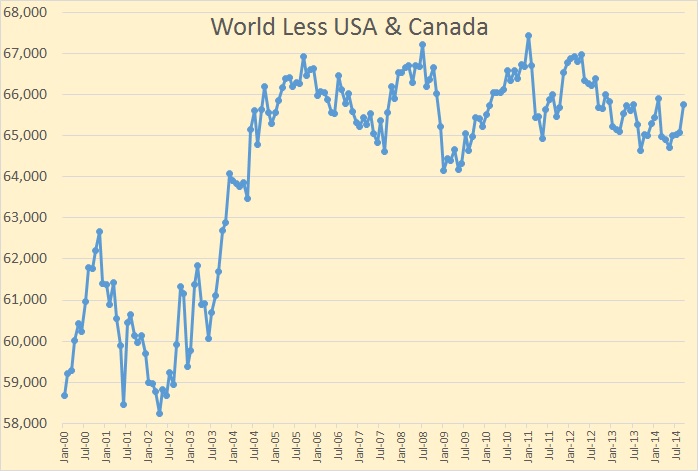
First I want to deal with the portion of the world that reached peak oil about four years ago, in January 2011. That is everywhere else in the world except the US and Canada. I am not saying that every country outside the US and Canada has reached peak oil, but combined they have reached peak oil
The world outside the United States and Canada has been on a bumpy plateau for ten years now and now, even with that last September 2014 surge, is still 1,670,000 barrels below the peak of January 2011. However only a few countries is responsible for this plateau.
The bumpy plateau actually began back in 2005 where the peak was in July. Since them, outside the USA and Canada, there have been 15 countries with production increases and 21 countries with production declines. Here is a look at the 15 winners outside the US and Canada.

Dealing with the winners one at a time:
Iraq: The EIA has data only through September but Iraq has actually increased production by about 300 kbd to December. but word is they are slightly down in January. That puts Iraq up almost 1.5 million barrels per day since they started their massive infill drilling program in 2009. Iraq still has some upside potential but their downside risk now even greater.
Russia: Russia has peaked, even according to Russian analyst. They will decline only slightly in 2015 but their decline will accelerate after that.
Brazil: Brazil has some upside potential and a lot of downside potential. The finances of Petrobras are a damn mess. Moody’s has downgraded them to Baa3, just one notch above junk status and further downgrades is expected soon. To increase their pre-salt production much more will require a lot more borrowed money. That is not very likely.
Qatar: The EIA says Qatar C+C production increased by 598,000 barrels per day between July 2005 and September 2014. The OPEC Monthly Oil Market Report says their crude only production declined by 78,000 barrels per day during that time span. The chart above was made with EIA data which counts condensate as oil. OPEC reports only crude. On the char below the EIA data is through September, the OPEC data is through December 2014.
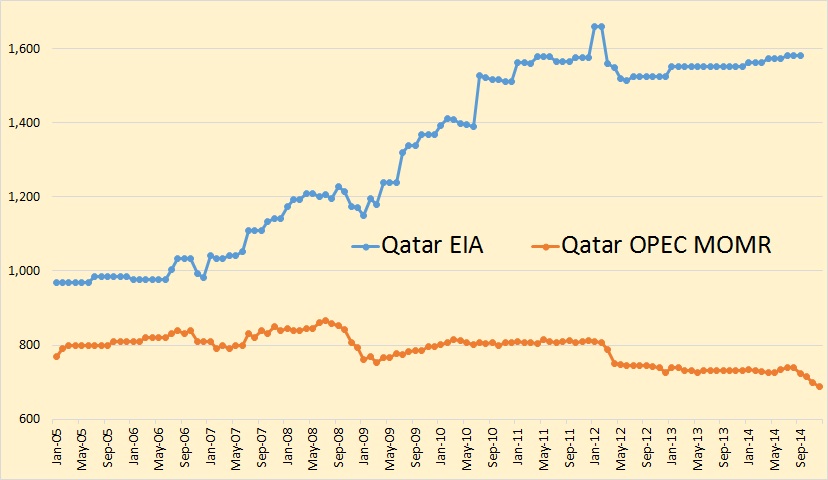
The EIA says Qatar has increased condensate production from her massive natural gas fields. Qatar crude oil production is in decline and has been since 2008. Qatar crude will continue to decline and their condensate is likely at a peak also.
Angola: Angola peaked in 2009 and 2010 and is now in decline. However some of the decline is caused by political problems. Those problems will likely get worse.
Colombia: Colombia’s production has doubled in the last 8 years but they reached their peak in 2013 and have held almost flat for the last two years. Colombia has peaked and will decline, though that decline will likely be very slow. I have included Colombia in the chart below that shows four countries that have recently peaked.
Kazakhstan: Kazakhstan is at peak of currently producing fields. Production will likely decline until Kashagan comes on line sometime in 2017. This field that once promised to produce over a million barrels per day is now expected to barely produce 300,000 barrels per day… if it ever manages to come on line. But nothing spectacular is expected out of Kazakhstan, especially since its old fields are expected to start to decline soon.
China: China peaked in 2010 and has held pretty well steady since then. I expect China will start to decline soon.
Azerbaijan: Azerbaijan peaked in 2010 and has been in steady decline since.
UAE, Oman and Kuwait: All three of these Middle East countries have implemented massive infill drilling programs in the last decade or so. But all three have now peaked. These three nations, along with Colombia, show a beautiful increase in production then a rounding peak at the top.
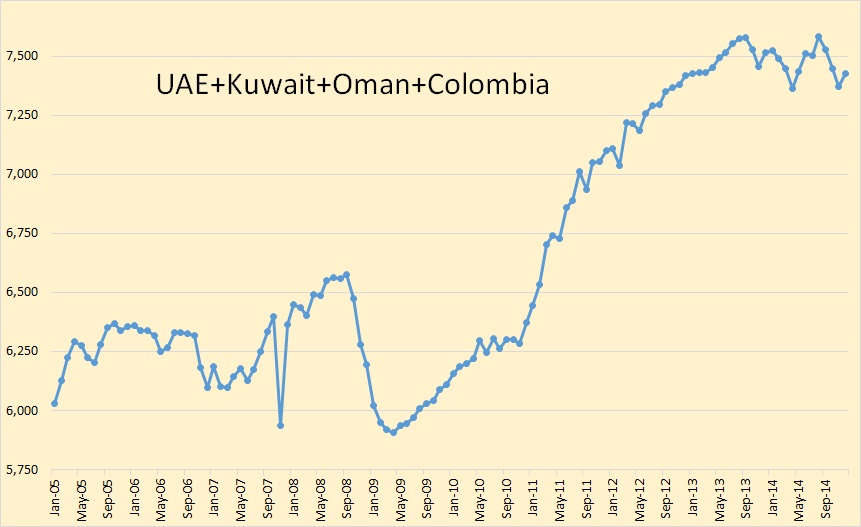
These four countries are responsible for 1.5 million barrels per day of the increase since 2005. They have all four now peaked, or at least very near their peak.
Saudi Arabia: Saudi has brought their last mothballed field on line, Manifa. Now they have none. Saudi is producing flat out. They might, with great effort, produce a few more barrels per day, but basically they are at peak right now.
And a look at the 21 losers.
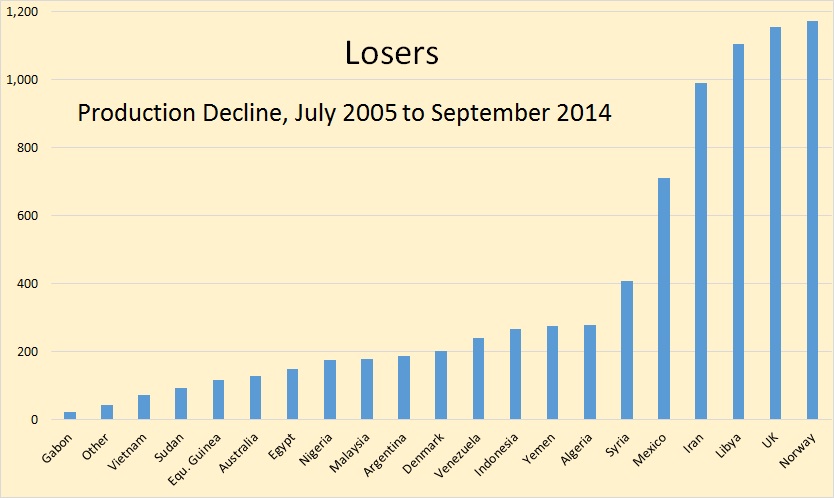
I have changed the negative numbers to absolute numbers in order to make it easier to read. But basically these are the nations that have peaked and are now in decline. A couple, Iran and Libya, because of political problems, have declined a lot more than they would have without that conflict. However neither is likely to recover very soon. And even when they do, it will be to a point lower than they were before their problems. Syria and Sudan, including South Sudan, and Yemen are others that will not recover in this decade, or until long after we are on the down-slope of peak oil.
That brings to the US and Canada.
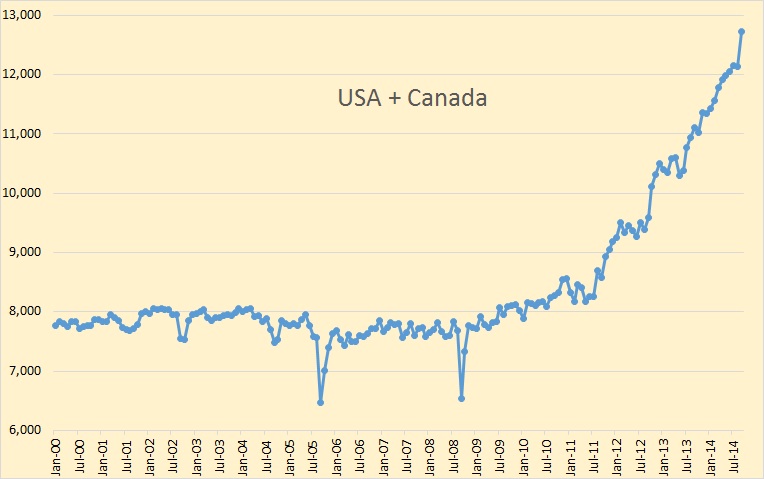
The USA and Canada are responsible for about 120% of the increase in world oil production since 2005, even though they did not begin their grand ascent until 2009. Canada’s over 400,000 bpd increase in September is responsible for that last spike upward. But can this continue?
In a word… no. The gain has been almost all LTO and oil sands. And low prices are killing both. If prices stay low both Canada and the USA will begin to decline by the second half of this year. But even if prices return to the $70 ti $80 range, (it is not likely they are going higher than that), their production will still not increase fast enough to offset the decline in the rest of the world.
But what about those massive reserves still in the ground? Many say we have not yet produced half the URR, the Ultimate Recoverable reserves, and until we are at least that half way point, we cannot be at peak oil. Well, there are a few really serious problems with that logic. First, what is meant by the word “recoverable”? And at what price? Let’s look at really important chart.
The 2014 data point on the chart below is the average January through November.
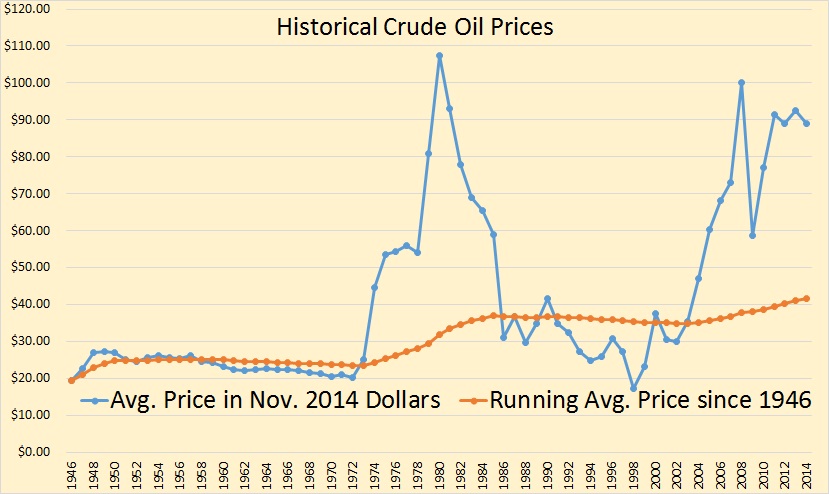
Here is a chart of Historical Crude Oil Prices. The average price, the blue line, is the average price of oil for that year. The orange line is the average price from 1946 to any point on that line. For instance the average price of oil for the 34 years from 1946 through 1973 was $23.68. And that in today’s dollars. From 1946 through 1973 oil companies were getting an average of $23.68 a barrel for their oil, and they were making a pile of money at that price. Today, the price is more than twice that amount, and many of them are losing a pile of money.
So let’s get back to reserves. The reserves produced in 1973 and prior years was very profitable at less than $24 a barrel. Then all hell broke loose in the Middle East and prices skyrocketed. Then for the next dozen years oil companies made windfall profits. But in 1986 oil prices came down to normal. Between 1986 and 2002 oil prices averaged $30.42 a barrel. (Not shown on the chart.) Even at that price oil companies still made huge profits. But today they are losing money at $50 a barrel.
The problem is with those “reserves”. Today’s reserves are just not the same as those earlier reserves. All the good cheap stuff has already been sucked up. We are now left with dredges at the bottom of the barrel. All today’s new oil is harder to find, depletes a whole lot faster, and cost many times as much to produce. None of the cheap stuff is left except in a few old super giant fields that are undergoing infill drilling like there is no tomorrow.
Once again, we are at peak oil right now. The peak will straddle the 2014 and 2015 time line. 2016 will be the first full post peak calendar year. It really doesn’t matter how many barrels of oil is left in the ground. The point is we will never again pull it out of the ground at the same rate we are pulling it out right now.
44 Comments on "Why we are at Peak Oil Right Now"
Speculawyer on Sun, 1st Feb 2015 2:50 pm
It is possible that we are at peak oil right now . . . but I HIGHLY doubt it. The current low oil prices are causing a lot of idiots to go buy gas guzzlers and we’ll be stuck with those vehicles for a while no matter what. So those sunk costs will probably mean oil production will increase a bit in the near term.
I don’t think you’ll ever hit a peak unless there are high prices that force demand destruction or a major technology breakthrough (like CHEAP electric vehicles) that cause people to consume less oil. Otherwise, we’ll just keep being addicted.
Baldwincng on Sun, 1st Feb 2015 3:06 pm
What a tedious article
GregT on Sun, 1st Feb 2015 3:18 pm
“It is possible that we are at peak oil right now . . . but I HIGHLY doubt it.”
We hit Peak Conventional oil in or around 2005-2007. The stuff that we have been extracting to make up the shortfall is not affordable to our economies. The current ‘low prices’ are still twice historical non-recessionary prices. IE, they are not low, they are still high.
The oil age will not end for lack of oil, it will end for the lack of affordable oil. Modern industrial society is fuelled by fossil fuels. Modern industrial society generates electricity. Electricity will not run modern industrial society.
On the flip side; We cannot afford to burn the known fossil fuel reserves if we hope to maintain a planet capable of supporting life as we know it. We have already done irreversible damage, at least from a human perspective. Consuming less oil would certainly be a good start, but within your lifetime Spec, we will need to stop burning ALL fossil fuels.
Rodster on Sun, 1st Feb 2015 3:57 pm
It goes to show the direct correlation between gas prices and consumer spending. Gas prices go up, SUV/Gas Guzzler purchases go way down.
Gas prices go down SUV purchases go up. Fuel prices does in fact drive the economy both good and bad. 😉
alokin on Sun, 1st Feb 2015 4:20 pm
Highly illogical behaviour. How long does an average person owns the same car? How much did petrol prices changed in that time? In the extreme case people are stuck with vehicles they can neither run nor sell.
GregT on Sun, 1st Feb 2015 4:35 pm
Rodster,
Your simple analysis does not explain the reality on the ground. Since we have been experiencing historically high oil prices, automobile sales year over year continue to rise. The top selling vehicles in North America are now full sized pick-up trucks.
Gas prices have gone up, gas guzzler sales have increased. Exactly the opposite of what you are imagining.
JuanP on Sun, 1st Feb 2015 9:03 pm
Excellent article. It may drive the denialists crazy. Sounds right on the money to me. I was not aware that the UK and Norway had been the two biggest losers of the past decade. Europe is in trouble and looking for more by picking a fight with Russia. It is very likely that all of Europe, including Russia, is already in decline and things there will very likely keep getting worse.
Don’t skip this one!
Plantagenet on Sun, 1st Feb 2015 10:40 pm
@GregT
Your claim that “gas prices have gone up” is nonsensical. Gas prices have now gone down below $1.99 gal across much the USA.
When the numbers get smaller, that means gasoline pries are going DOWN—when the price per gallon gets bigger, that means gas prices are going UP.
Cheers!
Plantagenet on Sun, 1st Feb 2015 10:41 pm
Its possible that peak oil is happening right now, but it would be very odd if peak oil was marked by a global oil glut and low prices, instead of oil shortages and high prices.
GregT on Sun, 1st Feb 2015 10:47 pm
Plant,
You must have an extremely short memory.
Perk Earl on Sun, 1st Feb 2015 10:53 pm
It could be peak oil right now because capex requirements to secure future supply have risen higher than consumer affordability.
If so, then future oil supply, i.e. new supply from exploration will not offset consumption and oil supply will descend from a peak.
But the tale of the tape will be what actually happens.
Perk Earl on Sun, 1st Feb 2015 10:59 pm
Keep in mind also that SA with Ghawar, Kuwait with Bergen and the UAE are all employing infield drilling. An obvious strategy to maximize extraction from an ageing field.
Many take for granted those fields supply, however someday the water percentage will be so great they will then have to rest those fields and later go to secondary methods of extraction, like pump jacks.
So the writing is on the wall to begin the descent from peak soon, it’s just that s has not h the f yet.
Plantagenet on Mon, 2nd Feb 2015 12:28 am
@GregT
Gasoline prices may be going up in your fantasy world, but back here in the real world they’ve plunged about 40% over the last two months.
Open you eyes, dude. Gasoline prices are DOWN because of the oil glut.
Cheers!
GregT on Mon, 2nd Feb 2015 12:29 am
Maximum extraction of a finite key resource, doesn’t really seem like such a good idea……………………
Plantagenet on Mon, 2nd Feb 2015 12:30 am
Perk Earl is exactly right.
Thats why its so stupid for KSA and the rest of OPEC to be conniving to create an oil glut. They’ll be sorry they sold their precious fluids for $50 bbl after their fields all start declining 4-7% per year.
GregT on Mon, 2nd Feb 2015 12:32 am
@plant,
“they’ve plunged about 40% over the last two months”
So your memory really is extremely short then. Considering all of the rest of the utter nonsense that you continually spew, I do not find that the least bit surprising.
GregT on Mon, 2nd Feb 2015 12:36 am
Plant said,
“Thats why its so stupid for KSA and the rest of OPEC to be conniving to create an oil glut.”
If only the world were as simple as you are able to comprehend that it is Plant………….
Plantagenet on Mon, 2nd Feb 2015 12:45 am
@GregT
YES– oil prices have plunged over the last two months.
Check it out Greg.
Cheers!
GregT on Mon, 2nd Feb 2015 12:52 am
And oil prices have actually gone up from last week Plant. To play your childish game, oil prices are rising. Gasoline here has risen 12 cents per litre since Saturday morning.
meld on Mon, 2nd Feb 2015 2:43 am
plat said “but it would be very odd if peak oil was marked by a global oil glut and low prices”
really the maximum oil supply the world will ever reach would be marked by shortages? you are aware that the peak in peak oil stands for maximum right. It’s actually very likely that a peak would bring about an oil glut and high prices.
meld on Mon, 2nd Feb 2015 2:43 am
*low prices
Adamc18 on Mon, 2nd Feb 2015 3:01 am
If we really have reached peak (affordable) oil, what about the alternatives? The problem is that nothing else comes remotely close to the energy density of fossil fuels, especially oil. Critics of ‘current-solar’ (solar panels, wind turbines, biofuels) just don’t grasp that fossil fuels represent maybe 60 million years of solar accumulation and we are burning vast amounts of it in a single human lifetime ( ok, it started in a few countries in the 19th century, but we only really got going post-WW2.). The infrastructure for all of the renewables is expensive, simply because it has to be huge to catch widely-dispersed current sunlight. Politicians and business leaders have no grasp of the mathematical impossibility of replacing disappearing fossil fuels with anything else.
Davy on Mon, 2nd Feb 2015 6:08 am
Planter there is no reason why peak oil can’t occur in an excess supply environment if demand has been damaged by that low economic value production or other economic issues. The fact is POD and ETP of oil is a multifaceted environment of the entire oil production and consumption symbiosis. It takes a car to utilize the gas and gas needs a car to produce value. The “oil glut” has a narrow simple meaning. An oil glut must be put into context of supply, demand, economic environment, a geopolitical situation.
Oil is a global commodity so it has a macro position in the global. If we have an oil glut but in an environment of lower overall production is that a smaller glut than a glut in a higher production environment with differing amounts? Shouldn’t a glut be put in some kind of context? What is a glut anyway an excess supply or an excess supply in a healthy or unhealthy economy. What about a glut of lower quality crude compared to a glut of higher quality crude with good ETP?
It is obvious the glut issues is divisive here on PO because the whole POD environment has a sloppy definition per your position on the subject. If we take the pure definition of PO then we have not seen PO yet but we may be at PO now. In any case the pure definition must be adapted for the large amount of unconventional oil which makes the whole topic muddy. I am not the expert here on PO and gluts but I find Planters insistence on an “oil glut” as lacking definition and thereby missing clarity. Planter that does not mean I am saying you are wrong. I am saying something is missing from your use of “oil glut”.
Arthur75 on Mon, 2nd Feb 2015 8:11 am
Nice summary.
But a bit of a pity that RP sticks to the song :
“Then all hell broke loose in the Middle East and prices skyrocketed.”, regarding the first oil shock.
When a little something happened in 1970 (end of year) : the top producer of the time –BY FAR– peaked.
https://i0.wp.com/upload.wikimedia.org/wikipedia/commons/c/c5/US_Oil_Production_and_Imports_1920_to_2005.png
An example of a Nixon speech of the time (before the “embargo” ) :
”
“195 – Special Message to the Congress on Energy Resources.
June 4, 1971
1971
To the Congress of the United States:
For most of our history, a plentiful supply of energy is something the American people have taken very much for granted. In the past twenty years alone, we have been able to double our consumption of energy without exhausting the supply. But the assumption that sufficient energy will always be readily available has been brought sharply into question within the last year. The brownouts that have affected some areas of our country, the possible shortages of fuel that were threatened last fall, the sharp increases in certain fuel prices and our growing awareness of the environmental consequences of energy production have all demonstrated that we cannot take our energy supply for granted any longer.
…
”
http://www.presidency.ucsb.edu/ws/index.php?pid=3038&st=oil&st1=
(was looking for an even clearer one video, cannot find it back)
Arthur75 on Mon, 2nd Feb 2015 8:12 am
And a bit more detailed summary (once again I know) :
– end 1970 : US production peak, the energy crisis starts from there, with some heating fuel shortages for instance (some articles can be found on NYT archive on that), or :
http://upload.wikimedia.org/wikipedia/commons/c/c5/US_Oil_Production_and_Imports_1920_to_2005.png
– Nixon name James Akins to go check what is going on.
– Akins goes around all US producers, saying this won’t be communicated to the media, but needs to be known, national security question
– The results are bad : no additional capacity at all, production will only go down, the results are also presented to the OECD
– The reserves of Alaska, North Sea, Gulf of Mexico, are known at that time, but to be developed the barrel price needs to be higher
– In parallel this is also the period of “rebalance” between oil majors and countries on each barrel revenues (Ghadaffi being the first to push 55/50 for instance), and creation of national oil companies.
– there is also the dropping of B Woods in 71 and associated $ devaluation, also putting a “bullish” pressure on oil price.
– So to be able to start Alaska, GOM, North Sea, and have some “outside OPEC” market share, the barrel price needs to go up (always good for oil majors anyway) and this is also US diplomacy strategy
– For instance Akins, then US ambassador in Saudi Arabia, is the one talking about $4 or $5 a barrel in an OAPEC meeting in Algiers in 1972
– Yom Kippur starts during an OPEC meeting in Vienna, which was about barrel revenus percentages, and barrel price rise.
– The declaration of the embargo pushes the barrel up on the spots markets (that just have been set up)
– But the embargo remains quite limited (not from Iran, not from Iraq, only towards a few countries)
– It remains fictive from Saudi Arabia towards the US : tankers kept on going from KSA, through Bahrain to make it more discrete, towards the US Army in Vietnam in particular.
– Akins is very clear about that in below documentary interviews (which unfortunately only exists in French and German to my knowledge, and interviews are voiced over) :
http://www.youtube.com/watch?feature=player_embedded&v=fQJ-0jAr3LQ
For instance after 24:10, where he says that two senators were starting having rather “strong voices” about “doing something”, he asked the permission to tell them what was going on, got it, told them, they shat up and there was never any leak. The first oil shock “episode” starts at 18:00
The “embargo story” was in fact very “practical”, both for the US to “cover up” US peak towards US public opinion or western one in general, but also for major Arab producers to show “the Arab street” that they were doing something for the Palestinians.
In the end, clearly a wake up call that has been missed, especially at a time when we are around global peak and the omerta about it is almost complete.
Note : About Akins, see for instance :
http://www.washingtonpost.com/wp-dyn/content/article/2010/07/26/AR2010072605298.html
And his famous foreign affair article :
http://www-personal.umich.edu/~twod/oil-ns/articles/for_aff_aikins_oil_crisis_apr1973.pdf
His report to Nixon in 71 or 72 is still classified to my knowledge though, would be interesting to know if it can be declassified now.
Arthur75 on Mon, 2nd Feb 2015 8:16 am
@Davy
Exactly, one should not forget that peak oil is by definition the time in history when the volume of oil available per time unit is the highest in history.
A graph from 2009 summarizing well the situation :
http://www.manicore.com/documentation/petrole/prix_futur_graph3.jpg
From the page :
http://www.manicore.com/documentation/petrole/prix_futur.html
marmico on Mon, 2nd Feb 2015 8:52 am
But a bit of a pity that RP sticks to the song
You must be referring to the Chicken Little December 2010 genre:
“In my [Darwinian aka Ron Patterson] opinion we are at that peak right now and have been for almost six years now.”
http://www.theoildrum.com/node/7246#comment-752370
Mike999 on Mon, 2nd Feb 2015 8:58 am
Whenever, in the real world, you’re drilling 2 MILES underwater in the Gulf of Mexico, You’re at Peak Oil.
When you even consider using “tar sand” for oil extraction, and the heavy energy and water needed to refine this junk, you’re at Peak Oil Now.
Only a fool could think otherwise.
But we have plenty of fools, the same ones who don’t believe Global Warming is real,
with real world evidence there as well:
Global glacier melt,
Global drought conditions,
ice shrinkage in Real Time at both polls.
The US is the most Uneducated Voting Public in the World, and we pay the price.
GregT on Mon, 2nd Feb 2015 9:01 am
““In my [Darwinian aka Ron Patterson] opinion we are at that peak right now and have been for almost six years now.”
It looks like Ron was correct. Much of what was produced to make up the shortfall has done nothing more than cause irreparable damage to the world’s economies.
If we can’t afford it, there isn’t much point in pumpin’ it. It may as well be sawdust.
GregT on Mon, 2nd Feb 2015 9:05 am
Mike,
Marmico isn’t a fool, he’s an economist in training. Fools can sometimes learn to understand physics, biology, and mathematics.
Sam on Mon, 2nd Feb 2015 9:05 am
What about analysis heard recently on NPR: Saudis seeing the future, don’t want to be stuck with Un-pumped product, dumping it now. Does this make sense? If so, are they not buying into PO?
Ralph on Mon, 2nd Feb 2015 10:16 am
Oil is still the largest single source of primary energy available to industrial civilisation. The Chinese coal consumption surge saw coal run up to a close second, but last year even Chinese coal consumption dropped. NG is a distant third, the rest (including nuclear and hydro) are single figure percentages.
Peak oil will therefore equate more or less with peak gross energy production. NG growth will continue to rise for a while, but global economic growth is now a two horse race between energy efficiency gains against eroei falls.
The eroei of oil is falling fast, and the combined effect of ZIRP and QE have run out of steam keeping prices high enough to support fracking and tar sands expansion.
So we are facing a low energy future. This has been obvious to me personally for 15 years, and other people for longer. The only question is how well we adapt to that as individuals, societies, and as a species.
To date, the answer appears to be badly.
marmico on Mon, 2nd Feb 2015 10:44 am
Peak oil will therefore equate more or less with peak gross energy production Highly unlikely.
The 40 year primary energy trend is substitution away from oil and coal towards natural gas and renewables, including nuclear. That trend will continue for the next 40 years.
Total Primary Energy Share, IEA
GregT on Mon, 2nd Feb 2015 10:47 am
“The only question is how well we adapt to that as individuals, societies, and as a species.
To date, the answer appears to be badly.”
Absolutely Ralph,
The average Joe on the street still has no clue about the implications of a reduced energy future, never mind the terminology that is ‘Peak Oil’.
We even have at least one person here on PO.com, that believes that we are in an ‘oil glut’, like that is in some way a good thing. Adaptation is much easier when one can anticipate what is approaching, IMHO most people are going to be in a severe state of shock, right before all hell breaks loose.
GregT on Mon, 2nd Feb 2015 11:02 am
The 40 year primary energy trend is substitution away from oil and coal towards natural gas and renewables, including nuclear. That trend will continue for the next 40 years
The world has never faced a problem like this. Without massive mitigation
more than a decade before the fact, the problem will be pervasive and will
not be temporary. Previous energy transitions (wood to coal and coal to oil)
were gradual and evolutionary; oil peaking will be abrupt and revolutionary.
Mitigation will require an intense effort over decades. This inescapable
conclusion is based on the time required to replace vast numbers of liquid
fuel consuming vehicles and the time required to build a substantial number
of substitute fuel production facilities. Our scenarios analysis shows:
• Waiting until world oil production peaks before taking crash program
action would leave the world with a significant liquid fuel deficit for more
than two decades.
• Initiating a mitigation crash program 10 years before world oil peaking
helps considerably but still leaves a liquid fuels shortfall roughly a decade
after the time that oil would have peaked.
• Initiating a mitigation crash program 20 years before peaking appears to
offer the possibility of avoiding a world liquid fuels shortfall for the forecast
period.
Looks like we are about 30 years too late.
Arthur75 on Mon, 2nd Feb 2015 11:06 am
“IMHO most people are going to be in a severe state of shock, right before all hell breaks loose.”
%ost probably, but in fact still might get unnoticed as the key or fundamental reason of the crisis to come (or on-going).
I mean the crisis will be there, but will be described as “economic”, “financial”, etc …
GregT on Mon, 2nd Feb 2015 11:18 am
Authur75,
The crisis is already here, and it IS being described as “economic”, “financial”, etc. So far………….
marmico on Mon, 2nd Feb 2015 11:23 am
GregT, the Hirsch Report was published 10 years ago. More Chicken Little singing in the pew of the Church of Peak Oil Apocalypse.
Davy on Mon, 2nd Feb 2015 11:38 am
Marm, you actually trust IEA numbers? I guess you massages envy.
Dragon Oil on Mon, 2nd Feb 2015 11:57 am
Every soul on this planet wants the best for themselves and their families that can reasonably obtain. As world population expands, the requirements to do that expand with energy expansion as the primary source. Fossil fuels are the primary source for that energy expansioun. The expansion occurrs at the cheapest cost “of the day”. Thus various sources of energy wax and wane as their delivery prices vary. Nothing new there. With an expanding population living with higher quality life styles the demand for more energy must go up. New oil discoveries, technology discoveries, new energy sources all make contributions but do not change the underlying formula that states increasing populations living a better life style requires more energy. So now what? Peak Oil is not questionable. It’s just a matter of when and at what price. Humans are clever creatures. We will find ways to postpone the inevitable in a host of different ways, but it will come. Caviat! Until we find a way to control ourselves to match the available energy at the price and with life style and numbers of us that balences the equation. Just like your retirement plans(?) Really!?
GregT on Mon, 2nd Feb 2015 12:04 pm
marmico,
Correct, the Hirsch report was published in Februaury of 2005. So far, other than natural gas prices, it has proven to be correct. natural gas prices will however, eventually rise as well. The Peak Oil Apocalypse is unfolding before your very eyes. If you choose not to take actions to mitigate the impacts to you and yours, that is entirely your choice. I feel badly for your family though.
Mike999 on Mon, 2nd Feb 2015 1:46 pm
Natural gas/Fracking just prove’s Shiller’s book “Irrational Exuberance”.
When you’d continue to drill, polluting your precious fresh water, while natural gas prices are at such low levels proves the incompetence of the Capitalistic model. The inherent stupidity of letting Capitalistic greed continue to year after year flood the market with no pull back in drilling, while CO2 emissions are at an all time high, proves the SUICIDE model that is Capitalism.
Bad for the environment, and certainly not Optimal for Business.
Arthur75 on Mon, 2nd Feb 2015 2:26 pm
It’s easy to point to “capitalism” when referring to “optimality”, when capitalism is in a way the very embodiment of the optimization mindset.
Try cursing science and technology, for a change.
Arthur75 on Tue, 3rd Feb 2015 8:42 am
@Mike
Sorry for above msg, a bit stupid and not written in “normal conditions”