
Peak Oil is You

Donate Bitcoins ;-) or Paypal :-)


Page added on January 5, 2015

Bakken, Let’s Do The Math

There has been considerable dispute over how many new wells required to keep production flat in the Bakken and Eagle Ford. One college professor posted, over on Seeking Alpha, figures that it would take 114 rigs in the Bakken and 175 in Eagle Ford to keep production flat. He bases his analysis on David Hughes’ estimate that the legacy decline rate fir Bakken wells is 45% and 35% for Eagle Ford wells. And he says a rig can drill 18 wells a year, or about one well every 20.3 days.
The EIA has comes up with different numbers. The data for the chart below was taken from the EIA’sDrilling Productivity Report.
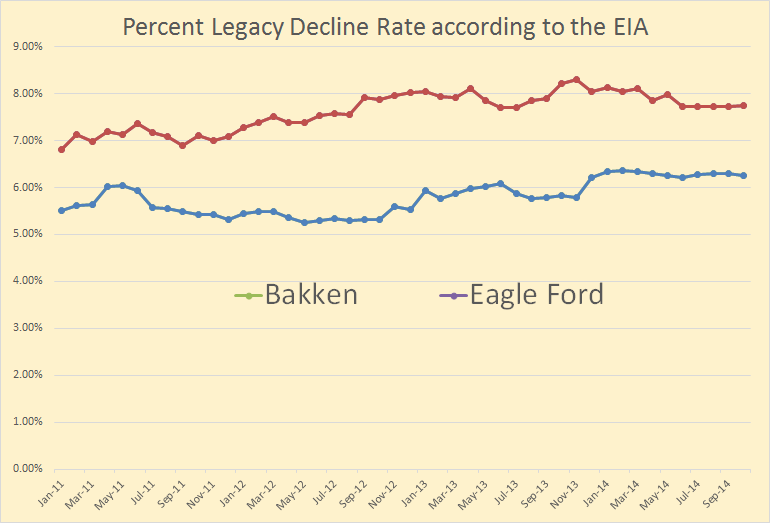
The EIA has current legacy decline at about 6.3% per month for Bakken wells and about 7.7% per month for Eagle Ford wells. That works out to be about 54% per year for the Bakken and 62% per year for Eagle Ford. I believe the EIA’s estimate of legacy decline, in this case, is fairly accurate. For instance last month Mountrail County had over 30 new wells completed yet still declined by 6.4%. And in December 2013 North Dakota declined by 5.22% yet had 119 new well completions.
I have examined the last sixteen Directr’s Cuts and gleaned, I think, some important data… I think.
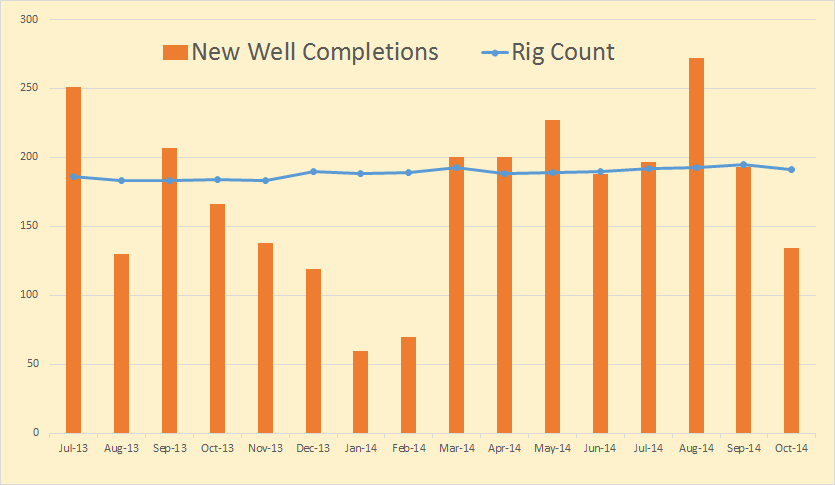
Rig count has averaged 189 rigs per mnth and has been fairly steady while new well completions has averaged 172 wells per month but has been highly erratic.
New well completions depends far more on weather and fracking crews than rigs. In October there was 650 wells awaiting fracking crews. At 172 wells per month that is almost a four months supply. And that is also what the average spud to completion is, 120 days.
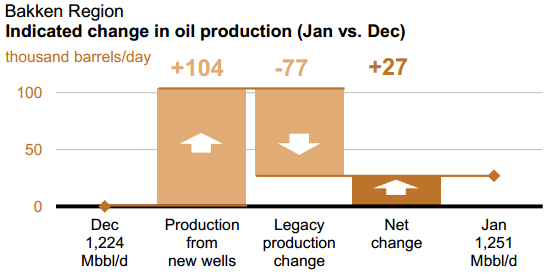
The Bakken part of the chart above says the Bakken legacy decline was 77,000 bpd but it was 77 bpd in Octber. This fits perfectly with what I found by looking at the 16 month Director’s Cut stats. They showed an average of 172 new wells per month, an average of 555 bpd per new well, (first month).
That is the 16 month average. Of course every month is different. But if we accept the EIA’s legacy decline data then everything fits perfectly. The legacy decline, in October, was 72,951 bpd. But they had a decline of 4,054 bpd in October. That means new production was 68,897 bpd, or 4,054 bpd less than the legacy decline. There were 134 new wells that averaged 514 barrels per day each.
It would have taken 142 new wells to keep production flat in October. They came up 8 wells short.
The situation in Eagle Ford is a little more dire.
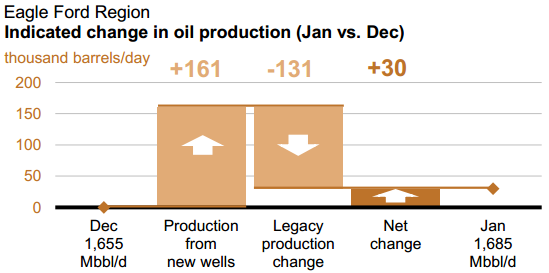
Their legacy decline is 81% of current production. If their new well production declines by only 19% then their production will be flat.
What will light tight oil production look like in 2015? I can only guess. But I expect Bakken production to continue to increase, at least until mid year, but at a much lower rate. I think Eagle Ford will start to decline, slightly, by the second quarter.
Rig Counts from Baker Hughes as of Friday January 2, 2015.
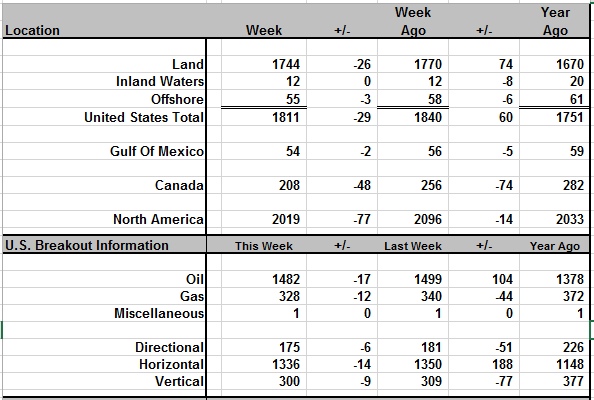
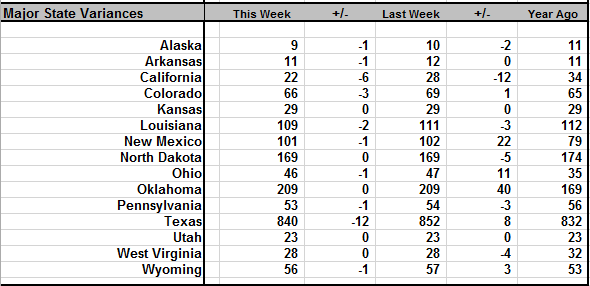
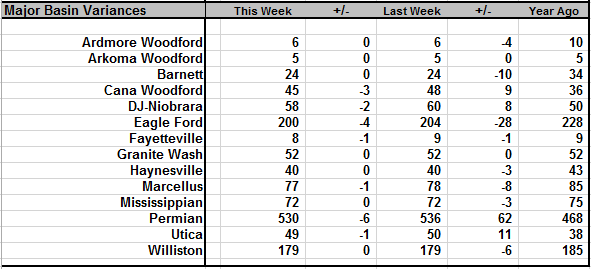
North Dakota at 169, flat for the week but down 28 from the most recent high of 197 in October. Williston Basin, which includes Montana, is at 179. Eagle Ford is dropping but not as fast as North Dakota.
If you don’t know about the web site Desdemona Despair, Blogging The End of the World, you should check it out.
The most surprising image of 2014 came with the discovery of large craters in the Yamal peninsula in Siberia, caused by sudden releases of methane as the permafrost thaws and collapses. This image captures a bit of the profound change that humans have precipitated in the great biogeochemical cycles of the planet, to the doom of all.
8 Comments on "Bakken, Let’s Do The Math"
GregT on Mon, 5th Jan 2015 7:26 pm
Those methane ‘burps’ should have been one of the biggest news stories of 2014. Yet most people have no idea that they exist, never mind the cause, or the potential dire implications for life as we know it on Earth.
Makati1 on Mon, 5th Jan 2015 10:23 pm
On burp leads to a belch and then all hell breaks lose…
Rodster on Tue, 6th Jan 2015 4:37 am
What are methane burps and what causes them?
ghung on Tue, 6th Jan 2015 8:25 am
Rodster: Vast expanses of permafrost encircle the the planet at higher latitudes. The permafrost contains incredible amounts of frozen methane which is released as the permafrost melts (that pesky global warming thing). As the methane gasifies and builds pressure, it ‘burps’ through the surface, released into the atmosphere. Since methane is a much more affective greenhouse gas than CO2, it contributes to global warming, which melts more permafrost, releasing more methane,, rinse, repeat => feedback loop.
Some consider this to be the greatest threat, near-term, to the habitability of the planet for higher lifeforms; NTE (near term extinction).
See: guymcpherson.com for a very dark assessment of this issue, or https://www.youtube.com/watch?v=lA7koR4pz68
Apneaman on Tue, 6th Jan 2015 10:33 am
Methane sphincters. We shit all over the planet for a long time and especially the last 275 years. Now the earth is shitting back at us.
http://ameg.me/
JuanP on Tue, 6th Jan 2015 11:34 am
This is the Methane Clathrate Wiki, http://en.m.wikipedia.org/wiki/Methane_clathrate
And this is the Methane Clathrate Gun hypothesis Wiki, http://en.m.wikipedia.org/wiki/Clathrate_gun_hypothesis
I believe, based on what I’ve read on the subject through the years, that we are way past the point of no return as far as Methane Clathrates are concerned. The Methane Clathrates releases are, IMO, what is most likely to make the planet uninhabitable for humans at some point in the short to medium term future.
Even if all humans died and stopped polluting the atmosphere today, it would be too late to stop it. Those releases will become self sustaining long before our past pollution gets processed by the atmosphere, if they are not already so.
GregT on Tue, 6th Jan 2015 12:11 pm
“Arctic Death Spiral and the Methane Time Bomb”
https://www.youtube.com/watch?v=5IevqUUWD4o
Why we should all be very concerned………………..
Apneaman on Tue, 6th Jan 2015 2:21 pm
Don’t need any big burst methane to be fired to do in most life on this planet. It is a self reinforcing positive feed back loop. It is not linear. It is unstoppable. It is one of dozens of self reinforcing positive feed back loops that carbon man has triggered.