
Peak Oil is You

Donate Bitcoins ;-) or Paypal :-)


Page added on January 2, 2015

Peak Oil From The Demand Side: A Prophetic New Model
The most attention-grabbing attempts to predict oil futures have come from geologists and environmental activists, who tend to look solely at production. An overlooked doctoral thesis by Christophe McGlade, Uncertainties in the outlook for oil and gas, in contrast, focuses on how both supply and demand might be constrained in the coming decades. Peak oil researchers should take note of McGlade’s thesis because he predicted, in November 2013, that oil prices would sink, and that they will stay low throughout the second half of this decade. I found this paper on Google Scholar and have no connection with the author, but I appreciate his careful consideration of peak oil arguments, and his ability to distance himself from the more narrow-minded aspects of both economic and geological thinking. Here’s a representative quote from the middle of the thesis, p. 216:
The focus of much of the discussion of peak oil is on the maximum rates of conventional oil production. Apart from issues over how this term is defined, results suggest that focussing on an exclusive or narrow definition of oil belies the true complexity of oil production and can lead to somewhat misleading conclusions. The more narrow the definition of oil that is considered (e.g. by excluding certain categories of oil such as light tight oil or Arctic oil), the more likely it is that this will reach a peak and subsequent decline, but the less relevant such an event would be.
Advocates for peak oil often try to fit oil production to a curve based solely on an idealized image of production. Indeed, when nothing unusual happens on the downslope, oil production looks like a Hubbert curve, especially on micro levels. But at the macro levels, unusual things do happen: for example, the shale boom. McGlade argues that pessimists have failed to acknowledge that now that conventional oil has reached its peak, we should not expect a smooth ride down, but rather we should expect the unexpected, such as discoveries of new methods of production or adjustments in demand. Oil production is an artificial, not a geological, process, and nothing about the way oil is produced at the macro level demands that it must look like a bell curve. Of course it is impossible to actually know what factors will really affect demand at a global scale, but the IEA considers two central scenarios which McGlade aims to apply to the future of oil (p. 174). One is the “low-carbon scenario” (LCS), in which the world’s governments take immediate and unprecedented action to keep anthropogenic warming below 2°C. The other is the “new policies scenario” (NPS), where new policies are adopted, but are insufficient for capping the temperature rise. This is assumed by the IEA to be what current green energy policy is actually pointing towards. McGlade does not even bother to model the IEA’s “current policies scenario” (aka “business as usual”), where very little is done to stop carbon emissions. It is hard to know whether the NPS has actually been implemented by IEA member states, but we will see that the NPS is disastrous enough.
Figure 10.12: Production of oil in the United Kingdom in NPS (top) and LCS (bottom)
(click to enlarge)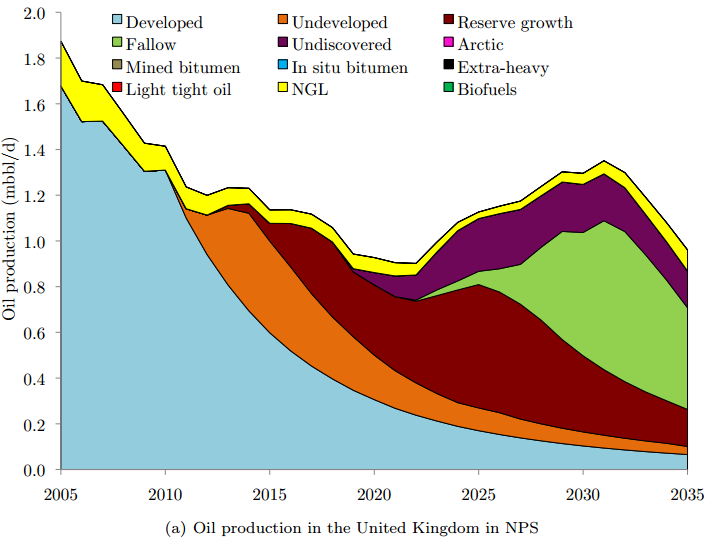 (click to enlarge)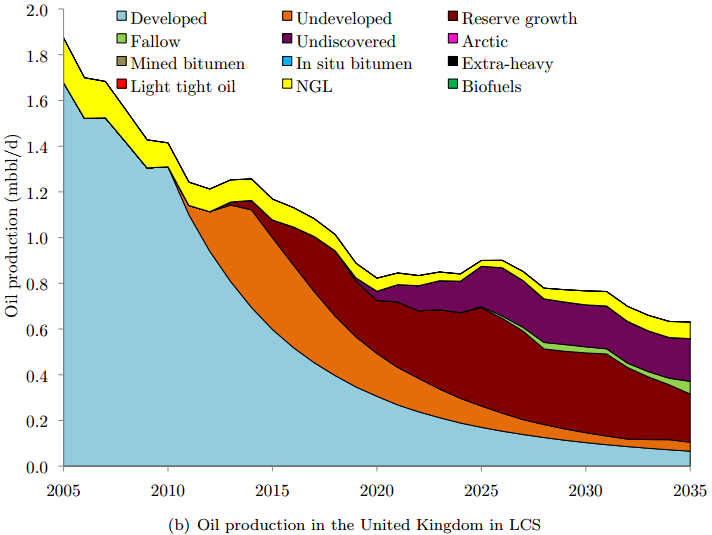
Here is a sample modeling of NPS and LCS, showing future production in Britain. Notice how much environmental policy can do to limit oil production. LCS looks a bit like a bumpy version of a Hubbert curve, while NPS, the “greenwashed business as usual” scenario, envisions the exploitation of currently unused “fallow” fields in order to feed higher demand. If we are concerned only with supply, we might glance at these graphs and assume naively that this shows a healthy supply meeting demand for both LCS and NPS. In fact this is not the case. The graph for NPS actually displays an insufficient supply for world needs. This is not the result of underestimation, either.
Global oil production in NPS grouped by field type and region
(click to enlarge)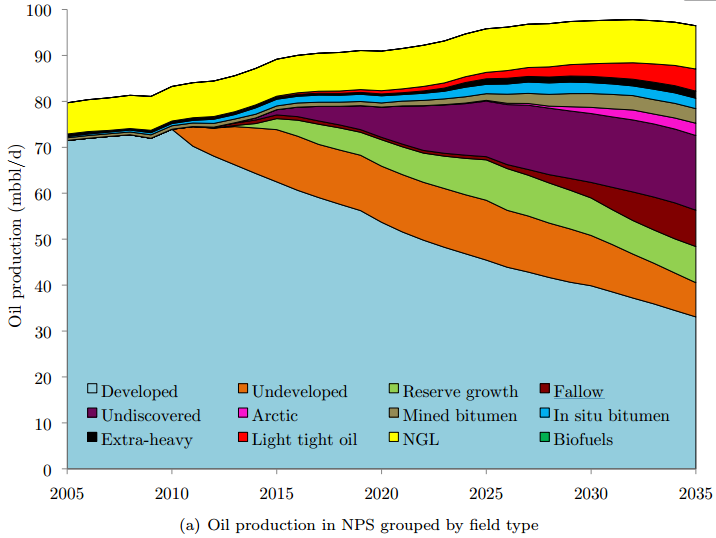
Global oil production in NPS grouped by discovery date and water depth
(click to enlarge)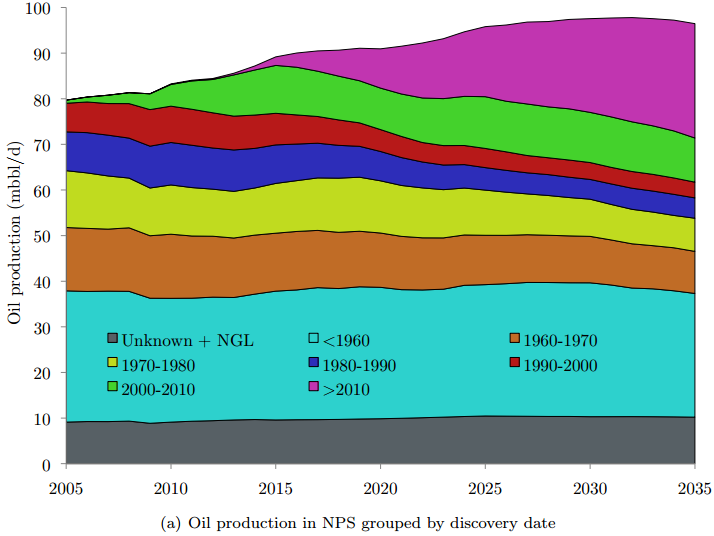
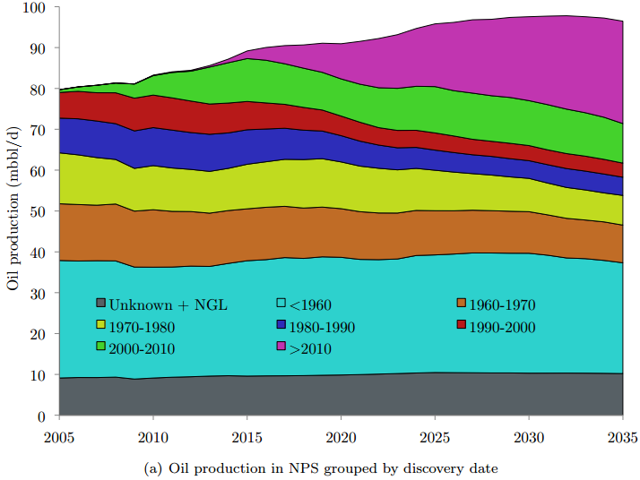
Here is world production for NPS. McGlade allows for very generous production increases, technological discoveries, and a long lifespan for conventional oil, which combine to produce Paul Krugman’s glorious fantasy: several decades’ worth of crude oil, biofuels, and NGL, and a gentle plateau over the years 2020-2035 with no one year that can be labeled a peak. This is the result of several upwards adjustments in McGlade’s model, including a built-in assumption that exploitation of an oil field is not a simple Hubbert curve but can be given a boost through “advanced oil recovery” (p. 232). The initial result of McGlade’s model, in both the NPS and LCS scenarios defined above, is a prediction that oil prices will actually sink in the second half of the 2010s (p. 247). I think this is quite notable as an accurate prediction made more than a year in advance; no other model seems to have accounted for the effects of shale and tar sands on supply so successfully. However, the price numbers that begin in the 2020s are not so pleasant, and would certainly upset the likes of Krugman.
First, prices in both NPS and LCS reach a slight peak in 2012 at around $100/bbl and $90/bbl respectively before they soften throughout the remainder of the 2010s. The price in NPS drops to a minimum of $57/bbl in 2019 while a minimum of $47/bbl is achieved in LCS in the same year. This reduction in prices may well lead to a cut in production by members of OPEC, but these results suggest that there is plenty of new capacity available on a global basis to meet demand at prices well below current levels. It is important to bear in mind that this reduction occurs without light tight oil playing any major role.
Second, this period of low prices is followed by a steady, and under NPS rapid, rise in oil prices after 2020. In NPS prices more than double (rising to $160/bbl) between 2020 − 2030 and global production rises by 6 mbbl/d. After 2030, there are insufficient new projects available, even from Canadian bitumen, and so demand destruction becomes the predominant mechanism used to allow supply and demand to match, resulting in a spike in prices reaching a maximum of just under $500/bbl in the final year. Even so total production remains on a plateau. This demonstrates that while there may not be a peak in oil production prior to 2035, it does not follow that there will be sufficient capacity available to prevent a major rise in oil prices. A more restrained yet steady rise is also seen in LCS, which averages just over $100/bbl in the 2030s.
Evolution of oil price between 2010 − 2035 as modelled by BUEGO under the NPS and LCS demand scenarios
(click to enlarge)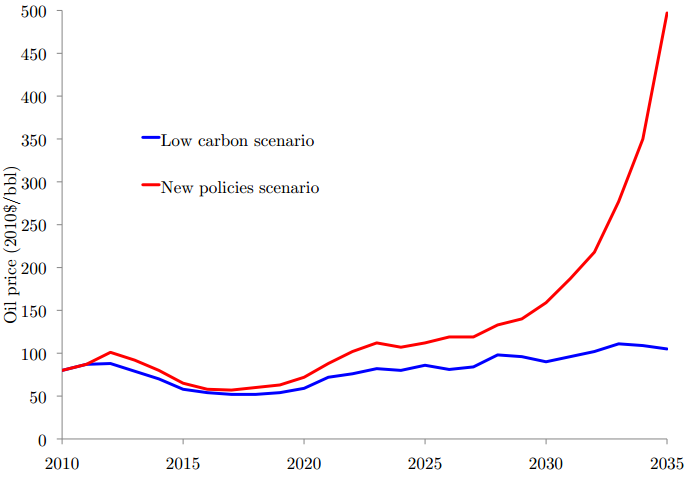
Comparison of real oil price projections in the reference and low-carbon scenario to other agencies’ projections
(click to enlarge)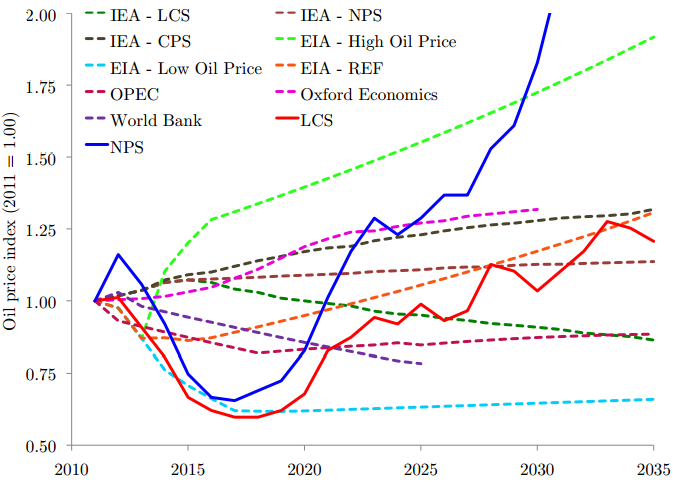
McGlade’s NPS scenario ends with the oil price literally off the charts by 2035, as can be seen in figure 10.10 above. But he predicts that this will be avoidable if the atmospheric CO₂ concentration remains on track to be below 425 ppm through 2100, with all the emissions cuts that entails. For the record: it was at 350 ppm in 1990, and is at about 400 ppm today; so the rate of increase needs to slow significantly. In other words, the next decade of global policy, 2015-2025, will determine the difference between a comfortable energy transition in 2025-2035 and a “business as usual” that transforms rapidly into a doomsday scenario. If the news carries items about previously abandoned plays in Britain coming back online, this should be taken as a sign of desperation — it will be far better news if we have no such news. If we hit 2025 without making severe changes to our lifestyles, even the most generous scenario will allow us no more wiggle room to avoid catastrophic collapse.
18 Comments on "Peak Oil From The Demand Side: A Prophetic New Model"
ghung on Fri, 2nd Jan 2015 9:42 am
I suggest folks read the conclusion section starting on page 265 of the rather large PDF:
http://discovery.ucl.ac.uk/1418473/2/131106%20Christophe%20McGlade_PhD%20Thesis.pdf
Folks like Nony are going to love it, though, like Nony, I think the author ignores (necessarily avoids?) far too many externalities to reach any valid conclusions.
Another question I have is how to implement CCS on about a billion motor vehicles.
buddavis on Fri, 2nd Jan 2015 9:46 am
Way too many unknowns and variables to accurately predict the price of oil 2 years out, much less 20 years out. But interesting reading.
rockman on Fri, 2nd Jan 2015 10:57 am
I’ve only been hunting and selling oil/NG for 4 decades but I’ve akways focused on the demand side if the dynamic with regards to future prices. In my 40 years demand fluctuations have always impacted priving more then production changea. Perhaps fir the simple reason that demand levels (and economic health) changes much quicjer the oriduction levels. Look at all the years to ramp up US production and just the few months to crater prices
nemteck on Fri, 2nd Jan 2015 12:04 pm
But whom should you believe?
The doctoral thesis by Mcglade: “After 2030, there are insufficient new projects available … and so demand destruction becomes the predominant mechanism … resulting in a spike in prices reaching a maximum of just under $500/bbl in the final year.”
Or our own shortonoil on Sun, 26th Oct 2014 8:10 am of the Hill Group: Oil will be $0.00 in 2030-2035.
I think all those who predict future oil prices are either naive or fools. No one in March 2014 predicted that oil will be $55 just 9 months later. Now how about 15-20 years into the future?
theultravixens on Fri, 2nd Jan 2015 12:22 pm
Having read through the conclusions he ignores any potential feedback mechanism from the economy. I think that maybe he missed a trick there, as if I were to speculate I’d guess that there might be a bit of coupling between the two. Yes it’s probably difficult to model, but if you don’t take it into account your model is ultimately going to be useless because it’s so far from reality.
He’s also completely missed out on the fracking boom, which must have at least some role in the current price rout.
It looks a bit like right for the wrong reasons.
Bob Owens on Fri, 2nd Jan 2015 1:00 pm
Predicting prices or supply of oil more than 5 years into the future is a fool’s errand. No one on planet earth predicted the collapse of prices over the last year. Not even the Pope. There are simply too many variables. So, go about your lives, buy a fuel efficient car, get a bike and have some fun other than reading some oil prediction novels.
shortonoil on Fri, 2nd Jan 2015 2:31 pm
No one on planet earth predicted the collapse of prices over the last year.
That is absolutely wrong. We were discussing the drop in oil prices in May, and finally posted this graph in September:
http://www.thehillsgroup.org/depletion2_022.htm
Several other people have also been talking about a maximum allowable price for oil. Gail Tverberg wrote an extensive article about it last spring which you can find at her site:
http://ourfiniteworld.com
But, the main failure of this article is similar to most. It does not take into consideration that oil, just like any commodity, has a finite value to the economy. Petroleum can not be priced higher than the value of the economic activity it can power. A dollar’s worth of goods, and services can not be produced (for long) using $2 worth of oil. None of these authors have made the slightest attempt to determine what the value of oil is to the economy. They all just assume it is infinite, or some other absurdly high value that justifies their hypothesis.
Our energy model demonstrates what that value is, and how it is changing as oil is extracted. It is called depletion, and it affects how much can be extracted, and how the cost to extract it increases as the process goes forward. Anyone who has spent any time, at all, in an extractive industry is very aware it. The Romans were talking about it happening 2000 years ago in their Iberian silver mines. Yet, we have Ph. D. thesis today that completely ignore it. It makes one wonder what a Ph. D. today is really worth!!
http://www.thehillsgroup.org/
Perk Earl on Fri, 2nd Jan 2015 2:38 pm
I’m with you on this one, Bob. People think that because they go to a lot of trouble to color code a graph with bright color contrast it must be an accurate projection into the future. We won’t know how it plays out until we can look back on it.
MSN Fanboy on Fri, 2nd Jan 2015 3:56 pm
We will soon see if shortonoil is correct, however nemteck shortonoil did predict lower prices, if anything short underestimated lol
The fact that short is predicting the correct direction of the oil market is worrying, especially if he underestimates it all, either way short won this prediction.
It will be interesting to see if short is right again, or is this depletion theory just coincidence lol
rockman on Fri, 2nd Jan 2015 5:18 pm
Fanboy – Others bad the same sense of change… like the insiders of the public oil companies. Folks do track what they do: last summer those insiders sold about a quarter $billion in their companies’ stock. There was no report of any insider buying a single share of their company’s stock.
There’s what the PR departments say and then there’s what the prez, VP’s and board members do.
shortonoil on Fri, 2nd Jan 2015 5:40 pm
It will be interesting to see if short is right again, or is this depletion theory just coincidence lol
Coincidence? Not likely, the theory is based an very fundamental principle, and well tested. What is shown here:
http://www.thehillsgroup.org/depletion2_022.htm
is the highest price that the economy can afford to pay for oil at a specific time. It is not what the market will be priced at, but the highest value it can be sustained at. However, we could have overlooked something (we have before) or someone dropped a decimal point in a calculation on page 137. Nothing would please me more! I have a very comfortable life, and would love for things to go on for an additional 10, or 20 years. But that is wishing, and if “wishes were horses beggars would ride”!
Apneaman on Fri, 2nd Jan 2015 8:07 pm
Hey Short. Do you guys ever get death threats like those other scientists who’s findings burst many folks world view, plans and hopes? Kudos for doing a tough job by bringing the message.
Harquebus on Fri, 2nd Jan 2015 8:08 pm
When factoring the price of oil one must remember that, all currencies are fiat. That means that they are intrinsically worthless.
Not a bad trade eh? Swapping worthless printed at will pieces of paper for valuable limited fossil fuels.
Harquebus on Fri, 2nd Jan 2015 8:14 pm
@Apneaman
Bankers don’t get threats. They just die mysteriously.
Google: mysterious banker deaths
http://www.hangthebankers.com/48-suspicious-banking-deaths/
Apneaman on Fri, 2nd Jan 2015 9:17 pm
Bankers? I thought they were petroleum geologists/engineers and the like.
Kenz300 on Sat, 3rd Jan 2015 9:10 am
It is time to speed up the transition away from fossil fuels.
Pope Francis’s edict on climate change will anger deniers and US churches | World news | The Guardian
http://www.theguardian.com/world/2014/dec/27/pope-francis-edict-climate-change-us-rightwing
eriktownsend on Sun, 4th Jan 2015 1:43 pm
I agree with the “right for the wrong reasons” sentiment.
Look, something’s going on here. KSA attacking the shale drillers? USA/CIA conspiring with KSA to lower prices to punish Putin? Heck, I don’t know, but someone is *making* this happen. Someone got to al-Naimi and had a “conversation” with him. Every time he comments publicly it’s like a kid with a motorcycle doing wheelies and donuts in the police station parking lot, practically begging the cops to come arrest him. For some reason, al-Naimi is practically taunting traders to sell. Every time a prominent analyst announces they think the bottom is in, al-Naimi comes up with another “We won’t cut no matter how low it goes!” quote, jab-boning markets lower.
This from a guy who runs what’s supposed to be a cartel that exists to support HIGHER oil prices? Dude, something’s going down here. I don’t know who’s pulling the strings or what their agenda is, but there’s a lot more to this sell-off than the climate change-related demand predictions of this article.
Erik
Northwest Resident on Sun, 4th Jan 2015 2:03 pm
eriktownsend — I know, it is tempting to suspect some kind of conspiracy theory when sudden and dramatic changes that threaten our peace and level of comfort suddenly intrude into our reality.
But in this case, having read many points of view from many different authoritative and not-so-authoritative sources, I’ve come to this conclusion:
The reason for the rapid drop in oil price is because the oil being produced does not contain enough energy to economically power its own use.
Many suspect that the end of QE Infinity has a LOT to do with the plunging oil price. When you consider that QE and other government massive debt accumulation dramatically inflated worldwide asset and commodity prices, including oil, then it makes sense that the price would rapidly plunge once that massive infusion of new debt is withdrawn.
It isn’t just oil price that is plunging. Look at iron ore, copper, almost all (if not all) commodity prices are also plunging.
Massive new money/debt infusion pumped the economic bubble up and along with it the price of oil. That situation had to end sooner or later, and it looks like we’re now seeing the end of it, and this is what it looks like.
Blaming Saudi Arabia for the drop in oil price, or suspecting a global conspiracy is involved in purposely causing the dramatic drop in oil price is maybe tempting to believe — but so was it tempting for aboriginals to believe that “the gods” were angry with them when the big volcano erupted. The real reasons are always harder to ascertain, but once you’ve got the facts, they make a lot more sense than “the gods” or “conspiracy theories”.