
Peak Oil is You

Donate Bitcoins ;-) or Paypal :-)


Page added on December 17, 2014

How Technological Progress can Generate a Faster Collapse
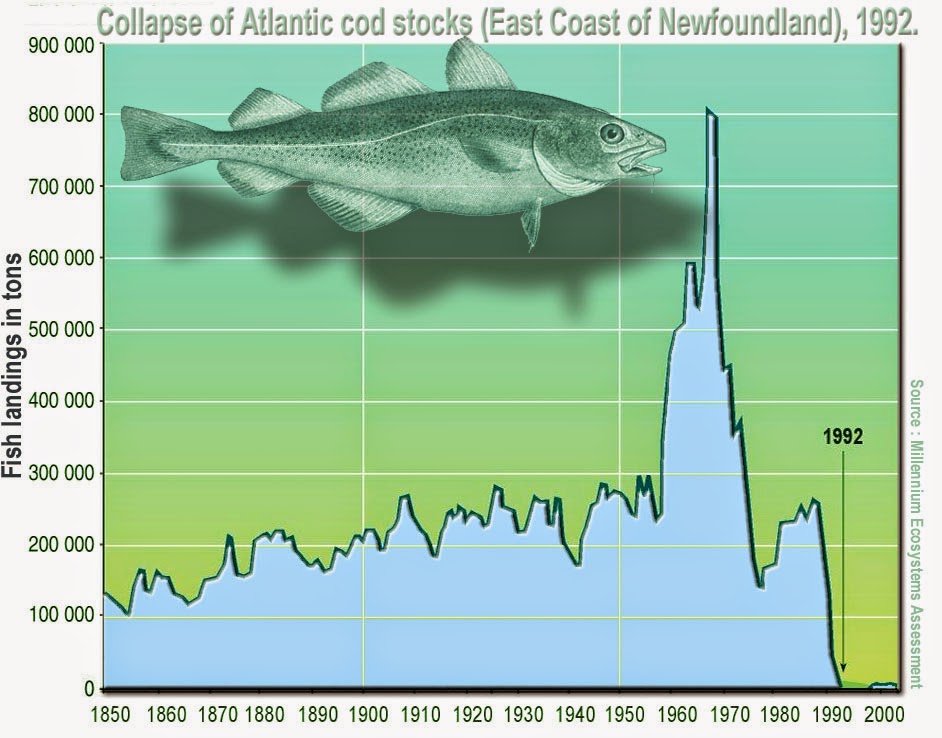
The image above (from Wikipedia) shows the collapse of the North Atlantic cod stocks. The fishery disaster of the early 1990s was the result of a combination of greed, incompetence, and government support for both. Unfortunately, it is just one of the many examples of how human beings tend to worsen the problems they try to solve. The philosopher Lucius Anneus Seneca had understood this problem already some 2000 years ago, when he said,“It would be some consolation for the feebleness of our selves and our works if all things should perish as slowly as they come into being; but as it is, increases are of sluggish growth, but the way to ruin is rapid.”
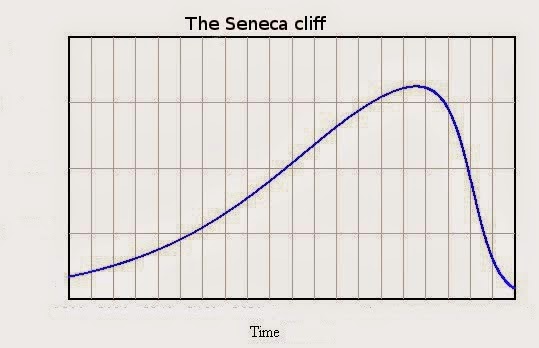
The collapse of the North Atlantic cod fishery industry gives us a good example of the abrupt collapse in the production of resources – even resources which are theoretically renewable. The shape of the production curve landings shows some similarity with the “Seneca curve“, a general term that I proposed to apply to all cases in which we observe a rapid decline of the production of a non renewable, or slowly renewable, resource. Here is the typical shape of the Seneca Curve:
The similarity with the cod landings curve is only approximate, but clearly, in both cases we have a very rapid decline after a slow growth that, for the cod fishery, had lasted for more than a century. What caused this behavior?
The Seneca curve is a special case of the “Hubbert Curve” which describes the exploitation of a non renewable (or slowly renewable) resource in a free market environment. The Hubbert curve is “bell shaped” and symmetric (and it is the origin of the well known concept of “peak oil). The Seneca curve is similar, but it is skewed forward. In general, the forward skewness can be explained in terms of the attempt of producers to keep producing at all costs a disappearing resource.
There are several mechanisms which can affect the curve. In my first note on this subject, I noted how the Seneca behavior could be generated by growing pollution and, later on, how it could be the result of the application of more capital resources to production as a consequence of increasing market prices. However, in the case of the cod fishery, neither factor seems to be fundamental. Pollution in the form of climate change may have played a role, but it doesn’t explain the upward spike of the 1960s in fish landings. Also, we have no evidence of cod prices increasing sharply during this phase of the production cycle. Instead, there is clear evidence that the spike and the subsequent collapse was generated by technological improvements.
The effect of new and better fishing technologies is clearly described by Hamilton et al. (2003)
Fishing changed as new technology for catching cod and shrimp developed, and boats became larger. A handful of fishermen shifted to trawling or “dragger” gear. The federal government played a decisive role introducing new technology and providing financial resources to fishermen who were willing to take the risk of investing in new gear and larger boats.
…
Fishermen in open boats and some long-liners continued to fish cod, lobster and seal inshore. Meanwhile draggers and other long-liners moved onto the open ocean, pursuing cod and shrimp nearly year round. At the height of the boom,dragger captains made $350,000–600,000 a year from cod alone. … The federal government helped finance boat improvements, providing grants covering 30–40% of their cost.
….
By the late 1980s, some fishermen recognized signs of decline. Open boats and long-liners could rarely reach their quotas. To find the remaining cod, fishermen traveled farther north, deployed more gear and intensified their efforts. A few began shifting to alternative species such as crab. Cheating fisheries regulation—by selling unreported catches at night, lining nets with small mesh and dumping bycatch at sea—was said to be commonplace. Large illegal catches on top of too-high legal quotas drew down the resource. Some say they saw trouble coming, but felt powerless to halt it.
So, we don’t really need complicated models (but see below) to understand how human greed and incompetence – and help from the government – generated the cod disaster. Cods were killed faster than they could reproduce and the result was their destruction. Note also that in the case of whaling in the 19th century, the collapse of the fishery was not so abrupt as it was for cods, most likely because, in the 19th century, fishing technology could not “progress” could not be so radical as it was in the 20th century.
The Seneca collapse of the Atlantic cod fishery is just one of the many cases in which humans “push the levers in the wrong directions“, directly generating the problem they try to avoid. If there is some hope that, someday, the cod fishery may recover, the situation is even clearer with fully non-renewable resources, such as oil and most minerals. Also here, technological progress is touted as the way to solve the depletion problems. Nobody seems to worry about the fact that the faster you extract it, the faster you deplete it: that’s the whole concept of the Seneca curve.
So take care: there is a Seneca cliff ahead also for oil!
36 Comments on "How Technological Progress can Generate a Faster Collapse"
Davy on Wed, 17th Dec 2014 7:20 am
“Hunger is the handmaid of genius”
Mark Twain quotes
You can very easily substitute for genius complexity, technology, and energy intensity
J-Gav on Wed, 17th Dec 2014 7:27 am
Probably a good admonition, though I’m not sure that it extends equally across all industrial activities.
So, what should we wish for? A “Super Game-Changing” tech breakthrough which, if it came, would at least put off collapse for some time but, if it didn’t, would make the crash that much worse? Or, a nasty Seneca cliff where things would fall apart more quickly but perhaps less totally?
Plantagenet on Wed, 17th Dec 2014 7:50 am
The global oil market is very complicated but you can clearly see this pattern at work in individual countries. Take Saudi Arabia—they’ve spent trillions on oil field technology, but their oil production is going to peak and then collapse very soon
Bandits on Wed, 17th Dec 2014 8:05 am
It’s a shame but simple human nature. We went after the passenger pigeon, bison, Atlantic Cod, whales, Black Sea caviar, forests and many others I can’t think of right now but all a case of “lets get them before they are all gone”.
Humans are a resourceful lot, much to our detriment. So we will thrash around building wind mills, solar panels, electric cars, dodgy economic measures and using technology and efficiencies to put off the inevitable for as long as possible, this will allow the plunder to continue of course, until it quite logically cannot, and then, as Darwinian from the Oil Drum used to say “we’ll be eating the songbirds out of the trees”.
We can’t expect any different. Humans are like a locust plague, at nearly 7.3 billion, more than double the population of 1970 when awareness of overpopulation was becoming mainstream, the resources required to sustain and facilitate growth are not only declining in quantity, the quality is declining just as fast.
Rodster on Wed, 17th Dec 2014 8:09 am
You can apply the following to pretty much everything. Take agri-business for example. While food supplies have increased to support billions of people on this planet, it has ruined the soil from all the chemicals and pesticides used in the process. One theory is that certain insects that are needed for pollination likes bees are being reduced from the pesticides used in farming.
There are many states in the US where you have water scarcity from technology and mismanagement.
rockman on Wed, 17th Dec 2014 8:21 am
“The Hubbert curve is “bell shaped” and symmetric”. FYI while some folks might like to draw hypothetical “Hubbert curves” that are bell shaped and symmetric, such plots will almost never be symmetric: not for a well, a field, a trend, a county, a country, a continent or the world. Mother Earth ultimately controls the dynamics of fluids flowing thru rocks.
She absolutely loves hyperbolic functions. LOL.
Kenz300 on Wed, 17th Dec 2014 8:26 am
Too many people meets too few resources……..
shortonoil on Wed, 17th Dec 2014 9:41 am
During the early 1990’s I was consulting to several Canadian mining companies in Newfoundland. I was there during the collapse of the cod fisheries. Everything in Newfoundland revolves around fishing, and everyone is intimately associated with it through many generations of fisherman. It is such a fundamental part of their culture that most of the idioms in their language evolved from that industry. You can hardly spend a day there without getting involved in a long conversation about fish.
Drag nets definitely destroyed the cod, but it didn’t happen until the drag boats discovered that the cod were spawning on two undersea plateaus just outside of Canadian territorial waters. Previously it had not been known were the cod spawned. In spite of protests by the Canadian government, and it was mostly foreign fishing boats (Portuguese, and Spanish primarily) that continued to fish the breeding grounds. There were several actual sea battles between the Canadian Coastguard, and the fishing trawlers while I was there. It was not unusual to see a Coastguard cutter escorting a trawler into St. John’s harbor.
A couple years later the Canadian government extended its territorial waters to cover the breeding grounds, but by that time it was too late. The tiny area where the cod spawned had been destroyed by the 10 mile wide drag nets used by the trawlers. The cod never returned, and 7% of the world’s protein supply disappeared. The Grand Banks, a five hundred year old world class fishing ground, died.
Because a female cod lays six million eggs a year, and the larva grow rapidly it was assumed that the cod stocks would regenerate. It didn’t happen. The cod did not want to bred outside their tiny islet. Why is not known. To blame the Canadian government is unfair, it acted much faster than most bureaucracies do. But while Ottawa was debating the issues, fishermen versus oceanographers, the cod disappeared. The problem was that the technology used by the industry evolved faster than the political system could respond.
It looks like the oil industry is on the same path.
Northwest Resident on Wed, 17th Dec 2014 10:44 am
That’s a sad story, shortonoil. But one that mirrors uncountable similar developments all around the world, in many different regions and locations. It is a story that describes a fundamental truth about humans and their ability to develop technology which they have a total lack of ability to use responsibly. A very sad story, indeed.
Davy on Wed, 17th Dec 2014 10:51 am
I know firsthand the voracious appetite the Spanish have for fish. The best fish I have ever had was in Madrid. My Spanish daughter loves fish. It is ashamed the oversize and excessive Europeans fishing fleets have plundered the oceans. Wow, I actually found countries that can be beaten up on besides America. That’s refreshing unfortunately.
sunweb on Wed, 17th Dec 2014 11:07 am
Give people a fish and you feed them for a day and maybe make them dependent. Teach people to fish and they will deplete the ocean. Now it may take time to do it but with modern technology it will happen in the blink of a species eye. Just add in high-tech ships with all kinds of electronics, powerful engines, and the accoutrements that make technology a weapon.
Apneaman on Wed, 17th Dec 2014 11:31 am
Short. The 1990s do not seem that long ago, but since then the regulatory boards have become completely corrupted/ captured/ handcuffed by corporate power. When a scientist or regulator speaks out in Canada they are attacked, pressured or simply let go. Mining, fisheries, forestry, energy, environment, etc. Soft fascism.
So, did you drink the screech when you were hanging with the Newfie’s?
Perk Earl on Wed, 17th Dec 2014 12:03 pm
Just as a side note to this discussion, oil came back up in price today:
http://www.bloomberg.com/energy/
WTI +2.31 to 58.24
Brent +2.88 to 62.89
I’d heard on the news this AM that oil supply was down 800k, so maybe that’s why.
shortonoil on Wed, 17th Dec 2014 12:23 pm
So, did you drink the screech when you were hanging with the Newfie’s?
Fish, moose, and 7.3% beer. We used to go down to the docks, and buy a bushel of lobsters for $5 (Canadian). Eat lobster, drink beer, and the next day try to figure out how to screw your eye balls back in. They worked like manics, drank like fools, and I never met an unhappy Newfie.
That culture was 500 years old. It took 3 to destroy it. The fish weren’t the only victims.
noobtube on Wed, 17th Dec 2014 12:32 pm
The Waste (I mean the West) are such sniveling cowards.
They are always screaming about their superiority, Democracy, freedom, 1st world, rich, developed, Christian-values, advanced, wealthy and all that other BS.
But as soon as it comes time for the Waste (I mean the West) to take responsibility for its actions… suddenly its a “HUMAN” problem.
Wait, I thought Wasters (I mean “Westerners”) are so superior and advanced and better than everybody else.
Surely, they can take sole responsibility for all the damage they are causing the way they take credit for all the benefits they get from it.
Yes, Americans (all of them) are self-serving, self-important, self-deluded, trash-making, entitled scumbags.
Is there any people on this planet more excrable than Americans?
Americans and the Waste (I mean the West) are at open war with Earth.
Guess who is going to win?
Hugh Culliton on Wed, 17th Dec 2014 12:33 pm
I was an RCN officer and spent a lot of time off the Nose & Tail of the Grand Banks before and during the “Cod War” we had with Spain, referred to by Davy and Shortonoil. While we might have moved quickly by the 90’s when the cod stocks were for all intent and purpose destroyed, it was just closing the barn after the horses got out. Fitting metaphor given that the Canadian and Newfoundland governments opened the door in the first place. Nfld was a rockin’ place – the nearest analogy would be the fracking boom. The governments were blinded by the tax profits they were skimming. The fishermen were making and spending like drunken sailors (oh – wait: they were drunken sailors lol). And anyone to mentioned the word “unsustainable” was openly mocked. No one gave a shit – the cod would last forever and it was no big deal if draggers were destroying spawning beds.
But the worst part of it? We never fucking learn and we just keep doing this again and again and again.
Northwest Resident on Wed, 17th Dec 2014 12:48 pm
Hugh — I’m sure it was really good times while it lasted. Here in the Pacific Northwest (Oregon specifically), the similar situation we experienced was the massive harvesting of old growth forest. The more high tech they got, the faster the forests fell. Needless to say, animal and plant life that needed those old growth forest biospheres for survival were just road kill left rotting in the sun, and that includes decimation of streams and rivers that were critical to salmon runs. The oil business isn’t the only industry that lives the booms and the busts — given our system of capitalism and exploitation of natural resources for the enrichment of the few, there have been plenty of boom and bust cycles in other industries since the industrial revolution and the Age Of Oil began. But they always end on a bust. You’re right, we never learn. And in the end, humanity will be forced to pay the price for their negligence and shortsightedness and total disrespect for Mother Nature.
ghung on Wed, 17th Dec 2014 12:55 pm
The flip side to the cod story was that it was a boon to the lobster industry; lobster is one of the cod’s favorite foods. Now I read that the lobsters are turning to cannibalism; adults preying on their juvenile young.
I suppose there’s another lesson in there somewhere.
ghung on Wed, 17th Dec 2014 1:03 pm
NWR: “You’re right, we never learn.” …because there is no “we”; no over-arching hive mind to trump our individualistic greedy nature. ‘We’ aren’t in control; never were, which is why our collective cleverness will be our undoing.
claman on Wed, 17th Dec 2014 1:24 pm
I came to think that fusion energi does not have a seneca curve. Now where would that leave us. With fossile fuels nature can fight back in the shape of pollution and global warming. Nature might loose a lot of soldiers, but in the end it would at least have set limits to humanitys devastating progress. If we succede in develloping free, abundant, non-polluting fusion-energi, i am afraid that nature (nature= life on earth minus the human factor) would be toast. Could any of you please share some links about this problem: Is free, abundant, non-polluting energi an unconditional good thing?
Rita on Wed, 17th Dec 2014 1:29 pm
The development of antibiotic resistant microbes may fix all these problems.
Apneaman on Wed, 17th Dec 2014 1:35 pm
When I was helping to destroy the Biosphere in the late 1990s up in Fort McMurray (SunCor, SynCrude, etc) many Newfie tradesmen were there too. One guy even showed up with a trunk full of lobster on dry ice. Culture really does make a difference; them boys are the salt of the earth; good times.
I’s da boy that built da boat and I’s da boy who’ll sail it!
claman on Wed, 17th Dec 2014 3:07 pm
Come on. Solar and wind might actually also be with out a seneca curve. Nuclear energi has its own “seneca features” because of its potential risks.
It is a fair question to ask if free, abundant energi has its own problems seen from an ecological point of view.
Perk Earl on Wed, 17th Dec 2014 3:33 pm
“Here in the Pacific Northwest (Oregon specifically), the similar situation we experienced was the massive harvesting of old growth forest.”
NWR, my wife and I drove inland in Oregon. I can’t remember the route we took, but we drove through a mountainous area which had been clear cut in huge square tracks. Some mountains were near empty of any trees. Then when we drove back to the coast we realized they purposefully left a stretch of trees between the clear cut areas and the coast. A good PR move to keep people from making too much of a fuss.
We noticed some neat new rows of trees but that’s a long ways from old growth forest. Hopefully it will eventually grow back.
I got tired of driving those windy mountainous roads and let my wife drive. At one point I said you’ve got slow down and stay to the right – if one of those logging trucks comes through we’re gonners. She pulled to the right, slowed some and suddenly a huge logging truck came around the corner like a freight train, my wife screamed and it just missed us as he was out wide.
Anyway, sure do love the Oregon coast though – that’s a sight everybody should see if they haven’t already.
Northwest Resident on Wed, 17th Dec 2014 3:49 pm
Perk — Those logging truck drivers are a special breed. Glad you didn’t do a head-on with one!
If you take a commercial flight over Oregon on a clear day — we have a few of those each year — then you can really see the extent to which the high tech machinery has ravaged the landscape.
I read somewhere that less than one percent of Oregon pre-European settlement old growth forest is left, and the only reason they didn’t cut that is because it is in extremely difficult terrain to access. Even so, there was a big fight a while back to prevent the logging companies from bulldozing mountains, filling in rivers — whatever they had to do — to get to that last remaining old growth. Left on their own, they were going to get every last old growth tree, leave none standing.
It all boils down to somebody somewhere wanting to squeeze the last remaining few bucks out of planet earth, consequences be damned. They got theirs. Sad statement on the human condition. Like Ghung says, no hive mentality exists to keep the greedy few from ruining it for everybody. Sociopaths rule the roost, and they have lead us to ruin.
Apneaman on Wed, 17th Dec 2014 4:33 pm
I have never made it down to Oregon, but I have gone camping at Deception Pass State Park in Washington state; beautiful. B.C. is worth the trip too. Y’all Americans who can still afford a vacation should come up here with the dollar being at .86 U.S. it’s a good deal. Best do it while they are still letting you leave the county ;)Dough-nuts on me.
Northwest Resident on Wed, 17th Dec 2014 4:39 pm
Verrry tempting, Apneaman!
J-Gav on Wed, 17th Dec 2014 5:00 pm
NWR – If it were only sociopaths in our oligarchy! Unfortunately, I’m afraid we’ve got a few psychos in there too.
WW III is looking more and more like a real possibility as “diplomatic efforts” have brought essentially no results on any fronts for years – and for good reason – they weren’t meant to.
Instead of cooperate, cooperate, cooperate, we’re still entirely in the demonize, demonize, demonize mode (I’m talking about the armed wing of the elites’ various strike forces – NATO!) There are other weapons of course, economic and financial being at the forefront.
NB – I’m NOT talking about North Americans or any other national population being assholes – I’ll leave that kind of crap to the Noobster.
I AM talking about an extremely greedy, powerful and fearful international elite which will stop at nothing in order to maintain their exorbitant privileges a little bit longer. Anyone who has not read General Smedley Butler’s “War is a Racket,” should do so immediately. It’s on the net for free.
Keep your critical-thinking distance, do not get roped into the coming group-think about how bad everybody else is whilst ‘we’ remain lilly-white.
Davy on Wed, 17th Dec 2014 5:43 pm
This was one of may favorite trips to the Oragon coast:
http://www.thekalalochlodge.com/cozy15?gclid=CPemhuefzsICFegRMwodOzkA9w
Like I have said before there is something very spiritual about big and old trees, I have a few 200 year old oaks on my farm I love in a special way.
Perk Earl on Wed, 17th Dec 2014 6:05 pm
“Sociopaths rule the roost, and they have lead us to ruin.”
I think when people get together in some pursuit, there develops an unwritten competition to see who can exploit whatever resource it is the fastest and in the greatest volume. Look at excavation for ores and the increasing size of trucks, extracting oil not only going from vertical to horizontal, but also branching out from the horizontal. Larger chain saws, better ways to pulley the logs up hill, bigger ships, every effort is made to do it on a scale no one else can compete with.
And this unwritten competition is absent any concern for long term sustainability. People get angry if there are efforts to slow the competition, to conserve. That idea is labeled liberal, bleeding heart, tree hugger etc.
That’s why sometimes I think it will be good to end this global FF experiment so there can be a humbling by way of a renewed respect for nature. Hopefully on the other side of the bottleneck will be a population constrained against their will, forced to once again connect with natural limits.
GregT on Wed, 17th Dec 2014 7:44 pm
I find myself looking at humans in an entirely different way lately. It’s like being at the zoo. I see animals wearing fancy clothes, driving cars, eating fast foods at bus stops, and talking on their electronic gadgetry. They are born, they eat, they shit, they sleep, and they die, just like all of the other animals. They just aren’t smart enough to figure out that after they have destroyed their only home, there will be nowhere else left for them to live.
A real tragedy.
Davy on Wed, 17th Dec 2014 8:19 pm
No shit Greg, pardon the French, I walk around in life with a surreal daze. No not visible but within my mind’s eye. It makes me feel almost like I am hallucinating sometimes. The reality of life so twisted at the peak of the entropic blow off of modern man.
You guys I am even a step up on some of you in this respect with a 1%er family to make the twilight zone that much more bizarre.
Dooming can be dangerous to your health. That is why prepping is so important. You can turn the bizarre into forceful action of lifestyle passion. IMA lifestyles that seek to acknowledge and submit to natures will.
Apneaman on Wed, 17th Dec 2014 10:43 pm
” I walk around in life with a surreal daze.” Ditto Davy. Even though I am still close with most of my family it is a long & lonely road. Hardest part has been accepting that the people you love are unable or unwilling to see the obvious. You can provide information, but you can’t make people change their minds. So I gave up trying, but I still have to bite my tongue quite often. I am the surreal watcher.
Apneaman on Wed, 17th Dec 2014 10:54 pm
Davy, spiritual and nature.
Civilisation is Boring
“We are pre-tuned to the natural world; wired to respond to nature.”
http://www.monbiot.com/2014/12/09/civilisation-is-boring/
Makati1 on Thu, 18th Dec 2014 5:55 am
By 2050, there will be few, if any, fish left in the hot oceans. The amount of oxygen in the air may be getting a bit thin also, but then, you have to have an real education to understand why I say that.
Kenz300 on Fri, 19th Dec 2014 9:31 am
Finite resources meets unsustainable population growth with bad results………..