



 Expand
When the residents of Tulsa, Oklahoma buried a car in 1957 as part of an enormous time capsule, they included containers of gasoline. The good people of Tulsa reasoned that the folks of 2007 might not have any gas left to fill up the Plymouth Belvedere that they were interring for a fifty year journey into the future. Boy were they ever wrong.
Throughout the 20th century we became tremendously dependent on oil. At the risk of stating the obvious, the world would look completely different today without it. But time and again, very smart people have predicted that we’d eventually run out of oil. Time and again those predictions were proven incorrect.
With gas prices currently plunging, it’s difficult to see any real end to the fossil fuel-based economy we’ve built. American consumption of oil is showing signs of plateauing and our oil imports have fallen to their lowest level since 1987. But historically that’s meant that people become complacent and start doing dumb shit like buying Hummers and doing less to conserve energy. Just look at this article from Bloomberg Businessweek yesterday called “With $2 Gas, The Toyota Prius is For Drivers Who Stink At Math.”123
The idea of peak oil has popped up repeatedly throughout the 20th and 21st centuries. But as I sit typing these words, the gas station nearby is selling a gallon of gas for under $3 — bargain basement prices for Los Angeles. It’s a wonderful boost for cash-strapped consumers, but I’m reminded that I might not see peak oil within my lifetime.
So join me as we revisit the oil predictions of yesteryear; times when humans were convinced that we were almost out of oil. Only to be proven wrong for any number of reasons — including the discovery of new sources, conservation efforts to stem consumption, and the development of new technologies to get that black gold out of the ground.
 Expand
1909: 25 or 30 years longer
“Petroleum has been used for less than 50 years, and it is estimated that the supply will last about 25 or 30 years longer. If production is curtailed and waste stopped it may last till the end of the century. The most important effects of its disappearance will be in the lack of illuminants. Animal and vegetable oils will not begin to supply its place. This being the case, the reckless exploitation of oil fields and the consumption of oil for fuel should be checked.”
— July 19, 1909 Titusville Herald (Titusville, PA)
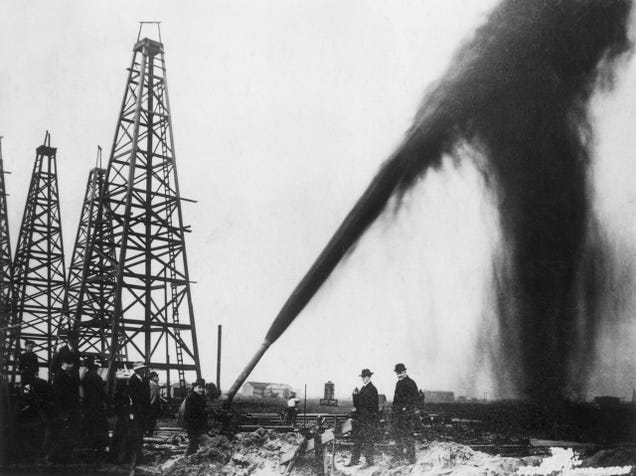
Image: Oil field in Beaumont, Texas circa 1901 via AP

1919: Two to five years until maximum production
“In meeting the world’s needs, however, the oil from the United States will continue to occupy a less and less dominant position, because within the next two to five years the oil fields of this country will reach their maximum production and from that on we will face an ever increasing decline.”
— October 23, 1919 Oil and Gas News
Image: Burkburnett, Texas in 1919 via Library of Congress
 Expand
1937: Gone in 15 years
Capt. H. A. Stuart, director of the naval petroleum reserves, told the Senate Naval Affairs Committee today the oil supply of this country will last only about 15 years.
“We have been making estimates for the last 15 years,’ Stuart said. ‘We always underestimate because of the possibility of discovering new oil fields. The best information is that the present supply will last only 15 years. That is a conservative estimate.'”
— March 9, 1937 Brooklyn Daily Eagle
Image: Oil field in Los Angeles circa 1935 via Getty
 Expand
1943: Peak oil has been reached
“There is a growing opinion that the United States has reached its peak oil production, the Oil and Gas Journal pointed out in its current issue. Since 1938, discoveries of new oil have not equaled withdrawals, in any single year, although there is a very good chance that 1943 will see enough new Ellenburger oil in West Texas to provide an excess.”
— June 7, 1943 Bradford Evening Star (Bradford, PA)
Image: Oil truck in New Orleans in 1943 via Library of Congress
 Expand
1945: Just thirteen years left
“Faced with the threat that our nation’s petroleum reserves may last only thirteen years, geologists are striving to tap the almost limitless supply of oil located beneath the seas off our coastline. The first attempt to get oil from the depths of the Atlantic Ocean was begun this month near Cape Hatteras, North Carolina, and Secretary of the Interior Harold L. Ickes revealed that the scientists are making progress in their efforts to reach the underwater oil.”
— December 10, 1945 Times Recorder (Zanesville, Ohio)
Image: Oil-burning train in London circa 1946 via Getty
 Expand
1956: Ten to fifteen years until peak oil
“M. King Hubbert of the Shell Development Co. predicted [one year ago] that peak oil production would be reached in the next 10 to 15 years and after that would gradually decline.”
— March 9, 1957 Corpus Christi Times (Corpus Christi, TX)
Gas station attendant wearing rollerskates in 1958 via Getty
 Expand
1966: Gone in ten years
“A geologist stuck a figurative dipstick into the United States’ oil supplies Tuesday and estimated that the country may be dry in 10 years.”
— August 3, 1966 Brandon Sun (Brandon, Manitoba)
Image: North Sea drilling rig circa 1965 via Getty
 Expand4
1972: U.S. oil depleted in twenty years
“At any rate, U.S. oil supplies will last only 20 years. Foreign supplies will last 40 or 50 years, but are increasingly dependent upon world politics.”
— May 1972 Bulletin of the Atomic Scientists
Image: Four people on horses in Amsterdam in 1973 during a day when cars are banned due to the oil crisis via Getty
 Expand
1977: Oil will peak by the early 90s
“As a nation, Americans have been reluctant to accept the prospect of physical shortages. We must recognize that world oil production will likely peak in the early 1990’s, and from that point on will be on a declining curve. By the early part of the 21st century, we must face the prospect of running out of oil and natural gas.”
— 1977 US Department of Energy Organization Act
Image: French fireman clean up an oil spill in 1978 via Getty
 Expand
1980: In the year 2000
“Stressing the need for conservation, [physicist Dr. Hans] Bethe said the world will reach its peak oil production before the year 2000. Production of oil worldwide will then drop to zero over about 20 years, he said. Rigorous conservation could stretch the world’s oil supply to the year 2050, he said.
— October 17, 1980 Syracuse Post Standard (Syracuse, NY)
Image: Oil rig workers in England in 1980 via Getty
 Expand
1996: Peak oil likely by 2020
“Unfortunately, oil production will likely peak by 2020 and start declining. Without a change, developing countries will ultimately be left in the dark, and developed countries will struggle to keep the lights on. Conflict is inevitable. My guess is that this won’t become a big issue unless there is a thalidomide event. We will have to see in the rear-view mirror that we are past the peak in worldwide oil production.”
— Richard Smalley, Nobel Laureate in Chemistry, 1996
Image: Oil rig platform in 1998 via Getty
 Expand
2002: Global peak by the year 2010
“Global supplies of crude oil will peak as early as 2010 and then start to decline, ushering in an era of soaring energy prices and economic upheaval — or so said an international group of petroleum specialists meeting Friday.”
— May 25, 2002 Index Journal (Greenwood, SC)
Image: Oil platforms off the coast of Santa Barbara in 2001 via Getty
 Expand
2007: Sometime between now and 2040
Most studies estimate that oil production will peak sometime between now and 2040. This range of estimates is wide because the timing of the peak depends on multiple, uncertain factors that will help determine how quickly the oil remaining in the ground is used, including the amount of oil still in the ground; how much of that oil can ultimately be produced given technological, cost, and environmental challenges as well as potentially unfavorable political and investment conditions in some countries where oil is located; and future global demand for oil.
— February 2007 GAO Report
Image: Gas flare near an abandoned building in North Dakota in 2013 via Getty
If anything should become clear by reading these predictions it’s that we can’t wait for oil to disappear before we wean ourselves from it. We have some significant momentum, but there’s a very real danger of slipping back into oil’s warm, wet embrace. It’s comfortable, it’s familiar, and it’s irreparably harming our chances at long-term existence on this planet.5
The idea of peak oil has arguably contributed to climate change more than any other meme of the 20th century. Rather than making the case for alternative energy sources, too many people believed that it would be a problem that eventually sorted itself out. Of course, it didn’t.
So whatever happened to that 1957 Belvedere? When they dug it up it was little more than a rusted hunk of metal.
Dredd on Fri, 12th Dec 2014 8:03 am
This article confuses and conflates “when” we will reach peak production with “if” we will reach peak production.
Not a well chosen trance (Choose Your Trances Well).
rockman on Fri, 12th Dec 2014 8:12 am
This would have been a much more meaningful article if they had not mixed the US peak oil conversation with the global peak oil situation. In the 50’s US PO was predicted to happen in the early 70’s. To date that prediction is still correct. In the future it may not. But that’s speculation and doesn’t change the fact that US PO occurred about 40 years ago. Global PO timing? That’s much more difficult to predict for a variety of reasons we have talked to death here so I’ll pass.
So I’ll resort to my standard response to such reports about the timing of peak production in the US, Russia, Saudi Arabia, etc: the dates don’t mean sh*t. LOL. Consider just the US: from the DATE of our PO in the early 70’s the average yearly price of a bbl of oil, adjusted for inflation, has progressively changed from $20 to $106 to $29 to $41 to $17 to $99 to $76 to $92 in 2013. And 2014 the average price will probably be even higher. And for 2015: time will tell but at the moment if current prices hold we could end up back below $70 for the year.
And lots of debates about the timing of global PO. Was it 2005? Are we counting the same thing as “oil” today as we were 10 years ago? But if it was 2005 or won’t be until 2030 how does that change the fact that we just saw oil prices in the last year fall from over $100/bbl to less than $70/bbl?
So yes: I’m back to what truly affects every oil consumer on the planet and it isn’t the date of peak oil: it’s our lovable POD…Peak Oil Dynamic. For those who had trouble absorbing that concept: what’s going on in the world today should make it a lot easier. In an unintended way crappy articles like this make my point easier to appreciate IMHO.
penury on Fri, 12th Dec 2014 10:03 am
I accept that the world will never run out of oil. But, my belief is that we humans will run out of money or what ever we trade in, very shortly. War is expensive, and our ability to create money from thin air is limited. Peak oil? Not so much, affordable oil? Also not so much.
Plantagenet on Fri, 12th Dec 2014 11:09 am
Its true that the track record of people predicting when peak oil will occur isn’t very impressive. Nonetheless, we will still reach peak oil eventually.
Perk Earl on Fri, 12th Dec 2014 11:24 am
I think all the period pics are intended to massage us into thinking they got oil out of the ground way back then and we can see the upgrades to technology now, therefore there will always be more oil.
NGGGGGGGGGGGG, and what do we have for the losers? A debt bubble bursting catastrophe of the worse kind for failure to acknowledge and adjust to diminishing returns of a finite resource.
Nony on Fri, 12th Dec 2014 11:29 am
Heck, look at Staniford with the Ghawar watering out and “nosedive to the desert” and “SA declined 6% in 2006” and all that guff. And James Hamilton reprinting it.
These peakers are real loud when they make the doom predictions. But real quiet when it comes time to revisit how much they SCREWED UP.
Davy on Fri, 12th Dec 2014 11:42 am
NOo, speaking of being quiet what’s up with you lad? As soon as the news gets bad you are under the covers. Get a backbone man face the storm. Admit the bitter pill of doom is setting in and no amount of corn porn will change reality.
Dave Thompson on Fri, 12th Dec 2014 11:46 am
I can only shake my head in disbelief. However, nice pix.
GregT on Fri, 12th Dec 2014 12:27 pm
So 54 of the 65 countries with the largest number of oil reserves have already surpassed their production peaks. But not to worry, there are still eleven more to go.
Apneaman on Fri, 12th Dec 2014 2:07 pm
I can never quite understand deniers like Nony. Why waste so much time arguing against something you do not believe? If peak oil is not real then so what? Real or not were gonna burn as much as we can afford anyway at least until our environmental kill us. I don’t believe in god, but you won’t find me going out of my way to argue with people who do. As long as they are not preaching at me, I simply do not care. Power to ya if it helps you through life; wish I could say the same. I may mock some of the fundies, but I do that to every self righteous group sooner or later anyway. I also don’t spend any time sparring on chem trail, agenda 21 or reptilian alien web sites for the same reasons. Me thinks the corns doth protest too much. A million wrong predictions changes nothing and thinking otherwise is a failure of logic.
tahoe1780 on Fri, 12th Dec 2014 2:26 pm
Nice videos: http://www.eriktownsend.com/Peak-Oil/peak-oil-explained-for-investors-video-1-of-2.html
Newfie on Fri, 12th Dec 2014 4:49 pm
Peak oil is as certain as death and taxes.
Tom on Fri, 12th Dec 2014 7:55 pm
It’s quite difficult to determine the actual status of world oil production when the definition is constantly expanding to include everything except the kitchen sink. What about peak oil-energy that would account for the lesser energy of the light end of the crude oil spectrum?
Bloomer on Fri, 12th Dec 2014 11:23 pm
If oil prices stay low for too long, then all the work done to reduce oil consumption will be for naught. Once again we be driving Hummers and SUV’s and driving to the store to buy a loaf of bread.
There is only a fix amount of oil in the ground. The faster we use it the sooner it will be gone, used up and spewed into the atmosphere.
If the Saudis want to use up their endowment of crude more quickly, life in their desert will cease as the earth burns up and water becomes a scarce resource.
Davy on Sat, 13th Dec 2014 6:14 am
Bloomer I don’t think you have absorbed POD (Peak Oil Dynamics). This economic oil glut may be the black swan that initiates the vicious cycle of the bumpy descent down to a much lower economic reality. The Global Ponzi scheme is cracking and ready to fly apart. The hummer crowd will be in tears when the problem is not high prices but shortages and rationing.
KrellEnergySource on Sat, 13th Dec 2014 8:19 am
I wake up in the morning and have a bowl of cereal. Next day, I do the same thing. And again. I notice that the box is almost empty. I look deeper and see another box. Problem solved.
As that box is finished, I notice that only oatmeal is left. I don’t like oatmeal. It’s not as convenient and it takes a lot of work to prepare compared to Lucky Charms. But wait, I look around on other shelves and find a box of Corn Pops. Problem solved.
The Corn Pops are gone. Back to the oatmeal. It took longer to make a bowl, ando there’s a mess in the kitchen. That’s going to take some work to clean up. I hope when the oatmeal is gone somebody refills my pantry. Because I’m kind of used to eating breakfast.
Not a difficult concept. Finite pantry. Problem is not solved.
Kenz300 on Sun, 14th Dec 2014 10:54 am
Time to replace fossil fuels with safer, cleaner and better for the planet alternative energy sources.