
Peak Oil is You

Donate Bitcoins ;-) or Paypal :-)


Page added on December 7, 2014

Study Finds Toxins, Cancer-Causing Air Pollution at Oil, Gas Wells
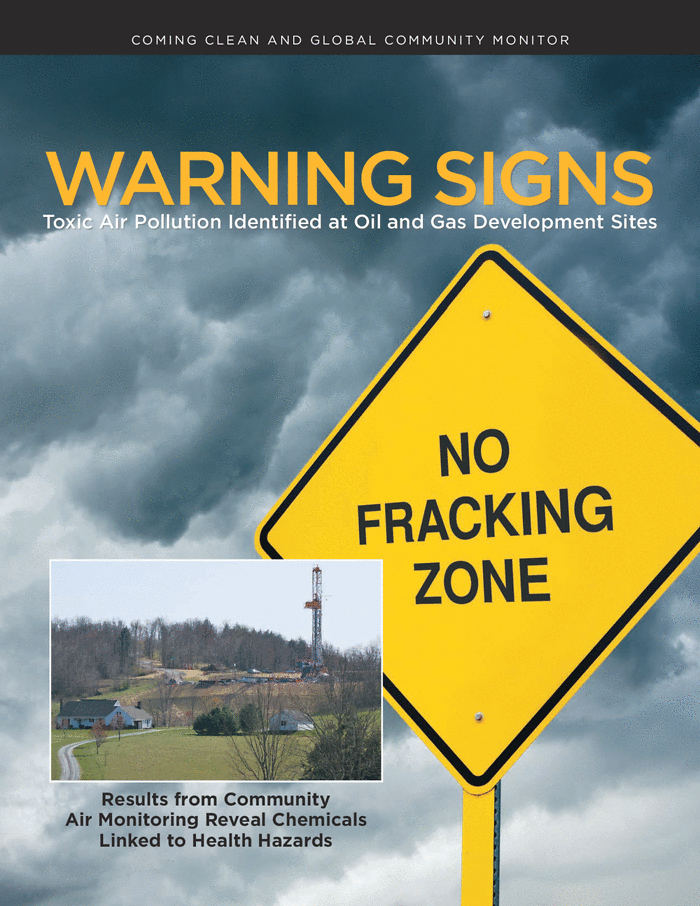
A cadre of citizens taking air samples for a scientific study has found toxic emissions from Wyoming oil and gas operations, some that are many, many of times above federal health standards.
In a six-state study published in Environmental Health, authors say the Wyoming samples show high concentrations of benzene, hydrogen sulfide, formaldehyde and more. Air samples taken in 13 of 15 sites in Park and Fremont counties exceeded the standards, prompting a call to action.
Deb Thomas of Clark, one of the co-authors of the study, said residents close to increasing oil and gas developments are in peril and have been abandoned by government watchdogs. She is a director of the group ShaleTest, and formerly worked with the Wyoming-based landowner advocacy group Powder River Basin Resource Council.
“They’re fighting for their lives,” she said. “Fracking not only fractures rock it fractures communities.”

The groups Coming Clean and Global Community Monitor announced the results today, saying “The natural gas industry often claims that it provides ‘cheap energy,’ but we are paying the price with the endangerment of public health.” While reports of illnesses are not tied scientifically to oil and gas field emissions, the groups called for protection before severe harm occurs to the environment and people.
Neighbors to oil and gas facilities suffer from headaches, rashes, loss of smell and taste, nosebleeds, neuropathy, kidney problems, pain, miscarriages and cancers, Thomas said. “People who are very eloquent can’t form their words any more,” she said of some effects.
Citizen researchers trained to federal standards collected bags of air and used other methods to sample the atmosphere near oil and gas operations where horizontal drilling and fracking was involved. Many were residents of areas affected by energy development and they collected the samples when they saw, smelled or heard emissions coming from oil and gas field machinery. Sometimes headaches or other symptoms believed associated with emissions prompted them to collect.
The samples were compared against standards set by the U.S. Department of Health and the U.S. Environmental Protection Agency.
“Seven samples, all from Wyoming, contained hydrogen sulfide in concentrations ranging from more than twice to 660 times the level classified by the EPA as immediately dangerous to human life,” the groups said in announcing the paper. The groups produced a companion publication “Warning Signs” (embedded below) that details results of the study in layman’s terms.
“One Wyoming sample contained formaldehyde exceeding EPA’s “most hazardous cancer level,” the groups said.
Hexane, a nerve toxin, occurred at seven Wyoming sites, one time measured at 7,000 times OSHA’s minimal risk level. Four sites produced samples containing the carcinogen benzene and five contained nerve toxins toluene and xylene at levels higher than short- or long-term health guidelines, the groups said.
“In Wyoming, multiple samples with high benzene concentrations were taken on residential property 30–350 yards from the nearest well, or on farmland along the perimeter of a well pad,” the research paper said. “The results suggest that existing regulatory setback distances from wells to residences may not be adequate to reduce human health risks.”
Those residents have been abandoned by their governments, Thomas said.
“We asked the State of Wyoming for years to address these issues,” she said. “We didn’t get much response. Wyoming officials continue to say we have some of the cleanest air in the country.”
She pointed to the influence oil and gas has on the Wyoming economy, where mineral revenues preclude the need for a state income tax.
“We continue to hear about the economic benefits,” Thomas said. “Nobody wants to kill that golden goose. Nobody will address what it’s going to cost to clean up this mess.
“Industry and the state are making all the money,” she said. “The people who are living with [this] suffer the consequences — they’re left holding the bag.”
An EPA study of contamination in Pavillion water wells was turned over to the state with no subsequent results, Thomas said.
“We’re really getting nowhere,” she said. “Those folks are still living in a community with serious groundwater contamination and now they’re also getting creamed by air emissions.”

David Carpenter of the Institute for Health and the Environment, University at Albany, Rensselaer, New York, was the lead author of the peer-reviewed scientific paper. The research marks the first time citizens were trained to do widespread air monitoring of oil and gas facilities and their work extended from Arkansas to Colorado, Ohio Pennsylvania, New York and Wyoming.
Two of the compounds found in the air “in extraordinary concentrations” are benzene, which causes liver cancer and leukemia, and formaldehyde, “basically an embalming fluid… a carcinogen,” Carpenter said in a telephone news conference. “Our concern is these carcinogens (are) near homes, schools, farms — the people exposed are going to be a risk for developing cancer, but only in the future.”
Such delays make it difficult to blame a particular source, he said. The oil and gas industry is largely exempt from federal environmental regulations for clean air and water, he said.
“We must apply the same rules to the oil and gas industry that we apply to other industries,” Carpenter said. “It’s ridiculous that there’s so much leaking at these sites.”
Human health concerns
In Sublette County, the Wyoming Department of Health last year reported an association between increased ozone levels and clinic visits. Ozone pollution, believed to be caused by oil and gas operations, snow cover, car exhausts, sunlight and other factors, has been measured there at levels higher than in Los Angeles.
The increased clinic visits came during a four-year period between 2008-2011. Clinic visits for respiratory problems were up 3 percent for every 10 parts-per-billion increase of ground-level ozone detected.
Agency director Thomas Forslund penned the report “Associations of Short-Term Exposure to Ozone and Respiratory Outpatient Clinic Visits — Sublette County, Wyoming, 2008–2011.” The clinic visits came when additional pollution increased ozone levels that were already between 19 and 84 parts per billion.
In Wyoming, county-based public health offices are typically the first to hear of a potential public health threat. If they suspect one, they coordinate with the Wyoming Department of Health (DOH).
Agency spokeswoman Kim Deti said people sometimes contact Wyoming DOH directly if they suspect an illness due an industrial facility or activity.
“We don’t necessarily have an ongoing tracking mechanism,” Deti said on Wednesday. “But if we were to identify a cluster (of complaints) that would indicate a public health threat, then we’d follow up on them.
“We’ve had calls and inquiries related to the refinery in Newcastle, and that was looked at,” she said. “People thought they had a much higher rate of cancer, but they didn’t.”
“It’s difficult because sometimes (an illness) takes place over a long period of time,” Deti said. “Another problem is often times the sample size is so small it makes it difficult to study.”
The Wyoming Department of Environmental Quality (DEQ) has authority over most aspects of emissions from oil and gas operations. When it receives complaints of potential rogue emissions and suspected illness, DEQ shares the information with the state’s health department, DEQ spokesman Keith Guille told WyoFile via email.
“We use to get more questions concerning health in the Upper Green during the years of higher ozone levels,” Guille said. “However, those studies and information are all handled through Department of Health.”
Doug Hock is spokesman for Encana Oil & Gas USA, which was the main developer of the Jonah gas field south of Pinedale until it sold the property earlier this year. Encana is still owner and operator of the Pavillion gas field, most known for questions surrounding contaminated drinking water.
Hock told WyoFile on Wednesday that the company hears many anecdotal claims about suspected illnesses related to its operations throughout North America.
“Yes, there are many anecdotal claims made but very little research,” he said in an email response. “When health impact studies have been undertaken, they’ve often failed to take into consideration the multiple factors beyond oil and gas development that influence health in a particular community.”
In the citizen research, those collecting samples were instructed not to take them when there was traffic nearby or other activity or sources that could taint the sample.
Hock continued; “the bottom line is that such studies are complex and difficult to undertake, but more information and data is certainly needed to move us beyond the unscientific realm of anecdote.”
Encana will follow up when somebody complains of illness suspected as a result of the company’s operations.
“Direct complaints about health are rare,” Hock said. “In such cases we take operational precautions to ensure that we’re meeting environmental and health standards. Also, we encourage people who believe they have a health issue to consult their physician.”
Reform advocates call pollution and lack of regulation a civil rights issue, with many people seeing drilling forced upon them. Poor or disadvantaged residents don’t have the ability to simply pack up and move, they said.
“What we are leaning toward with this project is building a movement … to reform the oil and gas industry, which by the numbers needs serious reform,” said Denny Larson, director of Global Community Monitor.
22 Comments on "Study Finds Toxins, Cancer-Causing Air Pollution at Oil, Gas Wells"
Plantagenet on Sun, 7th Dec 2014 7:21 pm
It makes you wonder where all the regulators are?
We already have both state and federal laws requiring clean air——why don’t the regulators get off their duffs and enforce the existing laws?
Plantagenet on Sun, 7th Dec 2014 7:29 pm
Has anyone here ever actually ran a drill rig (other then Rockman and me, of course)?
Anyone ever actually participated in a drilling operation?.
No?
Well, its essentially a giant industrial operation carried on outside. Drill rigs are huge pieces of industrial equipment, and fracking and logging equipment just adds to the complexity.
I’m not surprised that chemicals and gases are leaking from drilling operations—-don’t believe the PR guys—drilling is a nasty dangerous and highly industrialized endeavor.
GregT on Sun, 7th Dec 2014 8:01 pm
“authors say the Wyoming samples show high concentrations of benzene, hydrogen sulfide, formaldehyde and more.”
In other news; “Scientists recently discover that water contains hydrogen, and oxygen.”
MSN Fanboy on Sun, 7th Dec 2014 8:53 pm
LOL
Is this really any surprise?
Every product we use can be traced in our blood and hair… we all all full of industrialised unnatural chemicals 😉
And in other news cancer rates are up… I ponder why lol
trickydick on Sun, 7th Dec 2014 10:00 pm
It hurts when I frack!
Something about this article doesn’t seem quite kosher. It’s too conversational, for one thing. And I’ve never heard of ‘Environmental Health’ magazine. I wonder if we can’t send some of these environmental watchdogs to China and India to investigate what they do to their rivers?
Apneaman on Sun, 7th Dec 2014 10:46 pm
I have built and done maintenance on power & recovery Boilers, tanks, refinery towers, digesters, heat exchangers and many other vessels at pulp mills, refiners, petrol chemical plants, tar sand plants and a couple power stations. No one kid yourself that regulations are always followed and accidents are always reported. It’s gotten worse due to nearly complete corporate control of governments and regulatory capture. In Canada, gas and oil are essentially regulating themselves. This stuff is the back bone of industrial civilization (not IT) and it is toxic. After 275 years and 7.2 billion people it’s become a deadly threat to everyone. It was just an experiment. Lets stop pretending we had a clue as to the long term consequences or even cared. We are just stumbling around in the dark and telling ourselves lies.
GregT on Sun, 7th Dec 2014 11:33 pm
Apnea,
Albertan?
rockman on Mon, 8th Dec 2014 8:18 am
I wouldn’t be surprised if there were a numbers of serious pollutants leaked from oil/NG ops. Heck, about 38 years ago I was almost injured by a poison gas leak on a well in MS. This sh*t really happens. But as said the info above is useless to consider: everything about the sampling and analysis has to be studied. There can be nasties leaked from the ops but Mother Earth puts her own nasties out there naturally. And landowners, farmers and ranchers have been known to put nasties in the ground and water. There’s a long history of searching for many of those nasties as an exploration method looking for oil/NG which are often associated with those naturally occurring nasties.
With that said it’s very easy in most cases to directly link any nasty coming from a well. And that kind of evidence is clearly missing from this report. Every landowner has the access and right to have everything tested at a well site. The article mentions sampling in the area of production. Any land owners can stand next a well head and sample for all compounds in real time. Every day my gaugers test for methane leaks with handheld monitors: most of them are opposed to getting their butts blown up by such a leak. LOL.
Trust me: if I owned land with a producing well on it I would test it regularly for everything. And not just for safety reasons: if I were to document an operator screwing up on my land it would make for a big payday for me. Texas courts don’t hesitate to crucify an operator if you present factual data.
Kenz300 on Mon, 8th Dec 2014 9:17 am
The sooner we transition away from fossil fuels the better…………..
Climate Change will impact each of us…… we can deal with the cause or we will deal with the result.
There are cleaner, safer and cheaper ways to provide energy. If the pollution damage and clean up costs of fossil fuels was added into the price we would get a true picture of the real cost of fossil fuels.
Apneaman on Mon, 8th Dec 2014 10:35 am
GregT
Albertan by birth, but a BC boy at heart where I have lived the majority of my life. Most of that work was in BC. Just the last few years of that career were in Alberta.
GregT on Mon, 8th Dec 2014 11:55 am
Apnea,
BC for me as well. Did work in the oilfields in Alta for a decade as a youngster though. Crossfield Amaco, helped build the Limestone Mtn. compressor station till the crash in the early 80s. Miss the foothills, love the coast.
Sounds like you have a good grasp of reality. Something that is sadly lacking these days, IMHO.
Mike999 on Mon, 8th Dec 2014 1:42 pm
Repubs create Job BOOM in Cancer Centers. Wow, no wonder we don’t have green energy, we’d lose all those JOBS. /s
Apneaman on Mon, 8th Dec 2014 2:12 pm
Chris Hedges Part I: Crisis Cults and the Collapse of Industrial Civilization
https://www.youtube.com/watch?v=s6BOvprpI6c
synapsid on Mon, 8th Dec 2014 6:11 pm
Hexane is a nerve toxin? Toluene too.
I don’t doubt toxicity but there seems to be some terminology slop for frightfulness effect.
Makati1 on Mon, 8th Dec 2014 7:39 pm
tricky, try:
http://www.amazon.com/dp/B00006KK6X/ref=asc_df_B00006KK6X3090948?smid=ATVPDKIKX0DER&tag=pg-1021-86-20&linkCode=df0&creative=395097&creativeASIN=B00006KK6X
“Journal of Environmental Health”
Subscription $135/yr for 10 issues.
Just because YOU have never heard of something, does not mean it does not exist. This is a journal for professionals, not the lay reader.
Makati1 on Mon, 8th Dec 2014 7:52 pm
FYI: “It has been estimated that there are approximately 100,000 chemicals
in commercial use. Of these, approximately 40,000 are used in the
Great Lakes Basin. Approximately 2,300 new chemicals are submitted to
the U. S. Environmental Protection Agency Office of Pollution
Prevention and Toxics (OPPT) each year…”
http://www.epa.gov/
~2,300 NEW chemicals added EACH YEAR! You have NO idea what you are breathing, eating, or drinking. It would be nearly impossible to do complete safety testing on each one as they are submitted.
I worked in a chem lab for a few years, after college, and we tested 10-15 items per week or maybe 500 per year, but it was not for toxicity, just content. A simple procedure. The lab was well equipped with the latest tech and 3 doctorate chemists. (I was one of the 4 lab assistants.) In all, it took 15 people to run the lab and office for simple analysis. It would take hundreds, maybe thousands to properly test 2.300 substances thoroughly. Ain’t agonna happen in this world.
Apneaman on Mon, 8th Dec 2014 8:15 pm
6 million years of evolution VS 300 years of Industrial Civilization.
National Report on Human Exposure to Environmental Chemicals
http://www.cdc.gov/exposurereport/index.html
Science is just starting to learn that many chemicals can change us at the genetic level and it can take multiply generations for the first effects to show. Ever see those black & white films of mom&dad or grandma&grandpa getting dosed up with DDT while playing at the local park back in the 1950s? Whoops.
Pesticide DDT linked to slow metabolism, obesity and diabetes
http://news.ucdavis.edu/search/news_detail.lasso?id=10982
Makati1 on Mon, 8th Dec 2014 8:31 pm
In other pollution news:
“As US cleans up, it’s exporting more pollution”
http://hosted.ap.org/dynamic/stories/L/LT_CLIMATE_EXPORTING_US_POLLUTION?SITE=AP&SECTION=HOME&TEMPLATE=DEFAULT
And the beat goes on…
GregT on Mon, 8th Dec 2014 9:58 pm
A little bit of trivia for everyone. Remember Acid rain? Something not spoken much about anymore. Rainwater should be neutral, and have a PH close to 7.0. I just had a chemist friend of mine show me that the rain falling outside my house in the Pacific Northwest has a PH of 5.2. Deadly for most aquatic life.
Apneaman on Mon, 8th Dec 2014 11:25 pm
Wait till they start (intentional) Geo engineering.
Geoengineering the planet: first experiments take shape
http://www.newscientist.com/article/mg22429974.000-geoengineering-the-planet-first-experiments-take-shape.html
Apneaman on Mon, 8th Dec 2014 11:32 pm
Extinction Rate Rivals That of Dinosaurs, 2014 Likely Hottest Year Ever
http://www.truth-out.org/
Makati1 on Tue, 9th Dec 2014 12:05 am
Apneamna, I remember the DDT smell coming from the apple orchard across the street when they sprayed. I can almost taste it today, 60 years later. I can only imagine how much we ingested in those days. Then there was the lead added to gasoline and white paint. And on and on. We are a very toxic species by now.