
Peak Oil is You

Donate Bitcoins ;-) or Paypal :-)


Page added on December 5, 2014

Eagle Ford Produces 1 Billionth Barrel of Oil


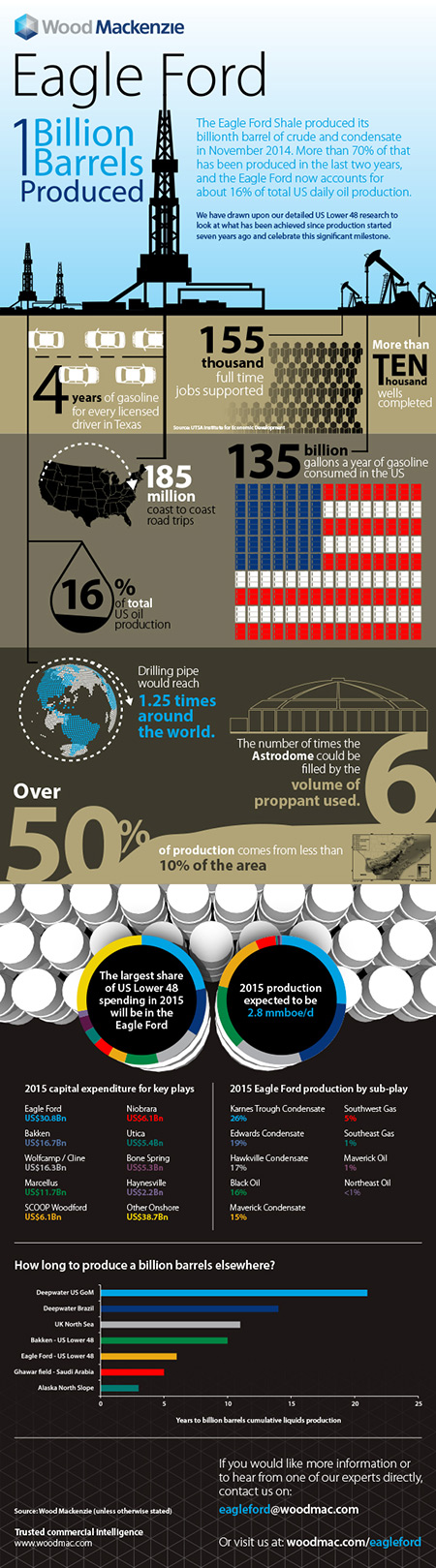
The Eagle Ford shale play in South Texas achieved a significant milestone last month with the production of its one billionth barrel of crude and condensate.
Over 70 percent of this oil production has been produced in the past two years, according to a recent update by Wood Mackenzie. Today, the Eagle Ford accounts for approximately 16 percent of total U.S. daily oil production. In 2015, 2.8 million barrels of oil equivalent per day of production is expected from the Eagle Ford, and the largest share of U.S. Lower 48 spending next year will be in the Eagle Ford with $30.8 billion.
A couple of factors have allowed operators to reach one billion barrels in cumulative production over the past seven years, said Cody Rice, upstream analyst with Wood Mackenzie, in an interview with Rigzone. One is the geology of the Eagle Ford, which offers tremendous potential in terms of productivity per well in the play’s core. The other factor is the learning curve of experience that operators have gained in working in other shale plays such as the Barnett play in North Texas and the Bakken play in North Dakota.
The play’s proximity to the knowledge, labor and skills of Houston, the capital of the energy industry, and the legacy infrastructure of a century of oil and gas activity in Texas, have also helped speed production from the Eagle Ford.
Despite the recent decline in oil prices, the play’s economics remain extremely robust in its core for high performing operators who keep costs low and drill high productivity wells. Here, breakeven oil prices on average are as low as $49/barrel.
But in the fringe areas of the play, breakeven prices can run over $100/barrel.
“Location and geology matters, but operator performance matters as well,” said Rice.
The Eagle Ford play includes three windows – the northern section, which is more oil prone; the central portion, which is more condensate prone and is the Eagle Ford’s sweet spot; and the southern portion, where wells are deeper and more prolific from a dry natural gas perspective, said Rice.
Wood Mackenzie has broken up the play into nine subplays, due to the variation even within the three product windows. The concentration of production from the Karnes Condensate Trough and the Edwards Condensate is expected to grow to 55 percent in 2015 from 44 percent in 2014, said Rice. The Karnes Trough Condensate runs from the northeast corner of McMullen County up to the northwest corner of Lavaca County, Texas.
Based on its current estimates, Wood Mackenzie anticipates that the market share of the Eagle Ford in total U.S. production is expected to grow through 2020. Wood Mackenzie also estimates the number of well completions to hold steady at 3,000 wells per year for the next five years, Rice said.
The recent decline in crude oil prices has raised questions about the impact that low oil prices will have on U.S. shale activity. Guidance on potential changes to capital expenditures in 2015 remains unseen, but the Eagle Ford in its core is less sensitive to price fluctuations. Potential changes to CAPEX will boil down to individual operator strategies and positions in terms of debt, said Rice.
The oil and gas industry will always remain focused on addressing the challenges that the public thinks are important, such as water recycling and shale activity’s impact on the local roads, environments and communities. While water usage has not been as big of an issue in the Eagle Ford compared with other plays, operators in the Eagle Ford have taken proactive steps to address the wear and tear of shale-related truck traffic on Texas roads. Rice noted that two operators are voluntarily contributing cash to road funds.
“Every operator I’ve dealt with tends to be a good neighbor in the Eagle Ford and a good steward of the land they’ve been entrusted to handle,” Rice said.
Thanks to the Eagle Ford and tight formations in the Permian Basin, Texas recorded the second largest increase in oil reserves, approximately .9 billion barrels in 2013, the U.S. Energy Information Administration reported Thursday. Texas and North Dakota accounted for approximately 90 percent of the overall net increase in U.S. proved oil reserves in 2013.
Extensions to fields in the liquids-rich section of the Eagle Ford in Railroad Commission Districts 1 and 2 and to Permian Basin oilfields in Districts 7C and 8 provided the biggest portion of the new Texas proved oil reserves, EIA said in its 2013 U.S. Crude Oil and Natural Gas Proved Reserves Report. Texas had total crude oil discoveries of 2 billion barrels in 2013.
Texas also had the most shale gas proved reserves at year-end 2013 due to production from the Barnett, Eagle Ford and part of the Haynesville/Bossier shale gas play. The largest increase in associated-dissolved gas production last year was in Texas Railroad Commission Districts 1 and 8, coinciding with gains in Eagle Ford and Permian Basin oil production, EIA reported.
EIA said Thursday that proven crude oil and lease-condensate reserves in the United States rose 9.3 percent to 36.5 billion barrels in 2013, up from 33.4 billion barrels in 2012, Reuters reported.
– See more at: http://www.rigzone.com/news/oil_gas/a/136251/Eagle_Ford_Produces_1_Billionth_Barrel_of_Oil/?all=HG2#sthash.XXFiYW4R.dpuf
29 Comments on "Eagle Ford Produces 1 Billionth Barrel of Oil"
nemteck on Fri, 5th Dec 2014 3:18 pm
“Every operator I’ve dealt with tends to be a good neighbor in the Eagle Ford and a good steward of the land they’ve been entrusted to handle,” Rice said.
Congratulations Eagle Ford operators. You should receive the congressional medal of environmental stewardship. You will be an example to the world how a business, we hear, destroys the environment, is now respecting the environment.
rockman on Fri, 5th Dec 2014 3:48 pm
Actually however well the operators are looking after the land it has nothing to do with how they choose to operate. I’m always amazed at when I see folks who don’t live in the area think the oil patch is free to do whatever they like above and below ground. If someone doesn’t like how subsurface ops are carried out they need to complain to the Texas Rail Road Commission: they make and enforce the rules. And those rules are stringent and are strongly enforced. I think too many folks have been influenced by the old “Dallas” TV how. LOL.
As far as surface damages go, Dog help you if you screw up…intentionally or accidentally. The land owners have full access to every square foot of the land a company operates on. And you can believe me: they watch very closely: if a company screws up that landowner is looking at a big payday even if the damage isn’t significant. The courts here fully back the surface owners in such situations. Which means it isn’t a question of an operator not having to spend what’s necessary to clean up the mess they caused but how much extra hey have to compensate the landowner.
But again let me make it clear: accidents do happen. But when they do the companies pay out the ass for it. Trying to get the job done with the least environmental impact has zero to do with being a good steward of the land by the operators. It’s a pure business consideration: screw up big time and it could cost a company $hundreds of thousands and even $millions. So you’re correct: the oil patch cares more about the money then the environment. And thus screwing up the environment is not good for profits.
antaris on Fri, 5th Dec 2014 4:32 pm
1 Billion barrels = 1777.34 cubic feet.
or is my math off ?
Apneaman on Fri, 5th Dec 2014 9:01 pm
Wow all that and yet the national debt is now at 18 trillion and growing. Apparently, ever ill cannot be solved by fracking. Who woulda thunk it?
http://www.usdebtclock.org/
Apneaman on Fri, 5th Dec 2014 9:36 pm
Industrial civilization destroys the environment. Including all so called green and alternative versions of it. Climate change, ocean acidification and the 6th mass extinction (humans too most likely) are all on us. The time for honoring ourselves for our technological achievements will soon be over.
antaris on Sat, 6th Dec 2014 12:46 am
Sorry, a cube 1777.34 feet on each axis .
Or a third of a mile cubed.
Dredd on Sat, 6th Dec 2014 5:16 am
These guys brag about filling the atmosphere with poison. Justice looms (Choose Your Trances Carefully – 2).
Makati1 on Sat, 6th Dec 2014 5:34 am
One billion barrels = 2 weeks of world oil production/consumption. Two months US consumption. Big deal!
Beery on Sat, 6th Dec 2014 7:33 am
I hope the person who decided on the image of the calculator knows that the calculator doesn’t show a billion.
shortonoil on Sat, 6th Dec 2014 7:45 am
It is doubtful that the EF will produce a second billion barrels. As we have been saying the long term trend for oil prices is heading down:
http://www.thehillsgroup.org/depletion2_022.htm
These analysts are projecting an $82.50/ barrel price for next year (we assume Brent), and they believe that will reduce E&D by about a third:
http://www.zerohedge.com/news/2014-12-05/150-billion-reasons-why-low-oil-prices-are-not-good-global-economy
Our projections put the 2015 price of WTI at $76/barrel, which would also reduce E&D by about a third. As we have been saying we expect high cost production to be phased out first: bitumen, arctic, ultra deep water, high sulfur extra heavy, and shale. We expect all liquids production to peak in 2016, and go into decline until most production terminates in the 2030-2035 time frame.
http://www.thehillsgroup.org/
marmico on Sat, 6th Dec 2014 8:20 am
1.1-trillion-reasons-why-low-oil-prices-are-good-for-global-economy
Back of the envelope, 77 million barrels per day consumption times 40 USD a barrel lower price times 365 days equals 1.1 trillion USD.
shortonoil on Sat, 6th Dec 2014 9:24 am
HY bonds in the energy sector have risen over 8% since the last July when the price of oil began its fall. That means that many of these producers will not be able to roll over their $billions in debt. That means that everything from sub prime auto to sub prime housing could soon be in serious trouble. A little savings in fuel costs is not going to much benefit to the millions that will no longer have a job, nor will it benefit an already highly stressed financial system.
GregT on Sat, 6th Dec 2014 9:33 am
The December issue centrefold from RigPorn.
Northwest Resident on Sat, 6th Dec 2014 10:55 am
marmico — 1.1-trillion-reasons-why-low-oil-prices-are-good-for-global-economy
Maybe the problem is you’re thinking short term, marmico. Sure, a little extra cash for the over-indebted consuming public will result from lower gas prices. But who says they will spend that money on new “stuff”. More likely they’ll pay off debt with that spare change from gas savings, or they’ll just save it. And what about the oil industry workers who lose their jobs or make less money due to falling oil prices? What about state tax revenues being lowered due to less oil production?
And if we look at the long term effects of this oil price drop, there is no way it can be spun as “good for the economy”.
150 Billion Reasons Why Low Oil Prices Are Not Good For The Global Economy
“While the clear narrative forced upon the investing (and consuming) public is that lower oil prices are great for the economy – which is utter crap (as we have explained here and here) – the fact of the matter both primary and secondary effects are extremely significant… and already occurring. As Reuters reports, global oil and gas exploration projects worth more than $150 billion are likely to be put on hold next year as plunging oil prices render them uneconomic as the cost of production has risen sharply given the rising cost of raw materials and the need for expensive new technology to reach the oil. As one analyst notes, “at $70 a barrel, half of the overall volumes are at risk.”
For a little “feel good” less expensive gas today, we create a situation where there will be much less oil/gas available in the near term future. Which, if you’re an econ 101 buff, will cause the price of gas to rise substantially — a little “feel good” now in trade for a lot of pain later. Sure, that always works just fine. Or, if you’re not an econ 101 buff and you believe that the economy simply can’t handle high oil prices any more, then that future of much less oil available doesn’t translate into higher oil prices, it translates into suffering on a scale we can only imagine as BAU cannot survive on half as much oil as we have today.
http://www.zerohedge.com/news/2014-12-05/150-billion-reasons-why-low-oil-prices-are-not-good-global-economy
antaris on Sat, 6th Dec 2014 11:05 am
If Short is right and “production terminates in the 2030-2035 time frame” then Mad Max is right around the corner!
Northwest Resident on Sat, 6th Dec 2014 11:06 am
Another BIG reason why the oil price drop is anything but “good for the economy”.
Energy Bond Crash Contagion Suggests Oil Will Stay Lower For Longer
“Now, as a 40% collapse in new well permits and liquidations occurring at the well-head, the world outside of credit markets is starting to comprehend the seriousness of the crash of a sector that was responsible for 93% of jobs created in this ‘recovery’.
The credit risk of HY energy corporates has more than doubled to a record 815bps (over risk-free-rates) crushing any hopes of cheap funding/rolling debt loads. Suddenly expectations of 1/3rd of energy firms restructuring is not so crazy…
The chart above suggests another problem for hopers… credit markets – the most sensitive to cashflows at this stage – are signaling either prices have considerably further to fall or will remain at these thinly-profitable-if-at-all prices for considerably longer…
* * *
There is a bigger problem though. As the following chart shows, there is clear ‘selling’ of high-yield bonds (and some hedging) which has crushed the most-liquid (HYG ETF) instrument for actual yield risk.
In other words, there is contagion and managers are rotating from protection to selling and reducing exposure.”
Maybe it would better if posters on this forum stop trying to make the argument that “lower gas prices” are good for the economy.
marmico on Sat, 6th Dec 2014 11:17 am
A little savings in fuel costs
U.S. households now have a $100 billion more annualized to service subprime auto and housing loans and to spend more dough on other products and services.
For context, total U.S. non-housing debt service ratios were already at 30 year lows.
marmico on Sat, 6th Dec 2014 11:58 am
Maybe it would better if posters on this forum stop trying to make the argument that “lower gas prices” are good for the economy.
Typical rookie moron who doesn’t comprehend the difference between a stock and a flow. You mean if private equity, institutional investors and mutual funds lose $50 billion (20% zero recovery) on $250 billion of energy HY bonds. Wow, $50 billion is a drop in the bucket relative to household net worth of $82 trillion. A rounding error in the stock. Stick with your zero dead hedge bull.
Lower oil prices are a net benefit for the U.S. economy.
Davy on Sat, 6th Dec 2014 12:07 pm
Marm, look at debt to income ratios then get back to me.
https://www.creditwritedowns.com/2012/10/us-household-debt-to-income-debt-servicing-cost-ratios.html
Northwest Resident on Sat, 6th Dec 2014 1:19 pm
marmico — I wonder how much of that $100 billion savings with “cheap” gas will be realized by households, and how much of it will be realized by the transportation industry and other businesses (and governments) that burn gasoline. Only a fraction, is my guess. Or do you believe that the entire $100 billion annualized savings will all go to households? What are the chances that the dramatic drop in oil/gas price puts a lot of oil industry workers and the service workers that support them out of business, resulting in even less gas/oil consumption? And, I’m not trying to be rude or confrontational, just asking for your reasoned response to those questions.
GregT on Sat, 6th Dec 2014 1:54 pm
“U.S. households now have a $100 billion more annualized to service subprime auto and housing loans and to spend more dough on other products and services.”
So instead of using these resources wisely, by building out alternate energy infrastructure for a reduced energy future, we are using them to continue to fuel a corrupt banking system, to buy more disposable consumer crap from China, and to carelessly dump who knows how many more millions of tonnes of CO2 into the environment.
Brilliant.
marmico on Sat, 6th Dec 2014 5:23 pm
Or do you believe that the entire $100 billion annualized savings will all go to households? Yes. Business firms and government costs will be lowered by another $100 billion for economy wide savings of $200 billion. Business cost savings will be mostly passed through to households. Don’t expect government to lower taxes. 🙂
Back of the envelope, petroleum costs have fallen ~1.2% of the ~$18 trillion economy.
Those are the benefits. Why don’t you tally the costs, e.g job losses and lower investment in the oil patch?
Makati1 on Sun, 7th Dec 2014 1:38 am
marm, 1.2% is rounding numbers in the “economy”. The lies are bigger than that. Most of the “savings” will go to pay current debts, or under the mattress of individuals. Any commercial savings will likewise go to pay debt, not increase production. In the long run (2-3 years) this ‘savings’ will cost thousands of jobs and close down some companies, shrinking the economy far more than any gain today. If it goes on long enough, it could bring down the whole economy and the US will be an accepted 3rd world country.
marmico on Sun, 7th Dec 2014 5:18 am
marm, 1.2% is rounding numbers in the “economy”.
Exactly. It’s just proof positive that peakers overestimate the importance of petroleum in the economy.
If today’s lower oil prices stick for a year or two, the net benefit to U.S. GDP is an increase of 0.25%-0.50%. Here is a model. If the price rises to $100 by next summer, it will turn out to be a nothing burger.
GregT on Sun, 7th Dec 2014 5:34 am
Today’s lower oil prices are still over twice as much as what our ‘economies’ have relied on for most of the last century. Unless the prices were to return to ~$30bbl and stay there, the effects on real GDP will continue to be negative. At this point in time, the only hopes we have of seeing that happen again are economic depression or collapse.
marmico on Sun, 7th Dec 2014 6:10 am
The December 2014 real price of oil is the same as the 1974 real price of oil (deflated by the CPI). Is forty years enough of a look back?
The difference is technology. A 2014 Btu of petroleum does twice the work of a 1974 Btu of petroleum.
Davy on Sun, 7th Dec 2014 6:19 am
Marm, to be fair you are in bed with the economist false gods, IMA that have steered us to the mess we are in. I am sure you have one side or the other of the economic argument you will demonize. Which is it Keynesians are the Austrians? Surely you agree there is some bad economics going on out there in the la la world of the global economy.
On the importance of petroleum. The overestimate is valid because of the sheer size of the underestimate by the MSM and economist demigods. Underestimating petroleum in the economy is like underestimating food to humans. Sure food is not an issue now because there is enough.
Wait until you have food scarcity Marm. One day this insane market will tank into the gutter. People are going to be hungry and food insecurity will be normal. Liquid fuels will be scarce and rationed. Famine will be widespread in the third world and Asia leaving the American economy no choice but to rely on its own gutted economy and ecosystem. This time is near definitely within 10 years.
marmico on Sun, 7th Dec 2014 7:03 am
Marm, to be fair you are in bed with the economist false gods
Davy-boy, to be fair you are in bed with the Malthusian false gods. Bring some empiricism instead of word salad to the table.
The overestimate is valid because of the sheer size of the underestimate by the MSM and economist demigods
Hardly. Are you saying that the data collectors and statisticians have overestimated U.S. consumption of gasoline which was estimated to be 135 billion gallons in 2013?
The arithmetic is basic. Volume times price. 135 x (-$0.90) = -$122. $122 billion is the annualized savings in gasoline consumption across all sectors of the economy since the $3.62 per gallon peak in June.
The price signal sure doesn’t indicate that petroleum is scarce. I’ve noticed that the hard core peakers are now relying on debt instead of peak extraction to rationalize their confirmation bias.
Davy on Sun, 7th Dec 2014 7:34 am
Marm, you are my most challenging corn. I enjoy your responses and you are very well supported. I fear you are deceived and in denial but I feel this true of many corns. On the oil subject you do not comprehend the vitalness of oil in the economy. It is similar to food in the realm of man. Economic statistics cannot approach the extent of this importance.