
Peak Oil is You

Donate Bitcoins ;-) or Paypal :-)


Page added on December 4, 2014

World Proved Oil Reserves, Fact or Fiction
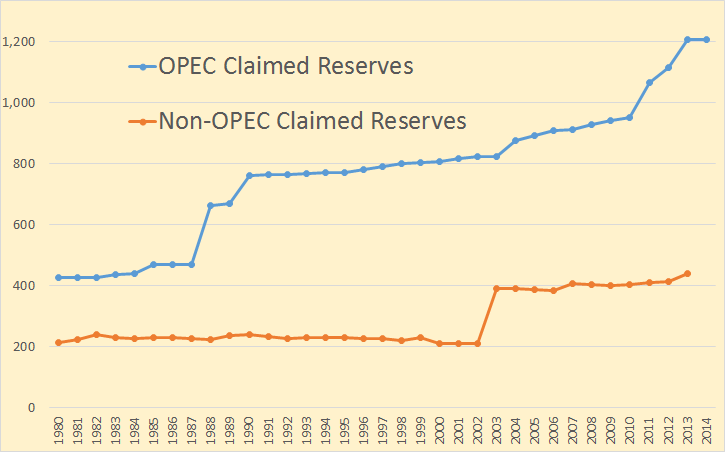
The EIA publishes Annually a list of World Proved Reserves of Crude Oil. Though all charts in this post use the EIA data, BP, the IEA and virtually every other reporting agency in the world uses basically the same data. It is my contention that this data is misleading and totally meaningless. This is especially true of OPEC Middle East Reserves. However because this data is taken as gospel by the media and perhaps 90% of energy analysts in the world, this misinformation becomes a serious problem.
But first let’s look at the data. It dates to 2014 in most cases but some data only goes to 2013. All data is billion barrels of reserves.
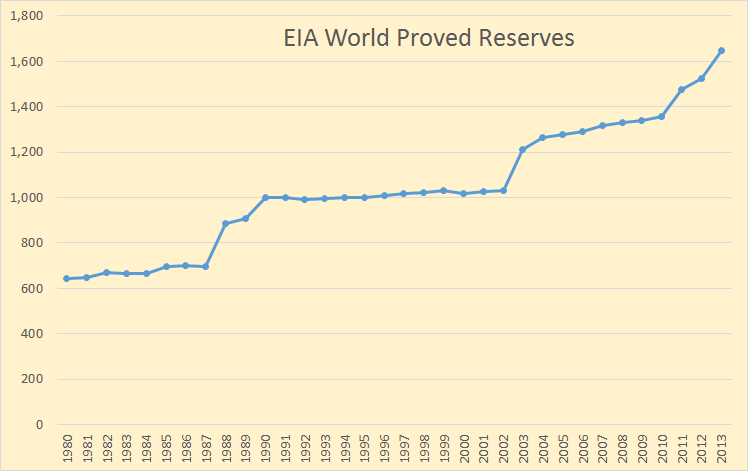 The EIA said we had 1,646 billion barrels of proved reserves in 2013. Other agencies put that figure a bit higher but we will go with this. And just where are these reserves located?
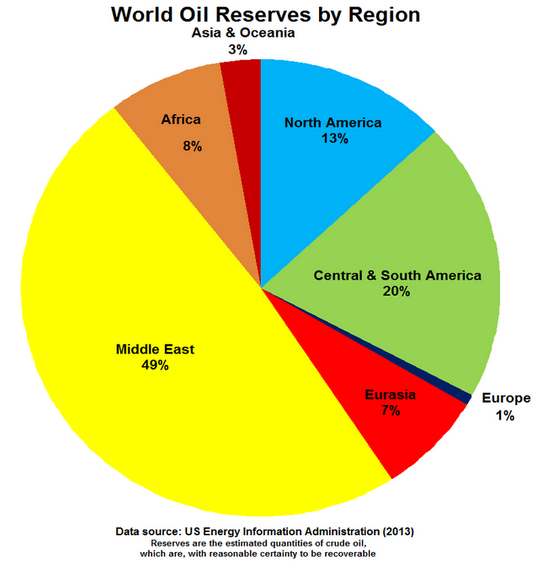
Almost half of the world’s proved reserves are supposed to be located in the Middle East. Actually it would be well over 60% if it were not for the recent additions to world reserves by the Venezuela Bitumen and the Canadian Tar sands.
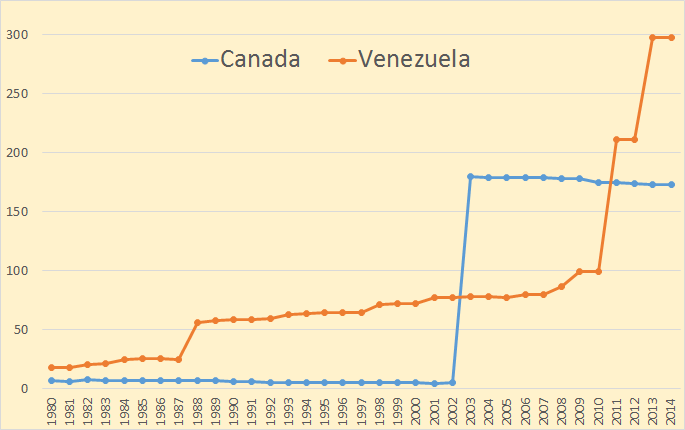
This is the proven reserves claimed by Canada and Venezuela. The EIA describes proved reserves as “reserves of crude oil which are with reasonable certainty to be recoverable.” So Canada has 173 billion barrels of reserves and Venezuela 298 billion barrels of reserves that we can believe has “reasonable certainty to be recoverable? What does that mean?
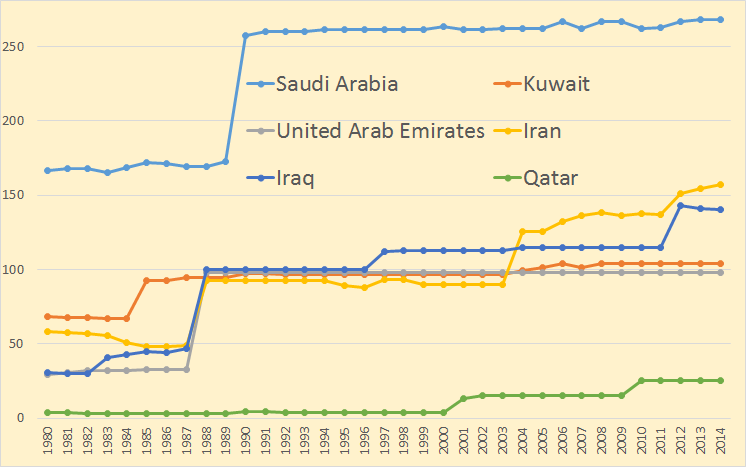
As you can see Middle East proved reserves always increase, they never decrease no matter how much oil is pumped from those reserves every year. And the worlds media accepts this nonsense without question. I once heard a reporter on CNBC point to the increase in world proved reserves in the decade of the 80s as proof that we are finding massive amounts of new oil all the time. No one bothered to point out that all this oil was found in board rooms by bureaucrats who simply “decided” this was how much oil they had.
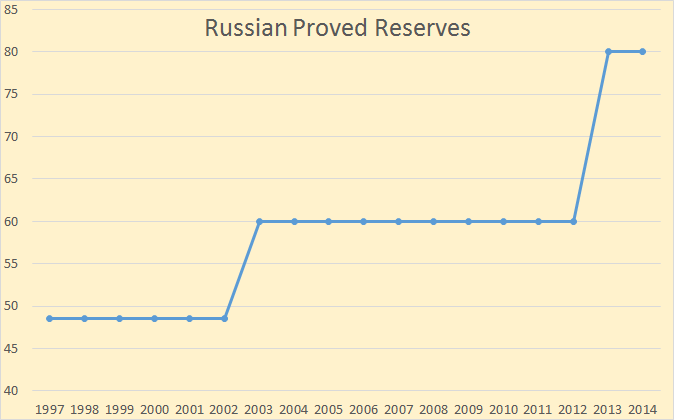
Russia is the world’s largest crude oil producer so we must look at her chart. (Not zero based.) Does this chart look realistic to anyone? This chart should prove to anyone that so-called proved reserves are simply set by bureaucrats with hardly any connection to actual reserves the country possesses.
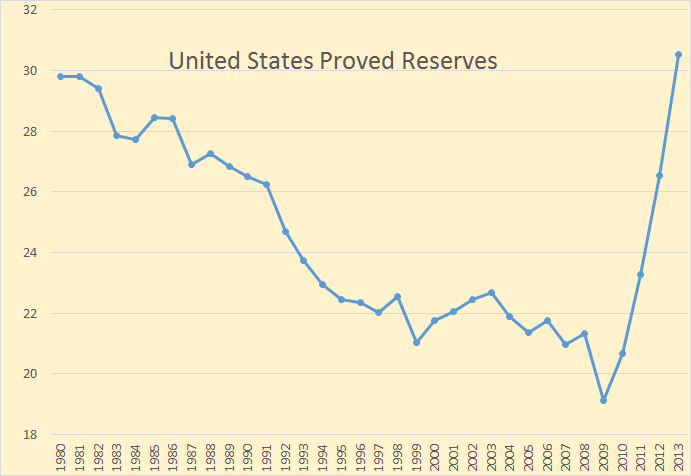
Even the US has gotten in on the act, adding 11.5 billion barrels of proved reserves since 2009. They did not report US 2014 reserves. Most of this increase is light tight oil reserves but some reserves have been added to the Gulf of Mexico. Notice that this chart is not zero based.
I have changed the definition here to “claimed reserves” rather than “proved reserves” because everyone should know by now that the vast majority of those claimed reserves are a joke. So how much oil is left in the ground? I mean oil that can reasonably be recovered at a price that economies can afford to pay. I have no idea and I don’t believe anyone else does either. But we can make an educated guess.
We must start by looking at reserves to production ratios. The RP ratio is expressed in “years of production at current production levels”. An RP ratio of 25 would mean that a has reserves of 25 times its current production. It does not mean that a country could produce at that level for 25 years then suddenly nothing. All reserves decline gradually. There are no hard and fast rules for RP ratios but in general we can say:
1. New fields have a higher RP ratio than old fields.
2. The larger the field the higher the RP ratio. Very large fields tend to produce higher for much longer than small fields.
3. The deeper the field the smaller the RP ratio. Very deep water fields have a very small RP ration.
4. Bitumen and tar sands have a very high RP ratio because their reserves can only be produced at a very slow rate.
4. Light tight oil is a completely different animal. Each well pumps from its own tiny reservoir. It is, or should be, totally independent from all other wells pumping from the formation. Each well would have a very small RP ratio but the RP ratio of the entire field, like the Bakken or Eagle Ford, would have a totally different RP ration from the entire field. Also, more than any other kind of reservoir, the RP ratio of an LTO field would depend on the price of oil.
All that being said we can say that the Middle East, because of its very large fields, should have a higher RP ratio than most other places in the world. But not that much higher. For instance the EIA claims OPEC has reserves of 1,206 billion barrels. OPEC produces about 11.7 billion barrels per year. That would give OPEC an RP ratio o about 103. Non-OPEC, on the other hand, the EIA says has 441 billion barrels of proved reserves. Non-OPEC nations produce about 16.28 billion barrels per year so that gives non-OPEC nations an RP ratio of about 27.
OPEC claims an RP ratio of 103, almost 4 times non-OPEC’s 27. Actually the OPEC Web Site claims non-OPEC nations have only 284 billion barrels of proved reserves. That would give non-OPEC nations an RP ratio of only 17.5.
What can we believe? Well I can only speak for myself but I have always used the reasoning that nations, the vast majority of the time, produce every barrel they possibly can. And also that the more oil one has to produce the more oil they do produce. Therefore OPEC nations should have an RP ratio relatively close to that of non-OPEC, perhaps slightly higher because of their larger fields.
If OPEC has an RP ratio of 35 then that would give them reserves of 410 billion barrels.
If non-OPEC has an RP ratio of 25 then that would give them reserves of 407 billion barrels. And that would give the world about 817 billion barrels of recoverable reserves. I can accept that number. But that is my high pick. I could also accept a slightly smaller number.
5 Comments on "World Proved Oil Reserves, Fact or Fiction"
Davy on Fri, 5th Dec 2014 6:38 am
Article said – If non-OPEC has an RP ratio of 25 then that would give them reserves of 407 billion barrels. And that would give the world about 817 billion barrels of recoverable reserves. I can accept that number. But that is my high pick. I could also accept a slightly smaller number.
Pretty profound analysis that I am just not qualified to opine on. I will be curious to see how long MSM can crow about all those energy positives we here that give the system confidence. Now is the time folks to see the super bowl commercials that many think are better than the games themselves. Here is a mention on what it may look like soon. Remember Baghdad Bob?
“In an age of spin, al-Sahaf offers feeling and authenticity. His message is consistent — unshakeable, in fact, no matter the evidence — but he commands daily attention by his on-the-spot, invective-rich variations on the theme. His lunatic counterfactual art is more appealing than the banal awfulness of the Reliable Sources. He is a Method actor in a production that will close in a couple of days. He stands superior to truth.”
— Jean-Pierre McGarrigle
Davy on Fri, 5th Dec 2014 6:56 am
What did I tell you above!!! check this article out:
http://www.bloomberg.com/news/2014-12-04/oil-drop-gives-u-s-drillers-argument-to-end-export-ban.html
shortonoil on Fri, 5th Dec 2014 9:28 am
This is called dragging out the old “official reserve numbers”, but there is a problem with that; reserves are not a constant, they are a moving target. Reserves, unlike resources which give the oil in the ground, depend on production costs and price. Over the last six months price has fallen 34%, and production cost has risen by about 1%. The reserves of six months ago are not the same as what they are today; they have fallen.
Many of the “official numbers” are taken from reserves that were posted as far back as 30 or 40 years ago. Circumstances have changed somewhat since then. Both the EIA, and the IEA like to quote “technically extractable reserves” while ignoring the impact of changing price, and increasing production costs. We have determined that oil prices are now in a long term decline phase, and the posted reserves, that will be extracted, will only amount to a small percentage of the “official numbers”.
http://www.thehillsgroup.org/depletion2_022.htm
Reserve quotes are best taken with a rather large grain of salt.
Richard Ralph Roehl on Fri, 5th Dec 2014 9:17 pm
Proven oil reserves? Peak oil?
Maybe we should be more concerned about peak atmosphere. If we continue to exponentially grow the human baboony population on this planet… and concomitant with that exponential growth, humans increase their emissions into the planet’s atmosphere… ah… er… what happens to the Earth’s biosphere?
Well… no matter. There hundreds of AGING time-bomb nuke plants on Planet Over-birth Earth. Over the next 20 to 40 Earth years… we shall witness a score more of Fukushima horrors. Even the wealthy will not escape the coming extinction event.
rockman on Sat, 6th Dec 2014 10:28 am
“This chart (Russian proved reserves) should prove to anyone that so-called proved reserves are simply set by bureaucrats with hardly any connection to actual reserves the country possesses.” Not that I necessarily disagree with the author’s skepticism but the abrupt stepwise jumps can also be explained by pricing. As shorty said there’s a number a factors used to calculate “proved reserves” beyond what sits in the ground. And the biggest non-geologic determinant is the price of oil.
Even if the amount of technically producible oil in the ground stays constant the “proved reserves”, which for most of means commercial proved reserves, can make sudden increases strictly from a quick and significant increase in oil prices. So there is such justification for at least some of the big step increases in the Russian curve.
But what Dog giveth Dog can just as quickly taketh away. LOL. The amount of proved commercial oil reserves in the world has dramatically decreased in the last several months. Regardless of how accurate such estimates were or weren’t 6 months ago those numbers have significantly declined based upon current prices. Regardless of what time span every gov’t, think tank, oil company, the know-it-all PO.com brotherhood, etc. uses eventually to recalculate “proved reserves”: all will have to issue a decreased estimate of proved reserves if oil prices remain at current levels. Which is why, IMHO, any discourse today on the ratio of production rates and former “proved reserves” estimates is pointless.
Which is why we’ll probably see many spinmeisters resort to the ole “technically recoverable reserve” numbers since they don’t have to be commercially producible.