
Peak Oil is You

Donate Bitcoins ;-) or Paypal :-)


Page added on September 11, 2014

Scotland’s $25 billion question: How much oil?

A week before Scotland votes on whether to split from the United Kingdom, a furious row has erupted over just how much oil the new state would have.
The heart of Britain’s energy industry is in Scotland. Oil and gas firms, and their suppliers, employ about 200,000 people and contribute about £15 billion ($25 billion) to the economy.
Around 90% of U.K. oil comes from areas that are likely to be claimed by an independent Scotland, and that energy wealth is central to the economic program put forward by its backers.
For decades, supporters of Scotland’s independence have accused London of squandering taxes paid on oil and gas extracted from below the North Sea.
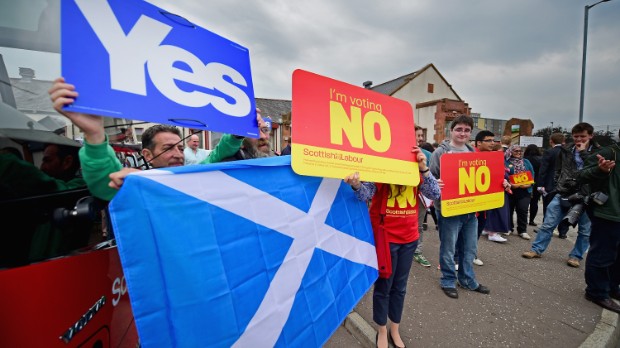
Those taxes would be the second biggest source of revenue, after income tax, for a new government in Edinburgh.
Scottish nationalists say they would follow Norway’s example and invest some of that money in a “rainy day fund” for future generations.
But Britain’s biggest oil companies have urged Scotland to remain part of the U.K. The vote will be held on September 18.
And on Wednesday two top CEOs publicly sided with a Scottish energy entrepreneur who has slammed independence campaigners for painting “an overly optimistic picture” of future riches.
Ian Wood, who built a global energy services company, says there could be between 15 billion and 16.5 billion barrels of oil and gas still to be recovered from Scottish waters. That’s far short of the 24 billion barrels, worth £1.5 trillion, claimed by the Scottish government.
Wood told industry website energyvoice.com last month that declining production would start to hit Scottish jobs and the economy in 15 years.
BP(BP), which has been pumping oil from the North Sea for 50 years, said the industry would be best served by keeping the U.K. together.
“However, the province is now mature and I believe Sir Ian Wood correctly assesses its future potential,” BP CEO Bob Dudley said.
Shell(RDSA) CEO Ben van Beurden said much of the North Sea’s remaining reserves were likely to be in isolated or remote areas, making them unprofitable to develop without improved tax incentives.
“As existing infrastructure gets older and output falls, costs will go up and tax receipts will come down,” van Beurden said.
23 Comments on "Scotland’s $25 billion question: How much oil?"
MSN fanboy on Thu, 11th Sep 2014 9:21 am
Scotland without oil, and without London pumping up their public services will fail… slowly.
Fun to watch.
Can’t wait, hopefully they will have to pay for prescriptions lol
Student fees
England will be better without this parasite.
The irony is, if the English had a vote, we would say YES.
Plantagenet on Thu, 11th Sep 2014 9:35 am
Scotland should be run for the benefit of the Scots, not the oilcos or the bankers in London.
Makati1 on Thu, 11th Sep 2014 9:46 am
Some have said that if Scotland leaves the UK, the UK will break up and the EU will soon follow. Should be an interesting week coming up. Maybe too good to be true? We shall see. I’m rooting for Scotland to vote YES!
rockman on Thu, 11th Sep 2014 11:00 am
“Scotland should be run for the benefit of the Scots, not the oilcos or the bankers in London” If the oil companies and the banks receive no benefit from the North Sea who, pray tell, is going to put up the $billions needed for the development of addition fossil fuel resources out there? Obvious the citizens of the new Free Scotland could do it. All they’ll need to do is take all their oil revenue (and probably borrow a bit more) and do it themselves. That way they get all the profits…and loses.
Same position I’ve taken with every mineral owner that didn’t like what I offered for their lease: they can go mortgage the farm/ranch and risk $millions of their own money to drill and thus keep all the profits…if it’s not a dry hole. I’ve yet to see one do so. And I have known a number of mineral owners who rejected my offers of $hundreds of thousands plus royalty for their lease thinking someone will come along and offer them more. And the vast majority of them are still waiting. For instance in my current program of drilling hz holes in old and nearly depleted oil fields I offered the most I could for leases in one area and they rejected my offer. So I just moved on to other field areas where I could get leases at the price that made sense. Given all the other opportunities available to me it’s very unlikely I’ll ever go back to those folks. And extremely unlikely anyone else will every offer anything to lease their minerals.
It’s nothing personal…just business.
mike on Thu, 11th Sep 2014 12:22 pm
Oil production from the North Sea has been declining year by year since the mid noughties. Production wil continue to decline rapidly in the future, year by year. Now a report has been published declaring there are vast amounts of oil under the North Sea waiting to be exploited by FRACKING. I repeat – by FRACKING – In one of the most hostile environments where oil is won from the earth’s crust. And according to reports, the oil bearing rock is the Jurassic Kimmeridge Clay formation. Kimmeridge clay is a plastic, highly water retentive clay with zero porosity. It is not a shale and lacks the lithification planes shale has that are produced by the compression of platey clay crystals such as montmorillonite, glauconite and micaceous minerals. How oil could be sucked or pumped out of such a rock I cannot imagine. I know that this formation has a high organic content – in the area I live, the clay is used to manufacture bricks, and because of the high organic content, the bricks are “self firing” reducing the heat input needed to bake the bricks. The Kimmeridge clay was briefly exploited after the WW1 in Buckinghamshire, but the cost of trying to win a meagre dribble of crude from this intractable clay. All this suggests that the promise of vast quantiies of oil that are to be won by fracking under the North Sea are dreams, delusions. The cost of exploiting Kimmeridge Clay under the hostile North Sea environment would surely be so high that only if oil prices shoot through the roof could an independent Scotland become a petrostate and see its budget black hole filled. Nither Salmond, nor Cameron should be hoping for energy salvation from the North Sea.
Feemer on Thu, 11th Sep 2014 2:37 pm
Scotland should vote no, in what person’s delusional mind does breaking up from the UK, or from the EU, make any sense? Einigkeit macht stark; unity makes strength. When Europe is in a very fragile and chaotic time, they need to unite. I’m not saying that the relationship between Scotland and the UK or the UK and the EU doesn’t need reform, but you get so many more benefits from being united. Scotland will soon find out just what it took for granted after it secedes, which will likely happen
Beery on Thu, 11th Sep 2014 3:15 pm
As an Englishman, I hope Scotland votes yes. The Scots have always resented being part of Britain and I would be happy to get back to having England be my nationality rather than this ridiculous mish-mash of British Isles cultures.
Northwest Resident on Thu, 11th Sep 2014 4:33 pm
Anything that breaks up the established borders of Europe is likely to set off a chain reaction of ethnic and separatist passions that would drag Europe in yet another goddamn bloody mess. Tensions are already high and a lot of people are watching to see what happens with the Scotland referendum — which I believe has already been voted down and resulted in a little upward blip in the stock market. But somehow I don’t think this issue is fully resolved just yet, not by a long shot. And now we have people in Spain raising their voices, wanting to break away and go it on their own. Here’s an interesting article I found that discusses the consequences of these separatist movements in European countries:
Only Germany is holding together as separatists threaten to rip Europe apart
”
Europe is disintegrating. Two large and ancient kingdoms are near the point of rupture as Spain follows Britain into constitutional crisis, joined like Siamese twins.
The post-Habsburg order further east is suddenly prey to a corrosive notion that settled borders are up for grabs. “Problems frozen for decades are warming up again,” said Giles Merritt, from Friends of Europe in Brussels.
The best we can hope for – should tribalism prevail – is German political hegemony in Europe. The German people so far remain a bastion of rationalism, holding together as others tear themselves apart. The French are too paralysed by economic depression and the collapse of the Hollande presidency to play any serious role.
The far worse outcome is that even Germany succumbs to centrifugal forces, leaving Europe bereft of coherent leadership, a parochial patchwork, wallowing in victimhood and decline, defenceless against a revanchist Russia that plays by different rules.
Former Nato chief Lord Robertson warns that a British break-up is doubly dangerous, setting off “Balkanisation” dominoes across Europe, and amounting to a body blow for global security at a time when the Middle East is out of control and China is testing its power in Asian waters.
He warns that the residual UK would be distracted for years by messy divorce, a diminished power, grappling with constitutional wreckage, likely to face a resurgence of Ulster’s demons. Scotland’s refusal to allow nuclear weapons on its soil means that no US warship would be able to dock in Scottish ports, while its withdrawal from all power projection overseas would push British fighting capability below the point of critical mass.
“The world has not yet caught up with the full and dramatic implications of what is going on. For the second military power in the West to shatter would be cataclysmic in geopolitical terms. Nobody should underestimate the effect this would have on existing global balances,” he said.
Europe has largely disarmed already. While America spends $76,000 per soldier each year, EU states are down to $18,000, largely earmarked for pay and pensions, according to the Institute for Statecraft. Almost nothing is being spent on new equipment. Europe has slashed defence budgets by $70bn over the past two years even as Russia blitzes $600bn on war-fighting capabilities by 2020 and turns itself into a militarised state, a Sparta with nuclear weapons.”
And more…
ht tp://www.telegraph.co.uk/finance/comment/ambroseevans_pritchard/11088265/Only-Germany-is-holding-together-as-separatists-threaten-to-rip-Europe-apart.html
Beery on Thu, 11th Sep 2014 5:56 pm
“Anything that breaks up the established borders of Europe is likely to set off a chain reaction of ethnic and separatist passions that would drag Europe in yet another goddamn bloody mess.”
LOL. Spoken like someone who hasn’t got a clue about Europe. This is not 1914, and Scotland breaking from the UK is hardly going to set off WW3.
Nony on Thu, 11th Sep 2014 6:20 pm
Don’t be getting any idea, Texas. 😉
Davy on Thu, 11th Sep 2014 6:38 pm
This will be good for the common man in Europe and bad for the banksters. In any case PO and descent mean localization needs to progress. The sooner Europe decentralizes the better for them. They are already in a population and economic descent especially in the south. Europe will leap frog the rest of the world in being prepared for descent.
rockman on Thu, 11th Sep 2014 8:12 pm
Nony – Too late…the idea took root in 1836.
peakyeast on Thu, 11th Sep 2014 8:18 pm
I wonder if making an oil fund like norway is a good idea.
Why not spend the money wisely while they are still worth something?
I have a feeling that in some years – when it really counts the saved funds are going to be nothing worth. Not even the intrinsic value of paper money – since they are electronic.
Feemer on Thu, 11th Sep 2014 8:29 pm
Germany really is the only thing holding europe and the euro together. If Merkel wants something to happen, it does. Europe needs to focus on economic growth and renewable energy, it’s the only way it will survive. Ukraine though is essential to the future success of the EU. The trade, resources, and expansion of borders would greatly help the EU.
Davy on Thu, 11th Sep 2014 11:23 pm
Feemer, so correct, Germany is the rock of Europe.
rockman on Fri, 12th Sep 2014 7:00 am
“I wonder if making an oil fund like norway is a good idea.” All depends on the timing. Texas is currently using it’s Rainy Day Fund to deal with the drought we’ve had by increasing our reservoir capacity…a benefit that will last many decades. They are also using it to beef up deficits in our education system…another potential long term return.
But the funds held in reserve earn interest. So maybe the buying power of those funds declines X% in Y years: they still earned interest in those years so perhaps little or no buying power is lost. And which gov’t would you rather have in future tough times: one that has a reserved fund that might have diminished in value to some degree or one that has no fund and has to either raise taxes or reduce services. IOW who would you rather: Norway with the better part of $trillion from its production or Great Britain that has spent every penny of its N Sea income?
Davy on Fri, 12th Sep 2014 8:46 am
I think eliminating a stock portfolio for an individual is a good idea “If” you are not going to actively play the market, can’t afford to lose an investment, and have few physical tangible assets you need to consider prepping for collapse. “All” paper wealth will be gone soon or it’s value hair cut to negligible amounts. It is just a matter of time. With a state or country this is a different situation. These funds will allow these entities to mitigate and adjust to the descent. The wealth may disappear but that will be the case across the board globally. IMO part of Norway’s success as a people and country is this investment. It allowed their people a disciplined and social effort at proper investments and social justice. They have avoided so many othe oil ills like we see in Russia with their mafia of oligarchs and the richest man in the world czar putt. Norway is a shinning example of a higher level humanity at work.
JuanP on Fri, 12th Sep 2014 9:36 am
We can add Catalunya to the list of nations seeking independence.
I have been following events there since the beginning, many years ago. IMO, it was the horrible reaction of the Spanish parliament, Supreme Court, and the Spanish establishment to the small, insignificant changes applied by the previous Spanish government in Catalunya that brought this on. The Catalans took it personally. I am 1/4 Catalan, and my Catalan side of the family are all for independence, except my sister who lives in Pamplona and is neutral.
Almost two million people took part yesterday in a pro independence celebration in Barcelona, a city of 1.6 million, by forming an 11km yellow and red V for Voluntat(will) to Vote for Victory in favor of a referendum. That is the largest manifestation of public will in Europe in a long time. The Catalans are done with Spain, and this split is at this point only a matter of time.
Northwest Resident on Fri, 12th Sep 2014 9:46 am
Beery said: “Spoken like someone who hasn’t got a clue about Europe”
If you disagree with the Telegraph article I posted, why not direct your disagreement to the points made in that article instead of flipping off my summary of it?
Your assertion that I “hasn’t got a clue about Europe” would indicate that you don’t have a clue about me. I read about Europe all the time, numerous articles which relate to the growing ethnic, nationalist and far-right tensions. Add to that my long interest and study of European history. And I don’t have a clue about Europe?
So beery, maybe you think that as the economic tensions build and established European borders are challenged as we are seeing happen right now, all the brotherly love and sense of European shared identity as demonstrated throughout the 20th century (and through the centuries before that) will prevail over chaos and mayhem? Are you sure it is I who don’t have a clue?
JuanP on Fri, 12th Sep 2014 10:14 am
If the Catalans split, so will the Basques, and then next would be Navarra. Nobody knows what could happen in Spain. A preventive federalization and regionalization with greater autonomy for the regions, applied now, could save Spain, but Madrid’s current government is pathetic and will not do anything constructive.
The UK without Scotland would be seriously diminished. The English would end up getting out of the European Union as a consequence, since support for EU membership is much lower in England than in Scotland. The English-Scottish divorce would distract both nations’ governments at a critical time.
I expect Europe’s borders to be redrawn completely after the end of BAU. No nation will be spared in the world, IMO. I just don’t understand people who claim that any place will be spared. This is a global collapse and noone anywhere will be spared.
synapsid on Fri, 12th Sep 2014 3:00 pm
JuanP,
Is there much secessionist sentiment in Navarra?
This is new to me. Wow! With Navarra, the Basque country, and Catalunya independent, Spain wouldn’t have much of a border left with France.
Now, if they stir up Gascony…
Northwest Resident on Fri, 12th Sep 2014 3:27 pm
Spain — One thing we do know for a fact, and that is, the police (and government) are getting ready for some major social unrest:
Spain prepares for an autumn of discontent by buying €1m of riot gear
“The Spanish government is readying itself for an autumn of discontent, spending nearly €1m on riot gear for police units as disparate protest groups prepare a string of demonstrations.
Since June, the interior ministry has tendered four contracts to purchase riot equipment ranging from shields to stab vests. The ministry also finalised its purchase of a new truck-mounted water cannon, an anti-riot measure used during Spain’s dictatorship and the transition to democracy but little seen in recent years. Despite attempts by opposition Socialist politician Antonio Trevín to paint the purchase as “a return to times that we would rather forget”, the ministry said in its tender that the water cannon was necessary, “given the current social dynamic”.”
ht tp://www.theguardian.com/world/2014/sep/08/spain-one-bn-on-riot-gear-autumn-of-protest
Bob Owens on Fri, 12th Sep 2014 5:35 pm
These independence movements are what you would expect in a world of shrinking resources and it is just what we are getting. Local control over local resources establishes shorter feedback loops between the public and rulers. This re-establishes stability for a bit, until the resource base shrinks again to a critical level. This process will continue until a steady state is reached. Unfortunately there won’t be much left of civilization at that point.