
Peak Oil is You

Donate Bitcoins ;-) or Paypal :-)


Page added on September 4, 2014

China now gets more oil from the Middle East than the US does
China is quickly overtaking the United States as the world’s biggest importer of oil. Not only that, but China now buys more crude oil from the Middle East than the US does — a shift that some experts think could have big geopolitical implications in the years ahead.
Roughly half of China’s imported oil now comes from the Persian Gulf, whereas America’s reliance on Middle Eastern crude has been steadily shrinking in recent years. Here’s a good map from Bruce Jones, David Steven, and Emily O’Brien of the Brookings Institution laying out China’s situation:
Where China’s oil imports come from

(Brookings Institution)
China currently imports around 5.6 million barrels of oil per day on net, with about half of those imports coming from the Persian Gulf region. As the map shows, Saudi Arabia, Iran, Oman, and Iraq dominate the list (as do Russia and Angola) — and most of the oil flows through the Strait of Malacca, a vulnerable chokepoint.
The United States, meanwhile, now imports around 5 million barrels per day, and its list is quite different. Only 41 percent of US oil imports now come from the Persian Gulf (mostly from Saudi Arabia). By contrast, more than half of US oil imports come from Canada and Mexico:
Where US oil imports come from:
Why does any of this matter? On one very basic level, where people get their oil isn’t overly important. Oil prices tend to rise and fall together all over the world, no matter the source, and an oil spike that crushed China’s economy would hurt America’s economy too.
China is becoming more dependent on Middle Eastern oil than the US
But as the Brookings paper notes, China is becoming much more directly dependent on Middle Eastern oil than the United States is, and that fact alone could have big implications for geopolitics for the region.
“The United States has long been exposed to the geopolitical risks associated with energy production and transit, but now, increasingly, so too are the Asian powers,” the authors write. “Chinese and Indian policymakers are scrambling to understand these risks and to work out how to manage them.”
They also note that the impact on the psychology of American policymakers could be profound: “American strategists, meanwhile, may be tempted to fulfill Chinese fears and use energy as a source of pressure on its most significant rival. Others will see an opportunity to disengage from the Middle East during a period of fiscal austerity, leaving Beijing and Delhi to take responsibility for the troubled region.” (The Brookings paper argues against both these approaches — see the full piece for more.)
Why China has surpassed the US in oil imports
It’s worth noting that China’s position as the world’s top oil importer is relatively new. For many decades, the United States was the undisputed champion of oil importing. This was basically the one fact that most people knew about US energy policy — that the country was way more dependent on foreign oil than anyone else.
But that’s now changing. The Energy Information Administration estimates that China surpassed the US in net oil imports sometime around the fall of 2013:
(Energy Information Administration)
Part of this is due to China’s rapid growth, as more and more people are driving. Part of it is due to the fact that China has been slow to develop its own domestic oil resources. So the country has to seek out petroleum abroad.
But another big factor has been changes in the United States. Thanks to the fracking boom in places like Texas and North Dakota, the US is producing more and more of its own crude oil. At the same time, improvements in fuel efficiency and a slowdown in rates of driving means that the United States is reducing its oil consumption. Add those two together, and imports are dropping.
Further reading: Here’s an excellent Wall Street Journal story from last year predicting that China would soon overtake the US as a buyer of Middle Eastern oil.
How has fracking boosted US oil and gas production?
Since the late 2000s, the amount of oil and natural gas produced in the United States has risen dramatically, thanks to fracking, horizontal drilling, offshore drilling, and other advanced techniques. Supplies are projected to grow further in the years ahead:
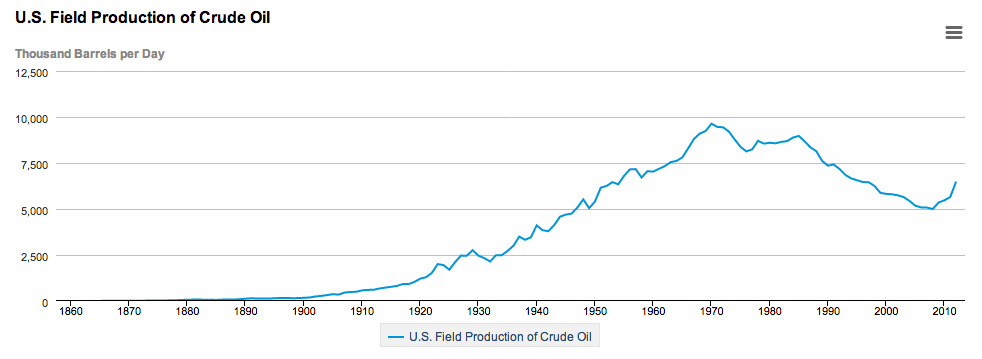
Crude oil: By November 2013, the United States was producing 7.8 million barrels of crude oil each day, the most in a quarter-century. Oil production is now expected to keep growing until it reaches a peak of 9.6 million barrels per day in 2019:
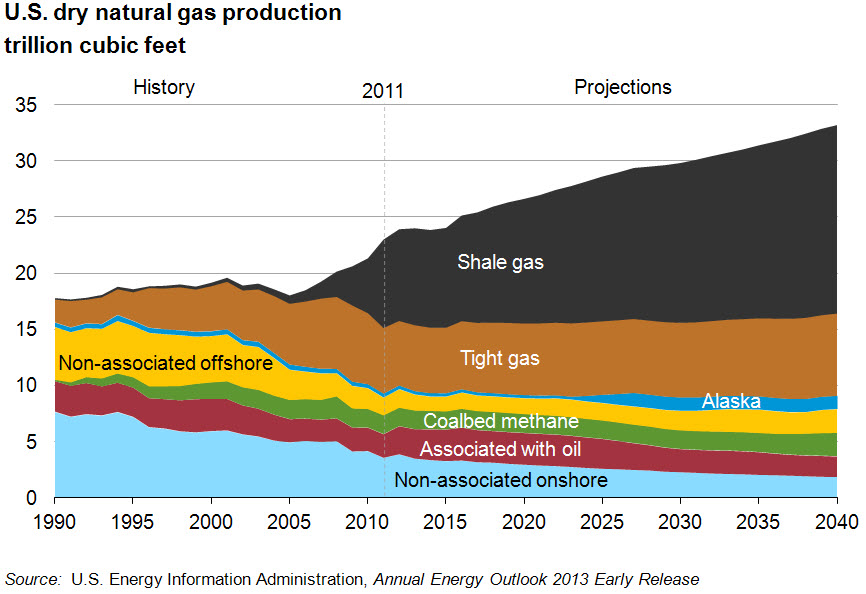
Natural gas: US natural gas production has also reached new historical highs, to 24 trillion cubic feet in November 2013. Supplies are currently expected to grow until at least 2040:
Note that these predictions are far from perfect — ten years ago, few were predicting the fracking boom.
5 Comments on "China now gets more oil from the Middle East than the US does"
bobinget on Thu, 4th Sep 2014 7:58 pm
Today’s EIA Inventory Report:
About that five million barrel import statement…
http://www.eia.gov/petroleum/supply/weekly/pdf/highlights.pdf
U.S. crude oil imports averaged 7.7 million barrels per day last week, up by 42,000 barrels per day from the previous week. Over the last four weeks, crude oil imports averaged about 7.7 million barrels per day, 5.8% below the same four-week period last year. Total motor gasoline imports (including both finished gasoline and gasoline blending components) last week averaged 801,000 barrels per day. Distillate fuel imports averaged 153,000 barrels per day last week.
bobinget on Thu, 4th Sep 2014 8:04 pm
Given China’s ‘hands off’ geopolitical stand, it won’t be
long before China will be able to absorb ALL the world’s oil suitable for export.
Davy on Thu, 4th Sep 2014 8:09 pm
Bob, what good is that for China and its export economy? Corner most of the worlds oil exports and destroy China’s export markets. It won’t be long after that and China will not need so much oil. China is in a poor position economically requiring significant growth dependent on a global export market.
Makati1 on Thu, 4th Sep 2014 8:59 pm
I would say that having trade agreements with over half of the world’s population is a good start to expand trade. That most of those consumers are outside the 1st world only increases the likelihood of export growth. And also increases the likelihood that the trade will be in currencies other than the USD as time goes by. Between the BRICS and their many other trade agreements, they seem to be in a good position to grow.
Makati1 on Thu, 4th Sep 2014 9:01 pm
BTW: “…Saudi Arabia, is in talks with the Eurasian energy giant (Gazprom) to join them in a partnership that will also disconnect the Arab Kingdom from the dollar, and open energy sales within the OPEC nations to be done in Roubles, Yuan, and perhaps even the Euro…”
Fact or fiction? We shall see.
http://www.examiner.com/article/jim-willie-saudi-s-are-on-the-verge-of-joining-russia-non-dollar-oil-sales