Three Nails in the Coffin of Peak Oil
This post was first published on The Oil Drum one year ago.

This post is based on a talk I gave as an “undistinguished speaker” to the American Association of Petroleum Geologists (AAPG) oil finders lunch in Aberdeen a few weeks ago. This will be one of my last posts on The Oil Drum. There should be enough controversy below the fold to keep a hoard of Oil Drummers satiated for weeks;-)
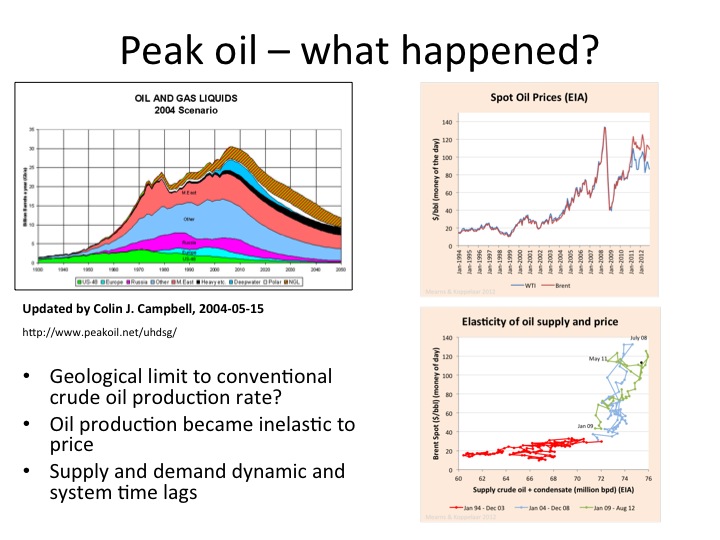
Peak oil – what happened? Before answering “what happened” it is perhaps best to try and define what peak oil actually means. In its simplest formulation, “the theory” is that owing to geological constraints on flow rates from natural finite reservoirs, global oil production will one day reach a maximum point and thereafter inexorably decline. An extension to the theory is to contemplate the possible consequences of peak oil for society. The argument goes that since oil is the pinnacle fuel in terms of energy content, transportability and storability, crucial to the smooth running of modern transport systems, that a decline in crude oil availability may lead to social disruption. The chart top left, shows a typical peak oil profile from Colin Campbell, one of the key Peak Oil analysts of recent decades.
The chart top right shows the oil price for Brent and WTI. The phenomenal rise in price from 1999 to 2008 bore witness to growing scarcity, where demand growth outstripped supply growth. The chart bottom right is a cross plot of the monthly production and price data and shows how supply became inelastic to price from January 2004. Many “peak oilers” were convinced that the time had come.(Click on slides to get a larger version that will open in a new window)
 Nail 0
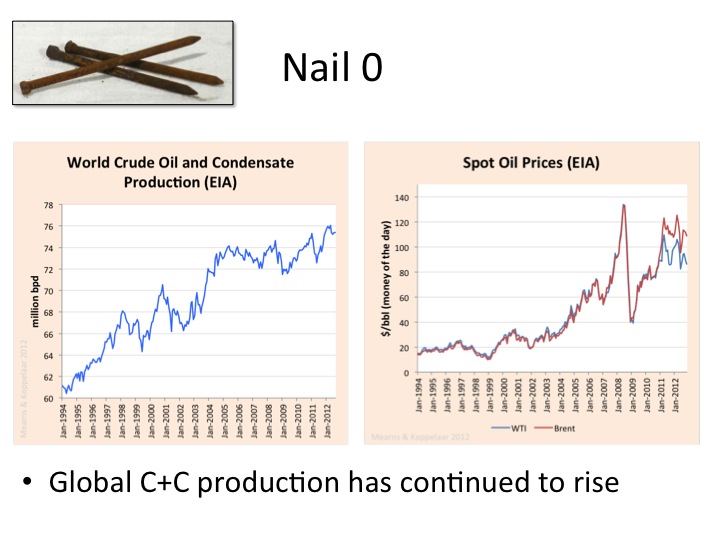
When I submitted the title to the AAPG many months ago I thought there were three main nails in the theory of Peak Oil, but when I came to write my talk I discovered there were four, hence the introduction of Nail 0. For the time being at least, it is an undeniable fact that oil production has continued to rise. Note that in this case, C+C includes conventional crude oil, condensate, shale oil and tar sands production but excludes biofuel and natural gas liquids. All scientists should update their views and theories when new facts come to light.
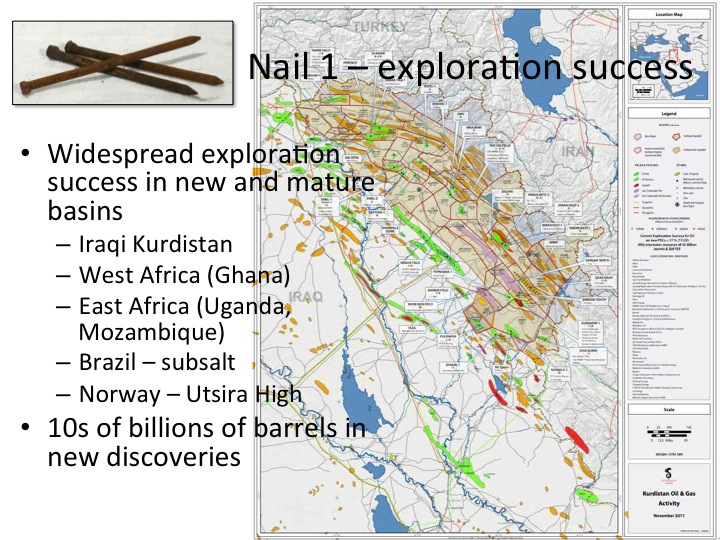 Nail 1 The first big nail is the ongoing exploration success of the international oil industry. Higher price has encouraged a resurgence in exploration activity that has resulted in tens of billions of barrels being found. Land locked Iraqi Kurdistan alone may hold >40 billion barrels in new reserves. We will of course one day run out of planet to explore but that day does not seem to have arrived yet.
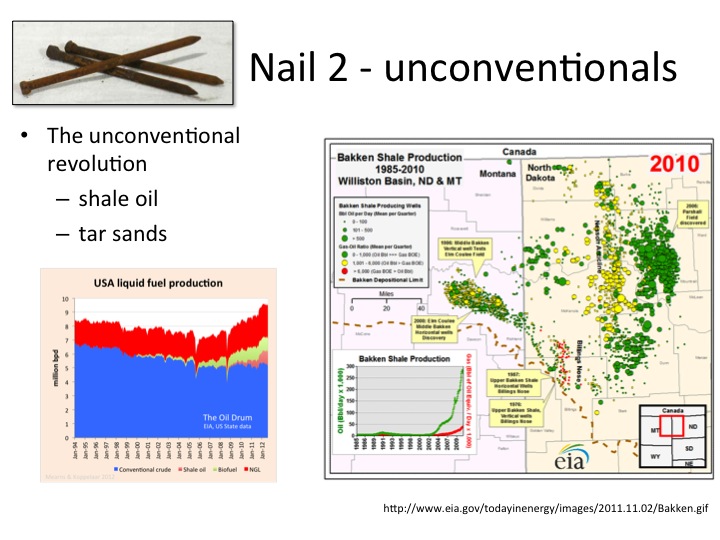
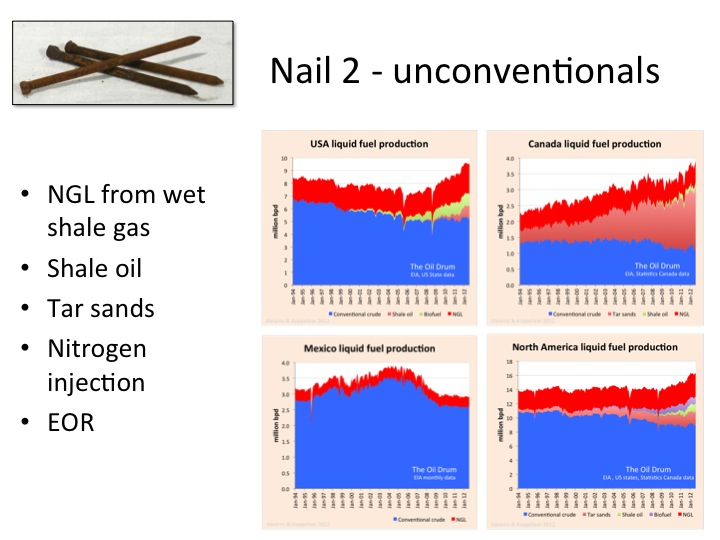 Nail 2 The second big nail has been the expansion of unconventional oil and gas production, especially shale oil and shale gas in North America. Several years ago when I first engaged with this debate no one ever mentioned shale oil as a massive new resource just begging to be exploited. Shale, together with tar sands, biofuels and enhanced oil recovery has transformed the fortunes of US and N American liquid fuel production.
 Nail 3
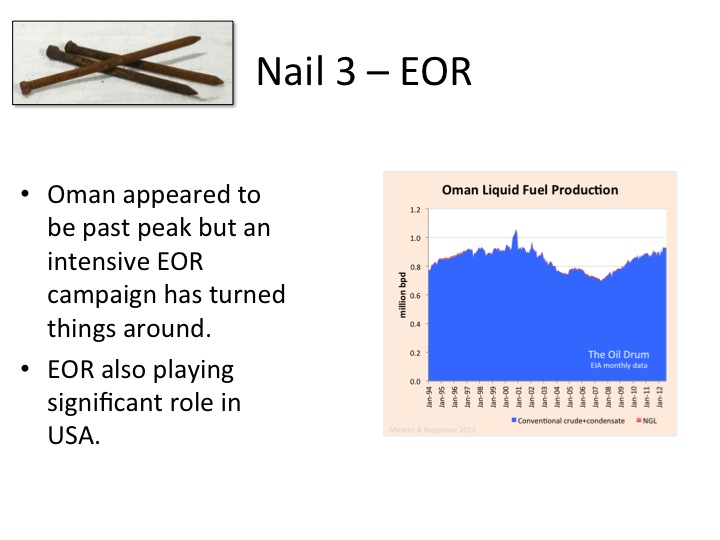
 The third and final big nail may not seem significant but it is symbolic of what can be achieved with technology and the desire to succeed. Oil production in Oman had been in decline since the year 2000 to the disappointment of the Omani people and Shell Oil that operates much of the production in that country through a joint venture with the Omani government called Petroleum Development Oman (PDO). Oman would have been a classic case of a country peaking. But the fortunes were reversed by rolling out an array of enhanced oil recovery strategies. Increasing recovery factors across the globe will add billions more to reserves.
 Points At this point many readers may think I have lost the plot, and indeed by the end of the post may still think so. It is important to set the preceding observations in context.
 Not all liquids are born equal
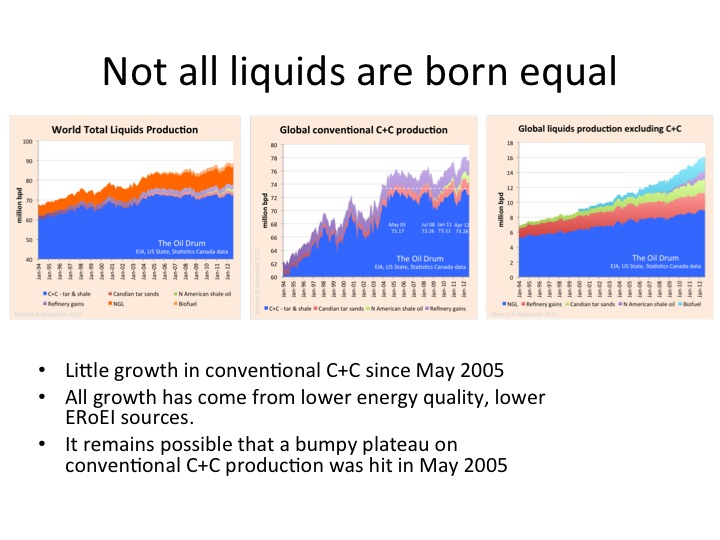
 A careful dissection of global liquids production data shows that conventional crude oil + condensate has been on a bumpy plateau, just over 73 mmbpd, since 2005 – that is for 8 years. Despite record high oil prices, the international oil industry has not been able to grow production of this most lucrative resource that flows freely from the ground. Something is up! All of the meagre growth in liquids production has come from liquids that are very difficult to get, i.e. shale oil and syn crude form tar sand, or from inferior liquids that condense from natural gas production (NGL). Note that in this case conventional C+C excludes shale oil and tar sands. It remains a debatable point whether or not shale oil should be classified as conventional or unconventional oil.
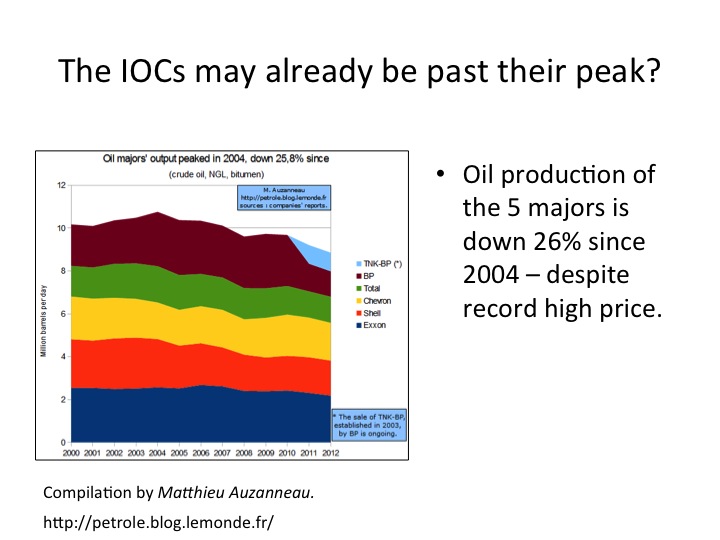 The IOCs may already be past their peak If the world is awash with oil as many reporters now claim, it is curious that this oil seems out of reach of the biggest independent oil companies in the world. Some of the new supplies may of course be in the hands of the second tier independents but most of it lies in the hands of national governments out side of the OECD. This presents very serious threats to energy security and on-going trade imbalances that lie at the heart of on-going financial system stress.
Thanks to Matthieu Auzanneau for the splendid chart.
 Oil field decline rates
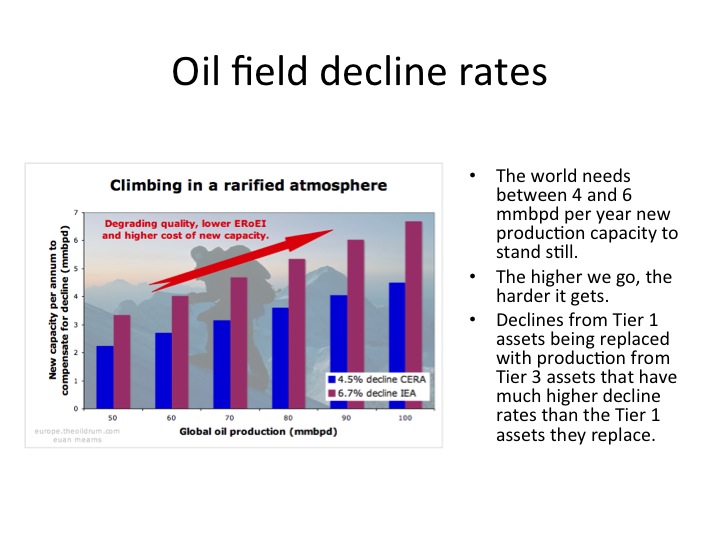
 In the context of oil production, decline rate refers to the fall in annual production that invariably takes place owing to pressure depletion of the reservoir, the production of oil and the ingress of water or gas into the formerly oil bearing strata. Companies are continually battling decline with strategies like injecting water for pressure support, drilling new infill wells, doing well work overs etc. and the combined effect is to reduce declines from headline numbers that may be much greater than 10% to more manageable numbers in the range 4 to 7%. Therefore, absent new field developments, global oil production would decline every year by about 4.5% according to CERA or 6.7% according to the IEA. Given crude + condensate production of around 73 mmbpd, this means that new fields amounting to between 3.3 and 4.9 mmbpd are required every year to just maintain global production at 73 mmbpd. This is a mammoth task, finding and developing fields equivalent to a province like the North Sea, every year. The industry has been working flat out to achieve and maintain this. Tier one supergiants are being replaced with tier three assets like shale oil, that by comparison require enormous effort to develop and decline much more rapidly.
 The world has changed The world changed in August 2008 with the onset of the financial crisis. This together with a range of other events, that all impinge on the global energy picture, has tended to take the media and public eye away from the energy crisis that was prominent before August 2008.
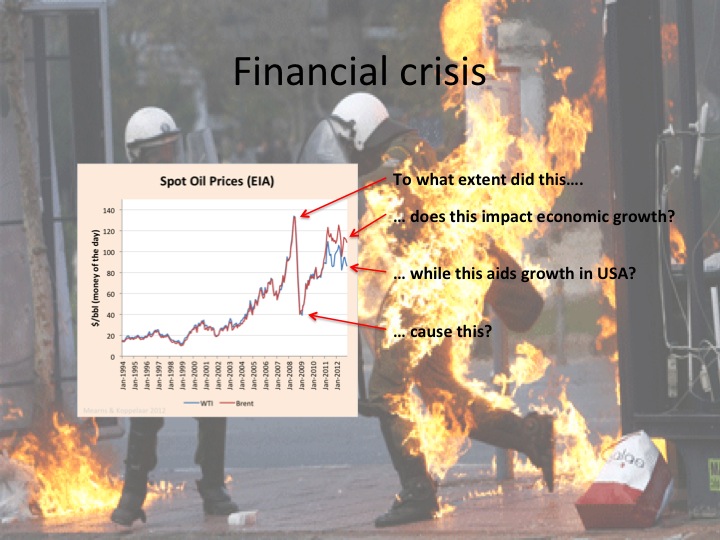 Financial crisis Eight years ago I would use images from movies to depict social unrest; now there is no shortage from the real world. There should be no doubt that the crash in oil price in 2008 was brought about by the financial crisis. The role of high oil and energy prices in triggering the financial crisis, however, remains less certain and mainly out of the public and political eye. The sharp recovery in oil prices following the crash is part of the new energy reality. Marginal supply is now much more expensive than in the past and to maintain supplies at current levels, a high price must be paid.
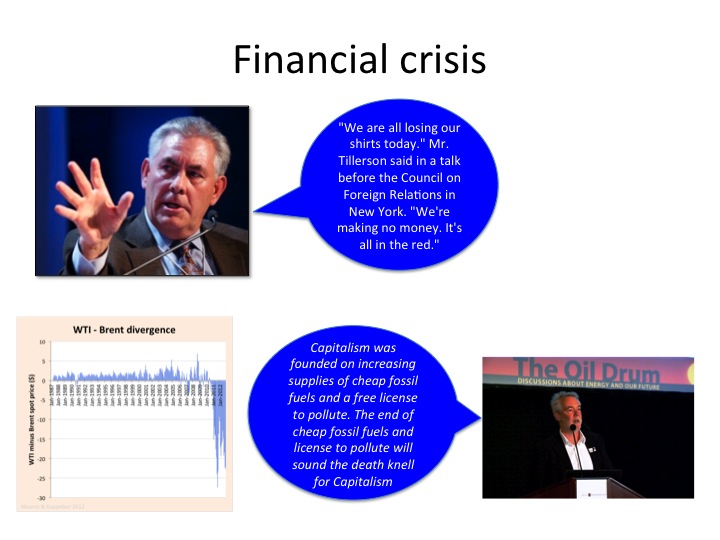 Financial crisis At a speech I made in Vienna last year I made the assertion that Capitalism was founded on growing supplies of cheap fossil fuels. The financial crisis bears many of the hallmarks to be expected with the end of cheap fossil fuels, and the end of capitalism, the loss of ability to pay rent on savings being one of them. The shale revolution is perhaps the best example of the end of capitalism as oil companies struggle to bring a vast but expensive resource to market and in so doing dump the price below which the resource can be produced. Rex Tillerson, CEO of ExxonMobil kindly affirmed the assertions made by Arthur Berman and others that the US gas industry is losing its shirt on shale. US natural gas prices seem to have bottomed, but are still below the price needed to turn a profit. US shale gas is expensive, and it is curious for me to observe that companies now seek to make it even more expensive by liquefying it and sending it half way around the world. This is curious behaviour for capitalists operating in a broken market.
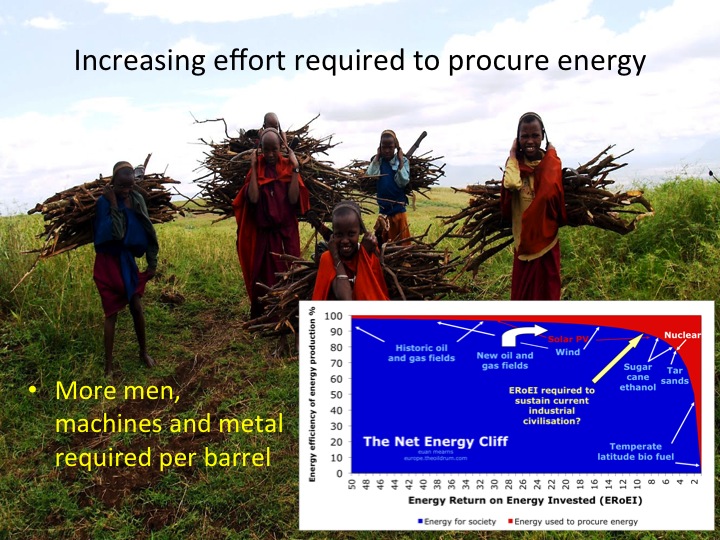 Increasing effort required to procure energy I first produced this chart many years ago now, inspired by Nate Hagens and many others. I have grown to realise that low ERoEI energy sources are in fact energy conversions. When we use natural gas to make biofuel or to help procure syn crude from tar sands we are electing to convert “cheap” natural gas into these more prized liquids. ERoEI of the global energy mix will undoubtedly be falling, but on average still so high so as to not be a problem for now. Likely not a problem for many decades to come.
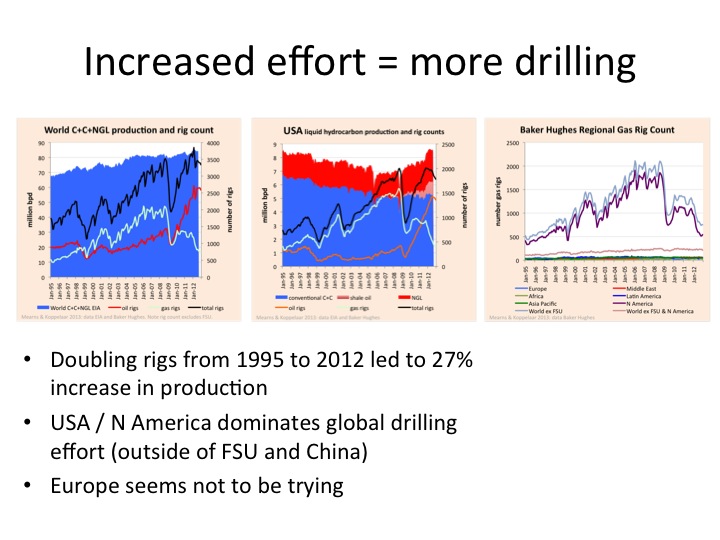 Increased effort = more drilling When it comes to N American oil and gas, increased effort simply means drilling more wells, more expensive wells, less productive wells. High resolution versions of the charts are given below. In this postI was astonished to see how the USA drilling statistics dwarf the rest of the world. Whilst Europe appears not to be trying, on reflection I am not convinced that covering our remaining countryside with drilling pads and service roads is a wise route to follow. North America has wide open spaces better suited to this type of resource exploitation than the densely populated rural landscape of Europe.
Global
 US
US
 Regional gas

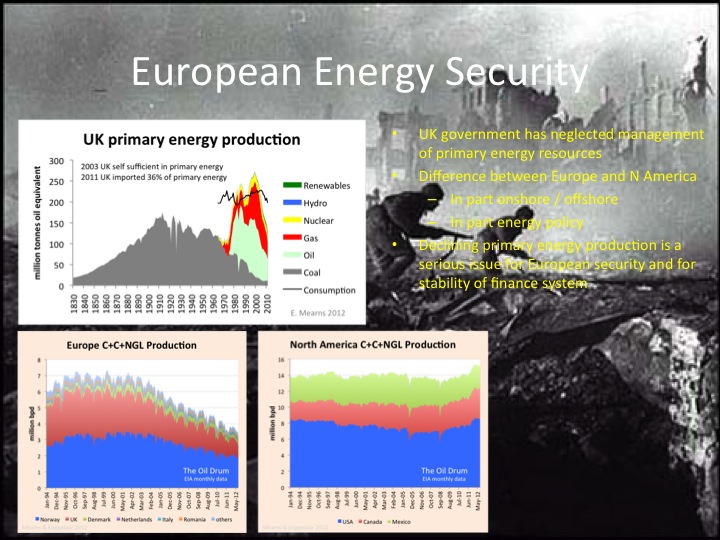 European energy security
Energy security has been a long-running and serious issue for Europe, one of the key factors leading to the expeditionary exploits of Germany in WWII. And yet, as discussed below, European energy policy is currently driven by a unilateral desire to reduce CO2 emissions which so far has achieved virtually nothing.
I sent the chart on UK primary energy to The UK Department of Energy and Climate Change (DECC) many years ago, asking, if confronted with nothing but this data, what should the UK do? It was and still is clear to me that we must do all we can to reduce our energy consumption (without harming the economy and the populace) whilst doing all we can to boost primary energy production. DECC did reply but did not give the glaringly simple answer I expected to get. In the interim, the government has implemented a totally botched tax raid on UK oil and gas production. And it continues to pursue (interminably) with its £1 billion carbon capture and storage competition that seems designed to give Britain the most expensive electricity on the planet. It should be blindingly obvious that if CO2 can be captured at power stations it should be used to enhance oil recovery from the North Sea. What has made our policy makers so blatantly dumb?
To be fair, the UK does have a raft of sensible measures such as progressive taxation on motor vehicles linked to energy efficiency (or is it linked to emissions?), tax breaks for home solar installations (though I’m still not convinced that solar is a great idea for a country where it is dark for most of the winter when demand is at a peak) and is rolling out smart meters at a snail’s pace. We are still taking two small steps forward for every three large steps back.
European oil and gas production is in free fall, in sharp contrast to North America. We are becoming increasingly dependent upon Russia, Africa and The Middle East for our energy supplies with every day that passes. Covering Britain with wind turbines seems increasingly to me like a bad idea. There is, of course, interminable chatter about fracking in the UK and elsewhere in Europe. This excerpt from an email from Arthur Berman I believe places the great fracking hope in context:
So, most-likely reserves suggest that all of the Wrexham, Blackpool, Nottingham and Scarborough shale reserves may amount to a Barnett Shale-sized accumulation. Not nothing, but on balance, not terribly impressive for an entire country. I’m sure the Brits will love the 30,000 wells necessary to develop 43 Tcf!

 Drill baby drill This final slide depicts the very different attitudes to energy policy on either side of the Atlantic pond. The USA, still dominated by free market policies, private ownership of mineral rights and the fossil fuel industries, has pursued a very different course to Europe that is pre-occupied with unilateral emissions reduction policies. So far, this unilateral EU action has achieved essentially zero on the emissions front, any savings made in Europe being wiped out by increased emissions else where. Europeans are being saddled with expensive and less reliable electricity supplies and increasingly loss making energy industries. Only time will tell if the European strategy bears fruit in the long run. The need to increase indigenous primary energy production in Europe does make expansion of renewable energy a sensible option, but I can’t help feeling that 100 GW of new nuclear capacity may better serve the people of Europe.
The future When I first came to The Oil Drum over seven years ago I was looking for information to explain the steadily rising oil price. It has been some ride. In the vastly complex system that is industrial society it is impossible to make predictions about the future, but here, in any case, is my wag. $100+ oil has opened the door to exploitation of more expensive resources and reserves. Society is adapting to the new reality of higher energy prices. Some are becoming more energy efficient, some have installed renewable energy devices at home, some will forgo an expensive vacation they can no longer afford and some have been squeezed out of the labour market, perhaps forever, and will live out their lives on dwindling State handouts, in poverty. The new higher oil / energy prices are here to stay but I believe they will stay range-bound in $100 to $150 / bbl bracket, perhaps for decades as we munch our way through the $125±25 slab of resource. The tremendous uplift in price from 2002 to 2008 may have been a generational one-off investment opportunity where some made billions whilst society lost its shirt. The energy industries are still under-dimensioned for the new reality of harder to get at energy but scarcity of women and machines will gradually ease as the industry continues to upscale.
As for me, I may start my own blog on energy, climate, and policy – that will not be suitable reading for many existing TODers. For the 7+ years I have been involved with The Oil Drum I have not worked and so any new venture will need to be fully funded, somehow.
euanmearns.com




westexas on Sun, 10th Aug 2014 9:54 am
Peak (Crude) Oil in 2005?
In my opinion it is very likely that actual global crude oil production (45 or lower API gravity crude oil) peaked in 2005, while global natural gas production and associated liquids (condensates & natural gas liquids) have so far continued to increase.
shortonoil on Sun, 10th Aug 2014 10:16 am
“the theory” is that owing to geological constraints on flow rates from natural finite reservoirs, global oil production will one day reach a maximum point and thereafter inexorably decline.”
This is a rather narrow interpretation for the decline of oil, and the coming end of the oil age. The oil age will end not for a lack of barrels in the ground, it will end as a result of its entropic behavior. It is losing its capacity to power the civilization that it was responsible for constructing.
“So long as oil is used as a source of energy, when
the energy cost of recovering a barrel of oil becomes
greater than the energy content of the oil, production
will cease no matter what the monetary price may
be.” (M. King Hubbert)
And, we are getting precariously close to that point.
http://www.thehillsgroup.org/
dissident on Sun, 10th Aug 2014 10:38 am
So all of the tar sands and the Bakkens have done is produced that anemic upward trend on the post 2005 plateau? Nothing to write home about is it?
Right now the problem is that this “increase” in oil production is nowhere near enough to meet demand. And don’t use your local gasoline price as a metric of the imbalance. Here in Canada it is clear that the gasoline price is being manipulated. One way this is done is to reduce the tax burden on oil companies. In the USA they pay about 11% even though the corporate rates are over 20%.
Norm on Sun, 10th Aug 2014 10:47 am
Weird article. Oil peaked already in 2005 and now they add other things into what they call “liquids” to fake it and have BAU. Also no talk of EROEI, they are burning a lot of the C + C just to extract it. Very rigged article, crooked and misleading.
shortonoil on Sun, 10th Aug 2014 11:14 am
“Weird article. Oil peaked already in 2005 and now they add other things into what they call “liquids” to fake it and have BAU. Also no talk of EROEI, they are burning a lot of the C + C just to extract it. Very rigged article, crooked and misleading.”
Shale, bitumen, extra heavy is like trying to patch the hole that sunk the Titanic with chewing gum. The world is going to run out of spit, long before it runs out of water.
http://www.thehillsgroup.org/
MD on Sun, 10th Aug 2014 11:24 am
First he drives nails in a strawman then proceeds to review the dynamics of peak oil.
Maybe he is getting paid after all…
rockman on Sun, 10th Aug 2014 11:25 am
Again the same worn out emphasis on dates. Unfortunately there have been many in the PO camp that have been sucked into this straw man debate. Not that I disagree with any of the statements of our cohorts made in response to this piece. But again this debate is about a rather unimportant factor IMHO.
When global PO or global Peak Conventional Oil or Global Peak Liquid Hydrocarbon has or will happen is a rather irrelevant metric IMHO. The most important metric to everyone on the planet is the price of oil. And that hinges on much more then any peak date. Just consider the most obvious. The world is currently producing more liquid hydrocarbons then ever before. Which also means more refined products are currently being produced then ever before. It matters little if those products are coming from shales, oil sands, etc. The world’s economies only care about the cost…a cost that has increased by 300% in a decade.
Ten years ago the global economy was doing much better when less oil was being produced. Increased oil production, the keystone of the anti-PO crowd, IS NOT A GOOD DEVELOPMENT. It has come about due to those higher prices. And not major tech improvements…another crutch used by the same crowd.
Every time the weak argument against the PO dynamic is offered I’ve challenged with the current economic damage being done coincidental with the increase in hydrocarbon production. Needless to say my challenge is always answered with silence. And for good reason: these are not good times for oil consumers around the world: these days are much worse then when less liquid hydrocarbons were being produced.
JuanP on Sun, 10th Aug 2014 11:45 am
Rock, as you know, I agree with your points on price and costs. But, 10 years ago there also were 800 million less people on this planet and all resources were cheaper, more abundant, and easier to access, not just oil. There are trends here of increasing overpopulation and resource depletion, combined with pollution and climate change. It’s the whole package that is the real mess. Now I’ll read the article.
Aire on Sun, 10th Aug 2014 12:24 pm
So many stupid little pictures – This was drawn up by a third grader for a first grader haha
JuanP on Sun, 10th Aug 2014 1:24 pm
I followed the link to the original TOD post. Wow, what a flashback. I hadn’t been there since it became an archive. I scrolled down through the comments, and I got very nostalgic. Losing TOD was an irreplaceable loss. I almost never posted comments there, but I read those threads for a very long time, what I refer to as my TOD era. I miss some of that crowd.
energyskeptic on Sun, 10th Aug 2014 1:55 pm
The amount of oil left doesn’t matter.
1) The amount of natural gas to make biofuels or convert tar sands doesn’t even begin to make a dent in the coming exponential decline rate of conventional fields
2) the decline rate is likely to be 8% or more: Andrew Gould, CEO of Schlumberger, said of the oil decline that “An accurate average decline rate is hard to estimate, but an overall figure of 8% is not an unreasonable assumption”. Matt Simmons also believes that an 8% rate of decline is possible, given how Saudi Arabia’s fields were mismanaged, the use of technology to extract the oil sooner than it would have otherwise been pumped, other super giant oil fields having depleted rapidly after their peak, and the likelihood that Saudi oil reserves are probably half of what is reported. The decline after peak might initially be low, buying a few years of time, but if it does reach 8% per year, world oil extraction would decline by almost half in eight years. That is likely to lead to the collapse of civilization, because there is too little time to adapt.
Hirsch & Bezdek (DOE peak oil 2005 report) said a 2% decline rate would have been bearable, but not 4% or more.
We get 80% of our oil from giant fields discovered decades ago, and they’re all going to go into terminal decline, just like Cantarelle and other large fields already have
3) Brown’s Export Land Model – exports will fade away as countries like Saudi Arabia, with still growing populations, use more oil, plus build petrochemical industries
4) war in the middle east and/or oil chokepoints getting blocked like the Strait of Hormuz, Strait of Malacca, Suez Canal / SUMED pipeline, Bab el-Mandab, Turkish Straits, Danish Straits, Ras Tanura port in Saudi Arabia: 10% of the world’s oil and/or their main refinery getting blown up, etc,
5) A financial crash would stop oil exploration and production since companies wouldn’t be able to borrow money to finance projects (i.e. Gail Tverberg http://energyskeptic.com/2014/gail-tverberg-on-why-oil-decline-will-be-fast/ and Nicole Foss)
There are too many other factors to list…but why did Euan leave so many important factors out that he surely knows about? I wonder why he wrote this?
http://energyskeptic.com/2014/transportation-how-long-can-we-adapt-before-we-fall-off-the-net-energy-cliff/
Steve Andrews, Randy Udall: http://energyskeptic.com/2014/peak-oil-its-the-flows-stupid/
Kurt Cobb: http://energyskeptic.com/2013/flow-rate-by-kurt-cobb-at-resource-insights/
http://energyskeptic.com/2013/oil-choke-points/
Jimmy on Sun, 10th Aug 2014 2:14 pm
This guy obviously never took a physics class. He should stick to articles on AGW denial.
M1 on Sun, 10th Aug 2014 2:30 pm
– Population Growth, we’re always going to stop at the next billion people, and yet we never do.
– China and India continue growth in energy consumed per household.
The only good this.
Solar and Germany.
EV’s and Hybrid production rising.
But, no action on a carbon tax means vast climatic devastation, with exponential growth in storm damage.
JuanP on Sun, 10th Aug 2014 3:07 pm
I’m going fishing, rafting, and hammock camping under the full moon. Bye, guys.
shortonoil on Sun, 10th Aug 2014 3:58 pm
“5) A financial crash would stop oil exploration and production since companies wouldn’t be able to borrow money to finance projects”
Because of the energy dynamics of the processes needed to extract oil when it requires one half of the energy content of the oil to produce it (and its products) the cost of production will begin increasing faster than the price can increase. Of course, when the cost of production reaches the price, production will cease. A financial crisis would only impair some producers. Many of the larger firms are self financing.
The oil industry has already reached the energy half way point. That occurred in 2012. From this point forward margins will shrink, and companies will have less money, to no money to invest in E&D. We are already seeing this taking place with ever increasing development costs, and very slowly rising prices. The industry will eventually be priced out of business.
This is equivalent to stating that the cost of production can, and will increase continuously. The price that the end consumer can pay – can’t.
http://www.thehillsgroup.org/
Tom S on Sun, 10th Aug 2014 4:10 pm
Norm:
“Weird article. Oil peaked already in 2005 and now they add other things into what they call ‘liquids’ to fake it and have BAU.”
No. Colin Campbell always included tar sands, deepwater, NGPL, and so on, in his definition of “oil”. Almost all of his published graphs in the ASPO newsletters (over 100 of them) included all of those things. Some of the graphs are entitled “all liquids”.
Colin Campbell and ASPO were very precise about what they meant by “oil”. What they predicted has not occurred.
-Tom S
Tom S on Sun, 10th Aug 2014 4:13 pm
MD:
“First he drives nails in a strawman then proceeds to review the dynamics of peak oil.”
It’s certainly not a strawman. He’s accurately reviewing the actual predictions put forth by the peak oil movement.
The initial graph in that article is copied directly from Colin Campbell and represents his “mature view” of future oil supplies. How is that a straw man?
-Tom S
Tom S on Sun, 10th Aug 2014 4:20 pm
Norm:
“Very rigged article, crooked and misleading.”
Aire:
“So many stupid little pictures – This was drawn up by a third grader for a first grader haha”
Jimmy:
“This guy obviously never took a physics class. He should stick to articles on AGW denial.”
…Back when Euan was a peak oil believer and a major figure in the peak oil movement, nobody thought he was a crooked stupid third-grader who had never taken a physics class.
-Tom S
Tom S on Sun, 10th Aug 2014 4:30 pm
energyskeptic:
“2) the decline rate is likely to be 8% or more: Andrew Gould, CEO of Schlumberger, said…”
You are conflating the decline rate of an individual field, with the decline rate of all fields worldwide. The two are very different. Schlumberger was not talking about all fields.
The decline rate of all fields will be much slower because not all fields peak on the same day, leading to a wider bell curve. Broad regions (such as the Americas) decline very gradually.
“5) A financial crash would stop oil exploration and production since companies wouldn’t be able to borrow money to finance projects”
The last financial crisis, which was the most severe in decades, didn’t stop oil exploration. Quite the opposite, oil exploration increased dramatically, despite the crisis.
Granted, the collapse of civilization would stop oil exploration. Other than that, however, there’s not a linear correlation between financial crisis and oil exploration.
-Tom S
Tom S on Sun, 10th Aug 2014 4:40 pm
rockman:
“Again the same worn out emphasis on dates. Unfortunately there have been many in the PO camp that have been sucked into this straw man debate… When global PO or global Peak Conventional Oil or Global Peak Liquid Hydrocarbon has or will happen is a rather irrelevant metric IMHO.”
It isn’t a “straw man debate”. The peak oil theory, as laid out by Colin Campbell, etc, was always about dates. That theory posited a bell-shaped curve with a peak around 2005-2008.
You may disagree and think that’s unimportant, which is fine, but then you’re basically disagreeing with almost the entire peak oil movement and what they’ve always claimed. Of course it’s legitimate for you to disagree or take a different view. However, it’s not just arguing against a straw man to point out that Campbell and peak oilers were wrong about some important things.
-Tom S
Davy on Sun, 10th Aug 2014 4:58 pm
Tom, Please, you can’t compare the financial crisis ahead with any of those in the past especially the last one. The last one (2008) you had a big price rise over a long period of time leading up to the crisis allowing several projects to get capex and begin long term investment. Investors were long oil up until 2008 crisis. The issue with the 2008 crisis is the crisis was repressed and repressed with low cost of money and artificial liquidity. This is perfect for oil exploration and production with low cost of money, artificial liquidity, and maintained oil demand from “Chindia”. There was a short price drop and economic uncertainty period that quickly vanished with “MASSIVE” monetary stimulus. Tom, what about the capex compression going on now? What will happen when confidence is breached and the cost of money shoots up a few percent and demand drops from a melting market? At no other time in history will the relationship between oil and finance be as profound as we will soon experience. That is a prediction and since I am no expert you can say I pull it out of my butt. This time it is different and the end of global BAU is near. We already have a fractured global political system interfering with the global economic system with trade wars and financial wars. There is nothing more dangerous to confidence and financial stability than trade and finance wars. If the escalations do not end soon there will be hell to pay by winter. There are already macroeconomic disequilibriums in play with diminishing returns of all the actions of all Central banks. This next one will be the big one and it will deeply effect oil production and exploration.
Tom S on Sun, 10th Aug 2014 5:02 pm
energyskeptic:
“the coming exponential decline rate of conventional fields”
It’s worth pointing out here than an exponential decline is one where the rate of decline is slowing down, so the production curve has “fat tails”. An exponential decline is much better for future oil production than a linear decline.
Whereas an exponential increase means that the rate of increase is increasing, an exponential decline means that the rate of decline is declining. An exponential function is one like y=b^x where b is a constant.
As a result, an exponential decline of 2% per year would leave oil production at about 36% of the peak after 50 years, as opposed to 0% if it were a linear decline. With an exponential decline, there is still considerable oil extraction 100 years from now, and some oil extraction (a few percent) 200 years from now.
-Tom S
Tom S on Sun, 10th Aug 2014 5:12 pm
Davy:
“Tom, Please, you can’t compare the financial crisis ahead with any of those in the past especially the last one. The last one (2008) you had a big price rise over a long period of time leading up to the crisis allowing several projects to get capex and begin long term investment.”
That may be true. Also, I don’t know what kind of financial crises are ahead.
I’m just saying that there’s not a linear correlation between total investment and oil extraction investment. It’s possible to shift investment to more important things, even in a crisis. As a result, a 50% decline in total investment does not imply a 50% decline in oil extraction investment.
-Tom S
energyskeptic on Sun, 10th Aug 2014 5:14 pm
Most of our oil comes from OLD, GIANT fields whose reserves were exaggerated, and sure, some will be just at 2% decline while others are at 12% decline, but as time goes by they will all accelerate to 8% or more. That’s HALF as much oil in less than 10 years. 2% is a fantasy, doesn’t match the real world! Especially when the EROEI is ALSO declining, so the NET energy is less and less.
The financial system in its own mysterious, byzantine way ultimately reflects the real world — at some point too high an energy EROEI will bring the financial system down. It will appear to everyone as if the reverse happened — oil shocks precipitated a financial crash or the sheer corruption and bankruptcy of the system caused the meltdown, but energy is always lurking in the dark alley, out of sight, because general awareness and acknowledgment of political and economic leaders of our peak oil situation would bring the stock market down sooner than it will crash on its own…
Davy on Sun, 10th Aug 2014 5:29 pm
Fair enough Tom.
Dredd on Sun, 10th Aug 2014 8:57 pm
Euan asks “what happened?”
Finite became infinite.
Limited became unlimited.
Facts became bull.
Nothing really mysterious about mythology … it always works that way.
SilentRunning on Sun, 10th Aug 2014 9:02 pm
Peak Oil Theory will only be overthrown when the laws of physics and mathematics are overthrown.
I am not surprised that a critic of peak oil can’t even count correctly.
Dredd on Sun, 10th Aug 2014 9:09 pm
rockman (on Sun, 10th Aug 2014 11:25 am)
“Again the same worn out emphasis on dates … this debate is about a rather unimportant factor IMHO … When global PO or global Peak Conventional Oil or Global Peak Liquid Hydrocarbon has or will happen is a rather irrelevant metric IMHO. The most important metric to everyone on the planet is the price of oil …”
I must agree except to the price of oil.
There is enough of the stuff in the ground to destroy civilization by destroying the global climate system, the global ecosystem, and consequently human civilization.
All we have to do is use it.
How much we pay, when we pay it, and/or how we pay Oil-Qaeda to destroy us by fuelling the engines of destruction is a straw man in the sense of being irrelevant.
It is like arguing about what colors the graphs should be on the charts that detail the demise of civilization.
rockman on Sun, 10th Aug 2014 9:15 pm
Tom – “How is that a straw man?” Easy answer: the importance of the PO dynamic has never hinged on the date. Collin is a very smart guy. But while he’s free to express his opinions and predictions he is not the KOPO…King OF Peak Oil. LOL. If you wish to piss away some of your life feel free to dig thru the thousands of messages I’ve posted as well as those of others and you will find the same point made repeatedly: the date of PO is of little importance.
The POD (Peak Oil Dynamic) is THE issue IMHO. At first it was difficult for some to give up the battle over PO dates. But eventually it becomes difficult to ignore the obvious: we are currently producing more liquid hydrocarbons then ever before while we’re also paying the highest yearly average oil price in history. That dynamic is what’s important to understand IMHO…not some date on a calendar.
If you haven’t heard my story before: in 1975 my first mentor at Mobil Oil explained the coming dynamics of PO. But in the oil patch we never called it “peak oil”. It was always the “reserve replacement problem”. As strange as it might sound the term “peak oil” isn’t even well known in most of the oil patch. At least not with the boots on the ground. But Yergin et al might bandy it about.
And again dates weren’t a very relevant to the RRP either. Mobil Oil management was already in a bit of a panic over the RRP/POD by 1980. And about 25 years ago I explained to my nephew that his very young daughters would be confronting some serious energy problems when they reached adulthood…sometime around 2010 to 2020. And there was nothing in that discussion regarding PO dates or global oil production rates.
None of which makes me or the rest of the folks in the oil patch smarter then anyone else. But this is a problem we’ve faced for decades. I’ve watched the problem up close and personal for about 4 decades. For many years I’ve watched one management team after another fired for not successfully addressing the RRP. In my small company there used to be 5 geoprofessionals. Now there are just three of us. Cutting those two loose wasn’t personal…just business. And if the three of us don’t add reserves faster then we produce them we’ll be gone also.
And it will have nothing to do with the date of PO. Selling oil for $90+/bbl isn’t a measure of success. Adding reserves is. IOW $90/bbl X Zero bbls = you’re fired. LOL.
Nony on Sun, 10th Aug 2014 9:39 pm
ASPO stopped having its conference, TOD shut down, and Google searches for “peak oil” crashed while those for
“fracking” skyrocketed. And all of this because the peakers had “won the argument”.
None of it because the Simmons/Savinar catastrophes didn’t happen. Because the Campbell/Ace/Deffeyes/Hubbert peaks didn’t happen. And oil price stayed fixed for last several years (admittedly at a level I don’t like, but not the Simmons $500, definitely not civilization crashing and trade localizing!) And shale oil from Texas and the rest of the US exploded to an extent that we VERY SERIOUOSLY may have repeaks in the exact two regions where “Hubbert theory was proved”.
Oh…yeah, you all won the arguments. Right. Too bad the rest of the country disagrees. Too bad the MSM disagrees. Too bad some of your own peakers disagree.
Have fun being the last fans of Spinal Tap.
Aire on Sun, 10th Aug 2014 11:19 pm
Euan is believes we can operation the economy on $150 barrel oil. Haha- that definitely would not work
Aire on Sun, 10th Aug 2014 11:25 pm
Euan believes we can operation the economy on $150 barrel oil. Haha- that definitely would not work . Although Colin Campbell may not ever be credited for making a perfect connection ,.. Just as Hubbert’s was it will be just as valid. Just as we don’t grasp the power of exponential growth neither do we grasp exponential decline! The technologies will not save anything either as they get more advance it only makes it that much harder to maintain. Society needs to be running smoothly… any major disturbance can cause a collapse I believe
Kenjamkov on Mon, 11th Aug 2014 1:23 am
doubling the rigs = 27% production increase…
twice the infrastructure for 1/4 more oil,
right… we are far from the peak… 😉
Dredd on Mon, 11th Aug 2014 5:31 am
rockman,
“Selling oil for $90+/bbl isn’t a measure of success. Adding reserves is.”
The consensus of science, IPCC et. al, U.S. gov. reports saying that even using oil in the reserves now in the ground is suicidal.
The suicide of civilization is success?
It isn’t called Oil-Qaeda for nothing.
Hating terrorists who have desert garb on but loving them if they have suits on is schizo.
Davy on Mon, 11th Aug 2014 5:51 am
Air said – Just as we don’t grasp the power of exponential growth neither do we grasp exponential decline!
Air I fear we may not get the luxury of exponential decline. I worry we may be in for short exponential decline followed by nonlinear decline in the condition of catastrophic bifurcation. Just as I hope I can age gracefully so do I hope we can have a gentle decline with manageable bottom for reboot? The Cornies that believe no decline is imminent “can’t count” as Silent mentions in his comment. The counting is not literal it is figurative. It is a failure to add up predicaments and the failure of counting on technology, knowledge, and substitution. For example what is substituted for oil next after the shale products play out? How long can less energy dense pseudo oil add up? How is all the debt in the financial system going to be paid back? What about across the board unfunded liabilities both direct and indirect (pollution/ecosystem destruction)? We can probably survive on $150 a barrel oil as long as we can continue the wealth transfer policies, financial repression of debt creation, artificial liquidity, and manipulated cost of money. Yet, it gets exponentially harder with every dollar over the goldilocks oil price range to maintain this managed/repressed economy. We are in a legalized Ponzi scheme that can last as long as the participants have optimism and confidence the authorities will maintain this pseudo market. The alternative is ugly and most smart participants know this. Most smart participants that can count also know there is no place to go with all this artificial liquidity. The amount of digital wealth/capital far outstrips physical capital. I imagine it will be the relationship between the degree and duration of $150/oil. $150/oil is dangerous even if this new normal can manage around it. We currently see diminishing returns and dangerous unintended consequences of this manage repressed economy. We see disequilibrium’s building and bulging out like trying to hold on to a water balloon. PO dynamics are a trigger. Whether we make it to that trigger is yet to be seen. Our polarizing multipolar world with its political system breaking up is more imminent. Our hyper complex global system of integrated trade, distribution, production, and exchange cannot function properly in a polarized world of competing political blocks engaged in trade, finance, and soon energy wars. On the surface these wars may appear slight and targeted. In summation when will the cocktail be an overdose? All it takes to tip confidence is the flap of a “butterfly’s wing” and or “black swan” to ripple through this delicate and brittle system of nothing more than confidence. That’s right confidence that is all we have now in a world in limits of growth facing diminishing returns in population and support overshoot in the environment of multiple predicaments. Confidence is such a delicate word. Do you trust human nature?