
Peak Oil is You

Donate Bitcoins ;-) or Paypal :-)


Page added on July 25, 2014

The Changing Face of World Oil Markets
Here’s the introduction to a new paper I just finished:
This year the oil industry celebrated its 155th birthday, continuing a rich history of booms, busts and dramatic technological changes. Many old hands in the oil patch may view recent developments as a continuation of the same old story, wondering if the high prices of the last decade will prove to be another transient cycle with which technological advances will again eventually catch up. But there have been some dramatic changes over the last decade that could mark a major turning point in the history of the world’s use of this key energy source. In this article I review five of the ways in which the world of energy may have changed forever.
Below I provide a summary of the paper’s five main conclusions along with a few of the figures from the paper.
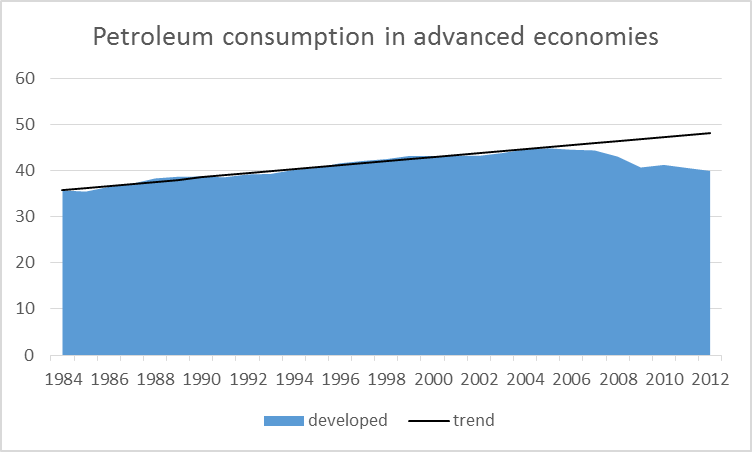
1. World oil demand is now driven by the emerging economies.
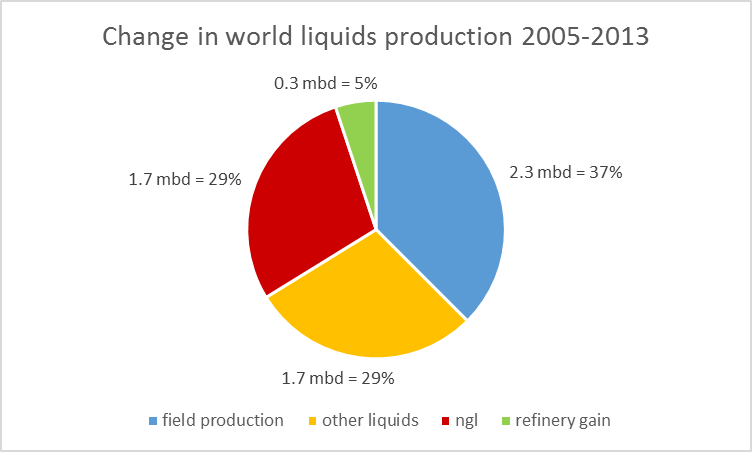
2. Growth in production since 2005 has come from lower-quality hydrocarbons.
3. Stagnating world production of crude oil meant significantly higher prices.
![Prices of different fuels on a barrel-of-oil-BTU equivalent basis (end of week values, Jan 10, 1997 to Jul 3, 2014). Oil: dollars per barrel of West Texas Intermediate, from EIA. Propane: FOB spot price in Mont Belvieu, TX [(dollars per gallon) x (1 gallon/42 barrels) x (1 barrel/3.836 mBTU) x 5.8], from EIA. Ethane: FOB spot price in Mont Belvieu, TX [(dollars per gallon) x (1 gallon/42 barrels) x (1 barrel/3.082 mBTU) x 5.8], from DataStream. Natural gas: Henry Hub spot price [(dollars per mBTU) x 5.8], from EIA. Figure taken from Hamilton (2014).](http://econbrowser.com/wp-content/uploads/2014/07/iaee3.png)
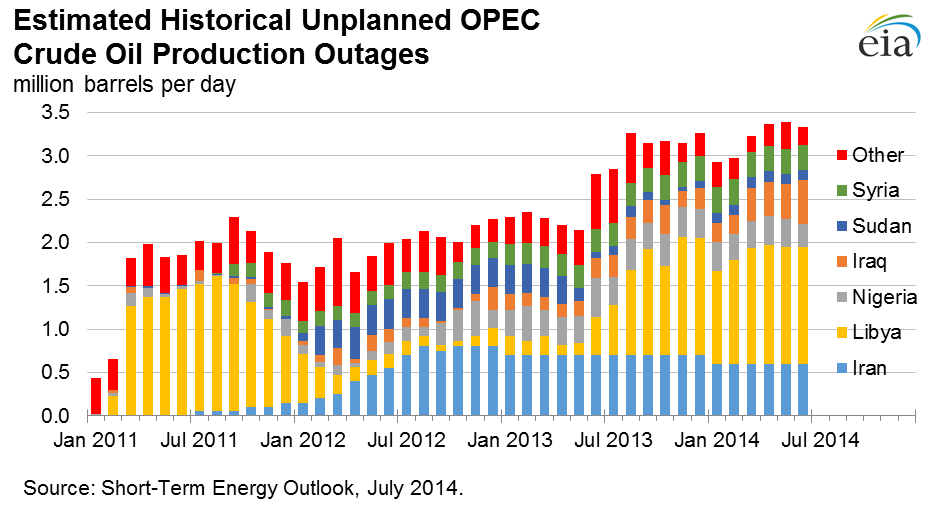
4. Geopolitical disturbances held back growth in oil production.
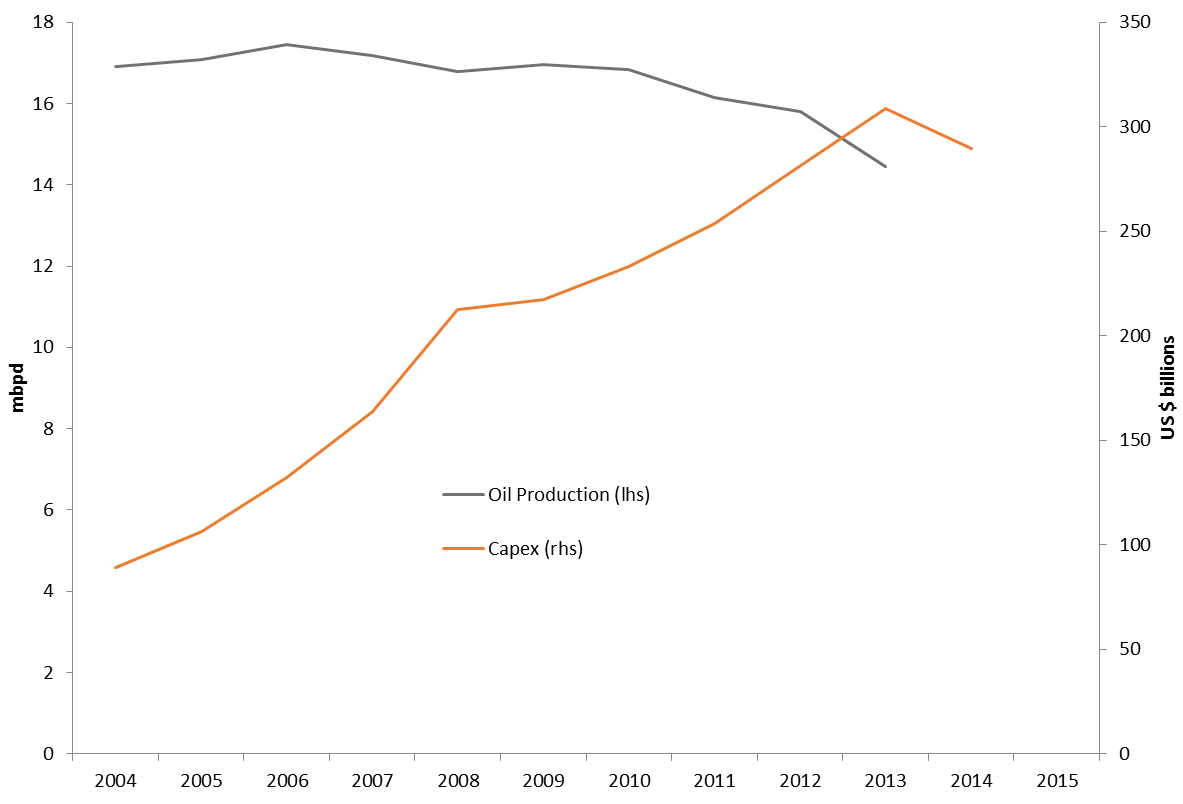
5. Geological limitations are another reason that world oil production stagnated.
And here is the paper’s conclusion:
Although the oil industry has a long history of temporary booms followed by busts, I do not expect the current episode to end as one more chapter in that familiar story. The run-up of oil prices over the last decade resulted from strong growth of demand from emerging economies confronting limited physical potential to increase production from conventional sources. Certainly a change in those fundamentals could shift the equation dramatically. If China were to face a financial crisis, or if peace and stability were suddenly to break out in the Middle East and North Africa, a sharp drop in oil prices would be expected. But even if such events were to occur, the emerging economies would surely subsequently resume their growth, in which case any gains in production from Libya or Iraq would only buy a few more years. If the oil industry does experience another price cycle arising from such developments, any collapse in oil prices would be short-lived.
My conclusion is that hundred-dollar oil is here to stay.
10 Comments on "The Changing Face of World Oil Markets"
Plantagenet on Fri, 25th Jul 2014 3:10 pm
Of course hundred dollar oil is here to stay. Plan accordingly.
rockman on Fri, 25th Jul 2014 3:16 pm
He makes some valid points. But drilling activity (and thus production) has always been dominated by the price of oil/NG much more so then by technological improvements. Recent events if the fractured NG shale plays bear that out: recall my often repeated story about Devon paying $40 million to cancel drill rig contracts when NG prices collapsed. The tech to hz drill and frac these plays was well developed at that time yet it made no difference: rigs drilling these shales dropped 75%.
Bottom line: if oil prices drop significantly there’s no existing tech or even hopeful future tech out there that will save these plays: the rigs will be stacked or be cut up for steel salvage. Exactly like they did in the early 80’s bust.
rockman on Fri, 25th Jul 2014 3:34 pm
P – I recall the numerous voices that made the same prediction when oil hit $35/bbl in the early 80’s and $TRILLIONS (in today’s $) were invested by companies. Remember we had over 4,500 rigs running then. And then the global recession hit and hundreds of oil companies went under. I know of two geologists that committed suicide shortly afterwards.
As I’ve said before I’ve been surprised how the global economy has handled $90+/bbl oil. But let the Chinese et al economies collapse and I easily see $40/bbl oil. I’m not predicting we’ll see such a collapse soon…or ever. But it is very easy to predict such a drop in oil prices if it does happen. I can tell you that everyone I know in the oil patch (including moi) is watching for such signs. And we all have very well developed exit strategies. All of is 45+ yo have no plans to go down with the great USS Oil ship. We’re all ready to run like a scalded dog and leave the rest of you to fend for yourselves.
Nothing personal…just smart business. LOL.
Northwest Resident on Fri, 25th Jul 2014 3:43 pm
“We’re all ready to run like a scalded dog and leave the rest of you to fend for yourselves.”
Sounds like the plan I’d be making if I were in your shoes. There’s a few people outside of the oil industry who know what’s coming down, and when the time to start running comes, we’ll be keeping stride right along with you.
nemteck on Fri, 25th Jul 2014 4:32 pm
A drop to $40/bbl will only be a short transient since oil companies will stop production, creating a shortage in oil. Hence, the price will rise.
Nony on Fri, 25th Jul 2014 5:28 pm
If the geology and the technology were so well known, why didn’t peaker articles or serious analysts show US LTO as an expected price-enabled boom?
Also, how about the Marcellus. That seems to booming even with low price. How can that be a price driven phenomenon?
Nony on Fri, 25th Jul 2014 5:30 pm
Rock, how about a supply-driven crash to oil prices? NG has crashed even though consumption is way up. It is conceivable. Heck, we had 20 years of cheap oil from 1985-2005 and the economy wasn’t crashed and demand declining that whole 20 years. More the opposite.
Makati1 on Fri, 25th Jul 2014 9:31 pm
nemteck, I doubt that anything causing oil prices to drop that low, will not also affect the developed countries economies and that you will not be able to afford even $40 oil. No, prices and available oil would likely remain low, eliminating much of your consumer use. Rationing? Limiting available fuel to necessary government, military and health/safety uses.
rockman on Sat, 26th Jul 2014 3:08 am
Nem – “A drop to $40/bbl will only be a short transient…”. Quit possibly. But if the price drop is the result of a global recession, as happened in the mid 80’s, low prices could last for many years if the recession holds on. Which is what happened back then: adjusted for inflation it took 20 years for oil prices to recover by the mid 90’s. OTOH when oil dropped from $145/bbl to $40/bbl back in ’08/’09 it began rising quickly. But still took the better part of two years to build back to current levels.
Nony on Sat, 26th Jul 2014 5:55 am
The idea that a temporary recession prompted a 20 year lower price (even while incredible amounts of growth happened) is crazy. Also, the recession timing for the 80s price crash is off as has been pointed out to Rock several times. The accepted view is that supply (significant from the US) caused the cartel to crack. That’s what dropped prices. And then the cartel couldn’t stop their cheating.