
Peak Oil is You

Donate Bitcoins ;-) or Paypal :-)


Page added on July 17, 2014

Almost a century ago, experts predicted the decline of natural gas production
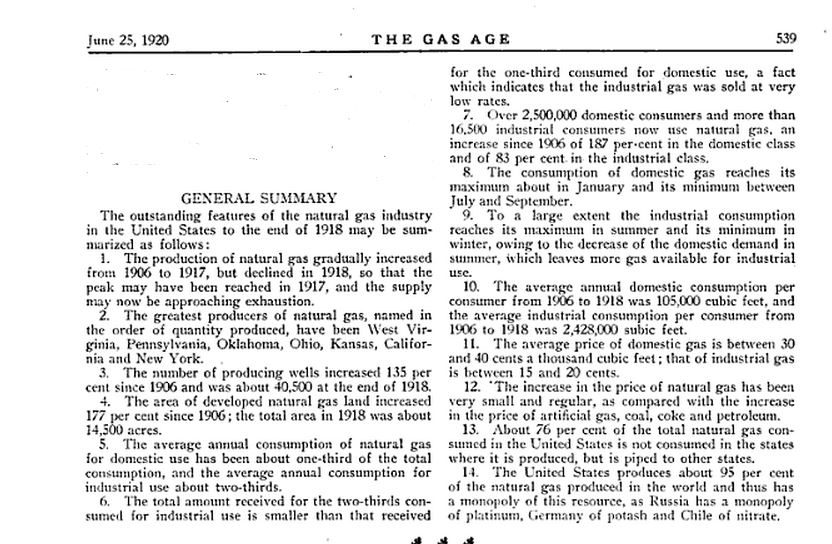
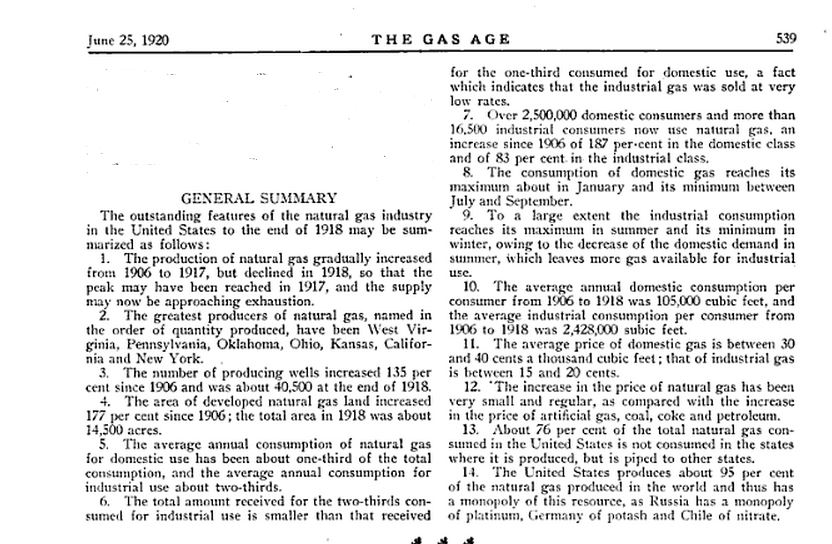
In 1920, a correspondent for The Gas Age, summarized national gas production data like this: “The peak of the production of natural gas in this country was doubtless reached in 1917.”
Pennsylvania and the Marcellus Shale may be synonymous these days, but the Keystone State is no stranger to oil and natural gas drilling, going back to the first commercial oil well drilled in Titusville in 1859. Here, we‘ll take a look back at Pennsylvania’s long history of energy production from oil, natural gas, coal, nuclear and renewables.
In 1920, a correspondent for The Gas Age, a digest for the natural gas industry, summarized national gas production data like this:
“The peak of the production of natural gas in this country was doubtless reached in 1917.”
If there’s one thing that separates the modern natural gas rush from the countless waves of excitement over the past 150 years, it’s predictions like that. Now we can get natural gas from shale, from tight sands, from miles under the ocean. That’s not to say natural gas isn’t finite. It’s just that it’s finality isn’t top of mind right now.
Reading through gas journals of the early part of the 20th Century, the attitude is very different. Scientists and businessmen feared the end of gas supplies was near. They bemoaned low gas prices that “make waste negligible.”
“This fuel, which is practically unexcelled in all its uses, has always been sold at a low price because its supply has plentiful, and its low price has, in turn, make its consumers careless in its use, so that the history of its utilization is a history of years of appalling waste,” the same article declared.
In 1918, by the way, that price was between 30 and 40 cents per thousand cubic feet. Last year, it was around $3.75.
People worried that gas was being needlessly vented and wasted at the wellhead and in homes. All this was back when the U.S. was not only the leading producer of natural gas, as it has once again become in 2012, but produced 95 percent of the world’s supplies of the fuel. And within the U.S., West Virginia led the country in gas production, followed by Pennsylvania.
Today, or rather in 2012, the latest year available from the Energy Information Administration, Texas and Louisiana lead the pack, with Pennsylvania in third place.
As for production, in 1918, about 721 billion cubic feet flowed out of gas wells in the U.S., with more than half of that going towards making natural gasoline. Last year, producers made that much in the first 11 days.
12 Comments on "Almost a century ago, experts predicted the decline of natural gas production"
Nony on Thu, 17th Jul 2014 4:10 pm
The peakers have been way off on NG. Hubbard totally missed the peak and the amount produced.
More recently we had the 2005 era articles on TOD about a “gas cliff”.
Then Berman, et. al made all these comments about shale being a mirage, $8/mcf needed, Marcellus would underperform, etc. And here we are 5 years later…and volume is up 20%, with price knocking on coming back DOWN below $4!
As recently as this winter, Rapier predicted a massive price squeeze (after the little spike was already subsideing). And lots of other people said we couldn’t refill storage during the summer. They were wrong too. Storage is being filled at record pace.
Nony on Thu, 17th Jul 2014 4:56 pm
Shale. Gale.
www dot Bloomberg dot com/news/2014-07-15/fracking-sends-northeast-natural-gas-output-to-record dot html
paulo1 on Thu, 17th Jul 2014 6:52 pm
They missed the tight plays in their forecasts, no doubt about it. However, until fracking shale changed the dynamics gas was headed for a big big decline. So, now shale gas is booming, production is up and few are making any money other than some lucky lease holders and expert/specialist producers. Many have stated that it is a stock play rather than a sound industry at today’s low prices. We are lucky to have it but I don’t know how long it can be counted on. Despite revamped fields, there sure won’t be enough to replace our portable liquid fuels we so rely on. Plus, there sure isn’t 100 years of it to keep everything going.
Glad to see flaring is finally being addressed this year.
Paulo
Calhoun on Thu, 17th Jul 2014 9:15 pm
It’s true that the predictions on NG have been way off. Sometimes laughably so.
But where does that leave us? Do we have 100 years of NG left (at present consumption rates) as the NG industry would have us believe? Will the fracking miracle continue? And if it does, at what cost to the environment? Are we going to drill all of Pennsylvania and New York’s southern tier?
And, while it is true that producers have been building storage faster than usual, they are still way below normal:
“Stocks were 608 Bcf less than last year at this time and 727 Bcf below the 5-year average of 2,856 Bcf.” from today’s IEA report.
If they get stocks back to normal levels by winter that will be quite an accomplishment. If they don’t, and if we get another cold winter, things could get difficult.
In any case, in my opinion, NG is important, but our economy runs on oil. Predictions about NG, right or wrong, don’t get me worked up too much. It’s oil that matters.
Nony on Thu, 17th Jul 2014 10:16 pm
Agrees, on a $$ basis, oil is more significant.
Yeah, if we have another cold winter will still be an issue. I don’t think anyone is projecting they will be back to normal at winter. Just not as bad. Injection is slowly catching up (is more than normal amount).
There was a good analysis (RBN, I think) which looked at futures curves and typical next season and longer estimates. Basically showed the market still pricing in some risk for next winter (because of the storage issue), but expecting the winters after that (and long term) to be fine. So basically, the issue was the bad winter, not long term outlook for gas.
Northwest Resident on Thu, 17th Jul 2014 10:26 pm
Nony — Any chance you work for the NG industry, laboring daily to spin positive outlook on natural gas prospects? You’ve been a consistent NG proponent for quite a while, never seeing an NG-related prospect that didn’t look very promising. Who knows, maybe NG does have a bright outlook for the near term future, but like Calhoun points out oil is what matters, the world doesn’t and can’t run on NG. Oil shortages are approaching. If the price of oil goes way up as its availability goes down, what will happen with NG production? What do you think will happen, Nony?
Nony on Thu, 17th Jul 2014 10:30 pm
Peakers have a stronger case on oil than NG. This means that cornies have a stronger case on NG than oil. 😉
Nony on Thu, 17th Jul 2014 10:31 pm
Or maybe Cabot is just paying me more than CLR. 😉
Nony on Thu, 17th Jul 2014 10:33 pm
I just checked the futures curve out to several years. The RBN analysis, while right at the time, has already become OBE. The futures market isn’t worried about next winter OR the winter after now.
Northwest Resident on Thu, 17th Jul 2014 10:35 pm
Nony, that doesn’t answer the question. Given the fact that if oil prices go up, so does the production cost of NG. Would that rise in production cost for NG result in more production do you think? Or less? Just curious what your thoughts are on the subject.
Nony on Thu, 17th Jul 2014 11:08 pm
NWR:
1. A rise in production costs would create a rise in price for NG which would create a drop in production.
See: en dot Wikipedia dot org/wiki/Complementary_good
2. However it’s not clear to me how much oil is a competitor fuel rather than a factor of productions. A rise in diesel (for drilling rigs) hurts NG production. But a rise in motor fuel leading to more conversions of vehicles would help NG! Which effect is dominant?
3. I suspect that the price of diesel for the drilling rigs, etc. is a small part of the NG cost (not like it’s a feedstock). And that NG will mostly gyrate based on other factors.
4. Right now the futures markets are predicting oil prices to drop for the next 20 years (moderately). So the gas markets are pricing in the expectation of slight drops in oil price.
Nony on Thu, 17th Jul 2014 11:40 pm
Here is a good paper on oil/NG price relationship.
ftp dot eia dot doe dot gov/pub/oil_gas/natural_gas/feature_articles/2006/reloilgaspri/reloilgaspri dot pdf
Situation is even more complicated because you have the issue of associated gas production (increase in supply, drop in price) and competition for rigs/labor (drop in supply, rise in price).
Based on time series, they say the major effect is from demand side though. The products compete in dual fired boilers. Increased oil price leads to switching to gas (higher production/demand and higher price).
Of course, this paper is a bit old…and realistically the current sitatuation you have in the US is a very prolonged period of high oil price (5 years around 100 or higher) and very low gas price (5 years around 5 or lower). So really the markets are amazingly disconnected. Actually this just makes the shale gale even more incredible…how it has been able to keep price low and volume increasing markedly.