
Peak Oil is You
Donate Bitcoins ;-) or Paypal :-)


Page added on July 11, 2014

EIA Projections Show Hydro Growth Limited by Economics not Resources
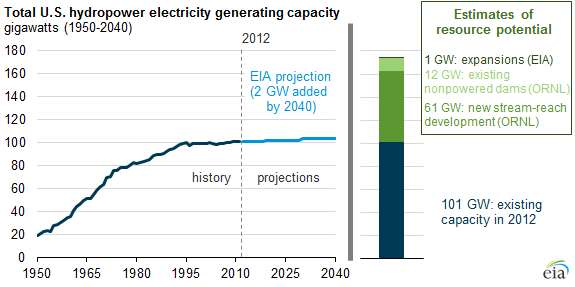
A recent study conducted by Oak Ridge National Laboratory (ORNL) for the U.S. Department of Energy, the New Stream-reach Development Resource Assessment, finds that 61 gigawatts (GW) of hydroelectric power potential exists at waterways without existing dams or diversion facilities. This value excludes Alaska, Hawaii, and federally protected lands. ORNL’s hydropower resource estimates contrast with the 2 GW of additional hydropower capacity projected to be added through 2040 in EIA’s latest Annual Energy Outlook (AEO2014) Reference case. The difference in the two sets of numbers represents the significant gap between technical potential on the one hand and economic and operational potential on the other hand.
ORNL’s assessment used topographical, hydropower, hydrologic, and environmental datasets to assess the energy density at stream reaches (segments), while spatially linking to each stream’s respective ecological, social, cultural, policy, and legal constraints. The report quantified the technical resource capacity available at more than three million U.S. streams, qualifying its findings by saying “the methodology alone does not produce estimates of generation, cost, or potential impacts of sufficient accuracy to determine project-specific feasibility or to justify investments.”
Hydro resource studies typically estimate potential hydropower capacity by resource class: undeveloped sites without dams (new stream reach); existing dams without hydroelectric facilities, or nonpowered dams (NPDs); and existing hydroelectric facilities with potential for additional generating capacity, all included in the chart above. In addition to its current study of undeveloped sites, in 2012 ORNL completed a DOE-sponsored assessment of NPDs. In that report, ORNL estimated that nonpowered dams could contribute as much as 12 GW of additional hydroelectric capacity. In addition to the first two resource classes, EIA’s AEO2014 also considers 1.4 GW of potential from the third resource class—expansion of existing hydroelectric facilities.
Although resource potential quantifies maximum feasible capacity additions, EIA’s AEO2014 Reference case also considers market and policy hurdles that can limit actual development of a new hydroelectric power plant. These include economic factors, performance characteristics, federal regulations, electricity demand, and the cost of competing sources for new generation. Because hydropower is a mature technology, most of the technically and economically superior sites have already been developed.
Current EIA projections do not reflect the recently released data from ORNL. However, the resource assessments for the AEO2014 Reference case do account for new stream-reach development and nonpowered dams potential and overlap between the two datasets is likely. Even though current EIA projections suggest that much of the undeveloped hydro resources may not be economic in the near- or mid-term, the latest ORNL report provides new information to assess the technical potential of hydropower and improve the understanding of resources that can take advantage of new technologies such as in-stream turbines.
5 Comments on "EIA Projections Show Hydro Growth Limited by Economics not Resources"
Makati1 on Fri, 11th Jul 2014 10:04 pm
How many acres of farmland need to be flooded to do this? maybe a few towns or small cities? And will the water still be flowing when the dams are complete? Many unknowns in the EIA’s ‘feel good’ projections.
61 gigawatts = ~.00001% of US electric use.
Norm on Sat, 12th Jul 2014 3:32 am
Hi Makati, just did the math. No opinion, just math.
Had to dig a bit on internet, but it appears total USA electric power generation is 4095 TW*Hr / Yr.
Convert to continuous average watts
= 467 GigaWatts Continuous (that’s a big light bulb).
(Get out of Watt Hours per Year, by dividing by 24 * 365 hours in the year)
= 627 Million Horsepower
That’s a lot of horses.
So the purported 61 GigaWatts (would be equal to 100 really big generators like you see at a large hydro dam)
That is in 2012.
Also, that is about 75.1 Million horsepower.
A fair amount of that, of course, gets used up at my place. :o)
So if you could have another 61 Billion Watts, per this article, that would be about another 13% (not 0.0001%) .
However…. betcha you aren’t gonna get any 61 Billion Watts, with what’s left to dam up. Probably won’t stop them from trying.
…. Entertaining thought, for all the 300 Million clowns in the USA (thx Kunstler) each one uses 2 horsepower electricity generation on average (1500 Watts). Not all of that directly to their house, but if you are including the factories that bake the Cheez Doodles, etc.
Norm on Sat, 12th Jul 2014 3:35 am
Typo’s… Not possible to edit comments on this website. pathetic. Delete ‘75.1 Million horsepower’. I already deleted that sentence before i hit ‘submit comment’ but you get to delete it again.
GregT on Sat, 12th Jul 2014 11:35 am
“EIA Projections Show Hydro Growth Limited by Economics not Resources”
Who would have thunk it? Considering the fact that economics is limited by fossil fuel costs, and growth, it looks like hydro growth is also limited. Not that more electric power generation is going to solve our predicaments anyhow.
Arthur on Sat, 12th Jul 2014 1:45 pm
Most hydro potential, certainly in Europe, has been exhausted. Nevertheless, hydro has gigantic potential, not as an energy source, but as a storage medium for excess renewable energy, generated all over Europe. In Europa, Norway has the most potential to act as Europe’s battery pack. The potential for this kind of storage is even larger in the Rockies, Canada and Alaska.