



The UK’s complex geology will pose challenges for fracking companies wanting to avoid water contamination in some parts of the country, according to the British Geological Survey (BGS).
New maps of underground Britain released by BGS and the Environment Agency show that almost half the area of England and Wales where major drinking water aquifers are located have shale gas deposits below them.
However, the maps also suggest that the vertical distance between the water and the gas is sometimes several kilometres, making water pollution very unlikely.
According to the BGS, the main drinking water aquifers are present across more than 80% of England and Wales, while shales and clays that have the potential for shale gas and oil cover 51% of England and Wales. Areas where the two overlap cover nearly 30% of the total area and are likely to be where development will be most strongly opposed.
The distance between the shale rocks and the water supplies will be critical considerations for the Environment Agency, which will have to assess the likelihood of contamination before giving companies permission to inject chemicals under high pressure to fracture the shale and release gas.
The Bowland shale rock formation in Lancashire, one of the main targets for fracking companies, is nearly 800m below the drinking water aquifer and the chalk aquifer of the South Downs is at least 650m below the uppermost shale oil rocks.
But, says the BGS, in some areas the water and the gas may be much closer. “Even in one region it can vary considerably,” said John Bloomfield, a hydrogeologist with the BGS.

“UK geology is particularly complex. There is enormous diversity on a small island. It’s very different to other places where shale gas has been developed. In the US a lot of the shale is highly continuous; here it is concentrated into tight basins. This offers challenges [in terms of avoiding water contamination] to putative developers,” he said.
Around 27% of the UK population – including London and much of south-east England– gets its drinking water from underground supplies. In the north and west, water supplies come predominantly from surface water.
The BGS also released data showing naturally occurring methane concentrations in UK groundwater. Because methane is many times more powerful as a climate changing gas than carbon dioxide, concerns have been raised about how much could potentially leak in the fracking process, compromising national commitments to reduce emissions.
Concentrations ranged from the practically negligible in southern England to very high in some parts of Lancashire and Cumbria. But, said Bloomfield, the high figures all related to known former landfill sites and other industrial deposits of the gas. “The natural environment is facing many pressures. There was nothing unexpected in the data,” he said.
The data will be used as a reference point by the Environment Agency against which any future changes in groundwater methane concentrations can be measured, he said.
Plantagenet on Fri, 4th Jul 2014 9:52 am
Don’t worry. The NG wells will be cased off where they intersect aquifers.
bobinget on Fri, 4th Jul 2014 10:47 am
If contamination occurs it will make fraccing unprofitable.
rockman on Fri, 4th Jul 2014 11:01 am
“…the vertical distance between the water and the gas is sometimes several kilometres, making water pollution very unlikely.” True in one sense as Plant points out about the protective casing. But not true regarding improper disposal of produced frac fluids. That needs to be monitored closely as I’ve been advising my Yankee cousins for years.
And no…the UK shales aren’t more complex then the US shales. There have hundreds of $millions lost by companies due to “complexity” of our shales. That includes the Eagle Ford and Bakken. Recall the $3+ BILLION Shell Oil spent drilling about 200 EFS wells that had an average INITIAL production rate of just 79 bopd. And the area in he Williston Basin where drilling discovered no Bakken formation was even present let alone productive.
The big increase the in shale drilling and production in the US shouldn’t be interpreted as an indication that it’s “easy”. I don’t drill the shales but I personally know more then a few that do. And it ain’t easy by a long shot. Earlier this week I attended school taught by one of the big direction drilling companies. The great majority in the class were engineers/geologists with one the big EFS players. From their questions I could tell what particular complexity they were struggling with. Just the mechanical aspects are challenging enough without adding the geologic uncertainties.
Plantagenet on Fri, 4th Jul 2014 11:06 am
Its also easy to get around the concern about disposal of fracking fluids. Simply use waterless fracking—it eliminates fracking fluids entirely.
Beery on Fri, 4th Jul 2014 11:11 am
“Don’t worry. The NG wells will be cased off where they intersect aquifers.”
And that casing never fails, right?
bobinget on Fri, 4th Jul 2014 11:15 am
“News of the Warm”
Mammoths Unearthed, National Geographic,
The mammoth business in arctic Russia is certainly wild and, er, woolly. Melting permafrost has provided a bonanza for mammoth-ivory poachers – one decent-sized tusk can be worth a cool $40,000 to whoever pulls it out of the mud, and up to $1 million when carved and sold in China. This eye-opening documentary follows US scientists Trevor Valle and Tim King as they head to where the action is and find a landscape littered with discarded mammoth bones. Valle and King, though, are after mammoth flesh and blood, so they head deep into melting mud caves that could collapse at any moment.
rockman on Fri, 4th Jul 2014 12:17 pm
Beery – No…csg can fail. Just like school buses can crash and kill kids. If you require a risk free world you might want to consider relocating to another planet. LOL.
BTW the majority of historic csg failures have happened in wells that weren’t frac’d. Much more common in high pressure wells that were never frac’d. Again 99% of the contamination risk is from improper/illegal disposal IMHO.
Norm on Fri, 4th Jul 2014 1:42 pm
if the citizens get cancer from the poisoned water supply, they were weak and genetically inferior and they deserved to die. So its not a problem if they poison all the water in the UK with their fracking.
this is just something i did, you should too …….. be sure to watch ‘Gasland II’ on DVD very informative !!
mike on Fri, 4th Jul 2014 1:53 pm
The shale gas and shale oil in the UK is mainly to be found in deep palaeolithic sediments. These have been intensly folded and faulted in the Caledonian and Hercynian orogenuies. The shales are therefore not nice flat strata that can nbe followed by the drillers for several kilometres. The beds dip steeply and suddenly come to an end where the faultlines have displaced the rock sequences. I suspect that it will be very costly to exploit the underground shale deposits, and the yield productivity of most wells will prove to be very disappointing. Cameron has talked blithely of immense reserves of gas that can be exploited to provide copious amounts of cheap cheap cheap gas like in the USA. Cameron has no understanding of geology whatsoever. He has a vision of half England (and I mean England, not the Celtic fringe nations) turned into a pincushion of fracking wells.
Beery on Fri, 4th Jul 2014 3:32 pm
Rockman, the difference is, we need kids to get to school, so the risk is acceptable. We don’t need fracked oil, especially if we’re risking water contamination to get it.
rockman on Fri, 4th Jul 2014 4:09 pm
Beery – So I take it you don’t use oil in your life and thus don’t need it. Lucky you.
rockman on Fri, 4th Jul 2014 4:25 pm
Mike – What you describe could provide great potential in the shales. The most politic fractured reservoir in Texas, much more producible then the Eagle Ford, owed it productivity to the natural fractures caused by structural deformation.
But bottom line: any speculation about the potential, positive or negative, is pointless IMHO. It is a complex dynamic ruled by numerous factors and thus cannot be predicted theoretically.
It has to drilled by numerous wells in multiple areas, produced from 2 to 3 years and then reevaluated. That’s been the history of every fractured reservoir developed on the planet since the beginning of the petroleum age. I see no reason to expect the English shales to follow a different path. At the least it would be good IMHO to find out there’s little to no potential then to think it might provide help one day. If the UK is near the end of its fossil fuel rope it would be good for them to know so they can start making serious societal adjustments.
meld on Fri, 4th Jul 2014 5:43 pm
I personally can’t see the fracking boom lasting very long in the UK, it’s just about to pop in the US and the UK has many many many more issues to contend with like geology and population density. I think a few sites will be fracked, an earthquake will go off or someone’s drinking water will become flammable and that’s the end of that. Somehow I can’t imagine Liverpool or Manchester being too happy with earthquakes and contamination
Beery on Fri, 4th Jul 2014 7:21 pm
Rockman,
The thing is, we’d all be much better off if we used it sparingly.
Personally, I don’t drive, which cuts my oil use down considerably, but I recognize that even though I use far less than most, I still use it.
My point is, we ought to be trying to use as little as possible, because it’s a limited supply. Fracking, in my view, is stupid, especially since there will come a time when we actually NEED that oil. Right now, we merely WANT it, yet we’re more than willing to risk spoiling the environment to get at it.
I realize the fact that you’re an oil guy colors your judgment a bit, but surely even you can see that oil ought to be a resource rather than a toy.
My perspective is colored too, by the fact that, as an Englishman, I love the English countryside. There’s not much of it left, and unlike the USA, England is a little country.
Makati1 on Fri, 4th Jul 2014 8:44 pm
Fraking should be stopped today. That is the fact. The fiction is all the “positive” BS propaganda by big oil. “Smoking is not dangerous!” The tobacco industry thought it was too profitable to be controlled also.
And, yes, rockman, we should stop destroying the planet and ourselves in the name of BAU. When is the best time? About 40 years ago. Every day we continue, is another nail on our coffin as a species. Stupid is as stupid does, in the name of greed.
Northwest Resident on Sat, 5th Jul 2014 11:25 am
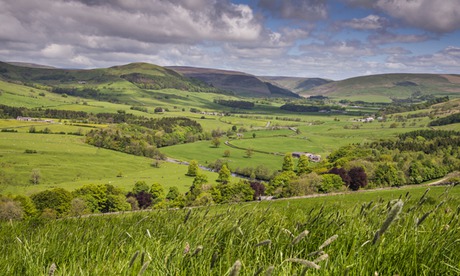
Look at the nice pretty picture of the green countryside posted with this article. Then look at the picture posted with the article just above this one on the main page titled “USA Biggest Oil Producer After Overtaking Saudi Arabia”. That picture is what the “after picture” of the one posted with this article will look like if TPTB get their way. In fact, that’s what the surface of a large portion of the entire plant will look like if we carry BAU to its “logical” conclusion.
Folks, when does the madness end? When do we just admit that the only way to carry on with our current lifestyles is to destroy so much that was once green and natural and capable of supporting life?
rockman on Sat, 5th Jul 2014 2:28 pm
Beery – I fully agree: conservation is our best, or more importantly immediate, method to offset the PO dynamic. And we all suffer from NIMBYism to a degree. Forgetting what I do for a living what should my attitude be towards drilling in the Gulf of México where BITISH COMPANY dumped millions of bbls of oil on MY SHORELINE? OK…no frac’ng in the UK or in our Northern states. Fine…and to reciprocated we’ll stop producing oil offshore GOM and N. Sea where both our countries get a significant portion of our energy. Would that be acceptable trade for you? And what about the horrible environmental damage done in Nigeria from oil field activity? Nigeria, the second largest source of UK imported oil. Are you as concerned about their environment then yours?
Let’s consider the UK’s NG situation. Britain’s natural gas imports from outside the North Sea will surpass domestic production by 2015. So would you be opposed to any of that imported NG coming from frac’d wells?
My questions are as unfair as they are uncomfortable. But they are the questions that can be rightfully asked of 99% of the global population. And while I’ll always give credit to those like your who minimizes their fossil fuel footprint they are still using some fossil fuels. The extraction of which is risking someone else’s environment somewhere.
And to tease you about my silly school bus analogy: no…we don’t need to put kids in school buses (that don’t require seat belts). It’s done for the convenience of the parents. But if one VOLUNTRIALLY puts their kid in a school bus someone like me will have to drill a well, and maybe frac it, to produce the fuel to run that bus. LOL.
With respect to fossil fuel consumption we’re all pregnant…just some more pregnant then others.
Lyn swan on Sun, 11th Jan 2015 9:45 am
Plantagenet, do you know that the only frack carried out so far in UK, four years ago at Preese Hall, has left us with a cracked well which is Still leaking?
Lyn swan on Sun, 11th Jan 2015 9:46 am
Sorry. I meant rockman!
Bert on Wed, 14th Oct 2020 10:33 am
fantastic issues altogether, you just won a brand new
reader. What would you recommend in regards to
your put up that you simply made a few days in the past?
Any positive?