
Peak Oil is You

Donate Bitcoins ;-) or Paypal :-)


Page added on June 2, 2014

If we can’t change our economic system, our number’s up
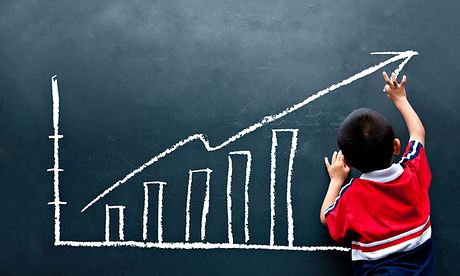
It’s the great taboo of our age – and the inability to discuss the pursuit of perpetual growth will prove humanity’s undoing
Let us imagine that in 3030BC the total possessions of the people of Egypt filled one cubic metre. Let us propose that these possessions grew by 4.5% a year. How big would that stash have been by the Battle of Actium in 30BC? This is the calculation performed by the investment banker Jeremy Grantham.
Go on, take a guess. Ten times the size of the pyramids? All the sand in the Sahara? The Atlantic ocean? The volume of the planet? A little more? It’s 2.5 billion billion solar systems. It does not take you long, pondering this outcome, to reach the paradoxical position that salvation lies in collapse.
To succeed is to destroy ourselves. To fail is to destroy ourselves. That is the bind we have created. Ignore if you must climate change, biodiversity collapse, the depletion of water, soil, minerals, oil; even if all these issues miraculously vanished, the mathematics of compound growth make continuity impossible.
Economic growth is an artefact of the use of fossil fuels. Before large amounts of coal were extracted, every upswing in industrial production would be met with a downswing in agricultural production, as the charcoal or horse power required by industry reduced the land available for growing food. Every prior industrial revolution collapsed, as growth could not be sustained. But coal broke this cycle and enabled – for a few hundred years – the phenomenon we now call sustained growth.
It was neither capitalism nor communism that made possible the progress and pathologies (total war, the unprecedented concentration of global wealth, planetary destruction) of the modern age. It was coal, followed by oil and gas. The meta-trend, the mother narrative, is carbon-fuelled expansion. Our ideologies are mere subplots. Now, with the accessible reserves exhausted, we must ransack the hidden corners of the planet to sustain our impossible proposition.
On Friday, a few days after scientists announced that the collapse of the west Antarctic ice sheet is now inevitable, the Ecuadorean government decided to allow oil drilling in the heart of the Yasuni national park. It had made an offer to other governments: if they gave it half the value of the oil in that part of the park, it would leave the stuff in the ground. You could see this as either blackmail or fair trade. Ecuador is poor, its oil deposits are rich. Why, the government argued, should it leave them untouched without compensation when everyone else is drilling down to the inner circle of hell? It asked for $3.6bn and received $13m. The result is that Petroamazonas, a company with a colourful record of destruction and spills, will now enter one of the most biodiverse places on the planet, in which a hectare of rainforest is said to contain more species than exist in the entire continent of North America.
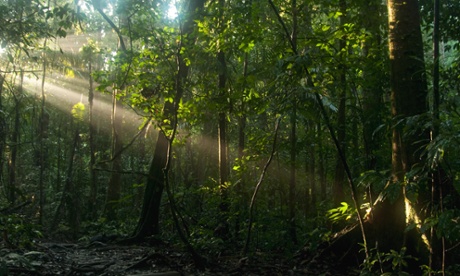 Yasuni national park. Murray Cooper/Minden Pictures/Corbis
The UK oil firm Soco is now hoping to penetrate Africa’s oldest national park, Virunga, in the Democratic Republic of Congo; one of the last strongholds of the mountain gorilla and the okapi, of chimpanzees and forest elephants. In Britain, where a possible 4.4 billion barrels of shale oil has just been identified in the south-east, the government fantasises about turning the leafy suburbs into a new Niger delta. To this end it’s changing the trespass laws to enable drilling without consent and offering lavish bribes to local people. These new reserves solve nothing. They do not end our hunger for resources; they exacerbate it.
The trajectory of compound growth shows that the scouring of the planet has only just begun. As the volume of the global economy expands, everywhere that contains something concentrated, unusual, precious, will be sought out and exploited, its resources extracted and dispersed, the world’s diverse and differentiated marvels reduced to the same grey stubble.
Some people try to solve the impossible equation with the myth of dematerialisation: the claim that as processes become more efficient and gadgets are miniaturised, we use, in aggregate, fewer materials. There is no sign that this is happening. Iron ore production has risen 180% in 10 years. The trade body Forest Industries tells us that “global paper consumption is at a record high level and it will continue to grow”. If, in the digital age, we won’t reduce even our consumption of paper, what hope is there for other commodities?
Look at the lives of the super-rich, who set the pace for global consumption. Are their yachts getting smaller? Their houses? Their artworks? Their purchase of rare woods, rare fish, rare stone? Those with the means buy ever bigger houses to store the growing stash of stuff they will not live long enough to use. By unremarked accretions, ever more of the surface of the planet is used to extract, manufacture and store things we don’t need. Perhaps it’s unsurprising that fantasies about colonising space – which tell us we can export our problems instead of solving them – have resurfaced.
As the philosopher Michael Rowan points out, the inevitabilities of compound growth mean that if last year’s predicted global growth rate for 2014 (3.1%) is sustained, even if we miraculously reduced the consumption of raw materials by 90%, we delay the inevitable by just 75 years. Efficiency solves nothing while growth continues.
The inescapable failure of a society built upon growth and its destruction of the Earth’s living systems are the overwhelming facts of our existence. As a result, they are mentioned almost nowhere. They are the 21st century’s great taboo, the subjects guaranteed to alienate your friends and neighbours. We live as if trapped inside a Sunday supplement: obsessed with fame, fashion and the three dreary staples of middle-class conversation: recipes, renovations and resorts. Anything but the topic that demands our attention.
Statements of the bleeding obvious, the outcomes of basic arithmetic, are treated as exotic and unpardonable distractions, while the impossible proposition by which we live is regarded as so sane and normal and unremarkable that it isn’t worthy of mention. That’s how you measure the depth of this problem: by our inability even to discuss it.
21 Comments on "If we can’t change our economic system, our number’s up"
Plantagenet on Mon, 2nd Jun 2014 5:37 pm
This writer is delusional—Far from being “taboo” People discuss the environmental problems that come with economic growth all the time. In fact, considerable thought and effort is going into smart growth, that would minimize ecologic impacts of continued economic growth
energy investor on Mon, 2nd Jun 2014 6:01 pm
No Plantagenet. Some people discuss it but the folk in power ignore the dialogue. Technology will solve all – or so they say.
Yeah, right.
Smart growth is simply a euphemism for saying, “let’s be more careful how we plunder the planet’s resources”.
Like Pacific islanders who ignore the rubbish mounting up on their windward beaches and throw away all of their rubbish on the leeward beaches for it to be carried away to become someone else’s problem.
At most, the industrial age of oil will end within the next 20 years. Won’t that be fun.
But Plantagenet, you can console yourself that we at least built more fuel efficient cars along the way.
Shaved Monkey on Mon, 2nd Jun 2014 6:06 pm
Apparently is possible to have exponential growth on a finite planet we just have to service each other and don’t get hungry and thirsty or crave anything material, that requires resources or takes away our ability to pay for the servicing.
HARM on Mon, 2nd Jun 2014 6:13 pm
“Far from being “taboo” People discuss the environmental problems that come with economic growth all the time.”
You and I must inhabit different planets then. The only places where this subject is NOT taboo is in select forums like Peak Oil and Automatic Earth (~0.000001% of the population). Aside from the rare blurb about the world population adding another billion, the MSM and politicians basically ignore population and growth issues, or actively CHEER growth in all forms (watch CNBC, Bloomberg, Fox, or watch any political speech).
Plantagenet on Mon, 2nd Jun 2014 6:24 pm
@energy investor
You are welcome to keep driving your oil-guzzline climate destroying clunker if you want to, but more and more people will be switching to energy efficient green cars and mass transportation all around you.
@HARM
I suggest you turn off your TV and try reading a book or going to a university or a scientific conference. You’ll find that environmental problems and economic growth are a common topic of study and discussion among thoughtful people.
Yeti on Mon, 2nd Jun 2014 7:52 pm
Plant, it didn’t seem like energy investor was advocating the right to drive his/her hummer over baby sea lions.
And this “discussion” you speak of; hasn’t “it” been going on for decades amongst “thoughtful people”. As we slowly decline, which side of the argument is going to catch more members, “Let’s stop fucking things up!” or “I don’t care if it’s the last fish, me hungry!”
Makati1 on Mon, 2nd Jun 2014 8:55 pm
There is more discussion on last nights TV shows than on any serious global problem. Always has been and will always be so until the TV no longer works. THEN there will be questions why and the finger of blame will point to someone else.
Plantagenet on Mon, 2nd Jun 2014 9:55 pm
Makati1 is right. Folks who complain about various topics being “taboo” and never discussed should stop watching TV and plug into the very active discussions of this very topic going on in the academic, environmental, econonomic, scientiic, and, yes, business communities.
antaris on Mon, 2nd Jun 2014 11:11 pm
Plant
I try to talk with normal people about subjects discussed here. Nobody has any idea or could care to listen. The vast majority of the population look no further than what affects them right now.
It is like the native thinking, why do I need to go work tomorrow, I still have a dollar in my pocket.
Northwest Resident on Mon, 2nd Jun 2014 11:31 pm
Plantagenet — You are correct I believe that there is a nearly constant discussion about environmental topics going on in government, academic and business communities. The volume of discussion, research, findings and opinions could fill a hard drive. Many laws have been passed to further the cause of environmental concerns. The problem is, what has been done and what might still get done is not enough, nowhere close. It is a lot of talk, but entrenched interests with big bucks on the line and an army of lobbyists at their disposal put up insurmountable obstacles. Capitalism and economic growth is all about plundering God’s green earth for riches. When the plundering stops, the global economy and life as we know it will come to an end. The only thing that keeps the economic world spinning these days is more plundering. The fact that there is increasingly less and less to plunder means that eventually, we will see the end. I’m one of those who think there is a good chance that the end is not very far down the road. Fact is, the end would come tomorrow if the governments stopped pumping billion$ into existence, growing the already unsustainable debts by substantial amounts monthly. It can’t go on forever.
J-Gav on Tue, 3rd Jun 2014 5:58 am
Monbiot is only stating what has been obvious for some time now – although a substantial majority prefers to remain comfortably in denial on the subject.
And of course, even radically changing the economic paradigm would only be a beginning toward dealing with the favrious crises we face. It would still be a beginning though, and might give give impetus to further action on other fronts.
The likelihood of accelerating transition efforts in the ‘critical window’ time-frame we still have, is debatable. But in present circumstances, giving it an even 50-50 chance would look quite optimistic.
Meld on Tue, 3rd Jun 2014 8:59 am
@ Plant – How does smart growth work?
Peter Vesborg on Tue, 3rd Jun 2014 10:40 am
To understand the “paradox” of why every “responsible” politician wants growth at all costs, one must understand the nature of our monetary system.
The depressing fact is that every dollar,yen,euro, renminbi,… in circulation (not just cash – all bank “deposits” included) have at some point been created as a double-entry accounting operation: The money (the asset) is matched 1:1 by debt (the corresponding liability).
And debt bears *interest*.
That means that ALL money in circulation in effect bears intrest- and therefore the economy must in the long run expand at whatever the (real) interest rate is. Thus the economy *must* grow exponentially (as compound interest) for the current system to remain solvent.
Non-growth (steady-state economy) is impossible under this monetary system. So really, the people “in power” have no choice – its either growth to infinity (global destruction) or economic depression to zero for the economy (global dieoff). There is no steady state.
–
In order to stand *any* chance of getting to some kind of steady state economy, we need to reinvent our monetary system. Full stop.
No other issue is important until we are off interet-bearing debt-money. We need an iterest-free medium of exchange.
Plenty of options and technologies are available to us. All that is needed is knowledge of the nature of the problem – and that is why it won’t happen.
Juan Pueblo on Tue, 3rd Jun 2014 11:18 am
I almost never talk to normal people as a rule unless necessary. And I never ever talk with them about reversing population and economic growth. I haven’t for more than 20 years. These subjects are beyond most people’s understanding.
I don’t always agree with Monbiot, but I agree with him in that these subjects are considered taboo in polite conversation in the places I’ve lived and travelled to amongst higher and middle classes. I admit I don’t have much experience interacting with the poor, but I’ve found them to be more honest and sincere, in general, when I do interact with them.
GregT on Tue, 3rd Jun 2014 11:56 am
Plant said,
“In fact, considerable thought and effort is going into smart growth, that would minimize ecologic impacts of continued economic growth”
??????
Minimizing ecologic impacts, is still adding to ecologic impacts, not ending them. As many are accumulative, further growth only causes more impacts, one of which happens to be extinction of life.
There is either sustainability, or there is not. There is no middle ground. Infinite growth in a finite environment is not sustainable, or even possible. Smart growth, in this context, is an oxymoron.
Davy, Hermann, MO on Tue, 3rd Jun 2014 12:29 pm
Smart growth is forced sterilization, mass car retirement, mega Walmart mothballing.
poaecdotcom on Tue, 3rd Jun 2014 12:33 pm
“smart growth, that would minimize ecologic impacts of continued economic growth”
You can minimize impacts BUT economic growth requires INCREASING net energy. A direct extrapolation of the Second Law.
Makati1 on Tue, 3rd Jun 2014 7:43 pm
Peter, that is a very good explanation of why continued growth is not possible in a finite world. The bacteria increase until they run out of food…
Northwest Resident on Tue, 3rd Jun 2014 8:56 pm
Peter — I second Makati1’s comment. Excellent explanation. No steady state. Grow or die. End of story. Problem is, to grow the economy, you need real assets and lots and lots of oil. The real assets have been almost entirely plundered already — the bone has been picked dry. And instead of lots of oil, we barely have enough to hold the line, and that’s with purposeful demand destruction policies in place. We’re creeping toward inevitable shutdown of this version of human civilization. It’s inevitable.
Pops on Wed, 4th Jun 2014 8:05 am
I got carried away so I started a thread
http://peakoil.com/forums/the-fallacy-of-growth-t69841.html
J-Gav on Wed, 4th Jun 2014 3:58 pm
Yeah, Pops, growth in the present economic paradigm is like a cancerous tumor. As long as the notion of ‘growth’ fails to include things like community spirit, individual and collective creativity, connection with nature, spirituality as opposed to religion … (I could go on), it can only become increasingly meaningless.