
Peak Oil is You

Donate Bitcoins ;-) or Paypal :-)


Page added on May 23, 2014

U.S. faces higher food price inflation in 2014
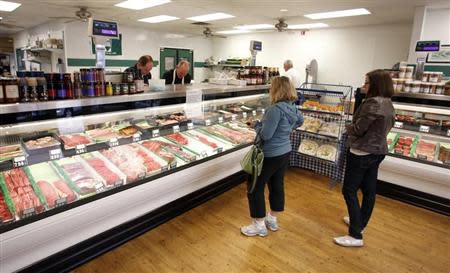
The severe drought in California could have a lasting effect on U.S. fruit, dairy and egg prices, while prices for meats, especially beef, look likely to continue climbing, the U.S. Department of Agriculture said on Friday.
The agency said overall U.S. food price inflation for 2014, including food bought at grocery stores and food bought at restaurants, would rise by 2.5 percent to 3.5 percent in 2014.
That is up from 2013, when retail food prices were almost flat, but in line with historical norms.
“The food-at-home consumer price index (CPI) has already increased more in the first four months of 2014 then it did in all of 2013,” USDA said.
It said the California drought “could potentially have large and lasting effects on fruit, vegetable, dairy and egg prices.” The most populous U.S. state is in its third year of what officials are calling a catastrophic drought.
The upcoming Memorial Day holiday weekend marks the unofficial start of the summer grilling season, and USDA said home chefs will face sticker shock.
Beef and veal prices, already at record highs, are forecast to increase by 5.5 percent to 6.5 percent and pork prices to rise by 3 percent to 4 percent.
Both forecasts were raised in the latest report. The beef and veal CPI is up almost 10 percent so far in 2014.
“The drought in Texas and Oklahoma has worsened somewhat in the last month, providing further complications to the beef production industry,” USDA said.
A major factor for rising pork prices is the Porcine Epidemic Diarrhea Virus (PEDv), responsible for more than 7 million U.S. piglet deaths in the past year.
Sweets lovers and caffeine addicts will see some relief, however, since global prices for sugar and coffee remain low.
The agency forecast sugar and sweets prices to rise by 1 percent to 2 percent in 2014 and prices for non-alcoholic beverages to rise by 1.5 percent to 2.5 percent.
“It appears supermarkets are maintaining minimal price inflation on packaged food products, possibly in an effort to keep prices competitive in light of rising cost pressures for most perishable items,” USDA said.
24 Comments on "U.S. faces higher food price inflation in 2014"
Plantagenet on Fri, 23rd May 2014 11:35 am
Looks like the Obama administration and the FED are succeeding in their plan to increase inflation.
Northwest Resident on Fri, 23rd May 2014 12:19 pm
Plantagenet — So you are saying that disease and drought combined with increasing demand for food products from a rapidly expanding worldwide population has nothing to do with the inflation — it is all the fault of the Obama admin and the FED?
Are you literally that stupid, Plantagent, or are you just mentally disturbed with an insatiable lust for blaming Obama for anything and everything. Does blaming Obama get you off, or what? Plant, you’re a very sickly strange and completely irrelevant voice on this posting board, specializing in idiotic comments like the one above. Who ARE you?
paulo1 on Fri, 23rd May 2014 1:45 pm
I thought he was making a joke. It was a joke, wasn’t it?
Paulo
Beery on Fri, 23rd May 2014 1:54 pm
Sadly, he’s not joking.
northwestresident on Fri, 23rd May 2014 2:17 pm
paulo1 — He’s not joking. That is a typical clueless post from Plantagenet. If you pull Plant’s string, it is pretty much a guarantee that the first word out of his mouth will be “Obama” — and the rest will be whatever the problem is that Obama is personally responsible for causing. The world, according to Plant.
J-Gav on Fri, 23rd May 2014 4:37 pm
In any case, water and food do kinda go together, one way or another. And if the severe drought conditions in CA, etc persist, the U.S. is likely to get a taste of what that means for the average Joe’s wallet sooner rather than later.
ezrydermike on Fri, 23rd May 2014 5:38 pm
it’s called ODS. Obama Derangement Syndrome. Blaming anything and everything on Obama due to his incompetence, while at the same time, blaming anything and everything on Obama due to his competence.
Unfortunately it is a very common malady. Some of the early and persistent symptoms was to attribute Obama as a communist/socialist, soft on immigration and/or soft on national security, while he was in fact feeding the corporate state with the ACA, not significantly going after financial criminals, carrying out massive deportations and continuing to spread the US MIC throughout the world.
GregT on Fri, 23rd May 2014 6:07 pm
” if the severe drought conditions in CA, etc persist, the U.S. is likely to get a taste of what that means for the average Joe’s wallet sooner rather than later.”
Too late for that J-Gav, the average Joe’s wallet has already been affected dramatically. Not just in the US, but here in Canada as well. Much of our produce in BC comes from California, and prices have already been skyrocketing for the past 2 years. If the drought continues, we are looking at shortages, not just further increases.
GregT on Fri, 23rd May 2014 6:10 pm
Also,
We are seeing more and more of our produce, being imported from China.
RICHARD RALPH ROEHL on Fri, 23rd May 2014 7:01 pm
The California drought is only one factor in the rising price of food. A bigger factor, however, is the collapsing value of the dollar (a.k.a.: the petro-dollar or Federal Zionist Reserve Note).
Faster poo-food Amerikans should prepare for radical fundamental changes in their day to day lifestyle… beginning with gasoline prices matching what Europeans are now paying.
Makati1 on Fri, 23rd May 2014 7:39 pm
Higher prices per pound/dozen/container.
Smaller amounts in the same sized container.
Smaller containers with smaller amounts.
Etc. Mostly go unnoticed if you so not read the labels.
I recently went back to the States to visit and had major sticker shock. I bought some things for a family cookout in the grocery store and did not even begin to fill the cart. My total was over $200! That would buy ALL of my groceries for a month in Manila. I thought the prices in Manila for imports were high, but they are about the same as shelf items in the US.
The US food inflation rate has to be over 10% per year, not the 3.5% stated above.
farmlad on Fri, 23rd May 2014 9:37 pm
I don’t buy a lot of groceries in stores and i’m not one of them guys that remembers prices but 15 years ago $100 bought kinda what $200 does today so like maybe 5% inflation per year. but iv’e experienced the most sticker shocks in the last 2 years or so.
northwestresident on Fri, 23rd May 2014 10:56 pm
ezrydermike — I hear you. America voted for hope and change. Well, they’re getting change, maybe just not the type that was expected. Hope, not so much. All and all, I think Obama is doing a pretty good job of keeping up appearances, appearing more or less noble and wise as he steers the good ship USA through the increasingly stormy waters of finance and energy realities. But Obama is just the captain, and the admirals are giving him orders that he must follow. That would be true with any president today. Where are they taking us, that is the mystery.
Davy, Hermann, MO on Sat, 24th May 2014 1:14 am
Mak spare me how bad the US is and how great the Philippians is. I don’t buy the grocery comparison. Food is fungible and global commodity so unless there is significant food subsidies the costs are in aggregate very similar globally. Here is your inflation figures:
The inflation rate in Philippines was recorded at 4.10 percent in April of 2014. Inflation Rate in Philippines averaged 8.91 Percent from 1958 …
The inflation rate in the United States was recorded at 2 percent in April of 2014. Inflation Rate in the United States averaged 3.33 Percent from 1914 until 2014.
MKohnen on Sat, 24th May 2014 1:52 am
You know, this sounds like blaming lack-luster GDP performance on a cold winter. Yes, no doubt some of the price increase is from drought. But if you check out this site:
http://www.cattlerange.com/cattle-graphs/all-cattle-numbers.html
you’ll see that US beef production is only down by 1.7%. So what? In farming, that kind of variation is perfectly natural. Yet cattle prices are sky-rocketing. Last I heard, feeders were at almost $2.00/lb, and in some auctions they were going for more than that! Consider that last year feeders were going at approx. $1.00/lb. There is no way a drop of 1.7% accounts for that! I’m suspecting that the Fed is getting the inflation they were looking for, but in exactly the place they didn’t want to see it. They were hoping the inflation would stick to the stock market or migrate back into real estate. But having inflation show up in food is bad, bad, bad.
Meld on Sat, 24th May 2014 2:12 am
Plant is one of these people that blames others for all their problems. Probably has parent issues.
GregT on Sat, 24th May 2014 9:57 am
MK,
Monetary inflation is a planned policy by the FED. By simply increasing the supply of money, every dollar in existence becomes worth less.
Price inflation is caused by many different factors such as supply and demand, or energy costs.
The two are often thought of as one, but in reality they are two very different things.
http://www.thedailybell.com/definitions/params/id/1892/
penury on Sat, 24th May 2014 3:28 pm
U.S inflation is computed minus food and energy. Hedonic adjustments take care of a lot of other inflation. The Fed says inflation is not measured by price increases but, the velocity of money. So when reading CPI and checking what you pay remember this does not correlate with .gov figures. Even the Chicago fed had to admit that the price increase in their cafeteria just announced was because food ingredient costs have been increasing at 3 per cent plus. Remember there are lies, damn lies, and statistics
GregT on Sat, 24th May 2014 3:54 pm
CPI, and monetary inflation are two entirely different things. When the USD was pegged to gold it was not possible to inflate the currency. Since 1971 when Nixon slammed shut the gold window, the US dollar has been inflated through monetary policy, and has lost over 90% of it’s worth.
“In August of 1971, Nixon slammed shut the gold window, cancelled the U.S. commitment to redeem dollars for gold, let the dollar float, and imposed a 10 percent across-the-board-tariff. “Nixon shock!” said the stunned Japanese.
The dam broke. After the dollar was cut loose from gold, the price of gold shot to as high as $800 an ounce in a decade. Bretton Woods was dead. Speculators who had bet against the dollar and against the American credibility in defending its currency were hugely rewarded.”
Source: Where The Right Went Wrong, by Pat Buchanan, p.200 , Aug 12, 2004
wildbourgman on Sat, 24th May 2014 4:28 pm
How about the riddle, take a quarter from 1960 and you could buy a gallon of gas, now take that same quarter from 1960 and you can still buy a gallon of gas.
There was food inflation before the drought now the drought certainly is going to make it much worse.
Thank goodness they don’t count food and energy in the CPI!
GregT on Sat, 24th May 2014 4:44 pm
Wild,
That quarter in 1960 was made out of silver. In 1960, 1 ounce of silver would buy 87 cents in US dollars, that exact same ounce of silver today, will buy you 20 US dollars. It isn’t the ounce of silver that has changed, it is the worth of the dollar.
GregT on Sat, 24th May 2014 4:52 pm
Also,
The silver content in that 1960 quarter, is worth $3.52 US today, or very close to the current price of a gallon of gas.
wildbourgman on Sat, 24th May 2014 7:32 pm
I know it’s real close GregT, I’m pretty sure a bunch of commodity charts from 1970 until now have the same look to them.
GregT on Sat, 24th May 2014 8:21 pm
Precisely the reason that nations around the world are demanding a new ‘reserve’ currency. Monetary inflation is a hidden tax. Anyone using the USD is being taxed for the sole benefit of the USA. The USD is not a stable currency, like it was when it was pegged to gold.