



“It’s always amazing when a United Nations report that has global ramifications comes out with little fanfare.” So starts an article in Forbes talking about the most recent UNSCEAR report on the consequences of the Fukushima accident in Japan. Three years after the accident, UNSCEAR, the United Nations body mandated to assess and report levels and effects of exposure to ionizing radiation has reported and its result could not be more clear. “The doses to the general public, both those incurred during the first year and estimated for their lifetimes, are generally low or very low. No discernible increased incidence of radiation-related health effects are expected among exposed members of the public or their descendants.”
This result is in stark contrast to a number of more recent accidents in other industries, all with a large number of fatalities. Whether it is a plane lost in Malaysia, a ferry sinking in Korea, an oil explosion in Quebec; the list goes on. Unfortunately there is no shortage of examples of terrible accidents resulting in loss of life. And yet, in comparison to these many tragic events, it continues to be nuclear accidents that many people fear the most.
But the reality is quite different. When it comes to nuclear power, we have now seen that even in the worst of the worst nuclear accidents (Chernobyl and Fukushima), we can protect people and minimize fatalities from radiation. In other words, the decades old belief that nuclear accidents are very low probability but exceptionally high consequence; effectively resulting in the end of the world as we know it (i.e the doomsday scenario), is just not the case.
For those that have been reading my blog for a while, it was about a year ago that I wrote about the need for a new paradigm to communicating the risks and benefits of nuclear power for the future with an emphasis on refining the message to reflect current reality. The message on safety should be:
- The risk of a nuclear accident is very low and is always getting even lower
- In the event of an accident the risk of releasing radiation to the environment is also very low; and
- Even in the unlikely event that radiation is released, the public’s health and safety can be protected.
Of course, this does not mean we should become complacent. Certainly the industry is doing the right things to make sure a similar accident cannot happen again. Many improvements have been made in plants around the world to both reduce the risk of an accident and in the event of a severe accident, reduce the risk of radioactive releases.
For example, here in Canada, we have broadened our safety objective to “Practically eliminate the potential for societal disruption due to a nuclear incident by maintaining multiple and flexible barriers to severe event progression”. Setting societal disruption as the measure is definitely something new as move forward post Fukushima.
As an industry, we are excellent at learning from every event and making improvements to reduce the risk of a similar event in the future. The global nuclear industry should be proud of its unwavering commitment to safety.
But that being said, while making technical improvements and reducing the risk of future accidents is essential; unfortunately this will be unlikely to result in the public feeling safer. I would argue that in general, the public already believe the risk of an accident is low – the problem is they also believe the consequence of an accident is unacceptably high. So no matter how low we make the probability, they will remain afraid of the consequences. In other words, as we continue to talk about improving technology to reduce risk; we need to enhance the discussion to talk about people and how to both keep them safe (the easy part); and of even more importance, feel safe (now here is the challenge).
Therefore an important lesson from Fukishima, is that accidents, however unlikely are indeed possible. And it is because of the perceived consequence of an accident that the public continues to be afraid. In fact, fear is an understatement. We know that nuclear accidents cause not only fear but outright panic. And this panic is not limited to people in the immediate area of the plant but is experienced by people all over the world. Not a week goes by when there is not some news item on how radiation from Fukushima is about to land on the North American west coast. While there is little risk of any radiation issue, to the public, it continues to stoke fear.
So now that we know that there is little to no health impact from radiation after Fukushima, does that mean the discussion is over? No, the next step is to address the real health consequence of a nuclear accident – mental and social well-being. Fear of radiation is a complex issue. While people will happily accept significant doses of medical radiation as they believe (quite rightly so) this will improve their health, they remain terrified of radiation from sources such as nuclear power plants.
In their report UNSCEAR noted, “The most important health effect is on mental and social well-being, related to the enormous impact of the earthquake, tsunami and nuclear accident, and the fear and stigma related to the perceived risk of exposure to ionizing radiation. Effects such as depression and post-traumatic stress symptoms have already been reported. “
They continue, “The evacuations greatly reduced (by up to a factor of 10) the levels of exposure that would otherwise have been received by those living in those areas. However, the evacuations themselves also had repercussions for the people involved, including a number of evacuation-related deaths and the subsequent impact on mental and social well-being (for example, because evacuees were separated from their homes and familiar surroundings, and many lost their livelihoods).“
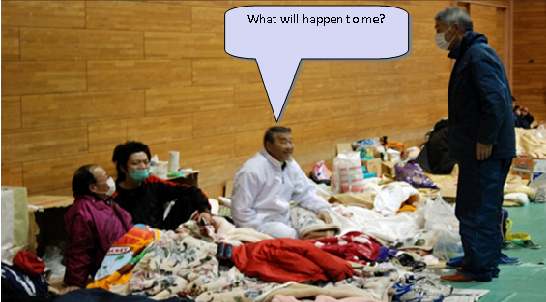
And this is where we need to do more. Once we accept that even after implementing our best efforts, there may well be another accident someday, there needs to be increased focus on accident management and recovery. This means clear guidelines on when to evacuate, what is required to remediate a contaminated area and when it is safe to go home again. A huge source of fear is the unknown and after a nuclear accident, people impacted are very worried about their futures. They want to know – will I get sick, how about my children and grandchildren – can I go home again – and if so when? And basically how and when will I be able to resume my normal life?
UNSCEAR noted that “estimation of the occurrence and severity of such health effects are outside the Committee’s remit”. Given these are important and significant health impacts; it is time for the industry to take action. As an industry we have long been leaders in industrial safety. Now we have the opportunity to be leaders in post-accident recovery psychological research. We need new research to better understand the impact to people in affected areas following nuclear accidents so we can better plan how to reduce their fear and indeed, have a happy and healthy future. This will lead to better decisions following events based on science rather than short term fear issues. It is important to understand that protecting people means much more than emergency planning to get them out of harm’s way when an accident happens. It also means meeting their needs right up until they can resume their normal lives.
The most important lesson from Fukushima is not technical. Of course we will learn how to avoid similar accidents in the future and make plants safer. But if we really want to change the dialogue and increase public support for the industry, we must also recognize the future is all about people – building confidence and reducing fear.
GregT on Thu, 15th May 2014 3:29 pm
The most important lessons from Fukishima should be, to stop screwing around with things that we don’t fully understand, and have no solutions for long term mitigation.
J-Gav on Thu, 15th May 2014 3:31 pm
“Increase public support for the industry.” That’s the nuclear industry. Who is this clown if not a shill?
Other studies have come out pointing to a marked increase in thyroid disorders, already including cancer cases, among children in the most-affected area. Those who “feel safe” with nuclear should all go live within 50 miles of a plant.
dsnthefuture on Thu, 15th May 2014 3:43 pm
I thought the reactors have been leaking 300 tons of radioactive water daily? lol
I don’t think they even know where the cores are for reactor 2 & 3, robots get their circuits fried from the radiation inside the building.
reactor 4 spent fuel pool has more ionizing radiation than 10,000 hiroshima bombs or something obscene like that, if it collapses they have to abandon the site. It’s been through an earthquake, a tsunami, a hydrogen explosion, and now the ground under it is turning into mud.
you increase the background radiation levels you mess with the gene-pool, it messes with our habitat gets concentrated in certain organisms like tuna&&humans
created a toxic water boiler to try and preserve our ungodly life-style
dsnthefuture on Thu, 15th May 2014 3:49 pm
also, I’ve been hearing that if grid goes off-line from some sort of collapse diesel generators can keep reactors cool for 2-weeks and then they’ll start melting down. Normally they take over a decade to decommission.
I think we have something like 450 of them around the world, lol
penury on Thu, 15th May 2014 4:19 pm
Liars lie, shills, shill it is ever thus. The question I suppose is why the Canadian government and the U.S. government will not test seafood or allow others to test for radiation? Check the latest from Hanford every thing is wonderful.
Plantagenet on Thu, 15th May 2014 4:24 pm
I see the anti-science crowd is out again. Heaven forbid anyone should look at the actual data—-it detracts from the hysterics of the anti-science crowd!!
J-Gav on Thu, 15th May 2014 4:38 pm
Plant – Hyper-ventilating can be dangerous to your health …
“I fucking love science” is the actual name of a site I check regularly – whether it’s botany, primatology, ornithology, astronomy, mycology, marine ecology etc. – I always find something of interest. So putting me on your anti-science list comes up a bit short, wouldn’t you say? If, on the other hand, you want to make an anti-miracle list, go ahead and put me right at the top.
GregT on Thu, 15th May 2014 7:42 pm
Plant,
Even one of the greatest scientists to ever live, Einstein himself said; “It’s one hell of a way to boil water.”
On nuclear energy he said;
“The release of atomic energy has not created a new problem. It has merely made more urgent the necessary solving of an existing one. One could say it has affected us quantitatively, not qualitatively.”
And on applying science;
“Why does this magnificent applied science which saves work and makes life easier bring us so little happiness? The simple answer runs: Because we have not yet learned to make sensible use of it. In war it serves that we may poison and mutilate each other. In peace it has made our lives hurried and uncertain.”
DMyers on Thu, 15th May 2014 8:13 pm
If we’re going to be scientific about this, then we first have to note that there is far too little information and far too much propaganda to draw any informed conclusions. But even without consideration to the lack of full and truthful, on the ground, data, time itself is a crucial factor in knowing what the current releases of radioactivity will cause.
For the moment, we’re like the guy who jumped off the top of a thirty story building and half way to the bottom thought to himself, “everything seems okay, so far.” Our astute journalists are reminding us that our skin isn’t falling off, and that radiation can in some cases kill cancer, so it must actually be good for us (yes, Ann Coulter said that). All the kids getting cancer are somebody else’s, and there can never be too much radiation, because all the government has to do is adjust “acceptably safe levels,” and any level you want can be made safe.
GregT on Thu, 15th May 2014 8:32 pm
In a way, I see nuclear power and climate change reacted to in much the same way. Both are ignored because the full effects are not immediate, and even the immediate effects are ignored, or blamed on natural causes.
More of a human behavioural/ psychological problem.
Kenz300 on Thu, 15th May 2014 9:27 pm
Work is currently under way on a new cover for the Chernobyl disaster. That disaster happened over 20 years ago and it still is not safe or cleaned up.
Fukishima still is producing radioactive water that can not be completely cleaned up………….. the current clean up plan has a 40 year time line and admits that technology to do some of the clean up does not exist yet.
Nuclear energy is too costly and too dangerous.
Wind, solar wave energy, geothermal and second generation biofuels made from algae, cellulose and waste are safer, cleaner and cheaper technology.
Kenz300 on Thu, 15th May 2014 9:29 pm
Chernobyl: Capping a Catastrophe – NYTimes.com
http://www.nytimes.com/interactive/2014/04/27/science/chernobyl-capping-a-catastrophe.html?emc=edit_th_20140428&nl=todaysheadlines&nlid=21372621
——————-
Forced to Flee Radiation, Fearful Japanese Villagers Are Reluctant to Return – NYTimes.com
http://www.nytimes.com/2014/04/28/world/asia/forced-to-flee-radiation-fearful-japanese-villagers-are-reluctant-to-return.html?emc=edit_th_20140428&nl=todaysheadlines&nlid=21372621
GregT on Thu, 15th May 2014 9:50 pm
Yes Kenz,
And they are hopeful that the new billion dollar dome will contain Chernobyl for another hundred years. The answer for containment for the 10s of thousands of year after that. No plans in effect. Yet another wonderful legacy that we are leaving behind for future generations, if there are any.
Also, all of your promising technologies may be safer, cleaner, and cheaper, but they are not safe, clean, or cheap.
DMyers on Thu, 15th May 2014 10:43 pm
“More of a human behavioural/ psychological problem.” Exactly, GregT.
But much to our concern, this realm is manipulated by a long-refined science of manipulation. Which is to say, our short-term-ness renders us manipulable.