
Peak Oil is You

Donate Bitcoins ;-) or Paypal :-)


Page added on May 8, 2014

Heinberg: The Anthropocene: It’s Not All About Us

We need to recognize we share the planet with millions of other life forms
Time to celebrate! Woo-hoo! It’s official: we humans have started a new geological epoch – the Anthropocene. Who’d have thought that just one species among millions might be capable of such an amazing accomplishment?
Let’s wait to stock up on party favors, though. After all, the Anthropocene could be rather bleak. The reason our epoch has acquired a new name is that future geologists will be able to spot a fundamental discontinuity in the rock strata that document our little slice of time in Earth’s multi-billion year pageant. This discontinuity will be traceable to the results of human presence. Think climate change, ocean acidification, and mass extinction.
Welcome to the Anthropocene: A world that may feature little in the way of multi-cellular ocean life other than jellyfish, and one whose continents might be dominated by a few generalist species able to quickly occupy new and temporary niches as habitats degrade (rats, crows, and cockroaches come to mind). We humans have started the Anthropocene, and we’ve proudly named it for ourselves, yet ironically we may not be around to enjoy much of it. The chain of impacts we have initiated could potentially last millions of years, but it’s a tossup whether there will be surviving human geologists to track and comment on it.
To be sure, there are celebrants of the Anthropocene who believe we’re just getting started, and that humans can and will shape this new epoch deliberately, intelligently, and durably. Mark Lynas, author of The God Species, contends the Anthropocene will require us to think and act differently, but that population, consumption, and the economy can continue to grow despite changes to Earth’s systems. Stewart Brand says we may no longer have a choice as to whether to utterly re-make the natural world; in his words, “We only have a choice of terraforming well. That’s the green project for this century.” In their e-book Love Your Monsters: Postenvironmentalism and the Anthropocene, Michael Schellenberger and Ted Nordhaus of the Breakthrough Institute say we can create a world where 10 billion humans achieve a standard of living allowing them to pursue their dreams, though this will only be possible if we embrace growth, modernization, and technological innovation. Similarly, Emma Marris argues in Rambunctious Garden: Saving Nature in a Post-Wild World that wilderness is gone forever, that we should all get used to the idea of the environment as human-constructed, and that this is potentially a good thing.
Is the Anthropocene the culmination of human folly? Or the commencement of human godhood? Will the emerging epoch be depleted and post-apocalyptic, or tastefully appointed by generations of tech-savvy ecosystem engineers? Environmental philosophers are currently engaged in what amounts to a heated debate about the limits of human agency. That discussion is especially engrossing because, as is usually the case in discussions about humans-and-wild nature, the conversation is all about us.
The viability of the “we’re-in-charge-and-loving-it” version of the Anthropocene – let’s call it the Techno-Anthropocene – hinges on highly optimistic prospects for nuclear power. A concentrated, reliable energy source will be required for the maintenance and growth of industrial civilization, and just about everybody agrees that – whether or not we’re at the point of “peak oil” – fossil fuels won’t continue energizing civilization for centuries to come. Solar and wind are more environmentally benign sources, but they are diffuse and intermittent. Of society’s current non-fossil energy sources, only nuclear is concentrated, available on demand, and (arguably) capable of significant expansion. Thus it’s no accident that Techno-Anthropocene boosters such as Lynas, Brand, and Nordhaus & Schellenberger are also big nuclear proponents.
But the prospects for current nuclear technology are not rosy. The devastating Fukushima meltdowns of 2011 scared off citizens and governments around the globe. Japan will be dealing with the radiation and health impacts for decades if not centuries, and the West Coast of the US is gearing up for an influx of radioactive ocean water and debris. There is still no good solution for storing the radioactive waste produced even when reactors are operating as planned. Nuclear power plants are expensive to build and typically suffer from hefty cost over-runs. The world supply of uranium is limited, and shortages are likely by mid-century even with no major expansion of power plants.
In 2012, The Economist magazine devoted a special issue to a report on nuclear energy; tellingly, the report was titled, “Nuclear Power: The Dream that Failed.” Its conclusion: the nuclear industry may be on the verge of expansion in just a few nations, principally China. Elsewhere, it’s on life support.
None of this daunts Techno-Anthropocene proponents, who say new nuclear technology has the potential to fulfill the promises originally made for the current fleet of atomic power plants. The centerpiece of this new technology is the Integral Fast Reactor (IFR).
Unlike light water reactors (which comprise the vast majority of nuclear power plants in service today), IFRs would use sodium as a coolant. The IFR nuclear reaction features fast neutrons, and it more thoroughly consumes radioactive fuel, leaving less waste. Indeed, IFRs could use current radioactive waste as fuel. Also, they are alleged to offer greater operational safety and less risk of weapons proliferation.
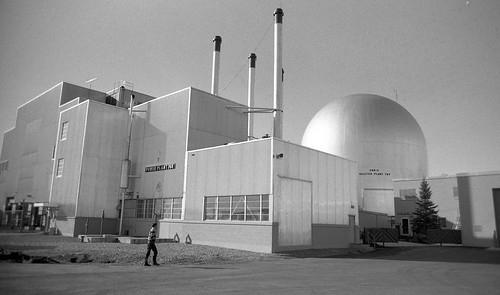 The Experimental Breeder Reactor-II (EBR-II) was used for prototyping fail-safes for an Integral Fast Reactor. (Photo by Argonne National Laboratory / Flickr)
These arguments are forcefully made in the 2013 documentary, Pandora’s Promise, produced and directed by Robert Stone. The film asserts that IFRs are our best tool to mitigate anthropogenic global warming, and it goes on to claim there has been a deliberate attempt by misguided bureaucrats to sabotage the development of IFR reactors.
However, critics of the film say these claims are overblown and that fast-reactor technology is highly problematic. Earlier versions of the fast breeder reactor (of which IFR is a version) were commercial failures and safety disasters. Proponents of the Integral Fast Reactor, the critics say, overlook its exorbitant development and deployment costs and continued proliferation risks. IFR theoretically “transmutes,” rather than eliminates, radioactive waste. Yet the technology is decades away from widespread implementation, and its use of liquid sodium as a coolant can lead to fires and explosions.
David Biello, writing in Scientific American, concludes that, “To date, fast neutron reactors have consumed six decades and $100 billion of global effort but remain ‘wishful thinking.’”
Even if advocates of IFR reactors are correct, there is one giant practical reason they may not power the Anthropocene: we likely won’t see the benefit from them soon enough to make much of a difference. The challenges of climate change and fossil fuel depletion require action now, not decades hence.
Assuming enough investment capital, and assuming a future in which we have decades in which to improve existing technologies, IFR reactors might indeed show significant advantages over current light water reactors (only many years of experience can tell for sure). But we don’t have the luxury of limitless investment capital, and we don’t have decades in which to work out the bugs and build out this complex, unproven technology.
The Economist’s verdict stands: “Nuclear power will continue to be a creature of politics not economics, with any growth a function of political will or a side-effect of protecting electrical utilities from open competition. . . . Nuclear power will not go away, but its role may never be more than marginal.”
Defying the danger of redundancy, I will hammer home the point: cheap, abundant energy is the prerequisite for the Techno-Anthropocene. We can only deal with the challenges of resource depletion and overpopulation by employing more energy, the Anthropocene boosters say. Running out of fresh water? Just build desalination plants (which use lots of energy). Degrading topsoil in order to produce enough grain to feed ten billion people? Just build millions of hydroponic greenhouses (which need lots of energy for their construction and operation). As we mine deeper deposits of metals and minerals and refine lower-grade ores, we’ll require more energy. Energy efficiency gains may help us do more with each increment of power, but a growing population and rising per-capita consumption rates will more than overcome those gains, as they have consistently done in recent decades. Any way you look at it, if we are to maintain industrial society’s current growth trajectory we will need more energy, we will need it soon, and our energy sources will have to meet certain criteria – for example, they will need to emit no carbon while at the same time being economically viable.
These essential criteria can be boiled down to four words: quantity, quality, price, and timing. Nuclear fusion could theoretically provide energy in large amounts, but not soon. The same is true of cold fusion (even if – and it’s a big If – the process can be confirmed to actually work and can be scaled up). Biofuels offer a very low energy return on the energy invested in producing them (a deal-breaking quality issue). Ocean thermal and wave power may serve coastal cities, but again the technology needs to be proven and scaled up. Coal plants equipped with carbon capture and storage are economically uncompetitive with other sources of electricity. Solar and wind are getting cheaper, but they’re intermittent and tend to undermine commercial utility companies’ business models. While the list of potential energy sources is long, none of these sources is ready to be plugged quickly into our existing system to provide energy in the quantity, and at the price, that the economy needs in order to continue growing.
This means that humanity’s near future will almost certainly be energy-constrained. And that, in turn, will ensure that we will still be depending on ecosystems that are largely beyond our control. We are unlikely to engineer nature on an ever-greater scale.
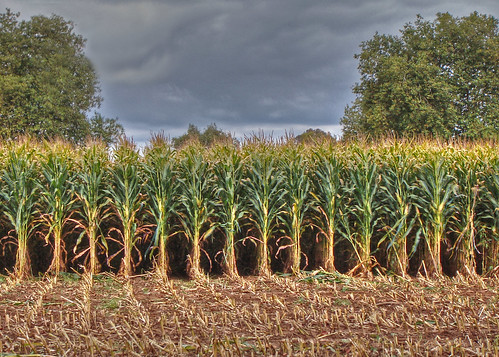 Corn grown for food or fuel. (Photo by Sarah Macmillan / Flickr)
As a species, we’ve gained an impressive degree of influence over our environment by deliberately simplifying ecosystems so they will support more humans, but fewer other species. Our principal strategy in this project has been agriculture – primarily a form of agriculture that focuses on a few annual grain crops. We’ve commandeered up to 50 percent of the primary biological productivity of our planet, mostly through farming and forestry. Doing this has had overwhelmingly negative impacts on non-domesticated plants and animals. The subsequent loss of biodiversity is increasingly compromising humanity’s prospects, because we depend upon countless ecosystem services (such as pollination and oxygen regeneration) – services we do not organize or control, and for which we do not pay.
The essence of our problem is this: the side effects of our growth binge are compounding rapidly and threaten a crisis in which the artificial support systems we’ve built over past decades (food, transport, and financial systems, among others) – as well as nature’s wild systems, on which we still also depend – could all crash more or less simultaneously.
If we’ve reached a point of diminishing returns and potential crisis with regard to our current strategy of constant population/consumption growth and ecosystem takeover, then it would seem that a change of direction is necessary and inevitable. If we were smart, rather than attempting to dream up ways of further re-engineering natural systems in untested (and probably unaffordable) ways, we would be limiting and ameliorating the environmental impacts of our global industrial system while reducing our population and overall consumption levels.
And if we don’t proactively limit population and consumption? Then nature will eventually do it for us, and likely by very unpleasant means (famine, plague, and perhaps war).
Governments are probably incapable of leading a strategic retreat in our war on nature, as they are systemically hooked on economic growth. But there may be another path forward. Perhaps citizens and communities can initiate a change of direction. Back in the 1970s, as the first energy shocks hit home and the environmental movement flourished, ecological thinkers began tackling the question: What are the most biologically regenerative, least harmful ways of meeting basic human needs? Two of these thinkers, Australians David Holmgren and Bill Mollison, came up with a system they called permaculture. According to Mollison, “Permaculture is a philosophy of working with, rather than against nature; of protracted and thoughtful observation rather than protracted and thoughtless labor; and of looking at plants and animals in all their functions, rather than treating any area as a single-product system.” Today there are thousands of permaculture practitioners throughout the world, and permaculture Design courses are frequently on offer in almost every country.
Other ecologists didn’t aim to create an overarching system, but merely engaged in piecemeal research on practices that might lead to a more sustainable mode of food production – practices that include intercropping, mulching, and composting. One ambitious agricultural scientist, Wes Jackson of the Land Institute in Salina Kansas, has spent the past four decades breeding perennial grain crops. As Jackson points out, our current annual grains are responsible for the vast bulk of soil erosion, to the tune of 25 billion tons per year.
Meanwhile, community resilience efforts have sprung up in thousands of towns and cities around the world – including the Transition Initiatives, which are propelled by a compelling, flexible, grassroots organizing model and a vision of a future in which life is better without fossil fuels.
Population Media Center is working to ensure we don’t get to 10 billion humans by enlisting creative artists in countries with high population growth rates to produce radio and television soap operas featuring strong female characters who successfully confront issues related to family planning. This strategy has been shown to be the most cost-effective and humane means of reducing high birth rates in these nations.
What else can be done? Substitute human or animal labor for fossil fuels. Localize food systems. Capture atmospheric carbon in soil and biomass. Replant forests and restore ecosytems. Recycle and re-use. Manufacture more durable goods. Rethink economics to deliver human satisfaction without endless growth. There are organizations throughout the world working to further each of these goals, usually with little or no government support. Taken together, they could lead us to an entirely different Anthropocene.
Call it the Lean-Green Anthropocene.
The Techno-Anthropocene has an Achilles heel: energy. The Lean-Green Anthropocene has one as well: human nature.
It’s hard to convince people to voluntarily reduce consumption and curb reproduction. That’s not because humans are unusually pushy, greedy creatures; all living organisms tend to maximize their population size and rate of collective energy use. Inject a colony of bacteria into a suitable growth medium in a petri dish and watch what happens. Hummingbirds, mice, leopards, oarfish, redwood trees, or giraffes: in each instance the principle remains inviolate – every species maximizes population and energy consumption within nature’s limits. Systems ecologist Howard T. Odum called this rule the Maximum Power Principle: throughout nature, “system designs develop and prevail that maximize power intake, energy transformation, and those uses that reinforce production and efficiency.”
 (Photo by Bill Couch / Flickr)
In addition to our innate propensity to maximize population and consumption, we humans also have difficulty making sacrifices in the present in order to reduce future costs. We’re genetically hardwired to respond to immediate threats with fight-or-flight responses, while distant hazards matter much less to us. It’s not that we don’t think about the future at all; rather, we unconsciously apply a discount rate based on the amount of time likely to elapse before a menace has to be faced.
True, there is some variation in future-anticipating behavior among individual humans. A small percentage of the population may change behavior now to reduce risks to forthcoming generations, while the great majority is less likely to do so. If that small percentage could oversee our collective future planning, we might have much less to worry about. But that’s tough to arrange in democracies, where people, politicians, corporations, and even nonprofit organizations get ahead by promising immediate rewards, usually in the form of more economic growth. If none of these can organize a proactive response to long-range threats like climate change, the actions of a few individuals and communities may not be effective at mitigating the hazard.
This pessimistic expectation is borne out by experience. The general outlines of the ecological crisis have been apparent since the 1970s. Yet not much has actually been accomplished through efforts to avert that crisis. It is possible to point to hundreds, thousands, even millions of imaginative, courageous programs to reduce, recycle, and reuse – yet the overall trajectory of industrial civilization remains relatively unchanged.
Human nature may not permit the Lean-Greens’ message to altogether avert ecological crisis, but that doesn’t mean the message is pointless. To understand how it could have longer-term usefulness despite our tendency toward short-term thinking, it’s helpful to step back and look at how societies’ relationship with the environment tends to evolve.
The emblematic ecological crises of the Anthropocene (runaway climate change and ocean acidification, among others) are recent, but humans have been altering our environment one way or another for a long time. Indeed, there is controversy among geologists over when the Anthropocene began: some say it started with the industrial revolution, others tag it at the beginning of agriculture some 10,000 years ago, while still others tie it to the emergence of modern humans thousands of years earlier.
Humans have become world-changers as a result of two primary advantages: we have dexterous hands that enable us to make and use tools, and we have language, which helps us coordinate our actions over time and space. As soon as both were in place, we started using them to take over ecosystems. Paleoanthropologists can date the arrival of humans to Europe, Asia, Australia, the Pacific Islands, and the Americas by noting the timing of extinctions of large prey species.
People have also been deliberately re-engineering ecosystems for tens of thousands of years, principally by using fire to alter landscapes so they will produce more food for humans. Agriculture was a huge boost to our ability to produce more food on less land, and therefore to grow our population. Farming yielded storable food surpluses, which led to cities – the basis of civilization. It was in these urban social cauldrons that writing, money, and mathematics emerged.
If agriculture nudged the human project forward, fossil-fueled industrialism turbocharged it. In just the past two centuries, population and energy consumption have increased by more than 800 percent. Our impact on the biosphere has more than kept pace. The industrialization of agriculture enabled – or forced – billions to move to cities. As more people came to live in urban centers, they found themselves increasingly cut off from wild nature and ever more completely engaged with words, images, symbols, and tools.
There’s a term for the human tendency to look at the biosphere as though it’s all about us: anthropocentrism. Up to a point, this is understandable. Every person, after all, is the center of her own universe, the star of his own movie; why should our species as a whole be less egocentric? But there are healthy and unhealthy degrees of individual and species self-centeredness. When individual human self-absorption becomes blatantly destructive we call it narcissism. Can a whole species be overly self-absorbed? The very idea of the Anthropocene would suggest the answer is Yes. Our planetary-scale narcissism is just the latest method for justifying our actions as we bulldoze, deforest, overfish, and deplete our way to world domination.
However, history does not portray a steady ramp-up of human hubris and alienation from nature. Periodically humans were slapped down. Famine, resource conflicts, and disease decimated populations that were previously growing. Civilizations rose, then fell. Financial manias led to crashes. Boomtowns became ghost towns.
Ecological slap-downs probably occurred with relatively great frequency in pre-agricultural times, when humans depended more directly on nature’s variable productivity of wild foods. The Aboriginals of Australia and the Native Americans – who are often regarded as exemplar intuitive ecologists due to their traditions and rituals restraining population growth, protecting prey species, and affirming humanity’s place within the larger ecosystem – were probably just applying lessons from bitter experience. It’s only when we humans get slapped down hard a few times that we start to appreciate other species’ importance, restrain our greed, and learn to live in relative harmony with our surroundings.
Which prompts the question: Are the Lean-Green Anthropocene prophets our species’ early warning system whose function is to avert catastrophe – or are they merely ahead of their time, pre-adapting to an ecological slap-down that is foreseeable but not yet fully upon us?
Throughout history, humans appear to have lived under two distinct regimes: boom times and dark ages. Boom times occurred in prehistory whenever people arrived in a new habitat to discover an abundance of large prey animals. Booms were also associated with the exploitation of new energy resources (especially coal and oil) and the expansions of great cities – from Mohenjo-daro, Rome, Chang’an, Angkor Wat, Tenochtitlan, and London, all the way to Miami and Dubai. Boom-time behavior is risk-seeking, confident to the point of arrogance, expansive, and experimental.
Historians use the term dark ages to refer to times when urban centers lose most of their population. Think Europe in the fifth through the fifteenth centuries, the Near East after the Bronze Age collapse around 1200 BCE, Cambodia between 1450 and 1863 CE, or Central America after the Mayan collapse of 900 CE. Dark-age behavior is conservative and risk-averse. It has echoes in the attitudes of Indigenous peoples who have lived in one place long enough to have confronted environmental limits again and again. Dark-age people haven’t skirted the Maximum Power Principle; they’ve just learned (from necessity) to pursue it with more modest strategies.
Needless to say, dark ages have their (ahem) dark side. In the early phases of such periods large numbers of people typically die from famine, also from war or other forms of violence. Dark ages are times of forgetting, when technologies and cultural achievements are often lost.
Still, these times are not uniformly gloomy. During the European Dark Ages, slavery nearly disappeared as new farming methods and better breeds of horses and oxen made forced human labor less economic. People who previously would have been bound in slavery became either free workers or, at worst, serfs. The latter couldn’t pick up and move without their lord’s permission, but generally enjoyed far more latitude than slaves. At the same time, the rise of Christianity brought new organized charitable activities and institutions, including hospices, hospitals, and shelters for the poor.
Today nearly everyone in the industrialized world has adopted boom-time behavior. We are encouraged to do so by ceaseless advertising messages and by governmental cheerleaders of the growth economy. After all, we have just lived through the biggest boom in all human history – why not expect more of the same? The only significant slap-downs in recent cultural memory were the Great Depression and a couple of World Wars; in comparison with ecological bottlenecks in ancient eras these were minor affairs. Further, they were relatively brief and played out three or more generations ago. For most of us today, dark-age behavior seems quaint, pointless, and pessimistic.
It would be perverse to wish for a Great Slap-Down. Only a sociopath would welcome massive, widespread human suffering. At the same time, it is impossible to ignore these twin facts: our species’ population-consumption fiesta is killing the planet, and we’re not likely to end the party voluntarily.
Will we avert or face a Great Slap-Down? We’re already seeing initial signs of trouble ahead in extreme weather events, high oil and food prices, and increasing geopolitical tensions. Still, it seems that every effort will be made to keep the party going as long as possible. Even amid unmistakable signs of economic contraction, most people will still require time to adapt behaviorally. Moreover, a slap-down likely won’t be sudden and complete, but may unfold in stages. After each mini-slap we’ll hear claims from boom-time diehards that a techno-utopian takeoff has merely been delayed, and that economic expansion will resume if only we will follow this or that leader or political program.
But if urban centers feel the crunch, and if widespread Techno-utopian expectations are dashed, we can expect to see evidence of profound psychological disruption. Gradually, more and more people will conclude – again, as a result of hard experience – that nature isn’t here just for us. Whether this realization emerges from extreme weather, plagues, or resource scarcity, it will lead an ever-expanding share of the populace grudgingly to pay more attention to forces beyond human control.
Just as humans are now shaping the future of Earth, Earth will shape the future of humanity. Eventually, the message of the Lean-Greens will gain more obvious relevance. That message may not save the polar bears (though ecosystem protection deserves every kind of support), but it might make the inevitable transition to a new species-wide behavioral mode a lot easier. It may lead to a dark age that’s less dark than it would otherwise be, one in which more of our cultural and scientific achievements are preserved. A great deal may depend on the success of the efforts of the small proportion of the population who are currently open to Lean-Green thinking – success in acquiring skills, in developing institutions, and in communicating a compelling vision of a desirable and sustainable post-boom society.
In the end, the deepest insight of the Anthropocene will probably be a very simple one: we live in a world of millions of interdependent species with which we have co-evolved. We sunder this web of life at our peril. Earth’s story is fascinating, rich in detail, and continually self-revealing. And it’s not all about us.
14 Comments on "Heinberg: The Anthropocene: It’s Not All About Us"
Davy, Hermann, MO on Thu, 8th May 2014 6:33 pm
Even if advocates of IFR reactors are correct, there is one giant practical reason they may not power the Anthropocene: we likely won’t see the benefit from them soon enough to make much of a difference. The challenges of climate change and fossil fuel depletion require action now, not decades hence.
Friends this is in a nut shell the systematic risk side of the equation that will nullify any new technology from being our BAU savior. Time, is something you cannot recover nor replace. Time is not renewable or substitutable. Our global system has run out of time in our race with entropic decay. A complex system like our global system cannot allow entropy to get ahead of our problem solving. We are there now. The 1st serious sign of trouble came in 2008. What we have currently are the first really apparent climate instabilities. We have the first signs of food, water, and energy risk currently. We have a financial system that has gone dysfunctional. Our complex global system is using primitive controls to try to do what is no longer possible and that is “grow”. This global system is at limits of growth facing diminishing returns with a population in overshoot to carrying capacity. Furthermore this global system vital command and control systems require ever more support but are receiving less. We are finding this most directly with the lower quality and higher expense oil and gas. The combination of so many predicaments is itself a predicament meaning there is no chance of maintain status quo BAU more than a few years. I wish I could tell you how many years a few is but there are too many tipping points in motion. These tipping points will react among themselves hatching feedbacks that further magnify and enhance other tipping points. Folks there is “nothing” beneficial in the pipeline. All trends are negative and increasing in negativity. OK, very doomish, I agree but I feel the above is very hard to argue.
Perk Earl on Thu, 8th May 2014 7:29 pm
I agree Davy, regarding time to do something else, a plan B, it’s too late. Some kind of a real good alternative plan would had to have been worked out by the major powers together and implemented starting decades ago and I’m not even sure what that plan could have been.
We set up trillions of dollars worth of infrastructure based on a densely energetic liquid that could be cracked into numerous different uses. Then the power players waited too long to accept (and many still don’t) the energy predicament, and meanwhile capitol available to do something, anything else is withering away.
I really give a lot of credit though to TPTB for limping this scene along since 08. I mean really, QE, borrowing, even borrowing from ourselves, propping up the dollar, manipulating gold prices, operation twist, Obamacare, Zirp, tax cuts, cash for clunkers, bailouts, stimulus, I mean these people have thrown the kitchen sink at diminishing returns to keep the lights on a little longer.
Davey on Thu, 8th May 2014 8:04 pm
Earl, you nailed it with the diminishing returns going on in global finance.
Joe Clarkson on Thu, 8th May 2014 8:07 pm
“It would be perverse to wish for a Great Slap-Down.”
I disagree. At this late date, only catastrophe can divert us from total destruction of earth’s biosphere. Another few decades of continued exponential increases in carbon emissions and the destruction will be irrevocable.
Even so, there are still small populations of humans that are right now living in equilibrium with nature. These aboriginal peoples are the original “Lean-Green” communities. If they are left alone, they’ll be fine.
It is those of us in the industrial world that are ruining the earth. The best thing that could happen would be for the vast majority of homo-industrialus to vacate the premises as soon as possible (without leaving the earth a radioactive wasteland).
It’s true that “nature always bats last”. The later the inning, the bigger nature’s bat.
Makati1 on Thu, 8th May 2014 8:07 pm
Yep, Perk, they have and they are not finished. Too many trillions in IRAs, 401ks, and other retirement plans that are already tempting the government to roll them into low interest Treasury Instruments and then they will give you what they think you should have every month. That is the next ‘kick the can’ event, I think.
J-Gav on Fri, 9th May 2014 3:32 am
A good, thought-provoking article with generous coverage of numerous aspects of our predicament and, a rarity, a timely reminder that we share the planet with other species. Whatever the dominant mind-set in a given historical period, it isn’t and never has been ‘ours’ to do with as we please.
I’m rooting for the Lean-Greens even if they only have an outside chance.
Davy, Hermann, MO on Fri, 9th May 2014 7:13 am
Nice term Gav, “lean greens”. I really like that and it will be included in my thinking. I don’t like to talk spirituality here it is really not the place. Yet, in regards to the biosphere we do have to accept that we are a species defined by extinction, plague, and complexity liquidator. In the realm of nature our purpose is a destroyer. As humans with self-consciousness and reflection we can say we are an evil species in relation to other species. I will go no further than that so I don’t touch on religion. I am just touching on our position with and within nature. So in a scientific reflection we humans have a position as biosphere spoiler which nature needs for evolution. Self-reflection in the human realm we see sadness in the destroying of beauty for vinyl/concrete/steel, industrial noise, dirty air, toxic water/soils, vast invasive species spreading, ecosystem sterilization, and finally climate destabilization. Tell me spiritually how you can defend the above except through abstract religion and or acceptance that we are doing Natures dirty work!
Dave Thompson on Fri, 9th May 2014 8:55 am
The 400 and some odd nukes that must be minded for the next 100,000 plus years alone will be the end of life as we know it.
Davy, Hermann, MO on Fri, 9th May 2014 9:36 am
Exactly Dave! What the hell where we thinking when we thought peaceful nuclear power was a great idea! Too many nuk engineers to keep employed. Economies of scale needed for Nuk arms race. I think mostly just plain old hubris and greed for the 50’s, 60’s, 70’s and 80’s. The superpower rivalry was a suicide pack of weapons of death and waste products of the folly of peaceful Nuk power program. Collapse will end management of these WMD’S and nuk wastes. We know all too well what that means.
Hugh on Fri, 9th May 2014 10:50 am
It saddens me to know that those born since at the the turn of the century are already working from a shifted baseline and will never experience the incredible biodiversity of a relatively stable environment.
J-Gav on Fri, 9th May 2014 11:20 am
Davy – “Our purpose is to be a destroyer.” It certainly looks that way but I’m not sure that’s the final word. Don’t see it carved in stone anywhere that it’s impossible for people to change, though admittedly, it ain’t easy.
Which brings me to this: we don’t have to shy away from a discussion of spirituality, and this is as good a place as any for one.
Real spirituality, as opposed to organized religions, is not a question of doctrines and dogma; of telling people what to wear, what to eat, who to marry or whether people have the right to touch their genitals when they feel like it. On the contrary, it’s about asking the simplest, most basic questions a consciousness can ask, starting with this one: “Who am I? No, I mean really! Do I have a place in the universe and, if so, what the hell could it possibly be??
After grappling with that one for a while, the next one might be: “And what about humans collectively? Who are WE? And indeed what meaning, if any, could life-forms in general incarnate within their mortal shells?”
It seems to me that any serious search for answers will eventually run up against the inescapable conclusion that we are all part of the same “Nature,” in all its vastness. If that’s the case, then what it inspires in me is not fear but, paradoxically, a kind of infinite satisfaction coupled with an infinite humility. As Heinberg says – it’s never just about US – and, at the individual level, it’s never just about ME.
You’ll notice I didn’t bring “God” into it at all. The reason is that I find ascribing attributes to the unknowable is about as futile an exercise as I can imagine (“All-powerful, Omniscient, All-Merciful”)? How could anybody possibly know?
So anyway, there’s a short, personal viewpoint on spirituality, for what it’s worth. The tie-in with our predicament is that if humanity fails to find some common ground on such questions, our chances of making it through the coming Transition diminish proportionally.
Davey on Fri, 9th May 2014 11:48 am
Rings true to my ears Gav. I just respect others religious views because who am I to know anything in that realm. The problem is the less educated and sophisticated lack the understanding to see the difference between spirituality and religion. Yet, I must admit plenty of smarts and sophistication here on this site. I am spiritual 1st before science and religion. When I went completely offline 10 years ago I found true spirituality on an isolated 150 acre farm. I did not leave that farm for 2 months until I was hauled off by a misunderstanding family. I will tell you this folks the best and purest spirituality I have found is there in nature with as little contact to modern man as possible. Sadly it is not in the dice for most but if a collapsed BAU comes it may be on the plate for many of us!
J-Gav on Fri, 9th May 2014 4:29 pm
Wow Davey! Sounds like you had quite an experience – 150 acres?
J-Gav on Fri, 9th May 2014 5:00 pm
Davey – What I meant to say was – I hope you had a team of at least 6 people helping you out. And secondly, even if it only lasted 2 months, that kind of experience will get you some spirituality for sure! (if it doesn’t kill you). So now you’ve got that treasure that only you know about to build on. Never let go of it when you start wondering, as we all do, what the hell it all means.