
Peak Oil is You

Donate Bitcoins ;-) or Paypal :-)


Page added on May 3, 2014

This Is What Tent Cities Will Look Like After Peak Oil
Expand
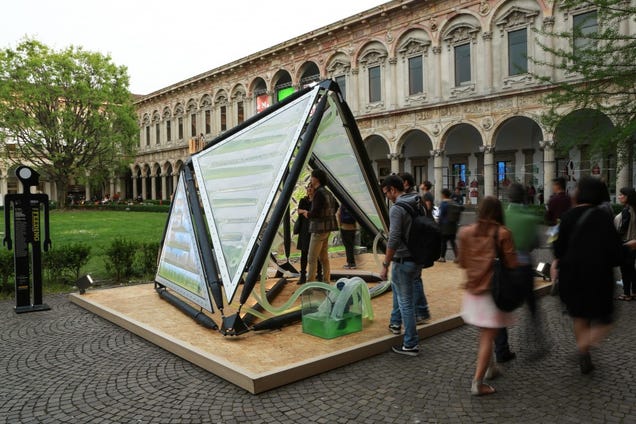
This tent could one day be your home. It will provide you with shelter from the elements, food, energy, and purified water. Meet the Urban Algae Canopy — perfect for all your environmental apocalypse needs.
 Expand
This prototype is the brainchild of Italian design firm Carlo Ratti Associati, and were previewed during last month’s Milan Design Week. The idea is to create a living structure whose very walls are thriving algae colonies. Algae is an incredibly useful life form, and it can be modified to perform a lot of functions, from generating energy through its natural photosynthetic processes to serving as a basic food item.
One day, algae could even be genetically modified to serve as a light source, a chemical sensor, or a water purification device.
For now, Carlo Ratti Associati are just focusing on its potential to serve as a form of living building material, regulating temperatures and providing energy.
 Expand1
Describing this project, Carlo Ratti Associati write:
The functioning principle of the prototypes is based on the exceptional properties of micro-algae organisms, which are ten times more efficient photosynthetic machines compared to large trees and grasses. The façade and canopy currently being developed for EXPO Milano 2015 develop a natural man-made ecology and explore the use of algae as an integrated architectural cladding and urban agriculture system.” Algae can represent an important part of creating a healthy and liveable planet. Giving life to mysterious urban gardens, algae can be used as an innovative energy and food production system within our cities.
Micro-algae perform an important photosynthetic activity, absorbing considerable amounts of carbon dioxide and producing oxygen, and growing into a biomass, which can be processed for energy, cosmetic, pharmaceutical and nutraceutical markets. “Micro-algae open up an incredible potential for new renewable energy resources, and hope for a greener future. Building and architectural surfaces are an incredible resource of space. Urban façades and roofs represent billions of square metres that instead of being made of an inanimate material such as concrete, could become clever photosynthetic surfaces that respond to the current state of climate warming. Micro-algae could add to the green urban system that exists already, intensifying carbon dioxide fixation activity and acting as cladding for buildings, increasing their passive performance.
The Urban Algae Canopy – based on ecoLogicStudio’s ‘HORTUS’ system, is presented here with a 1:1 scale prototype of the world’s first bio-digital canopy integrating micro-algal cultures and real time digital cultivation protocols on a unique architectural system. The potential of micro-algae have been integrated within a custom designed four-layered ETFE cladding system, whilst the flows of energy, water and CO2 are controlled and regulated in real-time and made to respond and adjust to weather patterns and visitors’ movements. Once completed, as part of the EXPO Milano 2015 Future Food District, this special edition of the Urban Algae Canopy will produce the equivalent amount of oxygen as four hectares of woodland, and up to 150kg of biomass per day – 60% of which are natural vegetal proteins.
Read more on the Carlo Ratti Associati website
 Expand

5 Comments on "This Is What Tent Cities Will Look Like After Peak Oil"
Beery on Sat, 3rd May 2014 6:45 am
Aaaah ha ha ha ha ha ha ha!
Davy, Hermann, MO on Sat, 3rd May 2014 7:11 am
I was thinking for my seed and plant starting in the late winter early spring greenhouse applications but it is not enclosed. Looks pricy too. Folks the primary shelters of the future in the decent will be particular to your geography. In the temperate Northern Hemisphere going back to the old will undoubtedly be the trend. Stone, logs, and brick are the number one designs. These need to take into account passive solar, ventilation, and natural insulation. Thick walls with proper orientation to sun and winds. My 12X40 log cabin has thick walls:
http://www.oakloghome.com/LogHomePlans/LogCabins2Go/Floorplans/tabid/181/Default.aspx
I know one things vinyl, particle board, irregular roofs, huge square footage, and commonly called mcmansions will not be the wave of the future. Many will, due to construction, location, and lack of a second life, be sources of salvage. There will be very few houses built after the decent because of the overbuild of the height of the oil age. Many will be lived in until they fall in disrepair. The article of topic is a joke but the needs of postindustrial man shelter are very real
Pops on Sat, 3rd May 2014 7:46 am
I’m thinking sod/adobe and salvaged glass.
Wood is now called biofuel but just like in the old days will disappear quickly into campfires – just before all the 2x4s and right after Ikea/walmart particle board “heirlooms.” LOL
Seriously, glass will be the mainstay of the “Solar Power Revolution” not plastic “bio-digital canopy integrating micro-algal cultures and real time digital cultivation protocols on a unique architectural system”
Again; LOL
DC on Sat, 3rd May 2014 8:08 am
Somehow, I seriously doubt PO tent cities will look anything like these hipster art pieces pictured above, but YMMV.
Expect your local ‘tent city’ to resemeble this:
http://dbradsher.blogspot.ca/2010/01/port-au-prince-haiti-doctors-without.html
PrestonSturges on Tue, 6th May 2014 1:12 am
Wow that could yield up to half a thimble of biomass daily.