
Peak Oil is You

Donate Bitcoins ;-) or Paypal :-)


Page added on April 19, 2014

Out of control: Fukushima manager admits to ‘embarrassing failure’
The manager of the stricken Fukushima nuclear power plant has admitted not having full control of the facility. Contrary to the statements of the Japanese PM, TEPCO’s Akira Ono said attempts to plug the leaks of radioactive water had failed.
 Image: Fukushima Plant (Wiki Commons).
“It’s embarrassing to admit, but there are certain parts of the site where we don’t have full control,” Ono told reporters touring the plant this week, reported Reuters. Last year, the Japanese PM attempted to assure the world that the situation at the stricken nuclear power plant was under control.
However, over the last couple of months the clean-up procedure at the plant has been fraught with difficulties.
Tokyo Electric Power Co (TEPCO), the plant’s operator, has consistently faced contaminated water leaks at the Fukushima plant.
Water has to be pumped over the facilities stricken reactors in order to keep them from overheating, but this process creates large quantities of contaminated water which has to be stored in tanks on the site.
Ono acknowledged to press that in TEPCO’s rush to deal with the stricken facility following the earthquake-triggered tsunami in 2011, the company may have made mistakes.
“It may sound odd, but this is the bill we have to pay for what we have done in the past three years,” he said. “But we were pressed to build tanks in a rush and may have not paid enough attention to quality. We need to improve quality from here.”
TEPCO will have to improve the quality of the tanks so the plant can survive the next 30-40 years of the decommissioning process, Ono went on to say.
The plant’s manager said that the number one aim was to keep the radioactive water from getting into the ocean.
“The ultimate purpose is to prevent contaminated water from going out to the ocean, and in this regard, I believe it is under control,” Ono said. But a series of leaks have obliged officials to “find better ways to handle the water problem.”
In the latest blunder at the plant, TEPCO mistakenly flooded the Fukushima facility’s basements with radioactive cooling-tank water. Earlier this week the Japanese newspaper the Asahi Shimbun reported that around 200 tons of water had found its way into waste disposal facilities under the power plant. TEPCO said they were working to fix the leakage as soon as possible.
Cleaning up Fukushima is becoming an increasing headache for the Japanese authorities. Experts predict that fully decommissioning the stricken plant is a process that could take decades, costing the country billions of dollars.
Following the multiple meltdown of the Fukushima plant in 2011 that was triggered by a tsunami, the Japanese government pledged to abandon nuclear power by 2010. However, in spite of public outrage, the government was forced to reactivate its nuclear power plants because of massive energy shortfalls.
11 Comments on "Out of control: Fukushima manager admits to ‘embarrassing failure’"
SilentRunning on Sat, 19th Apr 2014 3:03 pm
The good news is that it takes less and less water every month to cool the reactors – as the really hot isotopes decay away the amount of heat generated falls off.
If they can get the filtering machinery up to speed, then they can filter out the really bad isotopes out of the storage tanks faster than the leakages are occurring, and they can begin emptying the tanks, and reducing the chances of a really horrendous leak into the ocean.
Less radiation going into the ocean should be something everybody can support.
Also, every month more of the spent fuel rods are being removed from reactor 4, also reducing the chances of a disaster on that front.
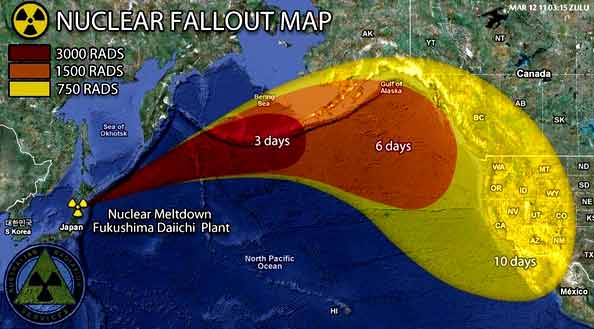
Conspicuously absent from the reporting here are the good things happening to lessen the chances of future disasters at this site. Also, I notice that we are STILL using the graphic with the outrageously high level of radioactive fallout that never, ever materialized – otherwise there would be at least 100 million immediate deaths from radiation on the US west coast.
SilentRunning on Sat, 19th Apr 2014 3:08 pm
Now 308 fuel rods have been removed from cooling pool of reactor #4.
They continue to make progress removing fuel rods, and every rod removed lessens the chance of a further disaster if there is another major earthquake…
http://www.tepco.co.jp/en/nu/fukushima-np/removal4u/index-e.html
GregT on Sat, 19th Apr 2014 3:11 pm
And all the King’s horses
And all the King’s men
Couldn’t put Humpty back together again.
Makati1 on Sat, 19th Apr 2014 3:55 pm
Silent, do you actually believe an article published on Tepco’s web site? I have a nice piece of oceanfront property in Colorado that I can let you have cheap if you are that naive.
“…According to Tepco, the pool at the No. 4 reactor, which was not operating at the time of the accident, holds 1,331 spent fuel assemblies, which each contain dozens of rods. Several thousand rods were removed from the core just three months before so the vessel could be inspected. Those rods, which were not fully used up, could more easily support chain reactions than the fully spent fuel. …”
“… the Fukushima Daiichi plant has seven pools dedicated to spent fuel rods. These are located at the top of six reactor buildings – or were until explosions and fires ravaged the plant. On the ground level there is a common pool in a separate building that was critical damaged by the tsunami. Each reactor building pool holds 3,450 fuel rod assemblies and the common pool holds 6,291 fuel rod assemblies. Each assembly holds sixty-three fuel rods. In short, the Fukushima Daiichi plant contains over 600,000 spent fuel rods…”
Sounds like they are just getting started. Nice what you can find on the internet if you try. I am more inclined to believe a source NOT tied to the failed Tepco.
diemos on Sat, 19th Apr 2014 5:14 pm
Gods above. On the web misinformation breeds like cockroaches.
http://fukushima.ans.org/inc/Fukushima_Appendix_G.pdf
Fuel assemblies in all pools as of 3/11/11: 11407 (496 are fresh fuel bundles)
Fuel assemblies in spf 4 as of 3/11/11: 1535 (204 are fresh fuel bundles)
And yes they are almost half done transferring the assemblies from sfp4 to the common pool.
diemos on Sat, 19th Apr 2014 5:16 pm
Bad! Silent Running Bad!
You called them rods instead of assemblies and you linked to the old obsolete page instead of the current one.
http://www.tepco.co.jp/en/decommision/index-e.html
Stilgar Wilcox on Sat, 19th Apr 2014 7:36 pm
“It’s embarrassing to admit, but there are certain parts of the site where we don’t have full control,”
Well, stop panicking and get yourselves a plan!
Kenz300 on Sun, 20th Apr 2014 12:04 am
Nuclear Energy —- too dangerous and too costly….
TEPCO and all their nuclear advisors and consultants can not control or clean up the mess they created.
Wind and solar are safer, cleaner and cheaper…….
How much will this disaster cost? How much will it cost to decommission and store the nuclear waste from all the nuclear reactors around the world?
It is time to learn some lessons from Chernobyl and Fukishima. Nuclear energy is a disaster waiting to poison the environment. How many more disasters do we need before we learn the lessons?
Makati1 on Sun, 20th Apr 2014 1:32 am
Bundles or rods, they are still only beginning to remove the thousands of bundles stored on site. And nothing mentioned about the cores…
diemos on Sun, 20th Apr 2014 5:21 pm
They’re not moving anything off-site.
The anti-nuclear activists have done too good a job ensuring that there’s no approved place to put it.
Old stuff that was in the common pool was moved to dry cask storage on-site to free up room to transfer assemblies from sfp4 to the common pool.
TemplarMyst on Mon, 21st Apr 2014 2:49 am
Kenz, Makati, Greg,
I can’t speak for anyone but myself, so that’s who I will speak for.
A major reason some of us support the continued use of nuclear power, despite Fukushima, and despite Chernobyl, is because the renewables are a couple of decades away from being able to support civilization. Every solar panel and every wind turbine at this point has to be backed up by either coal or natural gas. Perhaps in a couple of decades, and a couple of major technical breakthroughs, they can take the mantle, but not yet.
In the balance, I personally find climate disruption to be a greater threat than radiation. But that’s because I’ve extensively researched radiation and found it to be the lesser threat. Of course you may disagree, but that is why some of us support nuclear.
I can’t find any extracted energy source that is risk free. The radioactive waste water created during the extraction of rare earth minerals, like molybdenum, used in both solar and wind devices, is substantial, just not discussed much. Thus far there is, so far as I know, no substitute for that metal in these renewable technologies.
If you want energy, there is no such thing as clean. One has to make choices. None of them are particularly good. The only ones available are real ones, with real risks and real benefits.
One has to weigh things, and come to ones own conclusions. But those of us who have concluded nuclear makes sense have done those calculations and come to that conclusion.
Your mileage may vary, of course.