



It’s all about supply and demand—the first, last, and everything for estimating the projected path of prices. Geopolitics can and does intrude, of course. This is oil, after all. But the raw numbers of economics have the last word eventually—even for the world’s most valuable commodity.
The price of Crude Oil has been trending higher this year, but three key events on the supply side will create new headwinds for the bulls. In particular, expectations for higher output in three crucial oil-producing nations: Iraq, Iran, and the US. The catalysts for increased supply are different for each country, but the expected results will be the same: more oil. Say bye-bye to the peak-oil narrative, at least for now.
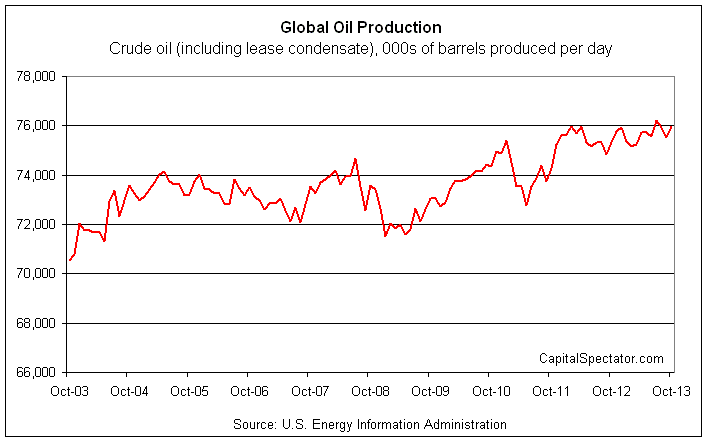
Global production, by the way, has already been bumping up against all-time highs recently, based on the Energy Information Administration’s latest data through October 2013. Total world output of crude oil (including lease condensate) was just a touch under 76 million barrels per day, or just below the peak, which was set earlier in 2013.
Even greater heights are likely in the near term for at least three key reasons. First, Iraqi production will increase by substantial amounts as a major oil field comes on line. “Russia’s Lukoil has opened a giant untapped oil field in Iraq that will play a major part in driving up production to new highs in the Middle Eastern country and potentially force down the price of crude,” according to The Telegraph.
Spigots in the West Qurna-2 field, Iraq’s second-biggest, were opened officially over the weekend in a move that will release 120,000 barrels per day of crude oil onto international markets. The field in Southern Iraq near Basra will eventually pump out 1.2m barrels-per-day (bpd) of oil.
Iraq’s oil minister Abdul Kareem Luaibi has said that West Qurna-2 will enable the country to hit its target of pumping 4m bpd by the end of the year. Already the second-largest producer in the Organisation of Petroleum Exporting Countries (Opec) after Saudi Arabia according to Reuters, Iraq pumped 3.5m bpd last month.
Meanwhile, the easing of sanctions on Iran will boost supply from this key Middle East supplier. In fact, that’s already happening. “Iran’s oil exports have stayed above levels allowed under Western sanctions for a fifth month, according to sources who track tanker movements, in a further sign that a deal to ease some restrictions is helping Tehran sell more crude,” reports Reuters. More of the same is coming, and probably with the West’s approval. Tehran, of course, is eager, to ramp up sales. “The revival of Iran’s lost share in the oil market is my top priority,” says the country’s new oil minister via the Oil & Gas Journal (OGJ). “Under no circumstances will we give up our rights on this issue; we will reach 4 million b/d [of oil] production, even if the crude price falls to $20/bbl, and we will be able to reach our presanctions level of exports early next year,” he said in late-2013.
A few weeks after taking office last August, Iranian President Hassan Rouhani invited western oil companies to meet him at United Nations General Assembly sessions. The Islamic Republic has desperately invited international oil companies to return to Iran under deals more attractive than they had been offered before and to showcase officials to American and European energy companies, including Zanganeh. At the end of the OPEC ministerial meeting, he signaled a new era of contract terms intended to be more appealing to international operators than those offered in his earlier term as minister.
According to a Financial Times report last October, Iran hopes to attract at least $100 billion in western investment in oil and gas development over the next 3 years. Details of new terms of participation were expected to be announced in London, where Iranian officials were to meet with mainly European international oil companies in April. But the meeting was later moved to November. Mehdi Hosseini, an advisor to the oil Minister, revealed that the government would reach out to old oil buyers and is ready to cut prices.
In addition, the shale oil boom in the US is putting the world’s largest consumer of crude back into the game in terms of lifting supply and reducing dependence on foreign imports. As the LA Times reported earlier this month:
For the first time since 1995, U.S. oil production surpassed oil imports, according to the U.S. Energy Information Administration. Predictions are that the trend will continue, eliminating the ‘oil deficit’ between what we drill ourselves and what we take in, and making the U.S. the number one oil producer in the world by 2020.
The International Energy Agency predicted last week that the U.S. will continue moving “steadily toward meeting all of its energy needs from domestic resources by 2035.” The drop in imported oil was attributed to the recession and higher fuel costs leading to lower consumption, and to automobiles getting better gas mileage.
Yes, there are risks that could derail the projections for higher output. That includes the potential for supply disruptions linked to the Russia-Ukraine crisis. Meanwhile, the Middle East is as volatile as ever in political terms and so all the usual caveats apply for assuming that exports will flow smoothly from the Persian Gulf to the rest of the world. Also, if demand growth exceeds the rise in supply, lower prices may elude the global economy after all. But that’s a low risk at the moment given the estimates for a modest expansion for the global economy. In sum, barring some unforeseen event, the economics of supply and demand imply that global oil production’s headed for a new peak.
That doesn’t mean that prices are destined to fall, at least not in the immediate future. Indeed, the oil market reflects more than simple supply and demand factors. It’s safe to assume that a geopolitical risk premium will remain a constant for the foreseeable future. But on the margins, the oil market is moving into a new period of rising supply.
andya on Wed, 2nd Apr 2014 3:53 am
A reasonable argument, wouldn’t want to mention the rest of the countries that have declining production though, that would mean saying hello to the peak oil narrative.
Plantagenet on Wed, 2nd Apr 2014 5:14 am
Its possible oil prices will fall in the short term. But in the long we are looking and higher and higher prices for oil.
Stilgar Wilcox on Wed, 2nd Apr 2014 5:54 am
It is remarkable the tenacity of the plateau since 05 and a wee bit of increase, and this report suggests we still haven’t reached world peak production. As Iran opens the spicket wider again, the US fracks shale oil and Iraq brings on new fields it will be interesting to see just how many barrels a day can be achieved and then how long that plateau can be held.
Maybe we are now looking at 2020 for a peak, or even 2025?
Meld on Wed, 2nd Apr 2014 6:30 am
I’m going to have to put up with this denial shit for another 10 years? no thanks I’m out of here. Peak oilers are becoming like religious nuts waiting for some holy day to come when the fast crash will happen…oh maybe 2016…maybe 2019….just hang on till 2025…or 2030.
Nope, happened in 2008, catabolic collapse is in process and unless people notice it they are going to get swallowed up by the rising waters at some point in the future. Me, I’m heading for higher ground, even if I’m wrong it’ll be a nice view.
Pacman on Wed, 2nd Apr 2014 8:47 am
Well personally I need the economy to struggle on for 10 more years so I can pay the debt on my renewable projects, after that I can fund future projects myself and I suspect much of the rest of the renewable industry will have a similar view
Davy, Hermann, MO on Wed, 2nd Apr 2014 11:04 am
Another Wall Street ‘smuk’ talks out his ass. He says “It’s all about supply and demand—the first, last, and everything for estimating the projected path of prices” Sure like Rock says “Look to the money”. So supply may go up “MAY” this guy is giving a foregone conclusion. The number 1 issue today with peaking supply is the cost of extraction and availability of capex. Costs are going up and available capex (liquidity) is going down. The high cost of unconventionals requires both these variables to produce. If we see prices drop from a financial correction or a temporary increase in ME oil supply from Iran and Iraq then projects elsewhere will go offline. Demand will increase with lower prices (generally) again pumping prices back up. There is really no alternative to the goldilocks range. We are seeing a stubborn price in plus or minus $100 range. Personally I doubt this will change much until the financial bubble inflating with financial repression bursts. Another issues with the global oil market it is the most corrupt and manipulated market on earth. Another issues is the players involved withhold vital data to determine supply properly.
Arthur on Wed, 2nd Apr 2014 11:05 am
It is remarkable the tenacity of the plateau since 05 and a wee bit of increase, and this report suggests we still haven’t reached world peak production.
Not remarkable at all. The price plateau is caused by ongoing demand destruction that, for the moment, beats the effect of depletion. Prices have reached a level such that makes ever more people decide that the car is no longer affordable and that’s what is keeping the prices constant or even causes them to slightly decrease, like here in Holland and probably elsewhere as well.
Stilgar: Maybe we are now looking at 2020 for a peak, or even 2025?
Meld: I’m going to have to put up with this denial shit for another 10 years? no thanks I’m out of here.
Both Stilgar and Meld are suffering from the TOD syndrome. All dressed up and nowhere to go.
http://www.freeduh.com/wp-content/uploads/2011/04/all_dressed_up_and_nowhere_to_go.png
Compare it to heating a casserole with water. After 10 minutes of heating (depletion) the temperature (fossil fuel price) reaches 100 degrees Celcius and stays there for hours, despite the large amount of heat (continued depletion) fed into the casserole until all water has vaporized.
Aaron on Wed, 2nd Apr 2014 11:13 am
The author sees increasing supplies from Iran, Iraq and US, but fails to acknowledge 4mbpd per year depletion in old fields. So we still don’t know whether supplies will be up, flat, or down this year.
rockman on Wed, 2nd Apr 2014 11:39 am
The future price (both long and short term) will go up/down/stay flat. There you go…you heard it here first. LOL. But how much oil production increases will have little bearing on the price. If it does then someone needs to explain why oil production increased from 78 mm bopd in 2002 to around 90 mm bopd while over the same period the price increase from around $30/bbl to around $100/bbl. IOW a 15% increase in global production led to a 300% increase in the price of oil.
It amazing at this point in the game some folks still can’t grasp the chicken/egg dynamic. LOL. But yes: we could see oil prices drop significantly. Which would indicate serious problems for the global economy. Hopefully most here understands why that would be the case.
meld on Wed, 2nd Apr 2014 12:37 pm
@Arthur – may you live in interesting times.
Makati1 on Wed, 2nd Apr 2014 12:49 pm
This is an April Fool article isn’t it? ^_^
westexas on Wed, 2nd Apr 2014 1:05 pm
Here’s a summary, from lightest to heaviest hydrocarbons, of the known and unknown data points for 2005 to 2012 volumes and rates of change in global data:
2005 to 2012 Global Data (EIA):
Dry Processed Gas: 270 BCF/day to 328 BCF/day (+2.8%/year rate of change)
NGL’s: 7.6 mbpd to 9.1 mbpd (+2.6%/year rate of change)
Condensate: ?
Crude: ?
C+C: 74 mbpd to 76 mbpd (+0.4%/year rate of change), an increase of 2 mbpd
Using various approaches, in my opinion it seems likely that we have not seen a material* increase in actual global crude oil production**, despite a doubling in the annual price of Brent crude from 2005 to 2012.
In a nutshell, it seems likely that crude oil production virtually stopped increasing in 2005, while gas production continued to (so far) increase.
*Which I would probably define as at least a one mbpd increase, given data uncertainties
**45 or less API Gravity, per RBN Energy
bobinget on Wed, 2nd Apr 2014 3:38 pm
Time for more rhubarb pie.
Skip over all the boring stuff and just read the last paragraph. In spite of lousy weather we are working our way back to 19 M b/d. Watch diesel consumption jump as farmers put in more soybeans than corn.
Summary of Weekly Petroleum Data for the Week Ending March 28, 2014
U.S. crude oil refinery inputs averaged over 15.3 million barrels per day during the week ending March 28, 2014, 223,000 barrels per day more than the previous week’s average. Refineries operated at 87.7% of their operable capacity last week. Gasoline production increased last week, averaging over 9.0 million barrels per day. Distillate fuel production increased last week, averaging 4.8 million barrels per day.
U.S. crude oil imports averaged over 6.8 million barrels per day last week, down by 786,000 barrels per day from the previous week. Over the last four weeks, crude oil imports averaged about 7.3 million barrels per day, 6.1% below the same four-week period last year. Total motor gasoline imports (including both finished gasoline and gasoline blending components) last week averaged 533,000 barrels per day. Distillate fuel imports averaged 240,000 barrels per day last week.
U.S. commercial crude oil inventories (excluding those in the Strategic Petroleum Reserve) decreased by 2.4 million barrels from the previous week. At 380.1 million barrels, U.S. crude oil inventories are in the upper half of the average range for this time of year. Total motor gasoline inventories decreased by 1.6 million barrels last week, and are below the lower limit of the average range. Both finished gasoline inventories and blending components inventories decreased last week. Distillate fuel inventories increased by 0.6 million barrels last week but are at the lower limit of the average range for this time of year. Propane/propylene inventories rose 0.9 million barrels last week and are near the lower limit of the average range. Total commercial petroleum inventories decreased by 1.3 million barrels last week.
Total products supplied over the last four-week period averaged about 18.6 million barrels per day, up by 0.1% from the same period last year. Over the last four weeks, motor gasoline product supplied averaged 8.8 million barrels per day, up by 3.8% from the same period last year. Distillate fuel product supplied averaged 3.8 million barrels per day over the last four weeks, up by 0.6% from the same period last year. Jet fuel product supplied is up 6.2% compared to the same four-week period last year.
bobinget on Wed, 2nd Apr 2014 3:56 pm
PS: There are virtually NO Libyan CL exports.
You may recall during ‘Arab Spring’ KSA jumped into the breach pumping an additional million B p/d.
That obviously could not continue for long. It didn’t.
The Saudis are in no mood, even if it were possible, to increase production. Watch for a new oil cartel formed by Russia, Venezuela, Iran, Iraq, Qatar, Nigeria, Ecuador and Canada… ok I kid Canada.. but don’t we all?
Russian production (weather related?) was down for both oil and gas last month.
Roughly one third of Nigerian exports, currently off line. More expected to be closed.
Understand billions are being spent to keep oil prices in check to prevent Iran from assuming ME leadership.
Futures prices have little relationship to current SUPPLY.
bobinget on Wed, 2nd Apr 2014 4:06 pm
If your interested in what this old codger says,
I’ll do the dumbest thing going and make a prediction for oil prices;
$100 trading range till September, ending year around $150.
NG continues to trade below $5. despite heavy draws on storage. This situation cannot last. I’ll say 2014 closes with NG selling $6. with much higher spot.
Kenz300 on Wed, 2nd Apr 2014 5:31 pm
Demand is still rising in China and India…… that will take up any increase in supply.
rockman on Wed, 2nd Apr 2014 5:48 pm
Ken – And as I pointed out not only “will” but has: global production increased 15% while prices increased 300%.
Stilgar Wilcox on Wed, 2nd Apr 2014 6:06 pm
“Peak oilers are becoming like religious nuts waiting for some holy day to come when the fast crash will happen”
Meld, my question was in regards to technical peak, not denial about situation at hand.
Davey on Wed, 2nd Apr 2014 6:20 pm
Still, generalizing today? Doomer here and not excited at all about the storm ahead. I am just honest where others here believe in fairy tales and happy endings.
Northwest Resident on Wed, 2nd Apr 2014 6:37 pm
Meld — When you write “Peak oilers are becoming like religious nuts waiting for some holy day to come when the fast crash will happen” I think maybe you should consider that “religious nuts” base their beliefs in the End Of The World on “faith” and mystical hocus pocus that has nothing to do with science or fact. But on the other hand, “Peak Oilers” base their predictions and speculations on science, fact and logic. Big difference between the two, huge.
But I get what you’re saying. We’re all waiting for the end of the world to begin when it actually DID begin back with the financial collapse of 2008. The whole global economy is a fraud right now, a bubble floating along just waiting to be popped, and a lot of people don’t realize that we’re already in “collapse mode”. At least, I think that is what you’re saying…
rockman on Wed, 2nd Apr 2014 8:14 pm
I always have to wonder what some folks envision as the “crash” to come. For me it’s easy: the crash came during the period were oil increased in price 300% while global production increased 15%. Maybe some folks really think of the “crash” as some sort of Mad Max world. Obviously I don’t. I’ve estimated that the global oil consuming economies have transferred over $5 trillion of ADDTIONAL wealth to the oil producers since prices boomed.
Maybe it like the old joke about the difference between a recession and a depression: depends upon who lost their job. If you’re one of the tens of millions around the world who has suffered a significant depreciation of your lifestyle as a result of higher energy costs I would suspect you might say the crash has already happened.
And has the crash hit me? Hell no…I sell oil for a living. LOL.
Stilgar Wilcox on Wed, 2nd Apr 2014 8:42 pm
I disagree the crash has already occurred, although 08 was certainly bad for a lot of people. Many lost their jobs and been separated from their assets, but TPTB have kept the ship afloat longer with QE/Zirp, operation twist, etc. I’m certainly expecting something worse than what has already transpired, and at some point I’ll label it a crash.
Northwest Resident on Wed, 2nd Apr 2014 9:15 pm
“I always have to wonder what some folks envision as the “crash” to come.”
Great point, rockman. What will “the crash” look like? I actually like to use the term “collapse”, because a lot of the driving forces in our global economic system can suffer crashes, but somehow everything still seems to stick together. But in what I think of as “collapse”, the whole shebang just comes to a grinding halt.
I will know we are in a period of collapse when:
1) Lines are forming at the gas station but they don’t have any gas to sell
2) Just in time delivery breaks down — food and other goods are not being delivered — sure to be acompanied by little and large riots in the big cities
3) The stock market tanks 30% or greater
4) Banks and credit unions shut down — people can’t get their cash
5) Military troops are seen patrolling trouble spots looking to quell or prevent riots and looters
6) Businesses shut their doors, people are sitting at home, watching the news, wondering what is going on
7) Nony writes a self-flagellating post on this site, admitting that he has now come to realize that NG gluts and shale oil plays are probably not going to save us, and he proudly claims that he has joined the ranks of the “doomers”
When all of that happens, I’ll know our global economy is collapsing.
Davey on Wed, 2nd Apr 2014 9:26 pm
Noo, convert NR, never!ol
Rock at some point the social fabric will break then even oil men will be nervous
rollin on Wed, 2nd Apr 2014 9:30 pm
Stilgar, maybe the slide will be more like erosion with the bottom being ground down over time and the top thinking that things are fine. Those in the middle self-delude to keep anxiety down and those near the bottom work twice as hard for fear of the inevitable time when the great grinder reaches them.
Death rates are on the rise in many places right now. Poverty rates are on the increase, held back by the shifting of the poverty line.
About 50 million Americans currently live below the poverty line which is $23,550 annual income for a family of four. Try living the American dream on less than $500 per month per person before taxes.
Davey on Wed, 2nd Apr 2014 9:38 pm
Picture phase change in H2O. It takes time and energy to get water to change phase but when it finally does it is swift. That is how I picture the decent. Through in some chaos and turbo charge it
shortonoil on Wed, 2nd Apr 2014 9:38 pm
“In addition, the shale oil boom in the US is putting the world’s largest consumer of crude back into the game in terms of lifting supply and reducing dependence on foreign imports.”
About half (1.5 mb/d) of US production goes into the category of all liquids, they are hydrocarbons that generally do not produce transportation fuels. Yet over 90% of crude (API 30-45) is used to produce transportation fuels. The shale industry arose because of huge subsidizes in the form of artificially low interest rates; for the Bakken that has amounted to a subsidy on production of about $20/b. For the Eagle Ford, that is now commonly seeing well cost running at $13 million and higher, the effect of that subsidy is even greater. But, the main factor that has allowed the shale industry to grow has been a market for the production (about half) that can not be used to produce transportation fuels. That has been as a diluent for Canadian bitumen, and as a chemical feedstock. That market is now saturated, and is not likely to grow significantly in the foreseeable future. If outrageous development costs, poor quality production, and horrendous geology do not kill the shale industry, its own success will.
“That doesn’t mean that prices are destined to fall, at least not in the immediate future.”
World wide the cost of production for petroleum, and its products will increase by $260 billion in 2014. That is derived from our model. Graph# 17 at our site is a plot of world crude prices for the last 48 years, against the projected costs from the model. The average deviation (crude price – projected price) from 1960 – 2009 was $0.00. The projected prices are derived from the calculated cost of production. The cost of producing petroleum has increased along a very predictable curve for the last half century, and it will continue to increase. Price does vary over short term periods, but it always, and must, return to the curve. Depletion is an on going event that the opinion of some Wall Street analyst is not going to change!
http://www.thehillsgroup.org
Northwest Resident on Wed, 2nd Apr 2014 9:40 pm
According to ZeroHedge and other sources, we are at the “end of the beginning” of the great financial unwind. I believe it.
Not “if” but when this financial unwind really starts to pick up speed, look for sheer panic, more banker “suicides” and a fair number of non-bankers taking the fast scenic route down to ground level from very high buildings. Once real panic sets in, nothing in this fragile duct-taped economy will hold together — that’s a prediction.
For anybody interested to know what is now going on, here is a great podcast, about six minutes that explains it all:
doomsteaddiner dot net/blog/2014/04/01/whats-the-frequency-kenneth/
Davey on Wed, 2nd Apr 2014 10:09 pm
Short, I have been preaching cost of money here but not much interest in my sermon. Thanks for the backup. Not only will that cripple some production the economic feedbacks are going to be ugly. NR and I are on the same page. Lots of interesting talk lately with the HFTrading or should I say scalping. Saw a zero hedge read called “Peak Wallstreet”. Wall Street is at the hieght of entropic decay and parasitic activity. It is no wonder that whole economic segment of the economy smells so bad. Folks these people have psychopathic tendencies and they run the economy. And there are those here with rosy view of things. Friends these are the kind of situations that end badly. Forget depletion of oil look at deletion of integrity and rule of law!
rockman on Thu, 3rd Apr 2014 1:16 am
So based on everyone’s idea of a “crash” or “collapse” the current state of affairs will viewed longing as the “good times”. I’ve got a feeling that I may be one of the few here that spends much time with the folks at the bottom of the pyramid. LOL.
And NR: with the sh*t hitting the fan you offer and the market only falls 30%…really…REALLY LOL.
Davy, Hermann, MO on Thu, 3rd Apr 2014 1:34 am
Rock a 10% drop is considered a correction, a 20% is a bear market, a 50% is a crash, and 80% or more a depression. What do they feel like well in the above order nerve wracking, panic, prison rape, and “pack up the kids”!!! Rock we are definitely due for a 20%er if not more. This is based on historic valuation, previous cycles and current trends. The problem is there will be no recovery. The debt based system we have has been forced too far. There is much too much debt to ever survive a down turn. This is global also. There is nowhere to hide. We are all naked. The interest can’t be repaid let alone the principal. This is even more pronounced when rates trend up which they will. They are at historic lows now.
Northwest Resdient on Thu, 3rd Apr 2014 1:52 am
rockman — LOL is right. Some collapse, huh? But from my point of view, that would just be the beginning of a long slide down. And like Davy says, this time, there won’t be any recovery — no excess quantities of cheap oil to pump the economy back up and get the good times rolling again — unless of course maybe a significant portion of the world dies off, which frees up the oil they were using so we can party on here in America for a while longer. In any case, don’t worry, it definitely gets worse as time goes on. 🙂