
Peak Oil is You

Donate Bitcoins ;-) or Paypal :-)


Page added on March 16, 2014

Blinkered to threat of rising oil prices
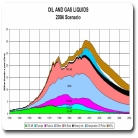
Oil production in Australia peaked in 2000. It would have peaked worldwide too by now, had it not been for the shale oil boom in the US.
Some interesting work by this country’s most unrelenting peak oil proponent, retired engineer Matt Mushalik, shows that without shale oil – which accounts for 1.5 million barrels a day – world oil production last year was back at 2005 levels. It seems a monumental economic crisis may have been averted.
Still, the price of crude oil has stubbornly hovered around its present mark of $US108 a barrel for the past three years even as shale oil production has ramped up.
For motorists in Australia, should consensus predictions of a falling Australian dollar come to pass, prices will head higher at the petrol pump in coming years.
This currency effect, however, is a sideshow compared with the big question of world oil prices and production.
Thanks to the shale oil boom, the more alarmist cries of the peak oil brigade have been subdued. Even with advancing technology and ever more sophisticated extraction methods though, it is London to a brick that the price of crude oil will rise sharply in the longer term.
You would think then that peak oil might be factored in to major policy decisions about the future of the nation and its infrastructure.
Energy security is paramount.
But it is not so. In early 2012, then industry minister Kim Carr declined to table the federal government’s peak oil report BITRE 117 before a Senate hearing on grounds that it was ”not up to scratch”.
Later that year, the energy white paper also failed to deliver an updated version. Research on oil, perhaps the most critical commodity for Australia’s long-term security, has been abandoned.
As the Abbott government grapples with the tricky question of how to fund big projects ahead of public hearings on infrastructure next month, the question of oil prices is not even on the agenda.
Already, the bias of state and federal governments for roads over rail has been well documented. As oil is the most critical commodity in fuelling any transport option, you could be forgiven for thinking that it should be on the agenda.
Nothing in the issues papers, nothing in the draft report from the Productivity Commission. It seems to be an article of faith that people will keep finding oil somewhere, so let’s not give it a second thought.
In an interview with the US Association for the Study of Peak Oil and Gas in January, an ex-Saudi Aramco geologist, Dr Sadad Al-Husseini, predicted oil price spikes of $140 by 2016-17.
”My base oil price forecast in 2012 dollars still ranges between $US105 and $US120/barrel … with a volatility floor of $US95/barrel and more probable upward spiking to $US140/barrel within 2016-17.”
Dr Al-Husseini’s forecast in 2009 of a limited plateau of oil supplies appears to have been vindicated. He said the plateau might have been inflated thanks to high-cost unconventional oils but major forecasters see this as pretty much transitional. ”The plateau itself remains a reality and unfortunately its duration is still unlikely to extend beyond the end of this decade.”
He highlighted several factors that would inhibit the expansion of production, including decline rates (more extreme than ever with shale oil and deep offshore), limited investments (quadrupled capex/barrel in the past few years) and economic growth (still recovering). ”In the long term, reserves depletion remains very high with totally inadequate reserves replacements regularly obscured by resorting to claiming ‘resources’ as reserves.”
The industry has moved into a higher-cost paradigm with very limited growth in conventional oil and condensate supplies, accelerated ”proven” reserves depletion and high levels of violence and conflicts around the world’s major basins of low-cost oil production.
Australia is fortunate in having enormous gas resources. Still, with the world population forecast to grow to 11 billion by the end of this century and the developing economies ever-thirsty for oil, it would seem foolish to ignore the oil price in long-term infrastructure planning.
Mind you, short-termism is an affliction not merely contained to oil. In the annual Mitsubishi lecture back in 2010, Don Elder, chief executive of coal company Solid Energy, said there was enough in coal reserves for 100 years. Yet in one more generation, global demand for food and energy would double.
8 Comments on "Blinkered to threat of rising oil prices"
rockman on Sun, 16th Mar 2014 8:55 pm
“It would have peaked worldwide too by now, had it not been for the shale oil boom in the US.” The world isn’t producing more oil because of the shale plays. All the plays are producing and developing more oil because the price of oil has increased over 300%.
“the price of crude oil has stubbornly hovered around…$US108…as shale oil production has ramped up.” Well, da! It’s almost as if the increased shale production is the result of the higher oil price. Or maybe based oni his thought processes he thinks the price of oil has gone up because we are producing more from the shale?
“It seems a monumental economic crisis may have been averted.” I suppose I have a different concept of “crisis”. I would consider the ADDITIONAL $10 TRILLION the global oil consumers have paid since prices jumped up a significant Economic crisis”. And let’s not leave out the $TRILLIONS and many tens of thousands of lives expended in the various military adventures conducted in oil exporting regions.
Perhaps the author considers these as just little bumps in the road to prosperity by the oil importing economies of the world. Or perhaps he’s referring to the economic crisis averted by countries like the KSA which has seen their oil export revenue increase from $60 billion/ye to over $300 billion/yr. Yeah, yeah…that’s the ticket. LOL.
bobinget on Sun, 16th Mar 2014 9:54 pm
repost of typical gas bag come on published a few hours ago.
Summary and Recommendation
Technological breakthroughs in 2013 for buy-recommended Cimarex Energy (XEC) may have boosted the company’s future value creation potential in the Permian Basin to $50 billion, four times today’s Net Present Value (NPV) of $125 a share. The catch is that it would take some ten years for the company to grow to five times its current size, which would be a rate of 17% a year. Yet, as Chairman Tom Jorden stated on the quarterly earnings call on February 19, “..the sheer size of Cimarex’s Wolfcamp opportunity became much clearer in 2013.” The first well to combine the new “upsized frac” with a 10,000 foot lateral well section produced at an initial 30 day rate of 2800 barrels equivalent daily. Previously, a 5000 foot lateral well created incremental value of $11 million for a drilling cost of $9 million (see chart Upsized Returns on page 2). We sketch a tally of 5200 locations for such wells (see table Permian Locations on page 2 and chart Wolfcamp Section on page 3). A pilot program is underway to develop data for designing the optimum development program (see slides Culberson Pilots and Reeves Pilots on pages 3-4). Meanwhile, few of the 5200 locations are included in our estimate of NPV, which is tied to proven reserves and estimated cash flow for the next twelve months (see tables Present Value on page 4, Operating and Financial Estimates on page 5). At a McDep Ratio of 0.92, Cimarex offers attractive value in a dynamic small cap independent producer group (see Tables 1-4 on pages 6- 9).
Kurt H. Wulff, CFA
bobinget on Sun, 16th Mar 2014 10:20 pm
Agreeing with Rockman, we, our economy, would have been totally screwed were it not for much maligned
miracle of wringing oil and GAS from source rock
more dense than foundations beneath our houses.
However, shale tech has given us a few more years, perhaps another decade, to ‘live’.
If three thousand agronomists, climate scientists, gave the planet three more years before major food supply interruptions, how many would do nothing thinking
‘those scientists are just looking for grant money’?
alokin on Sun, 16th Mar 2014 10:22 pm
All what Tony want is to convert Australia into a big mining and fracking place. He will not spare UNESCO world heritage areas (i.e Blue Mountains) and he is not not interested were the drinking water in Sydney comes from.
Australia has one of the most appalling public transport Systems in the world and we are stuck with this.
Stilgar Wilcox on Sun, 16th Mar 2014 11:16 pm
”My base oil price forecast in 2012 dollars still ranges between $US105 and $US120/barrel … with a volatility floor of $US95/barrel and more probable upward spiking to $US140/barrel within 2016-17.”
If oil goes to 140 a barrel in 2016-17, why wouldn’t the world economy slip into recession like it did in 08? And if it does, why wouldn’t oil price drop like it did in 08 greatly reducing non-conventional supply?
Calhoun on Mon, 17th Mar 2014 10:53 am
Rockman, give the guy a break. His reporting is pretty good for a MSM outlet. He’s delivering the message that needs to be heard, not that it will be.
rockman on Mon, 17th Mar 2014 11:46 am
Calhoun – I used to be more patient with folks like this. But eventually I got tired of misrepresentative statements regardless of which side of the fence they are coming from. Facts are great but spin based presentations are very inappropriate at this dangerous state of the process IMHO.
Davy, Hermann, MO on Mon, 17th Mar 2014 12:23 pm
Stilgar — ”My base oil price forecast in 2012 dollars still ranges between $US105 and $US120/barrel … with a volatility floor of $US95/barrel and more probable upward spiking to $US140/barrel within 2016-17.” If oil goes to 140 a barrel in 2016-17, why wouldn’t the world economy slip into recession like it did in 08? And if it does, why wouldn’t oil price drop like it did in 08 greatly reducing non-conventional supply?
Stilgar, if the financial system manages to stay in a pseudo growth phase your price range is feasible. This pseudo growth phase is defined as a the new normal of central bank induced artificially low interest and monitarization of money supply rates leading to wealth transfer and maintenance of sovereign solvency reflected in a relatively stable bond market and rising stock market values. This growth is a possible by suppressing the normal business cycle with new normal fundamentals and very low bear sentiment. I believe this environment with the corresponding environment of manipulation, corruption, and disregard for rule of law can last. The problem is forecasting the life of this new normal is very difficult because it is completely confidence based at this point. It is a Ponzi scheme and all Ponzi schemes are confidence based. It does not matter how bad things get near the bottom because it is near the top where the action is. “IF” these folks at the top have confidence issues the flight to safety could be swift, messy, and painful. In this case, 2008 is a good template for oil prices. Oil would be a safe haven but prices would initially tank as the markets react to reduced economic activity. Many big plays would have to liquidate leveraged positions leading to price declines in gold and other hard value items to cover the unwind of speculative positions. “IF” a reboot occurs then oil prices could rise again if economic activity returns and investors pile into hard assets. The big word is “IF” this is because at this point the tools at the disposal of central banks and governments were used up in 2008 aftermath. These tools were monitarization and stimulus. These can only lead to hyperinflation if applied again in another 2008 style economic crisis. There are no other tools to fight a loss of confidence and regain stability. War may be an option but that will further depress economic activity by disrupting trade and confidence. This means war would be a short affair without the financial resources to maintain it.