
Peak Oil is You

Donate Bitcoins ;-) or Paypal :-)


Page added on March 10, 2014

Fukushima Radiation to Hit West Coast
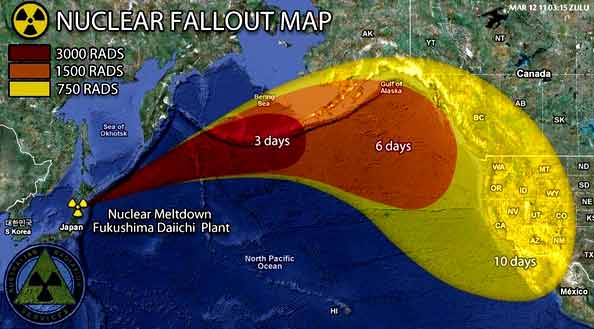
Very low levels of radiation from the Fukushima nuclear disaster likely will reach ocean waters along the U.S. West Coast next month, scientists are reporting.
Current models predict that the radiation will be at extremely low levels that won’t harm humans or the environment, said Ken Buesseler, a chemical oceanographer at the Woods Hole Oceanographic Institution who presented research on the issue last week.
But Buesseler and other scientists are calling for more monitoring. No federal agency currently samples Pacific Coast seawater for radiation, he said.
“I’m not trying to be alarmist,” Buesseler said. “We can make predictions, we can do models. But unless you have results, how will we know it’s safe?”
The news comes three years after the devastating Japan tsunami and resulting nuclear accident.
On March 11, 2011, a 9.0 magnitude earthquake hit off the coast of Japan, triggering a tsunami with waves as high as 133 feet. More than 15,000 people died and about 6,000 were injured.
The earthquake and tsunami knocked out power to cooling pumps at the Fukushima Daiichi nuclear power plant complex, causing meltdowns at three reactors.
Last July, Tokyo Electric Power Co., which operates the plant, acknowledged for the first time that the reactor was leaking contaminated underground water into the ocean.
Since then, the news has gotten worse, and there is widespread suspicion that the problem is underreported.
There are three competing models of the Fukushima radiation plume, differing in amount and timing. But all predict that the plume will reach the West Coast this summer, and the most commonly cited one estimates an April arrival, Buesseler said.
A report presented last week at a conference of the American Geophysical Union’s Ocean Sciences Section showed that some Cesium 134 has already has arrived in Canada, in the Gulf of Alaska area.
Cesium 134 serves as a fingerprint for Fukushima, Buesseler said.
“The models show it will reach north of Seattle first, then move down the coast,” Buesseler said.
By the time it gets here, the material will be so diluted as to be almost negligible, the models predict. Radiation also decays. Cesium 134, for example, has a half-life of two years, meaning it will have half its original intensity after that period.
In Oregon, state park rangers take quarterly samples of surf water and sand at three locations along the coast. The water is analyzed for Cesium 137 and iodine 131. Both of those already exist in the ocean at low levels from nuclear testing decades ago.
The monitoring began in April 2012, when tsunami debris began arriving along the Oregon coast. So far, all of the tests have shown less than “minimum detectable activity,” or the least amount that can be measured.
Results of the most recent samples, taken in mid-February, won’t be available until mid-March, Oregon Health Authority spokesman Jonathan Modie said.
Washington does not test ocean water for radiation.
“We have none happening now and we have none planned,” said Tim Church, communications director for the Washington State Department of Health. “Typically that would be something that would happen on the federal level.”
California regularly samples seawater around the state’s nuclear power plants to determine whether the plants are impacting the environment. Those results all are below minimum detectable activity.
Some citizens and scientists are taking sampling into their own hands.
Cal State Long Beach marine biologist Steven Manley has launched “Kelp Watch 2014,” which will partner with other organizations to monitor kelp all along the West Coast for Fukushima radiation.
And Buesseler recently offered the services of his lab at Woods Hole in Massachusetts.
His project — titled “How Radioactive Is Our Ocean?” — will use crowd-sourced money and volunteers to collect water samples along the Pacific Coast, then ship them across the country to be analyzed.
So far, results are in for two locations in Washington and three in California. They show that the plume has not yet reached the coast.
Meanwhile, West Coast states are winding down their tsunami debris response efforts.
Oregon’s coastline is seeing less debris from the tsunami this winter than in the past two years, Oregon State Parks spokesman Chris Havel said.
If that doesn’t change, officials likely will disband a task force that was mobilized to deal with the debris.
Last year, Washington suspended its marine debris reporting hotline.
15 Comments on "Fukushima Radiation to Hit West Coast"
CAM on Mon, 10th Mar 2014 5:05 pm
No amount of radiation is “safe”! Less is always better. The very first exposure to low level radiation could prove fatal eventually to some individuals. Radiation is a hit and miss type event. The more radiation in your environment the greater the chance of certain types of cancer. There is no such thing as “zero risk” when it comes to radiation!!
Kenz300 on Mon, 10th Mar 2014 5:15 pm
Nuclear energy is too costly and too dangerous…….
Elon Musk Thoughts on transitioning to 100% renewable energy – YouTube
http://www.youtube.com/watch?v=rce5RZHCzLk
Northwest Resident on Mon, 10th Mar 2014 6:14 pm
Fukushima Radiation to Hit West Coast.
Oh no! Not again! Isn’t this about the tenth or twentieth time it has hit the West Coast — if all the “news” articles are to be believed?
Don’t worry. If and when Fukushima Radiation really does hit the West Coast in any amounts that are dangerous, we won’t be reading about it as if it is an imminent event, we will be reading about mass panic, chaos and disaster in the making. Until then, I’m going to maintain my skeptical point of view on the dangers of Fukushima radiation hitting the West Coast.
Nony on Mon, 10th Mar 2014 6:40 pm
Looks like we’ve reached peak peakoil.com. Reruns…
😉
GregT on Tue, 11th Mar 2014 12:08 am
Fukushima radiation has been found off of the west coast of Vancouver Island in BC Canada, levels are being monitored by government officials as we speak.
http://news.discovery.com/earth/oceans/fukushimas-radioactive-ocean-water-arrives-at-west-coast-140222.htm
It has been in the local news here for the last week. Whether levels rise above those considered ‘acceptable’ we will just have to wait and see. I agree with what Cam said above though, no amount of radiation is safe. The higher the dosage, the higher the chance of adverse health effects. My wife is a cancer specialist, and this is her conclusion as well. We should see the full effects of Fukushima in a few decades.
SilentRunning on Tue, 11th Mar 2014 1:14 am
I agree that radiation levels should be monitored on the West Coast, as a precaution.
But it would take an extraordinary confluence of events for the levels to reach anything serious – and if they did, it would only be in a small area.
There simply isn’t enough radiation in the entire Fukushima complex to poison the entire Pacific ocean. It would take over 100 Fukushimas – all the radioactive debris in all reactors and cooling pools – ground into a powder and sent adrift – to equal the naturally occurring radiation from Potassium 40 and Carbon 14.
So by all means – yes – monitor the radiation – but don’t be surprised if it is very low.
PS: If you’re worried about cancer deaths – then avoid going out in the sun. UV radiation causes skin cancer. It’s also 100% natural.
GregT on Tue, 11th Mar 2014 2:08 am
“UV radiation causes skin cancer. It’s also 100% natural.”
Skin Cancers also, are on the rise. Scientists are not sure what the cause is.
http://www.skincancer.org/skin-cancer-information/skin-cancer-facts/nonmelanoma-skin-cancer-incidence-jumps-by-approximately-300-percent
dubya on Tue, 11th Mar 2014 2:33 am
It seems a simple issue – There is no monitoring since there is nothing the government can or will do about it anyway. Assuming the water is tested and a dangerous level of radiation is detected, what would we do?
The Canadian government has become a pro at this, shutting down most climate and pollution research, then claiming there is no evidence of same.
About all you could say is don’t eat the fish, but those fish have already swum ahead of the plume.
Kenz300 on Tue, 11th Mar 2014 3:59 am
Nuclear energy — “too cheap to meter” ends up being too costly and too dangerous for humanity.
Poordogabone on Tue, 11th Mar 2014 4:09 am
CAM wrote: “No amount of radiation is “safe”! Less is always better.”
If I may be a bit contrarian on that statement.
Everything on earth has evolved bombarded by low level radiation. It is part of our fabric and help speed up our evolution if you believe that radiation causes mutations. As long as levels remain low I think it’s OK.
OTOH if you’re a diet coke user or ingest any chemical based sugar substitute on a regular basis, you’re introducing something in your system that it has never coped with since life began. Like playing guinea pig IMHO.
I’m also more concerned about our everyday exposure to urban/industrial pollutions also alien invaders to our bodies.
I do feel bad for the japanese, it’s such bad luck and a huge tragedy, whole towns were wiped out.
GregT on Tue, 11th Mar 2014 6:19 am
Poordog,
From Wiki,
“Caesium-137 in the environment is anthropogenic (human-made). Unlike most other radioisotopes, caesium-137 is not produced from the same element’s nonradioactive isotopes but as a byproduct of the nuclear fission of much heavier elements,[10] meaning that until the building of the first artificial nuclear reactor, the Chicago Pile-1, in late 1942, it had not occurred on Earth for billions of years. By observing the characteristic gamma rays emitted by this isotope, it is possible to determine whether the contents of a given sealed container were made before or after the first atomic bomb explosion (Trinity test, July 16, 1945), which spread some of it into the atmosphere, quickly distributing trace amounts of it around the globe. This procedure has been used by researchers to check the authenticity of certain rare wines, most notably the purported “Jefferson bottles”.[11] It is also possible to date soils and sediments, given the short life of Cs137 across the Earth’s entire surface.”
In other words, all radiation is not the same. Our species has never been exposed to the ‘characteristic gamma rays’ emitted by caesium 137, until we put it into the environment. Also C137 bioaccumulates in soft tissue, and since radiation exposure is reduced in inverse ratio to the square of the distance, the reverse is also true, the closer you get the greater the exposure.
GregT on Tue, 11th Mar 2014 6:37 am
dubya,
“It seems a simple issue – There is no monitoring since there is nothing the government can or will do about it anyway. Assuming the water is tested and a dangerous level of radiation is detected, what would we do?”
The only that we can do, is stop producing more of these radioisotopes, and spreading them throughout the Earth’s environment. It is too late to stop the damage that we have already done, but it is not too late to stop doing even more damage.
It is all a game of chance now, as to whether or not cancer is in our individual futures. We never should have screwed around with things that we don’t understand, and continuing to do so is not only extremely irresponsible, it is idiotic.
SilentRunning on Tue, 11th Mar 2014 7:16 am
GregT wrote:
>In other words, all radiation is not the same. Our species has never been exposed to the ‘characteristic gamma rays’ emitted by caesium 137, until we put it into the environment.
Perhaps true, but we *have* been exposed to the even higher energy gamma rays of K-40. K-40 puts out gamma rays at 1.33 & 1.46MeV energy. Cs-137, on the other hand, puts out lower energy 0.662MeV energy gamma rays.
GregT>Also C137 bioaccumulates in soft tissue,
That it incorrect. Cs-137 washes out of your system with a biological half-life of around 70 days.
SilentRunning on Tue, 11th Mar 2014 7:23 am
BTW: I notice that the radioisotope is just now being detected in very tiny concentrations in Canada, and is expected to start being detectable off the west coast of the USA in a few months.
But that makes me confused. Wasn’t the deaths of star fish a few months ago being attributed to Fukushima radiation in these areas – areas that apparently hadn’t even gotten exposed to any Fukushima radioisotopes yet. Isn’t that weird?
GregT on Tue, 11th Mar 2014 3:25 pm
Silent,
A quick google search, “caesium 137 bioaccumulation” results in information as to HOW Cs-137 bioaccumulates. I see no argument as to whether it does or not.
Also, the distance from radioisotope to the tissue in question is of utmost importance. At an atomic level, Cs-137 is lethal. At a molecular level, it is obviously many magnitudes greater than when outside of the body.