
Peak Oil is You

Donate Bitcoins ;-) or Paypal :-)


Page added on March 3, 2014

Post peak countries: the collapse of Yemen
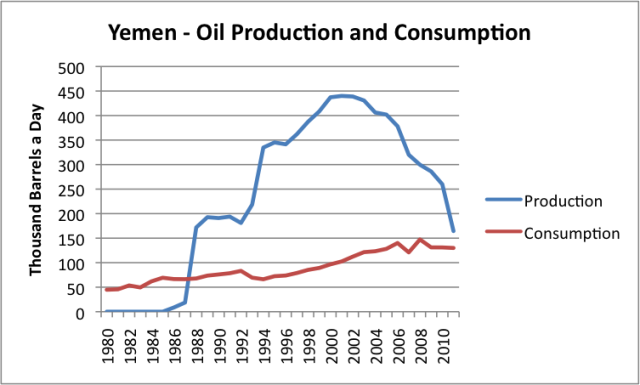
Image from “Our Finite World”
When I saw for the first time the data about oil production in Yemen, I was so impressed that I wanted to know more. I found a news source in English – the “Yemen Times” and I placed the link in my feed. For several months, by now, I have been reading the news from a place where I have never been and, probably, will never go, but that I find incredibly fascinating.
The stories in the Yemen Times read as a tragedy written by Shakespeare: for a taste of this feeling, you may read the article titled “Carrying out a death sentence,” but it is just an example of a never ending series of disasters taking place in the country, which include some 4000 people murdered every year, including a few taken as target by American drones flying over the country.
Surely, not everything that’s taking place in Yemen is to be attributed straight to crude oil but, surely, with oil production now crossing consumption, with the government getting about 70% of its revenues from oil, and with Yemen producing very little that can be exported apart from the “Qat” drug, then some kind of disaster is to be expected. And consider that population continues to grow: Yemen has now about 25 million people (and 50 million guns).
What is perhaps most startling of the news that you read on the “Yemen Times” is that crude oil is rarely mentioned – except to say that everything is fine and production will soon increase. It seems that the real reason of collapse must remain hidden from those who are experiencing it. Yemen, surely, is not the only case.
Although oil depletion is rarely mentioned in the Yemen Times, sometimes it is and recently an article appeared that does mention oil; actually, barely mentioning it but at least providing a merciless analysis of the Yemen situation. Qais Ghanem defines the future of Yemen as “bleak”, and correctly so. But it is not just about Yemen’s future: living in post peak countries seems to be bleak everywhere.
Yemen’s future looking very bleak
Multiple disasters are looming for Yemen.
One that is rapidly approaching is that of water shortage. Already, the per capita water availability in Yemen is the lowest in the world. A 2005 study by Al Asbahi estimated the total annual water requirements of Yemen to be 3.4 billion cubic metres. At the same time renewable sources, such as rain, can provide up to 2.5 billion cubic metres. There is, therefore, a deficit of 0.9 billion cubic metres, which has to come from the aquifers deep underground, which are progressively depleting, and may run dry by the time US President Barack Obama finishes his term, and starts writing his autobiography! We know this because wells have to be dug deeper and deeper, many as deep as half a kilometre.
The mismanagement of water resources is shocking. Due to a lack of maintenance, loss from leaking pipes can be as much as 60 per cent. Contamination of water, by sewage seeping into the ground, is difficult to measure but significant. Wasteful flood irrigation is the norm in Yemen, whereas drip irrigation would be 50 per cent more efficient.
As expected, agriculture uses 90 per cent of the available water, but half of that is squandered on growing qat, the infamous mild stimulant of Yemen and the countries of the Horn of Africa, which have a per capita GDP of under $1,000 (Dh3,673), the lowest in the world.
Yemeni farmers grow qat because it sells and has profits that are at least five times higher than other crops. In July 2013, Foreign Affairs website published an article titled ‘How Yemen Chewed Itself Dry’.
Yemen has the occasional floods caused by heavy rains, as happened in 2010. But it does not have the dams or expertise to save such huge quantities of water—for a non-rainy day!
Unlike some countries in the Gulf region, Yemen can neither afford the cost of desalination nor of pumping water uphill from the Red Sea level to the mountains of the capital. Sana’a’s current population of two million is projected to reach four million in a decade.
The consequences are predictably serious. First, food production will suffer, and food prices will skyrocket. When farmlands run out of water, the animals also die of hunger and tourists stop coming. When poverty reaches a critical level, neighbours begin to fight over water resources. In a country that has 25 million people and 50 million guns, civil war is just waiting to erupt. Even today, an estimated 4,000 people are killed every year in disputes over land—many more than the victims of terrorism or drones.
It is not only water that is steadily depleting—oil is too. Foreign aid is very unpredictable, and comes with strings attached, such as a carte blanche to assassinate Yemenis with Obama’s drones.
The prospects are even worse when we factor in the fertility rate in Yemen, one of the highest in the world. Last week, I attended a one-day conference on Yemen at the London School of Oriental and African Studies, where I learned that there would be a huge increase in the teen population over the next 15 years.
Ordinarily, that would be an encouraging development. Not in this case, as these youngsters will be unemployed but will be well-versed in social media, and therefore well connected and presumably well informed — the requirements for riots and revolution.
So, if these dire predictions above are correct, what should Yemenis do?
I would respectfully suggest to my kith and kin that they first and foremost realise that the solution needs to come from them. The international community will only take feeble, temporary and strings-attached actions.
Second, Yemenis must find a way to ban qat. There! I said it! There will be many who might say that I have lost my mind. It won’t be easy. It will require an intensive and extensive educational pan-Yemen campaign, like the one mounted against smoking, and it will need to be a gradual one—over five years.
Yemenis should be watching numerous daily TV ads about how to help themselves, instead of wasting time watching the contrived comings and goings of the president.
Fortunately, qat is not an addictive drug, because it does not cause classic withdrawal symptoms. Many Yemenis who moved to GCC countries abandoned qat and are now very prosperous. Water, thus saved, could be used for human consumption, as well as for tourism and for the growing of vegetables and fruits. Farm animals should then thrive.
If Yemenis are not willing to do that, then let them stop complaining about thirst, diarrheal and liver diseases and ulcers, poverty, the absence of a modern state, and corruption. Let them also stop seeking handouts. It is ironic that the Kingdom of Sheba established its prosperity with the construction of the Mareb dam — 3,000 years ago.
Dr Qais Ghanem is a retired neurologist, radio show host, poet and author. His novels are ‘Final Flight From Sana’a’ and ‘Two Boys from Aden College’. His latest co-authored non-fiction work is ‘My Arab Spring My Canada’ (Amazon.com) and his combined English/Arabic poetry book is ‘From Left to Right’. Follow him on Twitter at www.twitter.com/@QaisGhanem
Cassandra’s legacy by Ugo Bardi
5 Comments on "Post peak countries: the collapse of Yemen"
TIKIMAN on Mon, 3rd Mar 2014 12:36 pm
Sucks to be them! LOL! 😀
Davy, Hermann, MO on Mon, 3rd Mar 2014 1:48 pm
Ugo Bardi is a great writer on the effects of contraction and collapse over the years. If we want to see what a global interconnected society face with a predicament of diminishing returns at the limits of growth then look to Pakistan, Yemen, Sudan, Greece, Argentina, Haiti, North Korea, and many others. Just look at the various problems that are not being solved and are worsening. Several of these countries have large and growing populations that are currently well past their carrying capacity. It is only the world’s global trade and distribution that keep those societies from imploding. As the global economic system begins to fail from all the tipping points facing its ability to grow and solve problems we will see these failed state symptoms in the richer developing and the developed world. When these problems become serious enough in a widespread outbreak of instability the connections that hold trade and vital global infrastructure together will fray and break. We will see the global society’s fabric come apart. Globalism is in its last pulse of growth and soon will experience a quick and dangerous contraction. The issue of our all-important local support system failing along with this global economic decline is all important to each of us. We live and survive locally but our local is a primary extension of the global currently. No area is immune from this contraction. We are facing a paradigm shift of mega proportions. Our positive response to these failed states can slow the process but it will not stop it as more states fail in a fall of the dominoes. The best we can do is work on local life boats and hope the top down does not create more obstacles in its failed attempt to maintain the status quo BAU.
ghung on Mon, 3rd Mar 2014 2:41 pm
Yemen may end up being a case of where winning the race to the bottom works out to be something of an advantage. Their oil endowment, being relatively modest and short lived, has not stimulated the high level of development that many other oil exporting countries experienced; not as much investment in infrastructure that must be maintained along with western levels of consumption. Population levels, of course, will/must fall closer to the carrying capacity of their environment.
Davy, Hermann, MO on Mon, 3rd Mar 2014 3:04 pm
Great point Ghung. The same can be said for Greece in Europe
noobtube on Mon, 3rd Mar 2014 8:35 pm
Haiti and the Sudan are examples of the racist trash terrorizing them.
When oil was first being exploited, the peoples in these lands were suffering at the hands of the imperialists.
During the bounty of oil, they were suffering at the hands of the imperialists.
With the decline, they are suffering at the hands of the imperialists.
Same spit. Different day.
It would be interesting if these peoples actually improve once Europe (West Asia), the United States, Canada, and Australia LOSE THEIR OIL and COAL bounties.
What would Africa and the Caribbean and the rest of the world be like without the racist garbage stealing their land, labor, and their natural abundance and carting it off to a bunch of ungrateful, spoiled, entitled, deluded idiots in Europe, North America, and Australia?