
Peak Oil is You

Donate Bitcoins ;-) or Paypal :-)


Page added on February 10, 2014

Gas Prices Set to Rise
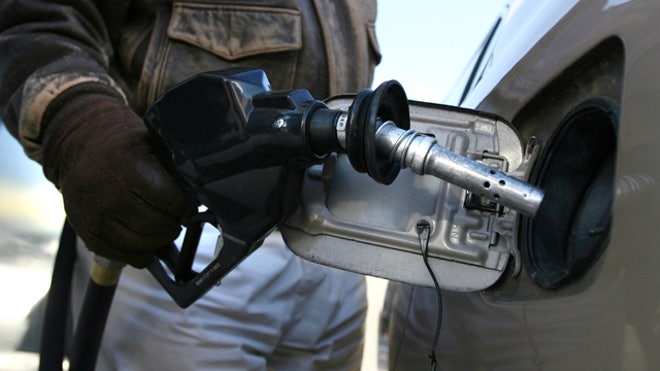
AAA warned gas prices are set to rise this spring, after winter weather across many parts of the country kept demand low and provided a slight reprieve in recent weeks.
Prices typically climb higher during the spring when refineries cut production to do seasonal maintenance. A regulated switch to summer-blend gasoline can also limit supplies, just as demand strengthens.
AAA said expected peak prices of $3.55 to $3.75 a gallon would be lower than last year, when the national average jumped 49 cents to $3.79 a gallon in just 41 days.
Bob Darbelnet, the travel group’s president and CEO, said the increase will likely be temporary, but it still may cost drivers in excess of $60 to fill up their cars.
“There is a good chance that average gasoline prices this year will cost less than in 2013, but it is not going to be cheap,” he said.
Prices often fall back once the refinery maintenance period ends and production returns to normal rates, AAA noted. The national average could drop to $3.30 to $3.40 a gallon by late June before climbing back up in late fall. Gas hit a summer low of $3.47 last year.
According to AAA’s Daily Fuel Gauge Report, gas hit an average of $3.27 a gallon on Friday, down a penny since last week and roughly four cents versus a month ago. The national average was about $3.55 on the same day in 2013.
AAA also said drivers along the Gulf Coast and in the central part of the U.S. will see the least expensive gas. Prices could drop below $3 a gallon in some areas before the year is out, thanks to lower taxes and abundant supplies of cheaper North American crude oil.
The Northeast and West Coast will be dealing with more expensive gas. Local refineries often rely on costlier imported oil and gasoline, and the regions also have higher gas taxes.
23 Comments on "Gas Prices Set to Rise"
TIKIMAN on Mon, 10th Feb 2014 1:02 pm
“$3.55 to $3.75” peak prices?
Yeah…
They will get over $4.00 at least once in even the cheapest part of the country.
Davy, Hermann, MO on Mon, 10th Feb 2014 1:48 pm
Strange world of prices in the US because of all this new internal North American production. I see them rising a bit. I still believe the Goldilocks range will put a limit on the price up and down at least if we want to maintain capex on down side and financial system on the high end.
rockman on Mon, 10th Feb 2014 2:17 pm
Davy – same old dynamic: demand can have a greater impact on prices then supply capability. We have the same or slightly more NG production today than a few years ago. Yet those prices are more than 2X higher now. Which is one reason that positive growth in the US economy is not a good thing in all quarters. Great to have more jobs and less unemployment. But those additional working bodies will increase demand. So even with more domestic oil/NG production the market will respond with upward pressure on prices as the economy grows.
Davy, Hermann, MO on Mon, 10th Feb 2014 2:57 pm
Rock, I agree at a certain level but I am not sure I would say the economy is growing in a pre-new normal setting. This economic growth may be valid in regions and markets though. Overall I am seeing indications of stagflation with the basics, number manipulations, bloated finance sector growth, and or paper growth. Real economic growth nationwide is plateaued similar to oil production. “Shadowstats” is a good source offering an alternative to the distorted government numbers meme. You probably been there already.
shortonoil on Mon, 10th Feb 2014 3:33 pm
In spite of the mythology that has arisen around shale oil, it will do very little to reduce finished product prices. Production out of the Bakken, Eagle Ford and the Permain Basin has flooded the Gulf Coast with field condensate (pentane, C5H12 ), Field condensate is a light hydrocarbon that must be further processed (with a very high energy input) to produce gasoline. EOG reports that 70% of Eagle Ford production is field condensate.
To capitalize on this flood of light (not particularly valuable hydrocarbons) companies like Marathon, and Velario are building condensate splitters (which are a type of mini refinery, only costing $200 million apiece). Condensate splitters reconfigure field condensate into other fractions:
Output %yield
LPG 3
Naphtha 60
Jet fuel 12
Gasoil 20
Fuel Oil 3
Even after being reprocessing field condensate produces less that half the gasoline per barrel that conventional crude produces (20% vs 45-50). Don’t expect shale production to reduce the price at the pump, its not going to happen!
http://www.thehillsgroup.org/
Northwest Resident on Mon, 10th Feb 2014 3:34 pm
Unemployment is much greater than officially reported numbers indicate, which lowers the demand on gasoline and that probably reflects in somewhat lower prices at the gas pump. I personally expect to see even more in the real growth of unemployment numbers as the year progresses. Especially in retail and auto industry. Cutting food stamps and unemployment benefits will further decrease demand on gasoline as unemployed people spend what little they have on Big Macs and other food essentials.
http://www.zerohedge.com/news/2014-02-09/about-those-29-million-jobs-lost-january
Northwest Resident on Mon, 10th Feb 2014 3:39 pm
“…abundant supplies of cheaper North American crude oil”
Question: Do we really have abundant supplies of cheaper North American crude oil, or do we have abundant supplies of cheaper fracked liquids which are NOT the same thing as crude oil?
And it looks like shortonoil has answered that question above. An abundance of cheap North American crude oil — totally misleading statement, IMO.
antaris on Mon, 10th Feb 2014 5:17 pm
Does not seem to matter here in San Francisco as most people are driving full sized cars (the exception being lots of Prius’s). When I get home to Vancouver this afternoon (where gas is much more expensive) I will again see mostly smaller more fuel efficient cars.
rockman on Mon, 10th Feb 2014 5:38 pm
“Do we really have abundant supplies of cheaper North American crude oil, or do we have abundant supplies of cheaper fracked liquids which are NOT the same thing as crude oil?”
I suppose it all depends on how one defines “cheap” and “abundant”. At $90+/bbl, be it crude or the light distillate from the shales none of it would be classified as “cheap” as I see it.
And abundant? In what context: compared to what we had producing 5 years ago or compared to how much we use daily. A big increase for sure. But not very abundant given we still import a huge amount of our consumption.
Was that a trick question, you dog?
Northwest Resident on Mon, 10th Feb 2014 6:12 pm
It was a trick question, rockman, but you didn’t fall for it. Dang it! But seriously, how can we claim to have abundant quantities of “crude oil” when we are importing so much of it. I think actually the wording in the article is what is “tricky” — I was hoping for a little informed clarification and you came through for me again. Thanks BUD!
ghung on Mon, 10th Feb 2014 7:04 pm
Abundant: present in great quantity; more than adequate; oversufficient…
DC on Mon, 10th Feb 2014 7:15 pm
Wow, the price of amerikas favorite drink, leaded gaz-o-leen, ‘might’, go up 4 WHOLE nickels, sometime this year. Or maybe not. 4 nickels does not begin to move gas towards its true cost, $10-$15 a gallon that the empires debt serfs in Wall-martlandia should be paying. Wake me up when it goes up in dollar sized increments, not a couple nickels.
Davy, Hermann, MO on Mon, 10th Feb 2014 7:31 pm
We are DC when you include the access premium of the cost of the US military. We pay more than anywhere else. Bitch to your Iranian buddies or the many others paying subsidized prices not us.
Northwest Resident on Mon, 10th Feb 2014 7:37 pm
That’s a very important point that Davy just made. We do have some posting on this site that seem to think the American “empire” is evil, and the U.S. Military is simply an evil arm of the evil empire. But the truth is, the American military is responsible for keeping the world trade commons open and protected. Were it not for that significant and expensive “protection”, this global economy and all national economies would fall very quickly like dominoes in a straight line. But don’t expect the America-haters and the not-so-deep thinkers to fully understand that fact.
shortonoil on Mon, 10th Feb 2014 7:50 pm
“Wow, the price of amerikas favorite drink, leaded gaz-o-leen, ‘might’, go up 4 WHOLE nickels, sometime this year. Or maybe not.”
By our calculations; federal, state, local governments, and some private institutions in 2012 spent $2.7 trillion dollars protecting, monitoring, regulating, and servicing petroleum and its products. The actual cost of a gallon of gasoline in 2012 was $10.43 per gallon. The reason gasoline is still cheap at the pump is because only a small part of its total cost is reflected in the price quoted to the consumer.
Someplace — 7 naval fleets, millions of miles of roads, and a plethora of regulatory agencies have to be added into the cost.
http://www.thehillsgroup.org/
DC on Mon, 10th Feb 2014 8:28 pm
Subsides are problematic everywhere. Iran tried to remove its generous end user-subsidies a few years ago, but had to back off in the face of public opposition-so much for the ‘mad mullahs and their iron rule’. But at least, Irans subsidies dont have much impact beyond its own borders. Subsidizing North Americas suburban shop-till-you-drop lifestyle however, affects the entire world.
rockman on Mon, 10th Feb 2014 8:56 pm
NR – “the American military is responsible for keeping the world trade commons open and protected”. True but let’s not forget a fortunate side effect: they also “get to blow sh*t up”. LOL.
But seriously it’s like the point I just made elsewhere: the US govt and private businesses are in a symbiotic relationship. Neither could exist as it does today without the other. Sure…lots of ugly pieces in that jigsaw puzzle. But once all those pieces are in place it works fairly well. The one big question for me is how well it will or won’t work as we stumble down the PO path. I have serious doubts at times. But an occasional large dose if single malt will ease those fears…for a while. LOL.
Davy, Hermann, MO on Mon, 10th Feb 2014 9:14 pm
Yeap, N/R shortonoil, and Rock, it has worked well overall for years but the writing is on the wall because you can’t change change. What is ahead is debated here day in and day out but I am sure we all agree not what we grew up with.
DC while I agree with your criticism of suburban life in the US it has been very profitable for the rest of the world. Just check out the multi-year US trade deficits. Yet the real tragedy is a built up way of life with no future. Yet, not sure any place has much of a future. “SO” it was fun while it lasted. I know my time spent there was fun in the 60’s and early 70’s. The early suburban days were packed with optimism and happiness. Country boy now and I can’t stand suburbia for more than a few days anymore!
Northwest Resident on Mon, 10th Feb 2014 9:34 pm
rockman — All so true.
One of the books I read and was forced to study in my college days was/is called “The Prince” by Machiavelli. That book had a profound influence on me, as it has so many others. The main theme in that book as I’m sure you are well aware is “what is the most good for the greatest number of people”? We find in real life many situations where “the Machiavelli principle” comes into play. And that’s just the way it is. Not news to you, I’m one hundred percent positive. Sometimes, you just gotta blow sh*t up — you’d rather not have to do it, you try to find other ways around it, but in the end you’re faced with a problem that only a sufficient amount of ordnance can solve. If it wasn’t that way, then it wouldn’t be planet earth or God’s great creation.
shortonoil on Mon, 10th Feb 2014 10:08 pm
“The one big question for me is how well it will or won’t work as we stumble down the PO path.”
Our determination is that for ANY organization to survive over the next two decades, they will have to reduce their energy consumption by 3% per year. At first that wouldn’t be difficult, but a decade from now it is going to produce some huge conflicts. We are talking about industry vs government, government agency vs agency. The competition will be horrific!
http://www.thehillsgroup.org/
Makati1 on Tue, 11th Feb 2014 2:02 am
FYI: Regular gasoline here in Makati today is $4.80 per gallon. I’ve been here for 6 years now and I watch gas prices from habit. It has cycled between $4.750 and $5.10 for all six of those years. Most variations are caused by the dollar exchange rate. The number of Pesos remains about the same.
While that is high, diesel is a dollar less. The excise tax is about the same as in the US $0.42 per gallon and has not changed in about 20 years. The excise on diesel is about $0.16 per gallon.
But, I do not own a car here so my gas bill is minimal for a taxi once or twice a month and many of them run on NG.
GregT on Tue, 11th Feb 2014 6:26 am
NWR,
“We do have some posting on this site that seem to think the American “empire” is evil, and the U.S. Military is simply an evil arm of the evil empire. But the truth is, the American military is responsible for keeping the world
trade commons open and protected. Were it not for that significant and expensive “protection”, this global economy and all national economies would fall very quickly like dominoes in a straight line. ”
If the global economy does not fall quickly enough, the result will more than likely be global mass extinction. Would you not consider that to be evil?
Makati1 on Tue, 11th Feb 2014 2:16 pm
GregT, I do not believe that the trade would end if the US pulled back and just protected it’s shores. What would happen is that merchant vessels would just have to be armed and pay their own protection costs like they did before. Once all freighters were properly armed, there would be no pirates to bother them. And piracy is almost nonexistent today. It is like the faux ‘terrorists’ that the US likes to threaten everyone with so that they are ‘needed’ for protection. A big pile of BS!