
Peak Oil is You

Donate Bitcoins ;-) or Paypal :-)


Page added on February 6, 2014

Limits to Growth–At our doorstep, but not recognized

How long can economic growth continue in a finite world? This is the question the 1972 book The Limits to Growth by Donella Meadows and others sought to answer. The computer models that the team of researchers produced strongly suggested that the world economy would collapse sometime in the first half of the 21st century.
I have been researching what the real situation is with respect to resource limits since 2005. The conclusion I am reaching is that the team of 1972 researchers were indeed correct. In fact, the promised collapse is practically right around the corner, beginning in the next year or two. In fact, many aspects of the collapse appear already to be taking place, such as the 2008-2009 Great Recession and the collapse of the economies of many smaller countries such as Greece and Spain. How could collapse be so close, with virtually no warning to the population?
To explain the situation, I will first explain why were are reaching Limits to Growth in the near term. I will then provide a list of nine reasons why the near-term crisis has been overlooked.
Why We are Reaching Limits to Growth in the Near Term
In simplest terms, our problem is that we as a people are no longer getting richer. Instead, we are getting poorer, as evidenced by the difficulty young people are now having getting good-paying jobs. As we get poorer, it becomes harder and harder to pay debt back with interest. It is the collision of the lack of economic growth in the real economy with the need for economic growth from the debt system that can be expected to lead to collapse.
The reason we are getting poorer is because hidden parts of our economy are now absorbing more and more resources, leaving fewer resources to produce the goods and services we are used to buying. These hidden parts of our economy are being affected by depletion. For example, it now takes more resources to extract oil. This is why oil prices have more than tripled since 2002. It also takes more resource for many other hidden processes, such as deeper wells or desalination to produce water, and more energy supplies to produce metals from low-grade ores.
The problem as we reach all of these limits is a shortage of physical investment capital, such as oil, copper, and rare earth minerals. While we can extract more of these, some, like oil, are used in many ways, to fix many depletion problems. We end up with too many demands on oil supply–there is not enough oil to both (1) offset the many depletion issues the world economy is hitting, plus (2) add new factories and extraction capability that is needed for the world economy to grow.
With too many demands on oil supply, “economic growth” is what tends to get shorted. Countries that obtain a large percentage of their energy supply from oil tend to be especially affected because high oil prices tend to make the products these countries produce unaffordable. Countries with a long-term decline in oil consumption, such as the US, European Union, and Japan, find themselves in recession or very slow growth.
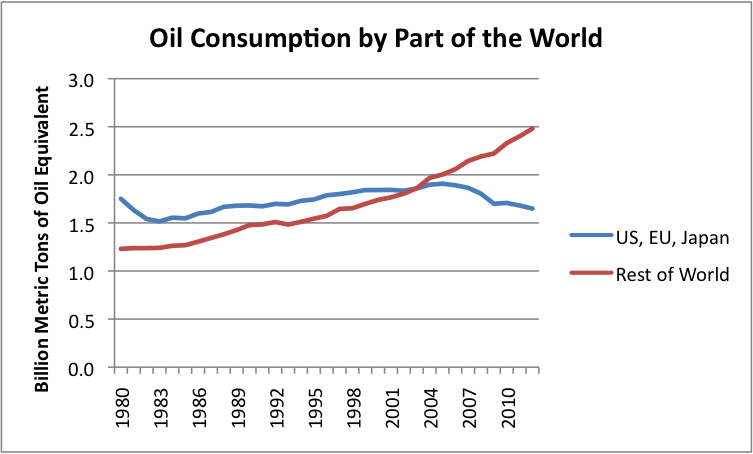
Figure 1. Oil consumption based on BP’s 2013 Statistical Review of World Energy.
Unfortunately, the problem this appears eventually to lead to, is collapse. The problem is the connection with debt. Debt can be paid back with interest to a much greater extent in a growing economy than a contracting economy because we are effectively borrowing from the future–something that is a lot easier when tomorrow is assumed to be better than today, compared to when tomorrow is worse than today.
We could not operate our current economy without debt. Debt is what has allowed us to “pump up” economic growth. Consumers can buy cars, homes, and college educations that they have not saved up for. Businesses can set up factories and do mineral extraction, without having past profits to finance these operations. We can now operate with long supply chains, including many businesses that are dependent on debt financing. The ability to use debt allows vastly more investment than if potential investors could only the use of after-the-fact profits.
If we give up our debt-based economic system, we lose our ability to extract even the oil and other resources that appear to be easily available. We can have a simple, local economy, perhaps dependent on wood as it primary fuel source, without debt. But it seems unlikely that we can have a world economy that will provide food and shelter for 7.2 billion people.
The reason the situation is concerning is because the financial situation now seems to be near a crisis. Debt, other than government debt, has not been growing very rapidly since 2008. The government has tried to solve this problem by keeping interest rates very low using Quantitative Easing (QE). Now the government is cutting back in the amount of QE. If interest rates should rise very much, we will likely see recession again and many layoffs. If this should happen, debt defaults are likely to be a problem and credit availability will dry up as it did in late 2008. Without credit, prices of all commodities will drop, as they did in late 2008. Without the temporary magic of QE, new investment, even in oil, will drop way off. Government will need to shrink back in size and may even collapse.
In fact, we are already having a problem with oil prices that are too low to encourage oil production. (See my post, What’s Ahead? Lower Oil Prices, Despite Higher Extraction Costs.) Other commodities are also trading at flat to lower price levels. The concern is that these lower prices will lead to deflation. With deflation, debt is strongly discouraged because it raises the “inflation adjusted” cost of borrowing. If a deflationary debt cycle is started, there could be a huge drop in debt over a few years. This would be a different way to reach collapse.
Why couldn’t others see the problem that is now at our door step?
1. The story is a complicated, interdisciplinary story. Even trying to summarize it in a few paragraphs is not easy. Most people, if they have a background in oil issues, do not also have a background in financial issues, and vice versa.
2. Economists have missed key points. Economists have missed the key role of debt in extracting fossil fuels and in keeping the economy operating in general. They have also missed the fact that in a finite world, this debt cannot keep rising indefinitely, or it will grow to greatly exceed the physical resources that might be used to pay back the debt.
Economists have missed the fact that resource depletion acts in a way that is equivalent to a huge downward drag on productivity. Minerals need to be separated from more and more waste products, and energy sources need to be extracted in ever-more-difficult locations. High energy prices, whether for oil or for electricity, are a sign of economic inefficiency. If energy prices are high, they act as a drag on the economy.
Economists have missed the key role oil plays–a role that is not easily substituted away. Our transportation, farming and construction industries are all heavily dependent on oil. Many products are made with oil, from medicines to fabrics to asphalt.
Economists have assumed that wages can grow without energy inputs, but recent experience shows the economies with shrinking oil use are ones with shrinking job opportunities. Economists have built models claiming that prices will rise to handle shortages, either through substitution or demand destruction, but they have not stopped to consider how destructive this demand destruction can be for an economy that depends on oil use to manufacture and transport goods.
Economists have missed the point that globalization speeds up depletion of resources and increases CO2 emissions, because it adds a huge number of new consumers to the world market.
Economists have also missed the fact that wages are hugely important for keeping economies operating. If wages are cut, either because of competition with low-wage workers in warm countries (who don’t need as high a wages to maintain a standard of living, because they do not need sturdy homes or fuel to heat the homes) or because of automation, economic growth is likely to slow or fall. Corporate profits are not a substitute for wages.
3. Peak Oil advocates have missed key points. Peak oil advocates are a diverse group, so I cannot really claim all of them have the same views.
One common view is that just because oil, or coal, or natural gas seems to be available with current technology, it will in fact be extracted. This is closely related to the view that “Hubbert’s Peak” gives a reasonable model for future oil extraction. In this model, it is assumed that about 50% of extraction occurs after the peak in oil consumption takes place. Even Hubbert did not claim this–his charts always showed another fuel, such as nuclear, rising in great quantity before fossil fuels dropped in supply.
In the absence of a perfect substitute, the drop-off can be expected to be very steep. This happens because population rises as fossil fuel use grows. As fossil fuel use declines, citizens suddenly become much poorer. Government services must be cut way back, and government may even collapse. There is likely to be huge job loss, making it difficult to afford goods. There may be fighting over what limited supplies are available.What Hubbert’s curve shows is something like an upper limit for production, if the economy continues to function as it currently does, despite the disruption that loss of energy supplies would likely bring.
A closely related issue is the belief that high oil prices will allow some oil to be produced indefinitely. Salvation can therefore be guaranteed by using less oil. First of all, the belief that oil prices can rise high enough is being tested right now. The fact that oil prices aren’t high enough is causing oil companies to cut back on new projects, instead returning money to shareholders as dividends. If the economy starts shrinking because of lower oil extraction, a collapse in credit is likely to lead to even lower prices, and a major cutback in production.
4. Excessive faith in substitution. A common theme by everyone from economists to peak oilers to politicians is that substitution will save us.
There are several key points that advocates miss. One is that if a financial crash is immediately ahead, our ability to substitute disappears, practically overnight (or at least, within a few years).
Another is key point is that today’s real shortage is of investment capital, in the form of oil and other natural resources needed to manufacture the new natural gas powered cars and the fueling stations they need. A similar shortage of investment capital plagues plans to change to electric cars. Wage-earners of modest means cannot afford high-priced plug in vehicles, especially if the change-over is so fast that the value of their current vehicle drops to $0.
Another key point is that the alternatives we looking at are limited in supply as well. We use far more oil than natural gas; trying to substitute natural gas for oil will lead to a shortfall in natural gas supplies quickly. Ramping up electric cars, solar, and wind will lead to a shortage of the rare earth minerals and other minerals needed in their production. While more of these minerals can be accessed by using lower quality ore, doing so leads to precisely the investment capital shortfall that is our problem to begin with.
Another key point is that electricity does not substitute for oil, because of the huge need for investment capital (which is what is in short supply) to facilitate the change. There is also a timing issue.
Another key point is that intermittent electricity does not substitute for electricity whose supply can be easily regulated. What intermittent electricity substitutes for is the fossil fuel used to make electricity whose supply is more easily regulated. This substitution (in theory) extends the life of our fossil fuel supplies. This theory is only true if we believe that coal and natural gas extraction is only limited by the amount those materials in the ground, and the level of our technology. (This is the assumption underlying IEA and EIA estimates of future fossil use.)
If the limit on coal and natural gas extraction is really a limit on investment capital (including oil), and this investment capital limit may manifest itself as a debt limit, then the situation is different. In such a case, high investment in intermittent renewables can expected to drive economies that build them toward collapse more quickly, because of their high front-end investment capital requirements and low short-term returns.
5. Excessive faith in Energy Return on Energy Investment (EROI) or Life Cycle Analysis (LCA) analyses. Low EROI returns and poor LCA returns are part of our problem, but they are not the whole problem. They do not consider timing–something that is critical, if our problem is with inadequate investment capital availably, and the need for high returns quickly.
EROI analyses also make assumptions about substitutability–something that is generally not possible for oil, for reasons described above. While EROI and LCA studies can provide worthwhile insights, it is easy to assume that they have more predictive value than they really do. They are not designed to tell when Limits to Growth will hit, for example.
6. Governments funding leads to excessive research in the wrong directions and lack of research in the right direction. Governments are in denial that Limits to Growth, or even oil supply, might be a problem. Governments rely on economists who seem to be clueless regarding what is happening.
Researchers base their analyses on what prior researchers have done. They tend to “follow the research grant money,” working on whatever fad is likely to provide funding. None of this leads to research in areas where our real problems lie.
7. Individual citizens are easily misled by news stories claiming an abundance of oil. Citizens don’t realize that the reason oil is abundant is because oil prices are high, debt is widely available, and interest rates are low. Furthermore, part of the reason oil appears abundant is because low-wage citizens still cannot afford products made with oil, even at its current price level. Low employment and wages feed back in the form of low oil demand, which looks like excessive oil supply. What the economy really needs is low-priced oil, something that is not available.
Citizens also don’t realize that recent push to export crude oil doesn’t mean there is a surplus of crude oil. It means that refinery space for the type of oil in question is more available overseas.
The stories consumers read about growing oil supplies are made even more believable by forecasts showing that oil and other energy supply will rise for many years in the future. These forecasts are made possible by assuming the limit on the amount of oil extracted is the amount of oil in the ground. In fact, the limit is likely to be a financial (debt) limit that comes much sooner. See my post, Why EIA, IEA, and Randers’ 2052 Energy Forecasts are Wrong.
8. Unwillingness to believe the original Limits to Growth models. Recent studies, such as those by Hall and Day and by Turner, indicate that the world economy is, in fact, following a trajectory quite similar to that foretold by the base model of Limits to Growth. In my view, the main deficiencies of the 1972 Limits to Growth models are
(a) The researchers did not include the financial system to any extent. In particular, the models left out the role of debt. This omission tends to move the actual date of collapse sooner, and make it more severe.
(2) The original model did not look at individual resources, such as oil, separately. Thus, the models gave indications for average or total resource limits, even though oil limits, by themselves, could bring down the economy more quickly.
I have noticed comments in the literature indicating that the Limits to Growth study has been superseded by more recent analyses. For example, the article Entropy and Economics by Avery, when talking about the Limits to Growth study says, “ Today, the more accurate Hubbert Peak model is used instead to predict rate of use of a scarce resource as a function of time.” There is no reason to believe that the Hubbert Peak model is more accurate! The original study used actual resource flows to predict when we might expect a problem with investment capital. Hubbert Peak models overlook financial limits, such as lack of debt availability, so overstate likely future oil flows. Because of this, they are not appropriate for forecasts after the world peak is hit.
Another place I have seen similar wrong thinking is in the current World3 model, which has been used in recent Limits to Growth analyses, including possibly Jorgen Randers’ 2052. This model assumes a Hubbert Peak model for oil, gas, and coal. The World3 model also assumes maximum substitution among fuel types, something that seems impossible if we are facing a debt crisis in the near term.
9. Nearly everyone would like a happy story to tell. Every organization from Association for the Study of Peak Oil groups to sustainability groups to political groups would like to have a solution to go with the problem they are aware of. Business who might possibly have a chance of selling a “green” product would like to say, “Buy our product and your problems will be solved.” News media seem to tell only the stories that their advertisers would like to hear. This combination of folks who are trying to put the best possible “spin” on the story leads to little interest in researching and telling the true story.
Conclusion
Wrong thinking and wishful thinking seems to abound, when it comes to overlooking near term limits to growth. Part of this may be intentional, but part of this lies with the inherent difficulty of understanding such a complex problem.
There is a tendency to believe that newer analyses must be better. That is not necessarily the case. When it comes to determining when Limits to Growth will be reached, analyses need to be focused on the details that seemed to cause collapse in the 1972 study–slow economic growth caused by the many conflicting needs for investment capital. The question is: when do we reach the point that oil supply is growing too slowly to produce the level of economic growth needed to keep our current debt system from crashing?
It seems to me that we are already near such a point of collapse. Most people have not realized how vulnerable our economic system is to crashing in a time of low oil supply growth.
41 Comments on "Limits to Growth–At our doorstep, but not recognized"
Davy, Hermann, MO on Thu, 6th Feb 2014 1:02 pm
The story is a complicated, interdisciplinary story. Even trying to summarize it in a few paragraphs is not easy. Most people, if they have a background in oil issues, do not also have a background in financial issues, and vice versa.
Any of us here that accept collapse tend to agree with Gail. She is one of the best I have found to clinically address these issues. I have been following her since the Oil drum days and my thinking has followed hers. Energy follows finance and vice versa. The variables of collapse are plain to see if you accept the possibility of collapse and the disconnectedness of these two primary variables. There are so many variables and tipping points known and unknown but these are right out in the open. Finance and energy can be feed upon by us “collapsenicks”
rollin on Thu, 6th Feb 2014 2:16 pm
Mass marketed to death. The mass marketing methods combined with greed and self interest set us on this path a long time ago. Of course mass marketing got much better in the twentieth century with the advent of new forms of communication, which corporations paid for. We have been overwhelmed with glitz, glitter, con-men and convenience.
Overwhelmed to disaster.
Makati1 on Thu, 6th Feb 2014 2:22 pm
Most people are deliberately misled by the MSM Ministry of Propaganda run by the corporate elite vampires. They are not supposed to know or understand. That is all part of the deliberate dumbing down of the population over these last 30-40 years. My high school education in the 60s was equal to at least a junior in college today. And we were taught to think, not memorize info for tests. It was before the government started to ‘consolidate’ the school systems and before teachers were unionized. My teachers taught because they wanted to be teachers, not because they wanted summers off and a nice retirement package with job security. So, no, most people do not and will not ever understand what is happening because they are being fed BS 24/7/365.
meld on Thu, 6th Feb 2014 2:48 pm
Makati, I agree that people are being fed bullshit, but do you think the corporate elite are smart enough to deliberately control MSM. MSM just parrots what the elite say because the elite believe in what they say, and well the MSM thinks the elite are the awesomness.
There is no deliberate dumbing down of society, people are just getting stupider because more things are done for them and government thinks it knows best when it comes to teaching.
There is no need for conspiracy when it can be explained so simply as basically a herd mentality following a doomed narrative that has been centuries in the making
Davy, Hermann, MO on Thu, 6th Feb 2014 2:54 pm
Good point meld, conspiracy theories give the smuks too much credit. They do not deserve it. More like entropy and cycles in nature should claim the credit for our stupidity
rollin on Thu, 6th Feb 2014 3:03 pm
Mataki has one of the key truths in the dumbing down of society, control and modify the educational system. Build sheeple from scratch and force it down the their throats with government force behind it.
One of the critical failures in education is diffusion. Children are given dribs and drabs of knowledge then later more bits. Focusing on a subject and teaching it in a linear manner seems to be disappearing.
ghung on Thu, 6th Feb 2014 3:05 pm
Those who don’t think this collapse can’t unfold quickly may gain some insight here:
Trade Off: Financial system supply-chain cross contagion – a study in global systemic collapse by David Korowicz Jun 17, 2012
“Overview
This study considers the relationship between a global systemic banking, monetary and solvency crisis and its implications for the real-time flow of goods and services in the globalised economy. It outlines how contagion in the financial system could set off semi-autonomous contagion in supply-chains globally, even where buyers and sellers are linked by solvency, sound money and bank intermediation. The cross-contagion between the financial system and trade/production networks is mutually reinforcing.
It is argued that in order to understand systemic risk in the globalised economy, account must be taken of how growing complexity (interconnectedness, interdependence and the speed of processes), the de-localisation of production and concentration within key pillars of the globalised economy have magnified global vulnerability and opened up the possibility of a rapid and large-scale collapse. ‘Collapse’ in this sense means the irreversible loss of socio-economic complexity which fundamentally transforms the nature of the economy. These crucial issues have not been recognised by policy-makers nor are they reflected in economic thinking or modelling. ”
http://www.feasta.org/2012/06/17/trade-off-financial-system-supply-chain-cross-contagion-a-study-in-global-systemic-collapse/
PDF: http://www.feasta.org/wp-content/uploads/2012/10/Trade_Off_Korowicz.pdf
This is the “Angel of Economic Death” that will move swiftly through global markets once critical systems begin to fail. Very few of our critical systems source their supply chains and labor locally, even nationally. “Just in time” will be “too darn late” as complex systems require parts and resource/energy inputs. All the Kings horses and all the Kings men…….
Davy, Hermann, MO on Thu, 6th Feb 2014 3:12 pm
Rollin your thought and Mataki point and then dump tv and games on what little remaining time they have to absorb the world around them. Sounds like a nasty mixed drink to me.
Northwest Resident on Thu, 6th Feb 2014 3:30 pm
meld — While I completely agree with your sentiments, one point: “…do you think the corporate elite are smart enough to deliberately control MSM”. — Fact is, MSM is OWNED AND OPERATED BY corporations, for the benefit of the corporations. So, my answer is “yes”. I majored in Communications and Public Relations at a top university for that field. Communications media provide corporations — and political machines — with powerful and invasive tools for influencing public opinion, for manipulating and yes even controlling populations. I’m telling you, they have it down to a science. With the internet and proliferation of electronic communications media, it became possible for corporations to basically slice and dice the population into hundred if not thousands of smaller “segments”, each one of which has its own unique set of buttons and strings which when pushed or pulled, can achieve very predictable and dramatic results. How many commercials do you see that you think, WTF!? But somewhere, there is a member of a “market segment” that that commercial is finely tuned to reach and influence — and it works. Concerning peak oil and hopium technology and all that crap — if you don’t believe that the corporate overlords are purposely driving communications that “keep the herd calm” and promote belief in “BAU forever”, then you’re just not getting it.
Do I think the corporate elite are smart enough to deliberately control MSM? Absolutely fucking yes.
J-Gav on Thu, 6th Feb 2014 3:39 pm
There’s a lot of food for thought in this longish article. Still, the key message is not hard to grasp: get ready for a rough ride folks! We’re already seeing convergence of several unwelcome trends so it may not be much longer before something gives.
Davy, Hermann, MO on Thu, 6th Feb 2014 3:53 pm
NR while I agree they are controlling MSM. It is a big step to say there is a conspiracy. Greed, corruption, and patronage is controlling the controllers of MSM. My meaning is this whole picture is far too complex and shows evidence of self-organization or beyond the human hand.
J-Gav your 2017 Collapse Gala is looking an ever increasing probability studying the markets these past weeks. We got lucky in 2008. Probability is not in our favor for two straight wins.
Northwest Resident on Thu, 6th Feb 2014 4:05 pm
Davy — “a big step to say there is a conspiracy”. Not really. Those corporate heads hang out together, go to the same restaurants and golf courses, they are “in the club”. And while they probably don’t (in most cases) sit down and draw up detailed plans to coordinate their messaging, they don’t need to. They reach consensus simply by sitting around, smoking cigars, drinking fine wine and discussing the situation. People at that level in society are very adept at recognizing and adhering to the unspoken, unwritten rules. Conspiracy isn’t the right word, I don’t think. Collective consensus would better describe it, I think.
Davy, Hermann, MO on Thu, 6th Feb 2014 4:31 pm
NR, agreed,
paulo1 on Thu, 6th Feb 2014 5:33 pm
hey Makati
This February I celebrated my 1st anniversary of retirement ‘after teaching’. I became a high school teacher at age 40, because I really really wanted to teach and work with kids. I left at age 57 because I had enough of ‘the bullshit’. First of all, when you have summers off you are not being paid and will not receive a paycheque for 3 months. It is our time to do what we wish, and it is nice to have time off, but you simply don’t have a job. You don’t get unemployment insurance for the layoff, either. This is unlike other jobs. You have to save for the time off and/or find another job for the summer. Just saying…I thought this statement fit with the current themes of today’s unemployment crisis. It would be like our local pulp mill shutting down every year because that is the schedule. I always thought parents believed we were paid, or something, mainly because of their displayed resentment. Because I had worked as a carpenter and pilot I simply did my summer jobs of renos and flying loggers into camp. Oh yeah, I did the flying on weekends year round too, and that was why I managed to retire when I did with a very uncushy pension (of which I am very very grateful for, don’t get me wrong). But I digress.
When I first started teaching I went home about 4:30, and after supper returned to the school to work until 8:30 or 9:00pm. Although I was initially hired to teach carpentry, I really taught 4 different blocks of math and one grade 9 science in addition to the carpentry. I had no resources (tools of the trade or materials to work with) so I had to make them for years. This would be lesson plans and visuals for the academics, and jigs and fixtures for the shops. I did my marking every morning before school. My friends who taught academics marked continually, every moment they got a chance. They always used at least one full day on weekends to prep and mark as well. But, we loved it and felt we were vital. I remember one day I got the flu and started to puke at school. I phoned the board office and asked them to send in a sub for me. I remember Karen telling me, (we were all on first name basis), “Paul, I don’t have anyone to send in, you have to stay”, so I did. That was what it was like for at least the first 10 years.
But things change and those changes reflect the changes in society as a whole. I am a little younger than you I think, but I remember that when I was in high school if I went home and complained about school, or a teacher, my parents would start with a few questions; “what did you do”? and/or “What didn’t you do”? If I lipped off at school I got the strap for it. (Canadian public school). If I whined to my parents about getting the strap I would get it from my Dad, maybe, or at least I would be grounded forever. I would also have to apologize to who I lipped off and would be required to “pull up your socks, (buster), or else”. There was follow up from home to make sure my socks were, indeed, pulled up. Fast forward to today. My buddy caught a kid smoking pot in his car behind the shop wing. The kid was scheduled to take woodwork in 15 minutes…(power tools stoned?, how stupid is that?). When he booted the kid out of the course the mom came in and stated he did not smoke dope because he said he didn’t and took the battle all the way to the superintendent. I had a math teacher friend come to me and ask me what she should do about the following? (I was the Union rep). A parent came in and said they were going on vaction to Hawaii, and what was the teacher going to do to help her kid get caught up upon their return? I told her to tell the parent he would be able to retake the course next year if he failed…same time/same place/next year. I don’t know about your parents, but in my house we did not miss school. However, in the ‘new society’ of cheap air fares in the off season, reduced travel costs are more important than education in many households, and in this case the teacher was expected to make up the difference. Go figure.
Before I quit I sometimes wondered if such and such kid would be one of the ones capable of coming back with a gun because I had to fail him for not showing up and actually doing anything? We don’t have too many hand guns in Canada because they are restricted weapons here and not readily available, but I did have a girl come in with a knife to stab another girl once. We did have a kid come in with a machete and attack another boy for dating his girlfriend. We did practice lockdowns every few months, mostly to guard against parents coming in and abducting or threatening out of custodial frustration. We would have alerts of dangerous relatives posted in the staff room every few months…with their mug shots. Oh yeah, in my last year I was training a new student teacher. He was teaching an applied skills math class. I just happened to look in at the end of class and saw one of my incorrigibles (who I really liked, but he was a fetal alcohol kid with no ability to gauge consequences or apply cause and effect to situations the next day…..every moment was a blank slate), anyway, I saw him reach over and flic his bic and light another kids coat on fire…it went ‘poof’ and burned up into his hair. You know what I did? I remained calm, sent him away to diffuse things and then took the burn victim to the office and dealt with it. Lots of phone calls and meetings transpired. This is what we sometimes do. I managed to keep both kids in school, in the same class no less, and last year they graduated.
I knew I was going to retire, no, had to retire when one day a girl handed me her cell phone in the middle of class, (in the middle of my lesson for chrissakes) and said, “my step dad wants to talk to you”. I started to laugh and told her that it didn’t work that way. I think I called the dad back the next afternoon to make my point.
The stats are as follows. 15% of new teachers quit within 1 year…45%-50% quit within the first 5 years. They never go back to the job. These stats are from Canada…(which has a much better system than US, sorry about that.) I can’t even imagine what it would be like to teach in a poor urban school?, although for years NYC was always thousands of teachers short. Maybe it is because the job is so great and the city is so affordable? Who knows?
When I announced my retirement last year my principal asked me to stay and said that if I ever wanted to come back I always had a job. But, I had enough of the bullshit…kids that didn’t work in class but instead tried to text, that argued when I took their phones away. I had enough of parents complaining about their children’s marks, and yes I had enough of public digs about weekends off, summers off, and our cushy jobs and pensions. (The pension I paid in $1,000.00 per month…and that is why I have one).
So when you insult teachers, I accept that you do so because you don’t know any better. I understand where you are coming from. At first blush it seems very cushy, but it isn’t. It was the hardest job I have ever done and like I said before, I cut my teeth building houses and commercial for some pretty rough guys; long enough to get a red seal and pay for flying lessons. I also spent 20 years (off and on…full and part-time) working flying beat up old beavers and otters into mining and logging camps, paid by piece work and paid well for it, but often working 12-14 hour days. I never knew what time I would get home when I left for work each day? Teaching was harder than any of those jobs and often a lot less rewarding. I did enjoy the weekends off with my own kids even though I had to work most of them so my wife could stay home when they were little and so we could afford to buy a house.
This Christmas I went out to get some firewood for the woodstove and noticed a package. In the packaage there were two bottles of wine and a card from a past parent thanking me for helping _____ get through school and for all that I have done for their boy. It was a good way to end a career and I will never forget it.
I hope this helps change some attitudes about teachers. And by the way, they have a Union for a reason. When I was in university at age 38, a younger guy was being faxed job postings and being set up for interviews by his dad who was the CFO for our local School District. He had a job lined up before he even graduated. That was what it was like…full of nepotism and favourites. Sucks or relatives would get the best jobs and be looked after, the others would get the dregs. If the District squandered money then wages would be frozen to make up for it. No, Unions exist for a reason and if employers were good they would never have to worry about Unions. In all my other jobs I mostly worked non-union, although once I was a teamster pilot and I worked both union and non-union construction. I think it is time to stop throwing stones at folks who are mostly doing their best, everyday. There is always more to every story and profession.
regards….Paulo
So, when you are in future tempted to make snide comments about teachers and their cushy
J-Gav on Thu, 6th Feb 2014 5:49 pm
I agree NW, MSM is owned and controlled by corporate masters. But on the question of “smart enough” to control what comes out in their media – they don’t have to be. Journalists quickly learn where the boundaries are and self-enforce their own limitations.
Davy, Hermann, MO on Thu, 6th Feb 2014 5:51 pm
Agreed Paulo, teachers are heroes. I have my kids in a local catholic school that struggles to survive. Local Public schools are flush with money but still fail to outperform our school. There is no fat to cut out. They are lean and efficient. Teachers do extra because that is what you do when it is from the heart. It is unjust to generalize about something like a countries education or teachers in general.
Northwest Resident on Thu, 6th Feb 2014 6:09 pm
J-Gav: I believe you are exactly correct. The owners, masters and bosses of any MSM media outlet make their desires and intentions and rules and limits well known — verbally or nonverbally, in writing or not — and journalists quickly catch on to the unwritten rules, or they get assigned to covering stories on the epidemic of bubble gum being stuck under school desks, or other trivial matters, or they simply lose their job. Actually, it is the same in my job as a software developer and always has been. There is no written or stated rule that says “Do not waste the God-like project lead’s time with your trivial nonsensical questions”, but it only takes on “trivial nonsensical question” to get a heavy dose of “you just fucked up” from the God-like project lead. From then on, it is understood — that’s the way it works everywhere, I assume.
Note to Paulo: I truly believe that the majority of teachers get into teaching because they are driven by ideals, by visions of the good that they believe they can do by instructing our youth properly. Along the way, I believe most of those teachers become disillusioned to a certain extent, and no doubt to a great extent in many cases, but by then it is too late for many of them, having invested so much time into that career they are left with limited options. So, what at first was admirable idealism that drove the teacher to be a teacher switches to an admirable toughness of character to stick it out and fulfill the original idealistic intent to the fullest extent possible despite the many hardships. People who demonize teachers are so frequently people who have their own severe issues, and I think we’ve got a dose of that truth right here on this article. Talk to me sometime about what one political party in America is saying and DOING about teachers, and you’ll get an earful. Its all part of the decline. When we do not revere our teachers and hold them up as shining beacons to be admired and modeled after, then it is likely because we are sinking into a cesspool of greed and every man/woman/child for himself — which, unfortunately, we are. End of rant.
Null Hypothesis on Thu, 6th Feb 2014 6:10 pm
The collapse will come when the US gold runs out. All indications seem to be pointing to that very soon, I would guess very likely this year. People dismiss it as a barbarous relic — how could some yellow metal have the world hanging around its shoulders? But gold is far far more important than hardly anyone understands, because it is the polar opposite of the debt based money Gail is discussing. The debt based ponzi scheme has grown for 40 years and is fuelled by CONfidence, confidence that growth will continue and people will be able to honour their debts. When confidence is lost (when gold runs out) then paper money will vaporize. The world will still need money, and that function will again go to gold. Then the world will be a much different place, and it will be the real beginnings of humanity’s descent down the back side of the Hubbert Curve.
shortonoil on Thu, 6th Feb 2014 6:27 pm
Any one interested in this article may be interested in this site.
http://www.thehillsgroup.org/
We don’t have the full site working yet, still fighting with vendors and search engines, but if you cut and paste it into your navigation bar you can read it.
Davy, Hermann, MO on Thu, 6th Feb 2014 6:50 pm
MSM is bought off like the other so called pillars of society. These journalist understand their paycheck, profitability, and career success rely upon following the course charted by their owners and editors. These folks must bow to shareholders, advertisers, and politicians. All of the above are in the revolving door of power and patronage. There is some deviation.
Yet, how many people today solely follow MSM. I follow MSM headlines so I can follow “The Story” but most of my serious news comes from a variety of alternative sources. It is these alternative sources that are knocking back the MSM establishment in a serious way. This is true except in tightly controlled nations for example China where the impact is less. I no longer feel MSM we are rightly bashing here has society in its pocket. Even Joe 6pack has his other sources. The current MSM is going through a slow death by attrition. This is part of the reason for NSA dramatic rise. MSM is losing control of the message. NSA is allowing the establishment some comfort to this loss of control. NSA gives the establishment the power of knowing who its competitors are for their message. The terrorism theme may have been the original intent for NSA but now it is about controlling society’s voice by backdoor methods. I am sure those of us here who speak freely about the establishment are on a list. We know from freedom of information that many past personalities had FBI files on them for trivial reasons. The ability to follow each and every one of us and put us on some list is incredibly easy now. So they are losing control of the MSM message but gained control of our privacy. This is much more scary then a conspiracy to control the MSM message. I am warning everyone. If a crisis develops and martial law is declared we are all at risk of a knock on the door!
Northwest Resident on Thu, 6th Feb 2014 6:55 pm
shortonoil — Dude, tell it like it is. “The maximum quantity of petroleum that can ever be extracted by utizing only its own energy content.” Exactly! We get to a point where the energy required to extract the oil is equal to or greater than the energy that would be provided by the extracted oil. THAT POINT is when we STOP extracting oil, no matter how much of it is left in the ground — unless of course we decide to go “full retard” and exert more energy to get the oil than we’ll get out of it. (Good chance we will go full retard, BTW.) “Dead State” — excellent term. Great read. I bookmarked the site. Good luck with those damned IT guys — they are very tough to deal with… 🙂
Northwest Resident on Thu, 6th Feb 2014 7:12 pm
Davy — Great points. Hey, WHAT exactly is MSM? Good question:
What Makes Mainstream Media Mainstream
http://www.chomsky.info/articles/199710–.htm
“What are the elite media, the agenda-setting ones? The New York Times and CBS, for example. Well, first of all, they are major, very profitable, corporations. Furthermore, most of them are either linked to, or outright owned by, much bigger corporations, like General Electric, Westinghouse, and so on. They are way up at the top of the power structure of the private economy which is a very tyrannical structure. Corporations are basically tyrannies, hierarchic, controled from above. If you don’t like what they are doing you get out. The major media are just part of that system.”
shortonoil on Thu, 6th Feb 2014 8:01 pm
@Northwest Resident
The “dead state” is a thermodynamic term that you can find in any text on the subject. We didn’t invent it; its been around for about 150 years. The second graph of the site refers to the point when the “average” barrel of petroleum hits the “dead state”. There will still be some petroleum produced, but the age of oil will be over! If you look at graph# 25 it gives you an appreciation for the value of petroleum.
Economic growth has been in lock step with petroleum production for the last 100 years. These aren’t our numbers, they are the EIA’s, and The World Bank’s. What we did was take their numbers and run them through a mathematical model. Its correlation to the price of crude for the last 60 years is used to verify it. It bases on 1st and 2nd Law premises makes it irrefutable.
http://www.thehillsgroup.org/
Northwest Resident on Thu, 6th Feb 2014 8:19 pm
shortonoil — Something tells me that it won’t be “smooth sailing” right up to that dead state point of 2030, as showing on the graph. Anything past 2030 of course is going to look dramatically different than what we see looking out of our windows today.
Question: That 2030 dead state assumes that we just keep pumping and extracting at the same rate that we are today — obviously, you’re using past and present trends to predict the future. But, let’s say some dictator takes over the world tomorrow and cuts off oil to all but the military and security forces, and maybe allows some oil for basic necessities provided to only the relatively small group of “supporters” he has. In that case, the “dead state” could be pushed out infinitely — true or false?
Point being — and I don’t have any facts or graphs to back this up, just intuition and common sense — we might never reach that “dead state” because long before then some power or group of powers are going to take control over the world oil supply and cut off all the wastage — wastage being defined to include the food that you and I and everybody else eats and the gadgets and “necessities” of life that we all buy, and the gas that we use to heat/cool and drive with.
Davey on Thu, 6th Feb 2014 8:20 pm
NR agreed on the media thing. One last kick to the dog. How many on here are intelligence people working the weeds trying to flush a bad guy. Any traitors to the truth talking among us??. If not now possibly when times get more desperate. Our weapon is knowledge and debate. That is very dangerous when a system is as corrupt as we see today. Ok doggie no more kicks
DC on Thu, 6th Feb 2014 8:56 pm
Gails primary concern, as always, as evidenced by this latest article, is for the status-quo. Gail T. is not least bit concerned about what industrial civilization has and is doing to the world and its peoples, but rather, shes mainly worried about how much trouble it seems to be in. At no point, in any Gait T article, will hear about the evils and damage industrial mass-consumption society does on a daily basis. No, you will only hear about how all how awful it will be when as it starts to run out of gas.
Her one token acknowledgement is setting up that little bit about a debt-free wood powered lifestyle. Bit of a straw man however, she quickly knocks it down then continues on with “Civilization needs cheap fossil-fuel so it can continue doing BAU”. Or as she warns, ‘disaster awaits’ Maybe it does. But she never discusses that the status-quo is what is causing the very problem(s). Her ‘solution’, has been, we need more of the status-quo, except at a more reasonable price. Her ideal world has plenty of cheap(er) fossil fuels, but maybe with some token pollution controls slapped on(I am not even sure she thinks pol-controls are a worthy endeavor-hard to tell with her). Or hybrid cars.
It amazes me how much sustainability cred shes managed to acquire, while in essence, moaning near exclusively about what the high cost of fossil-fuel is doing to the drive-shop-consume economy.
Davy, Hermann, MO on Thu, 6th Feb 2014 9:24 pm
DC, I beg to differ. It is precisely her non-confrontational words that comfort people into listening. She has grandkids for God’s sake. Do you think she relishes a collapsed world? I agree with you on the damage, the crimes, and the exploration of BAU. It is horrible. Yet, wait until collapse and see how much these things improve.
Gail is an actuary. They have a particular personality, mentality, and attitude that pervades their writings. At least she is addressing collapse as a product of the dysfunctional nexus of finance and energy constraints. She is the type of writer I can get my skeptical family and friends to read. Many of the others peak oil/collapsniks are a bit on the radical side for mainstream folks.
Northwest Resident on Thu, 6th Feb 2014 10:06 pm
DC — I don’t get your hostility toward Gail the Actuary. It seems to me that she is presenting the facts. And it seems to me that you’re reading a lot more emotion into her writings that actually exists. I have never seen a single example of her “moaning” in her writings. But I detect unfathomable bitterness and distorted perceptions in your writing.
shortonoil on Thu, 6th Feb 2014 10:16 pm
“shortonoil — Something tells me that it won’t be “smooth sailing” right up to that dead state point of 2030, as showing on the graph. Anything past 2030 of course is going to look dramatically different than what we see looking out of our windows today.”
The model indicates that “conventional crude” peaked in 2006, and will continue to decline until 2030 to about 44 mb/d. The 2030 point is what we call a Point of Criticality, it is the point when petroleum can longer contribute enough energy to the general economy to drive its own demand. Production will certainly plunge after that point is reached.
But, you are certainly right! The model is a “thermodynamic analysis”. It tells us that the laws of physics say that this is the best that can be done. The Second Law just won’t let us go any farther than the “dead state”. Once this is fully understood, the geopolitical ramifications could be enormous! I hope we can convince people not to start a useless war over a commodity that soon will be of little value. If the situation is fully understood, perhaps more reasonable heads will prevail. An oil war would be much like a nuclear conflict; no one would win. You can’t campaign against the laws of physics.
Northwest Resident on Thu, 6th Feb 2014 10:39 pm
“Once this is fully understood, the geopolitical ramifications could be enormous!”
I think we could swap “could” for “will” in that sentence, and be just as accurate, maybe more so.
Pure speculation on my part of course. But I’ll bet there is a room full of senior military commanders and elite politicians and intelligence heads, maybe a couple of lackey politicians, all sitting around staring at that grim fact right now, scratching their heads, thinking something like, “Hmmm… do we hold this global economy and BAU together until we completely run out of gas at which time just about everybody dies and we revert back to the stone age, or do we pull the plug sometime in the very near future and preserve enough energy for a much smaller portion of the world population to continue on with existing technology and an intact civilization?” Tough question, but if I was one of those elites, I know what my vote would be.
action on Thu, 6th Feb 2014 10:50 pm
At that point we’ll be fighting wars with sticks and stones, nukes aside of course. So 2030 is the year, it does sound about right. Now we just have to cross our fingers that a mentally disturbed person doesn’t press the button on the nukes in the face of societal collapse, you know so we can exercise our survival skills like everyone seems so excited to do. It does amaze me how many ways such a simple concept can be viewed. Still no solution and we’re definitely past peak peak oil articles. The people trying to nail down the date are who interest me the most now, keep up the good work! When the internet goes dead we’ll know we have a problem, and also lots of collapse writers with nothing to do.
Davy, Hermann, MO on Thu, 6th Feb 2014 11:03 pm
NR/shortonoil, I personally find the key to understanding the energy predicament we are in is the recognition of the systematic effects. This is where Gail is so forceful. If you scientifically look at oil trends in graphs we can the miss the point of its connection to the real world and vice versa. We are going to have plenty of supply when the financial market dumps. Yet, we will be in no better shape than a severe shortage and a healthy global economy. Either way the system grinds to a halt. Demand destruction through a financial collapse will free up supply but for what? And who? Many of the peak oil analysis avoid this systematic risk to remain clear and simple. These analysis are good at looking at regions or individual fields but the whole picture becomes distorted if you do not add the human component. The largest damage created by Peak Oil is the systematic disruption. This is where people get lost with the idea behind peak oil. Common sense says “ok we have less supply so let’s cut back our driving or the price is high so we will buy less. The effect of lower supply and or price extremes is financial and systematic. We see a cascade of dysfunction in the type of global economy we have today with price extremes or supply issues. Anything other than the so called “goldilocks range is dangerous”
Makati1 on Fri, 7th Feb 2014 1:38 am
Paulo1, I was using the teachers I knew, and my kids had, for my comparison. There are always real teachers who want to teach, but they are now the exception to the rule. And my wife worked in the district office so she knew what was going on behind the curtains. It was a large public school in a well to do neighborhood in the countryside, not a city school which is worse. It was also not a religious school, which have their own problems not to mention the excessive brainwashing of whatever dogma they were teaching.
Davy, Hermann, MO on Fri, 7th Feb 2014 1:45 am
religious school, which have their own problems not to mention the excessive brainwashing of whatever dogma they were teaching.
Makati, what do you thing education is fundamentally….basically what you said about religious schools my friend
GregT on Fri, 7th Feb 2014 5:54 am
Call me a conspiracy theorist:
http://www.youtube.com/watch?v=Xbp6umQT58A
action,
The people trying to nail down the date are who interest me the most now, keep up the good work!
Me too, which leads me to:
shortonoil,
I look forward to any further additions to you site. Been waiting for a link for a while.
And finally,
NWR,
“Hmmm… do we hold this global economy and BAU together until we completely run out of gas at which time just about everybody dies and we revert back to the stone age, or do we pull the plug sometime in the very near future and preserve enough energy for a much smaller portion of the world population to continue on with existing technology and an intact civilization?” Tough question, but if I was one of those elites, I know what my vote would be.”
Once the livestock are no longer able to ‘pay their keep’, I know what my vote would be too.
coolhand on Fri, 7th Feb 2014 1:22 pm
Null Hypothesis – you touch on the solution.
So if we are going back to a no-growth world as mandated by geological realities, then as Gail notes, a debt-backed currency system could no longer work.
So what currency system worked perfectly for thousands of years before fossil fuel consumption temporarily ramped up growth?
A gold trade standard.
As far as “not enough gold” – that is always a moot point. There is not enough gold AT CURRENT PRICES.
At $55,000/oz, there is plenty of gold to run a low-no growth global economy. And that price will collateralize 100% of the world’s sovereign debts & then some.
So who would lose out in the case of devaluing sovereign debt against gold? Well, who have been the biggest marginal buyers of sovereign debt? Central banks. Who owns the most gold? Central banks. Who’s been buying the most gold? Central banks.
And ironically, b/c ‘gold isn’t used for anything’ as we hear so often from financiers, there will be no real world fallout from revaluing gold as high as it must go to make the system work again. Look at gold’s “stock/use” ratio v. all other commodities – it isn’t used for anything, & THAT’S its value. You can’t deflate the debt against anything else b/c the debt is too big & people would starve/fight.
Take a look at what China has been doing & their proposal to “allow offshore yuan balances to buy physical gold in shanghai”.
You’d never hear it called that, but that’s a gold trade standard.
I think the big surprise coming is not how broken the world would be at $55,000 gold, but how fixed it will be. It will be a different, non consumerist world, with a rough period of dislocation I am sure, but I think it will be a better world for our kids.
Davy, Hermann, MO on Fri, 7th Feb 2014 2:08 pm
Coolhand, getting from here to there in a still connected globalized world gold standard may play a roll. Or, are we looking at a collapse to a lower standard of living unable to include gold in a widespread monetary system. This local re-localized world may or may not have access to gold to re-monetize things. If the contraction is severe enough we will drop below the use of currency. It will revert back to barter and the gift economy. There may be locations of comparative advantage that will be able to form a pseudo modern economy maybe? If the contraction is gentle enough and society is able to maintain some of its global connections I imagine gold will have to play a part in holding value, trading, and debt. The tradition and history are plain to see. We will fall back on what worked in the past most likely.
shortonoil on Fri, 7th Feb 2014 2:23 pm
@ Davy, Hermann
“We are going to have plenty of supply when the financial market dumps. ”
Yes, we will have plenty of supply. There are a lot of hydrocarbons on the planet, and 4,300 Gb of it are liquid hydrocarbons. What we call petroleum. Petroleum has become our most important energy source over the last century, as shown by the graphs at the website. The only problem with this rather rosy scenario is that only 40% of that 4,300 Gb can be used as an energy source, and we have consumed 75% of that 40%. The other 60% has almost no commercial value. It is black goo in a barrel. At about $16/gallon for transportation fuels we have an almost unlimited supply. $16/gal also means that you have almost no economy!
http://www.thehillsgroup.org/
coolhand on Fri, 7th Feb 2014 6:27 pm
Collapse to lower living standards? Go visit Detroit. Or Cleveland. Or Syracuse. Or any other US city that was based on unionized labor 40 yrs ago.
The collapse already happened & is progressing.
~20% of the world’s oil is used daily by 4% of the world’s population. The world has plenty of oil for the next XX years if it simply rations the use of that oil by its biggest users – the Americans.
Not coincidentally, America is the only nation that can & has ever been able to print money for its oil, which led to US per capita use being by far the biggest of any importer.
If the world removes the US’ ability to print money for oil, it INCREASES the viability of the world’s economic system for the rest of the world.
They can do this (and IMO are doing this) through the gold markets. Gold will become the oil currency, replacing Treasuries.
Gold is simply a 0% coupon bond of infinite duration. Or the perfect bond on which to base a declining economy driven by reduced supply/rising cost of energy.
Compare the annual production of oil in dollars & the annual production of gold in dollars. Notice the mismatch.
Gold IMO will be the once in a multiple centuries wealth transference vehicle used to reduce oil consumption by the US.
Most Americans will lament it, but it is something that must be done if we are to have a more sustainable economy.
Davy, Hermann, MO on Sat, 8th Feb 2014 3:41 pm
short on oil do not disagree but short term demand destruction will free up supply even though it will be shut in for economic reasons
Davy, Hermann, MO on Sat, 8th Feb 2014 3:46 pm
Coohand, gold is not capable of taking over the role as a reserve currency for multiple reasons. It may fit in to a new world currency with multiple currencies that adopt gold as backing could be used. The end of the dollar is on the horizon but china and Europe are in no way ready to step in and make the changes needed to become part of this currency. Big changes like this always have unintended consequence in a complex global world