
Peak Oil is You

Donate Bitcoins ;-) or Paypal :-)


Page added on January 17, 2014

Peak Oil Is Irrelevant

CC BY 2.0 Wikipedia

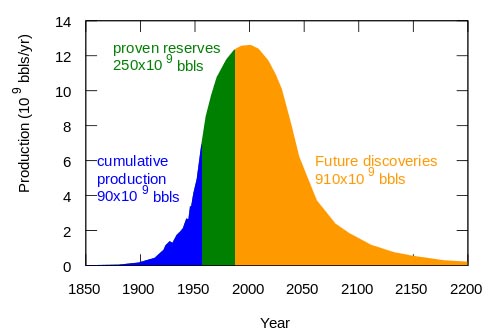
Peak oil has been predicted since the 1950s to occur by various near-future dates, originally as early as 1965. The prediction that US oil production would peak in the 1970s was, in fact, accurate, but new discoveries – including North American sources involving fracking and tar sands – keep pushing the timeline outward. Some say we will always find new oil sources, though economic theory states they will also get inexorably more expensive.
Recent discussions have revived the peak oil debate. A Business Insider article last spring claimed “it is probably safe to say we have slayed “peak oil” once and for all, thanks to the combination new shale oil and gas production techniques and declining fuel use.” It was counterpointed here. But I basically don’t care.
All the talk of peak oil, that we are running out of fossil fuels and therefore need alternatives — or that we’re not and therefore there’s nothing to worry about — is a distraction. In fact, it’s worse than a distraction; it’s misleading because it makes people think that the goal is to find more oil. And that then gives people the impression that since we, in fact, do have existing and yet-to-be-found sources, we don’t have any energy problems. That’s a dangerous path.
The problem, as Sami Grover wrote in a Treehugger post in 2012, is not a lack of carbon-based fuels. The problem is that, if we use those fuels, the resulting greenhouse gas emissions will push the atmosphere far off the critical balance needed to maintain the climate. In other words, those sources – coal, oil, gas – must be left in the ground. Burning them is nothing less than suicide.
The only reason we should really care about peak oil is that it means oil will be getting increasingly expensive and, as that happens, renewable sources will become more competitive. (And that’s before factoring in technical and manufacturing advances for renewables. And certainly before factoring in the unaccounted for “external” costs of non-renewables. When you do that, renewables simply become an even more overwhelmingly obvious choice.)
In many of my environmental classes, I start with a slide that shouts “It’s not just about climate change.” And it isn’t: we have a litany of other serious environmental concerns that shouldn’t – can’t – be neglected as we address human-caused climate disruption. But in the case of carbon-based fossil fuels, it really is all about climate change. Whether we’ve reached peak oil or not is irrelevant. Whether we have oil spills or polluted water from fracking is almost irrelevant, too. (With emphasis on the word “almost.”) The carbon within fossil fuels must be left sequestered in the ground.
That leads to one more point. Those untapped fuels are sometimes referred to as “stranded assets.” Those poor assets, left stranded. (Or perhaps more to the point, those poor, poor owners of those assets.) We should really think of them, though, not as stranded assets, but as neutralized WMDs, since burning them would, in the words of Columbia environmental science prof and former NASA scientist James Hansen, “make most of the planet uninhabitable by humans.”
So we want to strand those WMDs, err, assets. It’s an EcoOptimistic solution in that it addresses both ecological and economic issues and puts us on a path to improving our lives as well. The oil industry may not see it that way, but their definitions of economics and human wellbeing are, to put it mildly, different from yours (I suspect) and mine.
8 Comments on "Peak Oil Is Irrelevant"
Meld on Fri, 17th Jan 2014 12:05 pm
“All the talk of peak oil, that we are running out of fossil fuels”
Writer doesn’t understand peak oil.
Peak oil is about supply flow not reserves. You’d think people would understand this by now, it’s a pretty easy concept to grasp. There is probably more oil and coal left in the ground at the moment than we have extracted so far. The fossil fuels left are dirty , dangerous, expensive and low EROEI. The elite will continue using fossil fuels for the foreseeable future at the expense of everyone else. Unless civil unrest happens of course (which it will eventually
GregT on Fri, 17th Jan 2014 5:20 pm
“All the TALK of peak oil, that we are running out of fossil fuels…..”
The Author never said that we are running out of oil, he said that the TALK of running out is a distraction. The entire point of the article is that we aren’t going to run out any time soon, and continuing to burn the rest of it, will be suicidal. The Author is correct in his conclusions. If we don’t stop burning fossil fuels, we face extinction.
PapaSmurf on Fri, 17th Jan 2014 5:57 pm
Exactly. The author nailed it. The fact is that we have too much oil, heavy oil, tar sands, shale oil, shale natural gas, etc.
I have no doubt that we can find ways to keep burning it in sufficient quantities to continue with BAU for a few more decades.
The author correctly points out that “Peak Oil”, and the hunt for more of it, is a distraction. We need to transition to nuclear, wind, solar, hydro, geothermal. We need to transition to electric powered forms of transportation. That is really the only solution. Discussing “Peak Oil” is a waste of time.
GregT on Fri, 17th Jan 2014 8:07 pm
Correct PapaSmurf,
Discussing ‘Peak Oil’ IS a waste of time, discussing how we are going to deal with it, now that it is here, is not. Nuclear, wind, solar, hydro, and geothermal are definitely options to mitigate the effects, but will in no way come even close to replacing fossil fuels in our energy mix. There is no solution that will allow BAU to continue, and there is no solution to stop the massive reduction that will occur in our population numbers.
If we do keep burning ‘sufficient quantities’ of fossil fuels for a few more decades, our children face a very dire future at the least, and a global mass extinction event at the worst. It is becoming more likely that the latter will be the case, very year.
The only solution is to completely shut down modern industrial society ASAP, and deal with the consequences of the last 200 years of human environmental destruction. The other option is to continue on with BAU and more than likely end all life as we know it on the planet Earth.
Nuclear, wind, solar, and geothermal are transitional energy sources. None of them will be permanent, once fossil fuels are no longer an option. The longer we keep burning fossil fuels, the less likely that there will be a future to transition to.
Either way, BAU is not an option for future generations, and it is our responsibility now, if there are to be any future generations.
steve from virginia on Fri, 17th Jan 2014 10:02 pm
Peak (affordable) oil occurred in 1998. We have been on the economic decline ever since (disguised with periodic credit expansions … what some call ‘bubbles’).
Humans are having a hard time affording war which is like not being able to afford NFL football.
Coming up is unaffordable nuclear, wind, solar, hydro … electric ‘transportation’ (time wasting). Let’s hope we can figure a new approach to doing business before we get to unaffordable food.
Makati1 on Sat, 18th Jan 2014 2:12 am
Let’s hope that the world’s financial system collapses and takes down the oil, coal and NG industry soon. Which black swan will be the key?
Meld on Sat, 18th Jan 2014 8:21 am
As yes , you are quite correct of course. I have a set of “stop reading” words with articles so I don’t waste my time on them (having read thousands over the years) I retract my statement about author and apologise.
Beery on Sat, 18th Jan 2014 1:47 pm
“The Author is correct in his conclusions. If we don’t stop burning fossil fuels, we face extinction.”
What’s this “if”? We are never going to stop burning fossil fuels. Even if they do run out, we will find ways to make and burn more.
There is no “if”. Anyone who says otherwise doesn’t understand how the human race works. While individuals may be capable of conserving energy resources, as a species, we are not.
So all this whining that “we need to stop burning fossil fuels” is the real distraction. We are headed for extinction – deal with it. Our only hope, as a species, is for fossil fuels to run out quickly and for all the options to make synthetic fuels not to work.