
Peak Oil is You

Donate Bitcoins ;-) or Paypal :-)


Page added on January 1, 2014

When it comes to our need for electricity, reliability is essential.
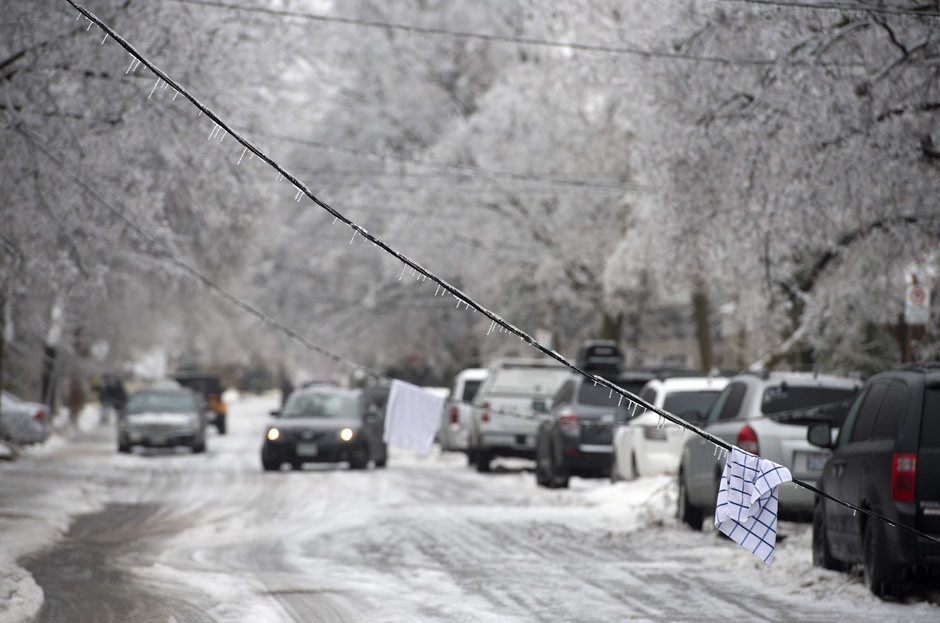
As we come to the end of another year, it is not a nuclear issue that I want to discuss but rather the broader issue of our need for reliable electricity. Last month I started with a quote from the IEA’s World Energy Outlook 2013 highlighting how important energy has become to our society – affecting the economics of nations and our environment as well as our daily way of life.
Over this holiday season in North America the importance of electricity to our very survival has become more evident. On the Friday before Christmas the northeast United States and Canada were hit with a massive ice storm. Hundreds of thousands of people lost power. The cause was primarily due to power lines being affected both directly by intense icing as well as by debris from trees and other items that fell onto the lines as they became heavy with ice causing the lines to fall.
And here we are days after Christmas and while most households have had their power restored (many after more than 5 days without), thousands continue to wait. This is different from other extreme weather events such as hurricanes that have been responsible for mass destruction of homes and infrastructure. This ice storm, while also an extreme weather event, has only caused power loss as its lasting effect. The result is we are able to specifically see the importance of electricity to our modern societies.
So what is the impact of a prolonged loss of electricity? Frankly it is very difficult for those without – especially for those most vulnerable – the elderly, the sick and those without friends or family nearby to take them in.
Living a large city in a cold climate, just imagine your home without heat in subfreezing weather, no power for the refrigerator or freezer (although outdoors can work), no water to flush the toilet or bathe or even more importantly drink; and you have the makings of a catastrophe – people freezing and hungry without the basics required for survival. And to make matters worse it is over the holiday season when most had plans to be with family. In some cases large family holiday meals were no longer possible as the emphasis was on finding ways to stay warm. The added downside of the season is that on Christmas almost everything is closed, no supermarkets, very few restaurants; no services of any type.
On the positive side, the number of people without power is now in the minority so there are many options for them to seek help and get warm. But others continue to struggle. The news has recently reported on police and fire departments having to visit large apartment buildings and take elderly sick residents down numerous flights of stairs to safety. These people have been stuck in their cold apartments for days without food or water. With no one to check on them, their lives were at risk.
As stated earlier, the cause of this mayhem is related to the transmission and distribution system failing in the weather, not generation. But the point to be made is that without electricity in our cities; it would only take days until the population would need to find ways to feed and warm themselves on mass.
So it is pretty obvious that we need to have reliable electricity supply to keep society working. And reliable supply means robust generation and distribution. Our aging infrastructure can no longer be left to decay further so that with every extreme weather event, we take days or weeks to recover. After the major blackout in the North American northeast a decade ago, the focus was on ensuring system reliability. The rules changed and all North American utilities now adhere to these rules, making our system better. But here we are a decade later and the issue has changed. It is no longer about reliability in general, but the ability to withstand extreme weather events. And most of all our ability to recover when the system is damaged during such events.
And of course we have the issues associated with individuals that oppose what is necessary to keep our system running. For example, power lines have fallen when tree branches have damaged them. While simple measures like pruning may be the cost-effective way to protect power lines, it can carry a public-relations price. As stated by the CEO of Toronto Hydro “You can imagine … our arborists show up on the curb and knock on the door and say ‘We’re here to cut your branches down.’ They’re not necessarily a welcome news,” he said. “So it’s really finding that right balance.” This shows that no matter what the issue, there are always those opposed (as with those opposed to nuclear power); but these are also usually the first to complain when they lose power and need their lines restored.
So while this is not directly about generation or nuclear power, it is important to remind ourselves of the importance of reliable supply as we continue the debate on how we want to generate our electricity going forward. Robust, reliable baseload electricity is important. And this is where nuclear power plays a very important role. We also talk about economics and environment. Both essential – so how can we meet the challenge of having reliable, economic and environmentally benign electricity?
As we prepare to enter a new year, let’s remember that fossil fuels like coal and gas are reliable, can be economic, but impact our environment. Renewable sources like wind and solar are good for the environment but can be costly and unreliable. Nuclear Power is an important source of electricity that can provide large amounts of clean, reliable and economic electricity to keep our society moving.
I hope that all power is restored to those without as soon as possible so they can enjoy what is left of the holiday season.
Wishing you all a very happy and healthy 2014!
19 Comments on "When it comes to our need for electricity, reliability is essential."
ghung on Wed, 1st Jan 2014 2:10 pm
Let’s see…. ice storms knock down trees and power lines so we need more nuclear power. Got it. I would have thought burying power lines would have been the logical suggestion, but what do I know? Our “unreliable” off-grid, redundant, solar system has had zero outages in over 16 years.
paulo1 on Wed, 1st Jan 2014 2:43 pm
Our BC Hydro line snakes 70 miles over rivers, creeks, alongside a forest, to get to our area on northern Vancouver Island. Bad trees are cut along the right of way. When we lose power it is usually a limb from a tree on a private homeowner’s property that falls across the lines. Once in awhile there is a freak storm of massive winds that knocks our grid down for a few days but that is only every few years or so. March 12, 2011 we had hurricane winds and high tides which also washed out the lower Island Highway and threw drift logs across the roads into town. Most people have emergency supplies. Where we live only a newcomer is unprepared to live without electricity for a week. We always enjoy it, to be honest. We hunker down with the led lights, books, the sat. radio, and the woodstove roars. We eat the same, if not better because cooking and prep is one of the few things we can do without power. (woodstove, camping gear, propane range outside salvaged from an old motel and tucked away in a southern style cooking area off the shop, and the year round used barbecue). The freezers have to be recharged with a generator about 1/2 hour per day if the temps are up.
If I lived in an apartment in Toronto I would have ice coolers ready (lots of snow and ice outside), water, candles, led lights, and a small camp stove plus sleeping bags. For anyone not too old and infirm, there is absolutely no excuse not to be better prepared. Plus, where are the neighbours? Doesn’t anyone check on elderly neighbours?
We take too much for granted. Having taught high school science I can tell you that many kids have absolutely no idea where their power comes from. For the adults on their own, there are no more excuses available not to be prepared. There is no ‘they’ going to come and fix things everytime we are inconvenienced by forecasted weather events. The warnings were on the weather channel for days before the event.
Paulo
yellowcanoe on Wed, 1st Jan 2014 3:19 pm
Eastern Ontario was really nailed by the Great Ice Storm of 1998 and ever since then our local hydro utility has been pretty aggressive at tree trimming. They send a crew through our neighbourhood every year. Big trees located too close to a line can look pretty funny after the trimmers have done their job! After this fiasco in Toronto I expect they will be more focused on tree trimming and less on keeping tree owners happy.
robertinget on Wed, 1st Jan 2014 3:21 pm
Even solar panels can be made sunlight proof with enough snow. Not to mention
nightfall.
One solution for backup power I currently use is a simple (Honda) gasoline generator. Because I use it infrequently,
once or twice a year for a few hours each, it’s the cheapest solution.
If solar panels were not optional I
would adopt a propane or NG powered
fuel cell for domestic hot water and full or part time power.
Here are two companies selling such
cogeneration products;
http://www.ballard.com/fuel-cell-products/Product_Portfolio.aspx
http://www.plugpower.com/Home.aspx
There are several others such as Toyota,
Fuel Cell (FCEL) that make commercial units less suited for residential use.
GE will usually choose the best technology of any smaller company to acquire. Even if you are not an investor, watch GE’s picks in any energy sector. Those products will be state of the art.
Full disclosure, I’m a GE Energy investor but have no plans to buy any other brands mentioned.
Kenz300 on Wed, 1st Jan 2014 4:42 pm
Poor maintenance by power companies that use storms and the needed repairs as a cost of business……….
Have your own reliable back up power source…
A little wind or solar power with battery storage for your home can provide much needed back up power.
DC on Wed, 1st Jan 2014 4:45 pm
An advert for nuclear disguised as concern over weather related grid failures.
Cloud9 on Wed, 1st Jan 2014 4:48 pm
Read One Second After. Clean reliable nuclear power, got to love it. What happens when the grid goes down and the diesel runs out and the cooling pumps stop at a nuclear power plant? The Japanese might have an answer for you.
rockman on Wed, 1st Jan 2014 5:02 pm
I wonder if the reliability issue (or lack thereof) explains why Texas has as much wind capacity as the #2 and #3 states combined. Our huge S Texas wind farm is on the same grid as our big S Texas nuke plant and the second largest fossil fuel burning plant in the country (50/50 NG and coal). With such back up a lack of reliability would not have been a deal breaker for the wind expansion. Plans are also underway to build a 600 turbine offshore farm that will tie into the same grid. As much as some folks want to completely replace fossil fuel sources with alts I suspect at least in the near term it appears a supplemental relationship will be more likely.
robertinget on Wed, 1st Jan 2014 5:28 pm
Who doesn’t love windpower?
Here in ‘my’ small, Nicaraguan fishing village in all our power comes from unsupported wind power. During this holiday season this picturesque village
is packed with rich Nicas and far wealthier young surfers from every non Islamic country on earth..(Bikinis)
Anyway, with no base power and thousands
of twenty-somethings taking long warm
showers, our power drops to zero at least five or six times daily.
Power outages are so common, few venture out at night without a flashlight.
Here’s the drill;
Lights go out, guy in restaurant, hotel,
bar but NOT the free clinic, crank up an
old gasoline generator, throw a three way switch on the wall and we are all bathed once again in lovely fluorescent
greenish light. The only good news must
be the crappy deep bass thump thump music is drowned out by the generator noise and car alarms.
Can’t wait for all these twenty one year old blond bikinis to go home to California or Denmark or Sweden or Long Island even Australia.
Hugh Culliton on Wed, 1st Jan 2014 6:27 pm
Since “enjoying” the ’97 ice storm through the luck of being newly weds shacked up at my well prepared in-law’s place outside Kingston, we learned our lessons. This latest storm found us with grid-independent heat, lighting, and ability to cook. As we can only look forward to more of the the same, I think it would be wise to prepare however you can. Waiting until the lights go out and it’s -20 outside is the wrong time to start – as so many still do. People quickly forget that there can be much graver problems to power loss then loosing one’s Wifi connection.
surf on Thu, 2nd Jan 2014 12:09 am
You could have the best maintenance keep the trees trimmed, and have the best power source, but you will still loose power when the wind, ice load, or mud slide caused a tree to fall over a power line.
The best solution is to move the power lines underground. Wind and ice won’t effect them. Even floods and rain don’t effect them because the underground equipment is water proof. Other than moving power lines underground the only other option is to make sure the power line is above the tallest tree and that the pole is strong enough to take a hit from a falling tree.
oldfarmermac on Thu, 2nd Jan 2014 12:56 am
Environmental concerns aside, the historical price tend of all fossil fuels us upward and it will continue to be upward.
Wind and sun will always be free and within a few more years it’s going to be obvious that the long rem savings in fuel alone are sufficient to make wind and solar power an economic bargain.
Look at it this way- lots of us have a small cheap running second or third on we drive when we can to save money on gasoline, or a wood stove we use to save money on electricity or natural gas used for heat.
In the long run the fuel savings alone will amply repay the subsides that wind and solar have gotten many times over.
Wind already provides about 4 percent of our electricity- and four percent of the money electric utilities spend on coal and natural gas is one hxll of a lot of money .
Inflation alone,never mind depletion, guarantees that coal and natural gas will on average over the years be ever more expensive.
Wind and sun will always be free and within another ten years they will be saving us well over ten percent of our collective coal and gas bills.
James on Thu, 2nd Jan 2014 1:10 am
One of the things that was overlooked in this discussion was the fact that the materials we use to build and maintain a grid are in decline, e.i. copper, steel, oil to make the insulation, oil for transformers Etc. All of this requires the use of natural resources that are all in general decline.
GregT on Thu, 2nd Jan 2014 1:55 am
Our electric power lines are underground. The power is out in my house right now as we speak, and has been out for about six hours. The electric company has not yet figured out why.
Makati1 on Thu, 2nd Jan 2014 3:42 am
Ghung, Frank L.Wright, the famous architect, suggested putting power lines under ground over 70 years ago when it would have been easy. I’m sure he was just one of many, but … it was cheaper (more profitable) to put them on the surface. Now we could not put even 1% of the old lines under because so many other things are in the way and the cost would be astronomical. Not going to happen.
As for the problems caused by power outages … too bad! It is an inconvenience to most of us and for those that it is life threatening … well … That’s life! We will only be having more and more power outages as the decline progresses. Eventually, electric power will be the true luxury that it is and not something we believe we are ‘entitled ‘ to.
Makati1 on Thu, 2nd Jan 2014 3:46 am
BTW: There are over 3 million miles of power lines in the US. That would cost in excess of $1.5 trillion dollars to bury, not to mention decades.
Kenx300 on Thu, 2nd Jan 2014 3:10 pm
Nuclear energy is too costly and too dangerous.
Fuksihima and Chernobyl have shown us how expensive nuclear power really is. The cost to store nuclear waste FOREVER is too much.
Wind and solar are safer, cleaner and cheaper ways to generate electricity.
Arthur on Thu, 2nd Jan 2014 10:49 pm
Our electric power lines are underground. The power is out in my house right now as we speak, and has been out for about six hours. The electric company has not yet figured out why.
Thou too, Brutus… an iPad?
😉
Stilgar Wilcox on Fri, 3rd Jan 2014 1:04 am
We never hear about the UK having this problem, because through a beautification program they put their power lines underground where trees cannot fall on them.