
Peak Oil is You
Donate Bitcoins ;-) or Paypal :-)


Page added on December 13, 2013

The Fire This Time

A few days ago I watched the documentary Chasing Ice, as part of our local Transition initiative’s film series. What really struck me in the film was the narrator’s four word comment about 1/3 through the film when he was discussing what we can/should do about arctic melting and runaway climate change:
“There is no time.”
Just that. He meant that there is no time for us to continue to do what we have been doing — the politicking, stalling, denial, endless debate and research. But what these four words mean to me, and I think at a visceral and perhaps subconscious level what they now mean to many people who are informed about what is happening in our world, is that there is no time for us to pull back from collapse, no time to avoid or even mitigate runaway climate change and the emergence, later this century, of a climate on Earth as different (7-8oC) from today’s (though in the opposite direction) as the climate during the most recent glacial maxima (colloquially, “Ice Ages”) 20 and 140 and 260 and 340 and 440 thousand years ago.
During these “Ice Ages” much of the planet’s land mass was covered in ice an average of 2 km thick, and the regions adjacent to the ice-covered areas suffered constant windstorms that transformed them into scrub and desert, and beyond that desert, what are now semi-tropical areas were covered in boreal forest. Equatorial areas then, in addition to being much cooler than today, see-sawed between prolonged periods of monsoon-like rains and periods of extended drought.
What will our planet be like with 7-8 degrees of warming in the next few decades? Weather will likely be more extreme (more flooding, desertification and fires, and, later, much higher sea levels) and much more turbulent, but instead of only the equatorial areas being habitable by significant human numbers, as happened during the “Ice Ages”, only the polar areas, with whatever vegetation will have emerged there in that short time, will likely be habitable in the coming “Fire Age”.
The Fire This Time.
There is no time for us to avert this. But there is time to imagine potential future scenarios and how we might react to them, to increase our resilience to the large-scale changes to our way of living it will bring, and to prepare ourselves for them (intellectually, emotionally, and capacity-wise that is — for the coming Long Emergency, hoarding assets and building bunkers is not a viable strategy).
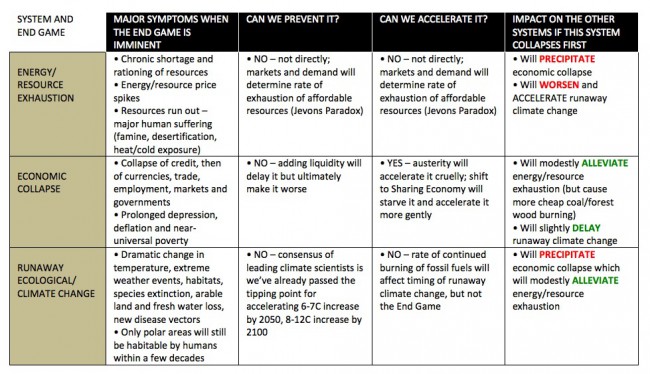
What complicates the future scenario for our planet is that we are also nearing End Games in our global economic and energy/resource systems, as I diagrammed in my post last month. Neither system is sustainable for more than a few more years, a few decades at most, and both systems affect the rate of atmospheric pollution and hence the extent and timing of runaway climate change.
I’m writing a series of articles that explains all this in more detail for the fledgling Sustainability Showcase magazine, but the chart above summarizes the interrelationship of our economic, resource/energy, and climate/ecological systems, and how ‘collapse’ (i.e. dramatic and uncontrolled unbalancing and change, with largely unpredictable consequences) of any of these systems would likely affect the other two. Here’s the prognosis in a nutshell:
Best case (Eisenstein) scenario: Shift to Sharing Economy precipitates near-term, gradual collapse of the industrial growth economy, which will leave some of Earth’s energy and resources in the ground and delay and slightly lessen runaway climate change. [Or similarly, major early unexpected impacts of climate change (e.g. pandemic) precipitate near-term, gradual economic collapse, with the same results.]
Worst case (Ehrenfeld) scenario: Politicians ratchet up the economy to extend industrial growth a little longer, exhaust energy and other resources faster and more completely, then use nukes to try to mitigate energy exhaustion, all leading to faster and more severe runaway climate change and total economic collapse and energy/resource exhaustion.
All scenarios end with runaway climate change. This is kind of hard to comprehend, but once you realize how delicate the balance is that has kept our planet in a brief paradisiacal near-stasis climate for several millennia, and how often runaway climate change has happened in our planet’s past (for many reasons, mostly unknown), it’s not too hard to accept. We’ve just unwittingly accelerated the process this time.
There will be large scale species extinction — it’s already begun and it’s also not a new phenomenon on this planet. Life will go on. Some like it hot. There will be a steady exodus toward the poles by many species, with varying degrees of success. What will evolve in the planet’s new super-hot, super-stormy zones is anyone’s guess.
From that perspective, the timing of the collapse of this civilization’s unstable, global, oil-and-growth dependent industrial economy, and whether we plunder the last of the easily-accessible energy, soil, water, minerals, forests and other resources (a billion years’ worth of accumulated riches) before the climate destabilizes, may seem a bit moot. But it will be very important for our immediate descendants, and for many living today.
As the table above shows, we have little say in (or control over) how all this unfolds. But we have a little. The sooner we bring down our rapacious and wasteful economy, the less severe and longer delayed ecological collapse will be — and the more resources will be left for post-collapse life.
We can (and some say should) help precipitate that economic take-down, through direct action against its most grievous activities — tar sands, nukes, deepwater, shale, mountaintop removal, rainforest razing, ‘blood’ mining, factory farming, forced/slave labour etc. And we can precipitate it by walking away from that teetering economy and shifting our activities to that of the sharing economy — by using, gifting and conserving local, organic, low-energy, durable goods and services in community with each other, without the use of fiat currencies.
Beyond that, there’s not much we can do to prepare for The Fire This Time, except learn some useful new skills, learn how to build (and live in) community (anywhere), get and stay healthy, and cultivate what we might call a resilient, adaptable attitude. Some of the qualities I think might be part of such an ‘attitude’ — a way of being in the world — are (in no particular order) being:
- generous
- self-aware and self-knowledgeable
- attentive (“present”)
- curious and imaginative (they’re not the same thing)
- able to let go (open, forgiving, patient, even ‘stoic’)
- challenging (able to think critically)
- self-expressive and articulate
- appreciative and grateful
- playful, joyful, and able to see beauty everywhere
- able to relish simple pleasures
- contemplative, gentle, and at peace
We can’t be these things if we’re not, of course, and the stresses of our modern lives make it hard to be them. But, joyful pessimist that I am, I believe most of these qualities are in most of our natures, if we can find space for them, and let them come out. Adversity tends to bring out the best in us, and we’re now in the headwinds of a maelstrom.
It’s hopeless, but we’ll be fine. One day, everything will be free.
5 Comments on "The Fire This Time"
J-Gav on Fri, 13th Dec 2013 9:35 pm
Well, there is something to be said for Pollard’s “joyful pessimism” but the table at the top of the article contains a patent falsehood. There will definitely NOT be any 7-8 C° increase in surface air temperature in the next few decades, barring some unforeseeable catastrophe. By 2050? BS!
That’s the good news. The bad news is that there doesn’t need to be in order for life on this planet to find itself in severely stressed circumstances. 2-3° C will suffice to do the job and may well have the potential to lead to something like the more dire predictions at the end of the century or during the 22nd. 4 or 5°C more than today and it’s game over so why even talk about 7-8°C?
GregT on Fri, 13th Dec 2013 11:05 pm
In 1990, the AGGG (The Advisory Group on Greenhouse Gases) released a report titled “Responding to Climate Change; Tools for Policy Development”. In that report the following statement was made;
Beyond 1 degree C may elicit rapid, unpredictable and non-linear responses that could lead to extensive ecosystem damage.
One of those responses includes a massive Arctic methane release. Many in our scientific communities predict that such a release has the potential to increase global mean temperatures by as much as 7 degrees C, in a matter of months, or even weeks. Not decades. And yes, it would appear that 4 or 5* C is game over for the human race.
Unless some unforeseeable miracle happens, it does not seem very likely that we humans will be around, long before the end of this century.
BillT on Sat, 14th Dec 2013 2:03 am
Greg-T, I agree that the increase is possible. It is not more than walking over to your thermostat, setting it 7C higher, then waiting for the furnace to fire up and raise the temps. The sun could easily cook the earth in one day with it’s radiation. A few degrees would be child’s play. Those few degrees would be controlled by the methane and CO2 in the air. The oceans are not able to soak up all that heat and even if they did, it would kill everything on land with super storms and lack of oxygen.
GregT on Sat, 14th Dec 2013 2:31 am
Seabed and permafrost methane, have been studied and understood for a very long time. They are believed to be, in part, responsible for the last major extinction event. The big difference between then and now, is the rate at which atmospheric CO2 is accumulating. We have managed to do in less than 200 years, what took tens of thousands of years, in the past. And we aren’t quite finished yet.
Jonathan Richards on Sat, 14th Dec 2013 8:28 pm
Author needs to do more research. It’s called wet-bulb respiration and it affects all living things.
To quote a friend / blog poster on my site: “Thermoregulating in a +6C or more world is not in the realm of the possible for primates (and virtually all other multicellular organisms) – which is to say nothing of continuing food sources (access) under a chaotic climate regime of escalating extremes. [Human] biology has very real (definitive) energetic limits, and ‘near term’ biosphere conditions, which we are in no way adapted for, are all but assured.”
Humans cannot survive an increase of 7C or higher temperatures. 7C increase destroys all life on Earth. This is the end game for all living things. It’s well docoumented on my site.
Admitting that this is likely, or even a virtual certainty, but not fully realizing what that conveys, leads to the wrong response. Embracing this life, right now, is indeed the “very best” we can do. But even this is not a “survival strategy”, even in the near-term, which I will focus on next.
Hoarding food is now the ONLY viable strategy for short-term survival of humans (next decades). You do this because you still want to live for as long as you can, so that you can continue to embrace life – and try to enjoy what is left. You cannot do this when you are starving to death.
There will be nothing growing and nothing to eat once temperatures increase 4C in our food producing regions. This is projected to happen in our lifetimes (even if you are 50 years old now).
“There is time to imagine potential future scenarios… ” – I suppose if you want to waste the remaining time of your life, you can do this, but you will not achieve or accomplish anything nor make any difference in the “now”, which is all that matters. You will actually be shortening your life by failing to “do” what can actually be done.
The constant speculation on “what to do” is a misguided exercise being desperately grasped, but note where this comes from. We already know what to do, endless articles have covered this more then adequately, now YOU go do it. Needless to say, this is being ignored wholesale.
Industry, business and government know what to do – but will ignore this too, as long as possible, determining that immediate short-term profits are more important.
Humanity, especially Americans who refuse to believe virtually any fact, is simply far more comfortable embracing incessant denial.
The end result however, will be the same. We die. All of us. Soon. There will be a stupendously large scramble for the absent “exits” to find refuge and a safe place to be.
All this “planning” and “adaption” will prove to be moot. It will be asses and elbows right to the bitter end, as we scramble enmasse to stay alive. This is what humans do, demonstrated throughout our entire history as a species, particularly when survival is at stake. We are not going to go down peacefully, holding hands – we NEVER have. All notion of peace, negotiation and civilized will have long departed.
Food will be the greatest lack of all as global production plummets to virtually zero long before the heat (and extreme events) kills off all life. Many will die of starvation long before then.
Personally, I find article like this entertaining, but on a deeper level, it’s just a grasp at “how the hell do I learn to cope with this impending doom and end game to my life” by the authors. Most desperately want to find some peace in all of this – and if at all possible, a peaceful solution. The harsh facts of human nature and existence, demonstrated by our history (past and present) is no such outcome actually exists.
Refusal to accept this is just another form of denial. Knowing the end is coming and why, is only a small part of the whole picture. Knowing further that we will not go peacefully is no comfort. There will be many who will ignore this, choosing instead to live their lives embracing hope. There is nothing wrong with that fundamentally. But the error is made when they naively expect everyone else to do the same – they will not.
It’s worth also looking at the personalities involved that seek to instill hopium. They represent the epitome of hundreds of thousands of years of human existence and development, advocating peace, hope, life, living, future, joy, entertainment and so much more. They are admirable precisely because of these points. But they are poorly equipped to adapt emotionally and physically to a harsher world, and they will not survive as long as those that are, having refused to acknowledge the base facts that make one human survive (longer) then another.
In other words – they are not where we need to garner the best advice for survival, lacking skill, experience and judgement. I do not promote such people for survival for this reason, although I do admire them for their personal philosophy and perspective. I expect they’ll be pretty useless when it comes to trying to stay alive in a increasingly brutal world looking for sustenance, having ignored that real adaption means far, far more then “embracing collapse” or some other such nonsense. Nobody will “embrace collapse”, only idiot authors write such garbage out of desperation, secretly knowing their toast.
The naivety expressed is actually dangerous for the rest of us, because it creates another false set of illusions about “how” we might adapt, or mitigate, or survive. This is becoming problematic. It fairly prevalent now in the collapse literature. The people who write these things are not the best equipped to give advice, theory, understanding or direction. The world they embrace and are “from” is ending. This evidence abounds everywhere. The world that is coming is utterly alien to them. They’re not adjusting very well and as a result, they’re advising many of the wrong things.
To demonstrate this point more clearly, imagine you are faced with the future being projected – intolerable heat, extreme events, displaced refugees and growing hunger. This bears down on you Every. Single. Day. Growing in intensity and suffering until it becomes truly insufferable.
Looking back, you belatedly realize that all your hopium did nothing. You’d rather have something to eat. Or some place safer to be. Watching your kids die of starvation will be unbelievably painful. Or freezing to death in the “storm of the century”.
The failure to adapt to real life, and do what you can about it, becomes the deciding factor on your actual existence. THIS is what is not being talked about and even rejected by hopium authors, probably because they don’t actually have a clue what to do. The world they once knew is long gone and they were simply unable to keep up to the changing realities.
In the end – this will mean life or death, possibly even decades of living lost, where those equipped would have lived more.
But even in the larger context, this isn’t about “time” or how long you get to live, it’s always about how you live – until you are forced to survive – and then the rules change (and so do you, if you can). Plenty of collapse authors completely fail to realize this transition point exists. But once all the hand-holding stops, reality will set in.
So my advice is to live your life now, while you still can, while still doing all you can for the future reality and how harsh things will be. Don’t ignore what it will mean in the future to survive.