
Peak Oil is You

Donate Bitcoins ;-) or Paypal :-)


Page added on December 10, 2013

America, The Energy Exporter
Bolstering North American energy infrastructure will solidify the United States as an energy exporter by the end of this decade. It is time to start the conversation about changing U.S. laws to allow exporting of American crude oil.
U.S. Government estimates released this month show the United States producing 25 million barrels of oil equivalent a day of natural gas and oil in 2013 surpassing Russia which produces 22 million barrels a day. The U.S. already took the lead in natural gas production in 2012 passing Russia for the first time since 1982. The U.S. is leading because of development the Bakken in North Dakota and the Eagle Ford in Texas.
North American energy self-sufficiency is within reach, but only if advancements such as horizontal drilling are matched by improvements to North American energy infrastructure such as its pipeline, railway and seaborne transportation.
There are two obstacles keeping the U.S. from being a net-exporter of crude oil. First, is a lack of infrastructure, whether pipeline, railway or truck transport, in place to move crude into a position for export. Second, U.S. law limits the type of refined products such as diesel or jet fuel that can be exported. Let’s first look the infrastructure challenge.
The interstate highway system, built after WWII, became the infrastructure backbone the United States needed to grow into a bustling peacetime economy. Spurred by President Eisenhower, who as an Army Captain in 1919 participated in a sixty-two day cross-country convoy that took eighty military vehicles from Washington, D.C. to San Francisco via the best road the U.S. had, the Lincoln Highway. The trip was not an easy haul. Roads were unpaved turning into dustbowls in the heat or mud pits in the rain. Bridges were weak and there were no signs to mark the way.
The construction of the Eisenhower Interstate system catapulted the U.S. into a modern economy. Goods and supplies were easily transported from ports to the prairie, and back again. Reviewing today’s energy landscape you find a crude oil glut from a lack of pipeline infrastructure to move Alberta oil sands and Bakken crude to refineries on the Gulf Coast.
Completing the Keystone pipeline system, which would connect Alberta’s oil sands with Gulf Coast refineries, would import an additional 730,000 barrels of crude oil a day from Canada and 100,000 barrels a day from the Bakken formation in North Dakota. Keystone XL will help displace similar imports from Venezuela but would not be enough to flatten the demand for crude imports.
At a minimum, motorists in an energy self-sufficient North America will benefit from stable if not lower gasoline prices. No longer would civil strife in the Middle East significantly affect family budgets in Middle America. On the other side of the globe, establishing the U.S. as an energy exporter strengthens economic partnerships with competitors in Asia such as China and India.
Additionally, the nation’s inland waterway system is in dire need of upgrades and routine maintenance. The network of canals and waterways that crisscross America carry approximately 22 percent of domestic petroleum products and more than half of our agricultural commodities. The system has faced years of neglect and is in need of additional federal spending to upgrade dam, lock and levy systems.
Passage of the Water Resources Reform and Development Act will provide much needed funding and reform to Harbor Maintenance Trust Fund, the Inland Waterway Trust Fund, and other waterway related programs and agencies. This will further expand our ability to freely and affordably transport and export domestically produced energy.
One indicator of the nation’s ability to transform into a net energy exporter are distillate exports such as diesel or jet fuel. The U.S. exported a record 3.8 million barrels a day in July 2013 to places as far away as Asia. One factor driving exports is low sulfur diesel produced in the U.S. but in demand in South and Central America because of new air quality laws.
As America moves into its new role as an energy exporter, public policy should keep pace with America’s booming energy finds. Permitting improvements to pipelines, ports, railways and highways will both strengthen the U.S. economy at home and stabilize partnerships abroad.
Jeff Huddleston is a managing director for Conway MacKenzie where he counsels energy companies on restructuring, strategic planning and merger & acquisition.
13 Comments on "America, The Energy Exporter"
westexas on Tue, 10th Dec 2013 2:54 am
A copy of my post on the Rigzone website:
From the article, “There are two obstacles keeping the U.S. from being a net-exporter of crude oil.”
I suppose that I would add a third, to-wit, that the US is currently reliant on imports for about half of the crude oil that is processed daily in US refineries.
I estimate that the US is going to average an annual crude oil (actually crude + condensate) production rate of about about 7.5 mbpd (million barrels per day) in 2013. In my opinion, the US is going to be lucky to maintain this approximate production rate out to the year 2023.
Assuming a 10%/year annual production decline rate from existing wells (this would be the production decline from 2013 to 2014, if no new wells were completed in 2014), which is probably a conservative estimate, the US oil industry would have to replace 100% of current crude oil production–every field from the Gulf of Mexico to Alaska–over the next 10 years, just to maintain the current crude oil rate for 10 years.
And Citi Research puts the overall decline rate from existing US natural gas production at about 24%/year, which implies that just to maintain current US natural gas production, the industry has to replace 100% of current US natural gas production in about four years.
Meanwhile, we have seen a regional decline in Western Hemisphere net oil exports, from the seven major net oil exporters in the Americas, as their combined net oil exports fell from 5.9 mbpd in 2004 to 5.0 mbpd in 2012 (EIA, total petroleum liquids + other liquids).
And we have seen a global post-2005 decline in Global Net Exports of oil, with the developing countries, led by China, consuming an increasing share of a post-2005 declining volume of Global Net Exports of oil.
For more information on net oil exports, you can search for: Export Capacity Index.
Ted on Tue, 10th Dec 2013 3:56 am
Who the hell is Jeff Huddleston? And what they hell does he know…can he vouch for this statement five years from now?I should have been a charlatan…instead I have to work for a living….the writer of this story does not even have an elementary knowledge of energy.
rollin on Tue, 10th Dec 2013 4:32 am
A comedy of errors. Rigzone is usually good for a laugh.
DC on Tue, 10th Dec 2013 5:07 am
RigPorn is the Onion News Network of Energy Depletion.
Dave Thompson on Tue, 10th Dec 2013 7:09 am
This is one of those easy to read and take in because he makes it all sound so good articles. I have many discussions with people that will take this type of view at face value. The idea of energy independence for example. I like to point out that all of us can be energy independent in this country simply by not driving a car anymore. You are now giving me that “are you nuts?” look. I have been getting by on about 7 gallons of gas per week these past few months/year. I can say it is not easy but something worth getting used to. It is coming.
Arthur on Tue, 10th Dec 2013 9:56 am
I am a little sceptical about the figures as presented in the article myself, but one thing is clear: the ASPO-2000 story, the story no doubt being the foundation of this very site and the story I believed in when I joined this board in January 2012, that story is dead.
J-Gav on Tue, 10th Dec 2013 10:12 am
Westexas: ” … the U.S. is going to be lucky to maintain this approximate production rate out to the year 2023.”
That’s exactly what I would have thought …
Read on Tue, 10th Dec 2013 2:45 pm
“but one thing is clear: the ASPO-2000 story, the story no doubt being the foundation of this very site and the story I believed in when I joined this board in January 2012, that story is dead.”
Arthur:
In what way is the ASPO story dead? I thought that the facts prove them to be extraordinary prescient especially compared to other forecasters.
Arthur on Tue, 10th Dec 2013 4:39 pm
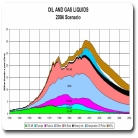
ASPO-2000 completely missed the fracking developments. Who would have thought that the US would be a top oil producer again only two years ago?
ASPO-2004:
http://www.peakoil.net/uhdsg/2004Scenario.jpg
Peak liquid 2008. Did not happen. Will likely be postponed at least until 2020 en gas will be king during the twenties. And God knows, methane hydrates during the thirties.
Norm on Tue, 10th Dec 2013 4:51 pm
ROTFLMAO. Something written for the far right to believe in, along with that krap that Santa Claus created the galaxies and formed the earth in 6 days. Makes em feel good in the Escalade on the way to church where they count up their money in the offshore accounts. Then they sing together, cause they so F Ing happy with the grand totals, and articles like this one.
.
shortonoil on Tue, 10th Dec 2013 5:06 pm
‘As America moves into its new role as an energy exporter, public policy should keep pace with America’s booming energy finds.”
This is the classic misconception of most writers; that petroleum, and natural gas are equivalent to energy. They are not! Only about 40% of the world’s oil reserve is capable of supply energy, after the energy required to produce it is subtracted. Like tight oil, most of it is an energy sink.
This article has one purpose; to encourage the tax payers to keep financing, a highly depleted, declining and aging industry as their own well being shrivels away!
rockman on Tue, 10th Dec 2013 5:29 pm
“ASPO-2000 completely missed the fracking developments.” Actually what they missed was oil prices increasing more than 300%. Had one made such an assumption of such high oil prices 13 years ago they might have predicted the shale boom. For instance the oil in the Eagle Ford has been known for decades. The horizontal drilling technology was well developed 20 years ago…frac’ng even decades earlier. Some folks are predicting a prolonged development of the shale plays. But they are making the assumption (whether they realize it or not) that oil prices will stay high. If oil drops to $40/bbl their expectation of future production will be just as wrong as the ASPO-2000 was. And for the same reason: the inability to predict oil prices long term.
Arthur on Wed, 11th Dec 2013 12:12 pm
rockman, that’s true. If the western financial system collapses, the oil demand destruction could be so enormous to the tune that nobody will be interested in resource depletion anymore. Oil prices could easily fall back to $40 in 2013 terms.