
Peak Oil is You

Donate Bitcoins ;-) or Paypal :-)


Page added on December 8, 2013

Why Natural Gas Could Save Coal
Natural gas is an increasingly abundant resource in the United States. It’s so cheap that it’s being integrated into the transportation sector, which sets the stage for lower fuel costs. That, in turn, could lead to cost savings for transporting coal by rail — which would make coal used for power cheaper.
Gas is great!
Natural gas is a wonderful fuel because it burns more cleanly than coal. However, the usefulness of a fuel is a combination of cost, environment, and energy. In the United States, natural gas is cheap and abundant because of shale drilling. That’s led a host of industries to convert to using gas.
For example, Waste Management (NYSE: WM ) has more than 2,200 natural gas powered vehicles and recently opened its 50th natural gas fueling station. Every natural-gas truck it buys means it avoids buying 8,000 gallons of diesel. No wonder the trash-hauling industry has made such a concerted shift toward natural gas, increasing such truck purchases from less than 10% of annual acquisitions to more than 60% in just five years.
Long-haul trucks are on the verge of following Waste Management and other trash haulers down a similar path. There’s the potential to increase natural gas truck purchases from less than 1% of new purchases to more than one-third in the next five years.
United Parcel Service (NYSE: UPS ) , for example, has made a commitment to purchase 1,000 long-haul trucks powered by liquefied natural gas. That will add to its already impressive total of more than 2,700 natural gas vehicles (most of which are not long-haul trucks).
How big a deal is this switch to LNG? United Parcel Service says that it can reduce fuel costs by 30% to 40% based on recent natural gas prices. No wonder Waste Management has been buying so many natural gas vehicles. And now that long-haul LNG trucks are increasingly available, including financing supported by a Clean Energy Fuels and General Electric (NYSE: GE ) partnership, it seems likely that the trucking industry is ready to start the shift, too.
But what about coal?
That’s where trains come into play. GE is also working with CSX (NYSE: CSX ) to test new gear that will allow a train to run on either natural gas or diesel. Assuming train companies pay about the same amount for fuel as truckers, that could lead to cost savings of up to 40% a year on fuel. Trains have run largely on diesel for around 50 years, so this switch is historic. And it sets up an interesting situation for coal.
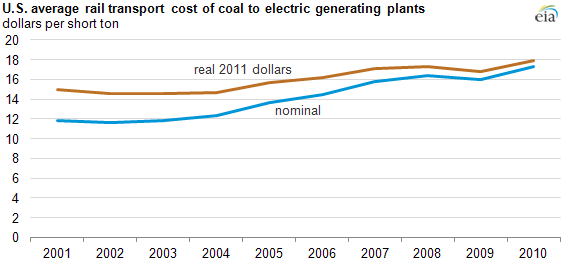
According to the U.S. Energy Information Administration, trains transport about 70% of the coal electric utilities use, and transportation makes up about 40% of the end-cost of using coal. This makes rail costs a big part of the equation in the choice between coal or natural gas. Between 2000 and 2010, the cost to ship coal increased 50%. Companies like CSX didn’t have much choice but to raise prices, however, because its costs were heading higher.
Source: EIA
Assuming CSX and GE can make the switch to natural gas work, fuel-cost savings would likely be passed onto customers. At the same time, demand for natural gas will be increasing in the trucking (UPS) and train spaces, with an abundance of GE’s help, which supports natural gas prices. Thus, the cost-benefit analysis might just start to favor coal in a more meaningful way.
Not unique
Don’t dismiss this scenario. The cost of natural gas in Germany has led gas-fueled power plants to operate at a loss. With cheap and abundant coal, U.S. utilities won’t need much of a push to shift their mix back in favor of the fuel.
Watch UPS to see if it can follow the lead of Waste Management, which will provide further evidence that GE and CSX can pull off a similar train switch. If the dominoes fall right, the next five years could be good to coal.
9 Comments on "Why Natural Gas Could Save Coal"
Baldwincng on Sun, 8th Dec 2013 8:20 pm
Gas is leaving coal in the ground – amazing fall in production of 180 million tonnes a year from 2007 to 2013!
This CCS – Coal Can Stayunderground is huge triumph for shale gas
Once a coal mine closes, it will not open again, so this is fantastic for the planet.
Let’s hope we continue to see reduction in US coal production of around 30 million tonnes per annum
Bob Inget on Sun, 8th Dec 2013 8:45 pm
If gas consumption continues to rise,
in transportation in particular, there’s hope for North America’s economy.
Most people confuse diminution of crude imports with tight oil. While there is truth there we need also calculate fewer
barrels out of Alaska.
Production in Alaska peaked in 1988 when companies sent 2.1 million barrels of oil per day down the pipeline. Declining ever since, last year production hit a low of 526,000 barrels per day.
The picture for gas is almost a mirror
image. Only five years ago we were preparing to IMPORT six billion dollars
worth of LNG a year.
Say what you want about cost, longevity
of wells, NG has already pulled US fat from the fire almost single handedly.
As for a ridiculous argument that commercial trucking can’t get gas at a gas station, I say pure horse-hocky.
Gasoline and diesel needs in all cases to be TRUCKED to fuel outlets retail and fleet.Find us a ‘gas station’ in any urban area without NG already in-ground
yards from pump islands. No trucking, no refining, infrastructure in place.
On the other end of the structure, find us a rural fuel outlet with/out propane
in a ubiquitous ‘yard-bomb’ in the back
or front of the station.
Running low on propane? Pick up a spare tank at any hardware or big box store.
(I know, I know, propane is NOT NG and it’s an oil refining by product) I’m talking availability now. Computers in cars and trucks today could be set up to burn more then one kind of liquid or gas fuel.
The future is obviously electric hydrogen vehicles. One excellent fuel cell stock for both is guess what?
mo on Sun, 8th Dec 2013 10:55 pm
Me thinks he got the propane part wrong
Stilgar on Mon, 9th Dec 2013 7:49 am
http://www.google.com/imgres?imgurl=http://cdn.theatlantic.com/static/mt/assets/business/Global_Coal_Usage.PNG&imgrefurl=http://www.theatlantic.com/business/archive/2012/11/why-the-us-alone-cant-stop-climate-change-in-2-graphs/265490/&h=351&w=570&sz=13&tbnid=aa437BH3riHglM:&tbnh=90&tbnw=146&zoom=1&usg=__aHUl4HYB-G0R6ocyI4Ja-7RbHPk=&docid=m99Id_kd4ynInM&sa=X&ei=eHOlUubANZXioATjioBo&ved=0CDIQ9QEwAg
That rather lengthy link shows a graph with China’s coal usage far outweighing the US, and still rising.
http://www.scientificamerican.com/article.cfm?id=chinas-soaring-coal-consumption-poses-climate-challenge
Since 2000, China has accounted for 82 percent of the world’s coal demand growth, with a 2.3-billion-ton surge, the agency said.
The rising consumption numbers reflect a 200-plus percent increase in Chinese electricity generation since 2000, with most of the new power coming from coal-fired power plants.
Chinese imports of U.S. coal surged from 4 million tons in 2011 to 8.3 million tons last year, according to the agency. Only Argentina and Austria saw larger percentage increases in U.S. coal shipments, but on much smaller volumes.
“It’s really a global story, global in the sense that as we look across the world we see that developing economies are accounting for three-quarters of the economic growth,” Hal Quinn, NMA’s executive director, explained to a Monday meeting of industry observers and energy reporters in Washington, D.C.
Looks like coal that is saved by increased usage of NG will most likely get exported to be burned in developing countries for ever increasing electrical demand.
J-Gav on Mon, 9th Dec 2013 11:58 am
Save coal and hasten our ecosystems’ demise. Cool trade-off!
rockman on Mon, 9th Dec 2013 1:22 pm
“….amazing fall in production…”. I’m not sure I would call it amazing. US coal production, despite the recent drop, is the same as it was in 1998 and 15% higher than it was 1993. Though there have been a number of down periods, US coal production has shown consistent growth for the last half century…about 100%. The Age of Coal in the US wasn’t in the 1950’s as many believe. It has been during the last 10 years when US coal production averaged higher than ever before in history. The recent drop in coal production is clearly related to demand destruction caused by the spike in coal process…not a desire to save the environment. As we stumble further down the PO path and coal becomes an even better economic choice it isn’t unreasonable to expect to record breaking production levels IMHO. Current fed govt plans are to increase the US coal export capacity as fast as possible so it can ship even more of its high sulfur reserves overseas.
Of course, this is just for the US. Global coal consumption continues to grow.
GregT on Mon, 9th Dec 2013 4:19 pm
Coal exports in Canada are at all time record highs. If this isn’t bad enough for the environment already, they are expected to double in the next 10 years.
http://www.vancouversun.com/technology/Industry+predicts+bright+future+coal/8906116/story.html
Stilgar on Mon, 9th Dec 2013 8:23 pm
Let me get this straight about Canada. Their coal exports are expected to double in the next ten years, They’re tapping Tar sands (need I say more) and they have quadrupled the number of polar bears that can be hunted. I thought Canada had the reputation of being an environmentally conscious country. Guess we can lay that idea to rest.
Arthur on Wed, 11th Dec 2013 10:29 am
The twenties will be the decade of natural gas, taking over from oil.