
Peak Oil is You

Donate Bitcoins ;-) or Paypal :-)


Page added on December 6, 2013

Fukushima Nuclear Situation Still ‘Very Complex’
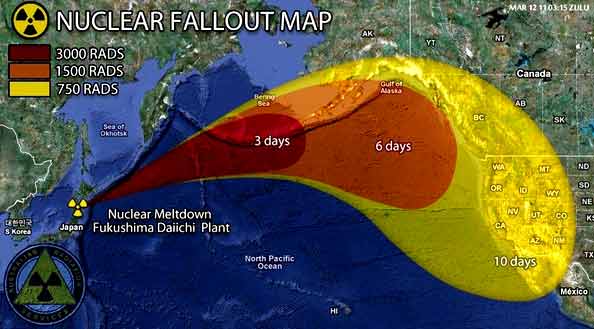

The UN’s nuclear watchdog on Wednesday delivered a preliminary report on their review of Japan’s efforts to plan and implement the decommissioning of the Fukushima Daiichi Nuclear Power Station that suffered a meltdown during the Great East Japan Earthquake and tsunami of 2011.
Following a 10-day visit, a 19-member team of experts praised Japan for making progress on shutting down the crippled plant, but warned that the situation there remained “very complex”. The International Atomic Energy Agency (IAEA) team also acknowledged that processed water now kept on site would probably have to be dumped in the ocean.
“We are still at the beginning of a lengthy process but Japan is gaining a better understanding of the situation, an understanding that is critical to address the challenges,” said team leader Juan Carlos Lentijo, Director of Nuclear Fuel Cycle and Waste Technology at the IAEA. “The situation, however, remains very complex, and there will continue to be very challenging issues that must be resolved to ensure the plant’s long-term stability.”
The visit and report spring from the IAEA’s Action Plan on Nuclear Safety — endorsed by all IAEA Member States in September 2011 and meant to strengthen global nuclear safety — that encourages the use of peer review missions to take full advantage of global experience.
Within that framework, the Japanese government invited the IAEA to conduct an independent review of their “Mid-and-Long-Term Roadmap towards the Decommissioning of TEPCO’s Fukushima Daiichi Nuclear Power Station Units 1–4” with two main objectives:
- To improve the decommissioning planning and the implementation of pre-decommissioning activities; and
- To share the good practices and lessons learned by the review with the international community
The latest visit was the second — an April 2013 initial review of the Roadmap included assessments of decommissioning strategy, planning and timing of decommissioning phases and a review of several specific short-term issues and challenges.
During the 25 November to 4 December 2013 visit, the team examined a variety of decommissioning issues, focusing particularly on TEPCO’s removal of fuel assemblies from Reactor Unit 4′s spent fuel pool and on contaminated water management issues. The experts also looked at Japan’s efforts to monitor radiation conditions in the marine environment, including seawater, sediment, and biota.
The Preliminary Summary Report highlights “19 areas of important progress (acknowledgments) to date and offers 19 advisory points where the team felt that current practices could be improved”.
But its overall tone seems to be one of encouragement. The report states that though the decommissioning “is a very challenging task that requires the allocation of enormous resources, as well as the development and use of innovative technologies to deal with the most difficult activities” the government and TEPCO have taken a more proactive approach since the April mission. “Japan has achieved good progress in improving its strategy and the associated plans, as well as in allocating the necessary resources towards the safe decommissioning.”
“The team also notes that the current situation is very complex, and that there are still some very challenging issues (e.g., contaminated water management, nuclear fuel removal, and fuel debris removal) that must be resolved to ensure the long-term sustainability of the plant’s stable condition.”
And all the encouraging praise aside, those challenging issues are indeed thorny. The recently begun work on removing fuel assemblies from the spent fuel pool in Reactor No. 4 means the removal of 1,533 fuel assemblies — a huge and sensitive task, well described by The Guardian. The job will take until the end of 2014.
The management of contaminated water that has been used to cool reactor cores also is a multi-faceted undertaking. Because groundwater from nearby mountains has been flowing onto the site and into the reactor buildings, 400 metric tons of radioactive water is produced daily. Japan’s Roadmap states that construction of a groundwater bypass to reroute that mountain water is underway and that the frozen underground walls planned for Building Units 1 to 4 are in the conceptual design phase and preparatory work was to commence in mid-November.
Meanwhile, 400,000 tons of water are stored at the site in about 1,000 tanks. The “Advanced Liquid Processing System” (ALPS) is capable of removing all radioactive materials except tritium (“one of the least dangerous of radionuclides” according the the US Environmental Protection Agency). And the IAEA preliminary report puts much emphasis on its “consistent and high performance”. Sadly, the system is trouble-prone and was shut down again last weekend, just prior to the report’s launch.
So it remains to be seen what will emerge from the experts’ advice on the topic:
“TEPCO should bolster its efforts to treat this water and then examine all options for its further management, including the possibility of resuming controlled discharges [to the sea] in compliance with authorized limits. To pursue this option, TEPCO should prepare appropriate safety and environmental impact assessments and submit them for regulatory review.”
The IAEA team will produce their final report on their inspection by the end of January. Overall, the government’s Roadmap for decommissioning the Fukushima plant envisages a process that is expected to last three or four decades.
9 Comments on "Fukushima Nuclear Situation Still ‘Very Complex’"
J-Gav on Fri, 6th Dec 2013 11:06 pm
This looks like desperation to me. Do you feel safe with these corrupt, incompetent, lying dick-heads in the wheelhouse?
DC on Sat, 7th Dec 2013 12:24 am
Q/ The International Atomic Energy Agency (IAEA) team also acknowledged that processed water now kept on site would probably have to be dumped in the ocean.
I am astounded by this. They are plainly admitting they are just going to dump, how many millions or more gallon\tons? of radioactive water directly into the ocean?
The people of Japan, will be literally eating that radiation via there seafoods. And so will people on the west coast of North America as well. All that radiation will end up in the ocean food chain, and then into humans. Nothing from the North Pacific can be considered safe after they do that.
Why are the people responsible for such gross negligence not being charged with crimes against humanity? Start with the IAE, the amerikan NRC(why are they even involved), TEPCOs engineers and most of the Abe Govt.
Manuel Lopez on Sat, 7th Dec 2013 1:29 am
Priority is, of course, safety. But another weakness of nuclear energy is cost. It’s said that it is very cheap to produce but, what about the cost of decommissioning a nuclear reactor? And the cost of setting up and maintain a secure place for residues? Half-life of plutonium 239 is about 24000 years. This means that after 24000 years, half of the plutonium is still there. One more thing is that although plutonium is toxic, its main damage is done by breathing. It is highly carcinogenic. It’s said that about one millionth of a kilogram in the lungs is capable of producing lung-cancer, but only plutonium produced in nuclear reactors. Military-grade plutonium is not dangerous in this sense.
BillT on Sat, 7th Dec 2013 1:37 am
While it will take years, the oceans of the world are ALL connected by the currents. See:
http://global.britannica.com/EBchecked/topic/249180/Gulf-Stream/2926/Movement-and-physical-features
DC, you are correct about the fish. Tuna, Alaskan salmon, King crabs, shrimp, etc. Any fish that migrates into the Northern Pacific will be contaminated. Maybe I should say MORE contaminated. After all, we did do all of those nuclear tests in the Pacific over the last 60 years. Hundreds of them. Then there are the chemical pollutants from industry, ships garbage, etc. that we have been dumping into the oceans for the last 150 odd years and the airborne pollutants that were brought down by rain over the oceans and land for the last 100 years or so. Nothing we eat or drink or breathe today is ‘pure’. Nothing.
GregT on Sat, 7th Dec 2013 6:24 am
We are nothing more than another species of animal on this planet. We are no more in control of nature than any other species. We have messed with things that we don’t fully understand. We are responsible for the consequences of our own ignorance, greed, and utter stupidity. It is very sad, that so many other species, will be wiped out with us.
They didn’t deserve it.
Kenz300 on Sat, 7th Dec 2013 2:55 pm
Quote — ” Overall, the government’s Roadmap for decommissioning the Fukushima plant envisages a process that is expected to last three or four decades.”
——————-
and at what cost? ………..
We now can see how costly and dangerous nuclear energy really is.
J-Gav on Sat, 7th Dec 2013 3:12 pm
“We can now see how costly and dangerous nuclear really is.”
Kenz – I may not agree with all your positions but I’m glad you keep hammering on that point. It bears repeating until nuclear is pushed entirely out of the picture, although that’s unlikely to be the case before other ‘incidents’ occur …
surf on Sat, 7th Dec 2013 6:21 pm
“Meanwhile, 400,000 tons of water are stored at the site in about 1,000 tanks. The “Advanced Liquid Processing System” (ALPS) is capable of removing all radioactive materials except tritium (“one of the least dangerous of radionuclides” according the the US Environmental Protection Agency). And the IAEA preliminary report puts much emphasis on its “consistent and high performance”. Sadly, the system is trouble-prone and was shut down again last weekend, just prior to the report’s launch.”
Didn’t any of you notice that part of the report? The plant that was just built will filter the stored water to remove the radiation. Once filtered the seperated radioactive materials will be concentrated into small easily stored containers in solid form. The only radiation left in the water after treatment would be from the very small quantity of tritium in the water, a very slightly radioactive version of hydrogen. The radiation from tritium cannot penetrate your skin. This water could be stored in an old depleted oil or natural gas fields. By the time it would work its way Back into the biosphere decades later it would not be radioactive.
the recent shutdown of the plant was due to a very small leak (one liter) of nonradioactive hydrochloric acid used to adjust the PH of the water. The leak is very small and will not take long to fix.
Since the accident:
The waist storage pools have been cleaned up and repaired.
The damaged buildings were repaired so that they would not collapse in another earthquake. There was a magnitude 7 earthquake earlier this year.
Preparation to remove the spent fuel from the waist storage pools was done and now the waist is being removed.
The reactors have been kept cool and a treatment plant for the radioactive water has been made.
That is an impressive list of accomplishments in only two years. Especially when you consider the hazards associated with working in a radioactive area.
J-Gav on Sun, 8th Dec 2013 12:37 am
Surf: “Waist” is actually spelled “waste.” Otherwise, you appear to be trying to get your head around the girth of something you don’t really understand.