
Peak Oil is You

Donate Bitcoins ;-) or Paypal :-)


Page added on October 19, 2013

Post-Modern Moonshots
 |
| Mobile burn at New England Small Farm Institute |
As Daniel Quinn, author of Ishmael, reminds us, “If the world is to be saved, it will not be by old minds with new programs, but by new minds with no programs.”
Actually, it may not be the lack of programs, per se, but more to do with new ways of looking at the world — as Proust said, “not in seeking new landscapes, but in having new eyes.”
Many of us who have been fretting over near term human extinction, a prospect recently bolstered by the advance release of the summary report of the Intergovernmental Panel on Climate Change, if not the near death experience of the global economy at the hands of a tiny political faction, have been probing this idea of new ways of thinking. That is what led us to travel up the Amazon river some years ago, and there to discover a secret climate control mechanism involving dark earths. Ever since then we have been using this space to report on new steps along that path, or new vistas we can discern with our new eyes.
We are fresh back from the 2013 North American Biochar Symposium and, as usual, dazzled by the latest vistas. To condense a 5-day conference into a short post is impossible, but fortunately the organizers had the foresight to video capture not just the plenaries but every one of the more than 100 presentations in the breakout sessions. These will soon be posted for public viewing on the UMass Amherst and/or Pioneer Valley Biochar web sites.
Highlights are many but here are just a few:
The conference served the first ever cool banquet — food items grown in biochar amended soil or foods/beverages that, in the course of production, provided feedstocks to be made into biochar. Entrees included biochar-fed smoked pulled pork, biochar-fed chicken sausage, charcoal pasta, biochar-wrapped goat cheese, biochar-covered peanuts and a variety of salad greens and vegetables grown in biochar conditioned soil.
 Kelpie Wilson provided a little-known piece of the history of biochar in the story of Justus von Liebig and the evolution of the theory of humus. Most fascinating was a vignette of the argument between Liebig and Pasteur over whether soil fertility could be attributed to “vitalism” (biology) or the presence of elemental compounds (chemistry). Liebig believed that plant growth could be explained entirely by the availability of soil minerals until Pasteur proved conclusively there was more to it, and that humus is, in fact, teeming with forms of life that make plant growth possible. Liebig was an early pioneer in studying the uses of biochar and when he died, left instructions to be buried in a coffin filled with biochar.
 Who knew NASA’s budget has a $160 million/year line item for educating US schoolchildren? The federal shutdown canceled attendance by many participants from USDA, USGS, USFS and ARS but Doris Hamill of NASA’s Langley Research Center paid her own way to give a plenary keynote on the children’s educational packet she and others at NASA developed for distribution to middle schools across North America. For reasons one can only speculate, her superiors deemed her effort “off mission” and did not elect to go public with the packet, but the developmental work is not in vain. Watch for this to be independently funded and distributed soon, in English and Spanish.
Among the many 5-minute “Insight” talks were nice little tricks-of-the-trade visuals from Kelpie Wilson (how to build and operate a conical open “wok” kiln); Josiah Hunt (large-scale batches using the pit method); and Thomas Reed (instant biochar from pinecones on wet newspaper).
CoolPlanet Biofuels, now supplied ample funding from Google, GE, BP and Conoco, is building mobile reactors that convert 1 ton of biomass to 75 gallons of biogasoline and 1/3 ton biochar.
In his opening keynote, Erich Knight reminded us that if CoolPlanet processed the entire projected US biomass harvest in 2030 (1.6 Gt), the yields would be 120 billion gallons of tank-ready fuel (the US now consumes 150 billion gal/year), and 0.3 billion tons of biochar, with a farming application of 300 million hectares, or 1.2 million square miles. The land area of the United States (excluding Hawaii and Alaska) is 2.9 million square miles. Of course, there is no possibility that CoolPlanet could process the entire annual biomass harvest of the United States! Their more modest goal is 100,000 one-million-gallon capacity plants, each at village scale. A typical village of 1000 residents with such a plant would net $1 million/yr besides making all the fuel they need and 60kW of electricity, with a capital payback of 2-3 years. CoolPlanet’s founder, Mike Cheiky, says that with 2% of the world’s arable land they could drag industrial civilization back to carbon neutrality. With 3%, they could cleanse 100 ppm CO2 from the atmosphere in 40 years (to 300 ppm if we begin right now). Meanwhile, the projected price of the Cool Fuel produced would be $1.50/gal in today’s dollars. Only time will tell whether this is a realistic projection or just so much more snake oil.
Meghana Rao, who dazzled us as a High School sophomore from Beaverton, Oregon, at the Sonoma conference a year ago, delivering a PhD level talk on the effect of particle size and feedstock on physical and chemical stability of biochar, was back as a 17-yr-old High School junior having now presented in Kyoto, Japan, become a finalist at the Intel International Science and Engineering Fair — which gave her 15 minutes of face time with President Obama at the White House to better educate him on the climate restoring value of biochar — and also being named the Young Naturalist of the year by the American Museum of Natural History. Her presentation this time, which was again jaw-dropping, was on the “Novel Implementation of Biochar Cathodes in Microbial Fuel Cells – Phase I.” Having earlier noted the high surface area and cation exchange capacity of biochar, she is conducting a longer study on replacing platinum and rare earths in fuel cells with biocathodes. Preliminary results suggest biochar is somewhat less efficient (10-15%) but up to 400 times more cost-effective and of course can be recycled to later uses, such as water filtration, toxin-scavenging or as an organic soil amendment.
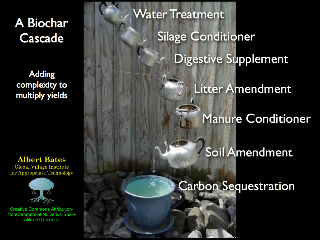
 And, speaking of stacking uses for biochar, many more wonderful contributions came from Hans-Peter Schmitt at Ithaka Institut in Switzerland who described his “55 uses for biochar” in greater detail, including a number of cascading processes that sequence the same batch through an array of uses. Schmidt pointed particularly to the digestive qualities of biochar, noting that the Zanzibar Red Colobus monkey eats char daily to detox the phenols in its leafy diet, that we currently spend $20 billion per year on animal pharmaceuticals, and that adding a tiny bit of biochar to animal feed would cut Germany’s GHG emissions by nearly 1%, not including methane. Hans-Peter circulated a charred wool product, looking like a rasta dread that had gotten too close to Jock Gill’s charbecue, that was, in fact, a slow release fertilizer stick containing 8% nitrogen. He described biochar textiles that served as deodorizers, plasters that absorb mycotoxins (like black mold spores), lightweight biochar bricks, a refrigerator house in Kenya, biochar pillows and mattresses that soak up toxins from your skin and ambient electromagnetic pollution, and graphite-quality biochar for semiconductors, batteries and nanotubes.

There was much more here than we can possibly describe, but we invite readers to visit the UMass site and take in some of the videos and powerpoints from the program as they are posted. With 4 concurrent sessions at any given time, you can’t see everything even if you attend in person, but thanks to the magic of new media, we will shortly be able to shift time and space and attend any session, on demand.
These video-on-demand features may be the next best thing we have to giving everyone new eyes.
6 Comments on "Post-Modern Moonshots"
action on Sun, 20th Oct 2013 1:51 am
For people so concerned about climate change and the global carbon budget, you’d think they’d see the irony in flying and driving to this convention that was hosted in an HVAC regulated building with overhead flood lighting. So many people really like to talk, while acting in complete contradiction, smiling and having a grand old time along the way, as if talking will somehow remove them from the age of hydrocarbons.
DC on Sun, 20th Oct 2013 2:14 am
I have come to the conclusion, that the only way to ‘save’ the world, is take away everyone’s fossil-fueled powered toys. That, and disband all MNCs. The sad fact is, the only thing that puts any sort of dent in the amount of pollution and toxcity that amerika produces, is economic recessions.
Not tech, not bio-char or bio-fools, or govt regulations, but near depressions. And even that does not help as much as built in demand for fossil-fueled crud creeps up along with the population, even in recessions.
But there it is.
Take away peoples gas-burning whatevers or a crushing planet-wide permanent depression, take your pick.
BillT on Sun, 20th Oct 2013 5:27 am
Hypocrisy is rampant in the Western world, action. “Do as I say, not as I do”,is the motto. That is why I hold little hope for the human race.
Perhaps a solar flare that takes out ALL power systems and tech in one flash would solve the problems, DC. Fry ALL of the satellites and electrical infrastructure beyond replacement/repair. That would solve the energy crisis and the population overload all in one easy step. A month later, the few million scattered over the world that were still alive, could start again.
Norm on Sun, 20th Oct 2013 3:59 pm
Welfare Bums.
Jerry McManus on Sun, 20th Oct 2013 5:41 pm
Charcoal Pasta… Yum!
Notice what isn’t said here, what exactly is the unstated goal of all this charcoal wonderfulness? Why, business as usual, of course! God forbid anyone should live in world deprived of all the conveniences of modern life.
I also love the artful euphemisms like “biomass”. Another word for “you know, like, all that useless icky stuff that grows everywhere”. As though they think tons of it is just laying around going to waste.
The inquiring mind would like to know: Just exactly how many thousands of farms and forests do they plan to lay waste in their rabid thirst for a few gallons of liquid fuel and, um, “soil amendments”?
J-Gav on Sun, 20th Oct 2013 10:05 pm
Hey all,
I’d love to have some land with a lot of biomass. With the help of my local friends, if I had any, I’d produce and share some fuel for local transport and equipment. As well as using it in part for heat during the winter along with solar (for water heating) and micro-hydro would be lovely for the rest … Wouldn’t make biochar though.
Let’s not forget the food forest either, but in my world, this is all still just dreamland so I defer to those who have actually managed to start doing it wherever they are. The only thing we can do where I am is reduce (a little bit more) a level of consumption which is now about 40% of the American way of life.