
Peak Oil is You
Donate Bitcoins ;-) or Paypal :-)


Page added on September 22, 2013

Horizontal drilling, fracking begins in old, shallow oil and gas fields
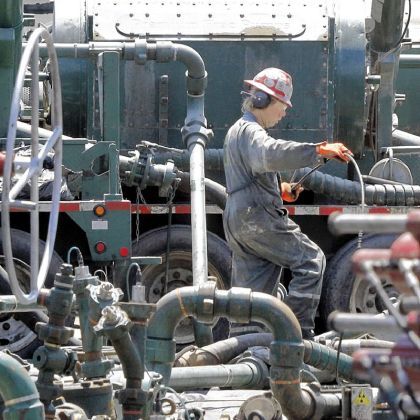
If we could take a tiny glass elevator down the trajectory of a Marcellus Shale well, we would see slabs of coal, sandstone, shale and siltstone alternating and colliding with one another for thousands of feet until we finally reach the target rock.
Today, half a dozen local oil and gas companies are forgoing the full ride. They’re getting off the elevator halfway down, before the Elk Sandstone formation that separates the conventional oil and gas reservoirs from the deeper, unconventional plays across the old oil and gas fields of Pennsylvania.
These reservoirs that have been fueling this region for decades all but faded into an afterthought when the Marcellus Shale boom redefined the industry five years ago.
As Bill Zagorski, vice president of geology with Range Resources, which pioneered development of the Marcellus region, recently told a group of mostly small companies at an industry conference, “We’re able to look at these old plays with horizontal eyes, with Marcellus eyes.”
That means drilling horizontal wells as shallow as 2,000 feet underground and fracturing, or fracking, them to force more fuel to the surface.
The verdict on most of these efforts won’t be known to the public until next February, when companies are required to file their production reports for this year.
Texas-based Range Resources, one of the biggest players in the Marcellus, isn’t downsizing its overall ambitions.
It’s still forcing drill bits a mile underground to reap Marcellus bounty. Instead, the shallower fields are opportunities for smaller, perhaps family-owned oil and gas companies that until now have been squeezed out of the game, Mr. Zagorski said.
That’s exactly what Mark Thompson was thinking when he founded Horizontal Exploration LLC two years ago.
Mr. Thompson has been drilling shallow, vertical oil and gas wells into the Upper Devonian sandstones with his Indiana, Pa.-based company Mid-East Oil for 35 years.
The newer business, Horizontal Exploration, was designed to profit from technology and services that followed Marcellus operators into Pennsylvania in recent years.
Horizontal Exploration has drilled three horizontal, or lateral, wells so far and has permits for another eight in Pennsylvania.
It fracked the first well this month and is awaiting results.
The wells are about 2,000 feet deep and extend between 3,300 feet and 5,300 feet horizontally.
“We think you should be able to do these for $800,000 to $900,000 [per well],” Mr. Thompson said.
But at the moment, the company is spending about $1.3 million a pop. It’s still toward the bottom of the learning curve, he explained.
A Marcellus well, by contrast, can run anywhere from $4 million to $10 million. It needs, on average, 5 million gallons of water for fracking.
Horizontal Exploration is using only about 120,000 gallons of fluid to frack its shallow wells.
The conventional laterals will never produce anywhere near the amount of oil and gas coming out of the deeper Marcellus wells, but Mr. Thompson is hoping for at least 10 times the bounty of a vertical shallow well and a quicker payback period — about 18 months, compared to four years.
The Upper Devonian sandstones are thinner than the Marcellus. Some are only 20 feet thick compared with the Marcellus’ average thickness of 70 feet or more, said Dan Billman, president of Mars-based Billman Geologic Consultants Inc., which helps companies identify suitable spots to sink both conventional and unconventional wells.
While shale rock is tight and relatively impermeable, sandstone is porous and oil and gas easily flow through its tunnels.
That means the pressure needed to frack it is a fraction of what’s required for a deep shale well.
And some conventional horizontal wells are designed not to be fracked at all, Mr. Billman said.
One of the earliest horizontal shallow wells in Pennsylvania, with advice from Mr. Billman, was drilled by Freeport-based Phoenix Energy Productions in 2010.
Since then, the company has drilled two more horizontal wells in Washington County and hasn’t fracked any of them.
Penneco Oil Company Inc. in Delmont, on the other hand, has been fracking horizontal shallow wells for several years now. It perforates the casing at more than a dozen stages and pumps “off-the-shelf” frack fluid additives into oil and gas formations about 3,200 feet under Greene, Westmoreland and Allegheny counties with great success, according to Penneco’s COO Ben Wallace.
“We hear this from a lot of drillers — they get called because oil and gas companies look up our completion reports,” Mr. Wallace said.
Penneco’s sandstone wells cost “several million” dollars to complete, Mr. Wallace said, and the company plans to drill about 10 horizontals a year.
While the wells are closer to the surface and to water aquifers, companies and the Department of Environmental Protection say there’s no reason to think fluids or fuel will reach the water.
“We certainly have less history on these wells, but so far no problems,” said Alan Eichler, DEP’s Southwest regional oil and gas program manager.
Shallower wells don’t need the same force to be fracked as deep wells, he said, and coal-bed methane wells, which are also shallow, “have been fracked for years without any problems to freshwater aquifers.”
But Mr. Eichler noted that coal-bed methane, which crumbles a lot easier than sandstone, likely needs even less pressure during a frack than wells like Penneco’s.
More will be known in the near future, as this type of drilling picks up steam.
Several other companies, such as Warren County-based Pennsylvania General Energy and South Side-based Catalyst Energy have secured permits from the Department of Environmental Protection to drill horizontally in shallow reservoirs.
Shallow, or conventional, drillers report their production annually, not every six months as Marcellus operators must, so the results of these efforts won’t be available until next year.
7 Comments on "Horizontal drilling, fracking begins in old, shallow oil and gas fields"
rollin on Sun, 22nd Sep 2013 12:11 pm
My question is that after they are drilling the Marcellus, the Utica, any other layer they can find and now the shallow wells; will there be any place in Pennsylvania that does not have a gas or oil well nearby?
actioncjackson on Sun, 22nd Sep 2013 4:01 pm
Agreed rollin, it’s an ugly picture. Furthermore when an environmental catastrophe ends up happening, and it has and will happen again, it’s enough for them to just say I’m sorry, please forgive me. Adding up all these I’m sorry’s results in a picture of large scale pollution, and of fresh water too. That’s suicidal but hey, why change our ways now. /sarc
rockman on Sun, 22nd Sep 2013 7:50 pm
Rollin – FYI there hasn’t been area in PA that hasn’t had an oil or gas well nearby for at least half a century. Also there have been many thousands of shallow wells frac’d in Texas alone. The story is trying to highlight such efforts as new despite it’s been happening for many years.
rollin on Sun, 22nd Sep 2013 10:25 pm
Rockman, I have hiked thousands of miles in Pa and toured many more by car. Never came across a gas well, finally saw a pipeline swath in NE Pa about 15 years ago. Almost all the gas wells were located in the western third of the state. Now they have advanced eastward threating the Susquehanna and Delaware drainages.
The potential number of Marcellus and eventually Utica wells is phenomenal. Makes what is in place today look like nothing.
Here is an interesting map with current and future estimated wells
http://maps.tnc.org/paenergy/
In the future, it looks like you could not get more than a kilometer away from gas wells over more than half of Pennsylvania.
rockman on Mon, 23rd Sep 2013 12:16 am
Rollin – There have been over 350,000 oil and gas wells drilled in PA. And many of those were drilled in the same area as the Marcellus is being developed. Thus the concentration of wells drilled in those areas is far greater than you map indicates.
IMHO you should be more worried about those old wells than the new ones. There is a well documented history of tens of thousands of those wells not being plugged by current standards. To make it worse there’s poor records of the locations of thousands of wells.
And besides what wrong with seeing a wellhead? Just consider the “modern sculptures”. LOL
BillT on Mon, 23rd Sep 2013 12:44 am
Rockman, there are no wells in the Eastern half of PA that I am aware of. I lived there for 64 years. Much of the area is limestone and granite, with spots of sandstone in the mountains. It is also mountainous with upthrusts of rock at angles that would not be conducive to trapped gas.
I suspect that as it approaches the wealthier part of the state, the drilling will be halted. And it is only a temporary bubble anyway.
rollin on Mon, 23rd Sep 2013 12:20 pm
Your right BillT, the active spots for gas well drilling and oil were concentrated in west and north of the Allegheny front until the Marcellus was started.
Another 100,000 or so shale wells might be planted across the region all the way out to Scranton and a little beyond. It will all depend on price, which means give it time.
Next comes the Utica, another 100,000 wells or so. Pa won’t look like the Athabasca tar pits but it won’t be pretty or clean.