
Peak Oil is You

Donate Bitcoins ;-) or Paypal :-)


Page added on September 19, 2013

Heinberg: “Peak Oil Demand” = Peak Oil
 A new phrase has entered our energy lexicon—peak oil demand. The essential idea: prophets of doom who warned about a looming global petroleum shortfall (“peak oil”) were wrong; instead of a downturn in supply, we’re instead seeing the shrinkage of demand for oil. A non-problem just solved itself! Nothing to see, folks; move along.
What’s wrong with this framing of our energy situation? Plenty.
To understand what and why, it’s helpful to start with a sense of who’s crooning the “peak demand” tune: it’s long-time peak oil critics like Daniel Yergin—the oil industry spokesman who, throughout the past decade of soaring oil prices, repeatedly assured the public that prices were going to fall back to historic levels (he was wrong each time, see here and here.). The industry hates peak oil, because if people took it seriously there would be a mad rush by individuals and governments to reduce petroleum dependency. Can’t have that.
Is it true that demand for oil has fallen? Yes—and there’s the kernel of truth from which “peak demand” has sprouted. In the older industrial nations—principally, the US, Japan, and Europe—oil consumption started moving sideways-to-downward around the time of the 2008 financial crisis. In fact, if US oil demand had continued its historic upward trend (about 1.5 percent per annum), it would be about 20 percent above the actual current level.
Here’s the all-important question: Why? The peak-demand chorus says, “developed economies are on an efficiency kick.”
Americans are buying hybrid cars and electric vehicles, and manufacturers are engineering traditional gasoline engines to be more fuel-efficient. The average fuel efficiency of new cars in the US is at its highest level ever.
Fair enough. But that’s far from being a sufficient explanation for the demand destruction we’re witnessing, given that relatively few Americans are buying new cars these days. In fact, the biggest single component of contraction in US oil demand is drivers clocking fewer miles annually.
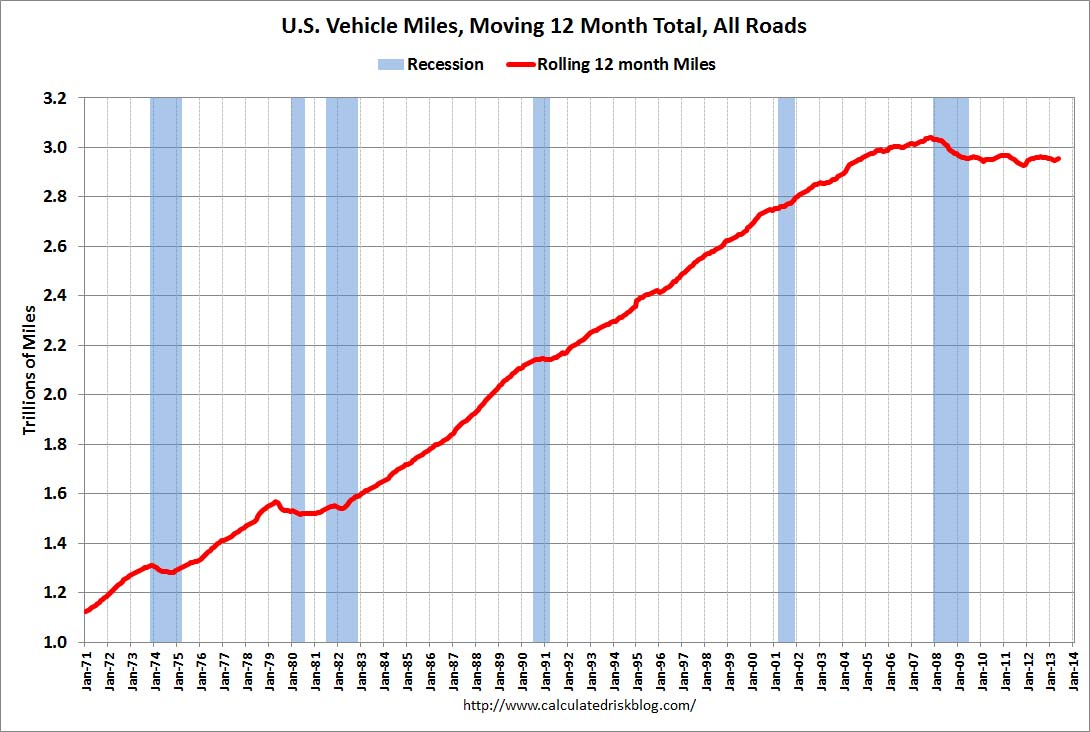
The past five years have seen the longest sustained period of non-growth of vehicle miles traveled (VMT) in US history. Why aren’t people driving more? Two words: gas prices. Incomes for most Americans haven’t improved in recent years, but gasoline prices are hovering near their highest level ever. Driving has gotten so expensive that attitudes toward automobiles are slowly changing, with many young people abandoning the very idea of car ownership.
However you look at the recent decline in petroleum demand, stratospheric oil prices are clearly implicated (it’s not just parsimony in miles driven; efforts to boost fuel efficiency are also largely motivated by gas pump sticker-shock).
But why are petroleum prices so high? Although some commentators are quick to blame oil companies or speculators, the main factor keeping the price of oil above $100 a barrel is supply. Yes, OPEC frequently reminds us that the oil market is “well supplied.” But that claim requires an addendum: the market is well supplied with $100 per barrel oil—which the economy can barely afford. If the oil price were to slip southward, back to historic levels (closer to $40 per barrel, adjusting for inflation), the number of barrels of petroleum available worldwide would quickly dwindle. That’s because the amount of oil that can be produced profitably at a low price (typically from onshore, conventional, vertical wells) has fallen in recent years. All new demand has been met with oil from marginal, expensive sources—tar sands, horizontally drilled and fracked tight oil wells, or deepwater wells. Producers need prices of $100 a barrel to justify investing in these operations. The oil industry has doubled its level of investment in production in recent years, and doubled the number of wells it drills annually, while taking on far more debt—just to grow total oil supply at an anemic rate.
So the correct framing of our situation is this: Falling production of conventional oil is pushing prices higher, and high prices are driving demand down. “Peak demand” is peak oil by another name—de-fanged and de-clawed.
Euphemisms don’t change reality, except by first changing people’s perceptions of reality, and hence their actions.
Here’s reality, stripped of niceties. Oil is the lifeblood of industrial society, since nearly all transport fuel is oil-based and transport is essential to trade. Industrial nations have no ready and adequate substitute for petroleum. Therefore, unless preparations are made, the inevitable decline in global conventional petroleum production will gradually strangle the world economy, starting with the most oil-dependent nations.
Production rates of conventional oil will decline more sharply as time goes on, making it harder with each passing year to keep total liquid fuel production steady, harder still to grow it.
As long as prices remain high, increasingly desperate efforts to slake society’s thirst for liquid fuels will lead to the exploitation of more costly substitutes for conventional crude, such as tar sands—but these sources also happen to carry more environmental costs and risks. Problem not solved.
The currently favored “fix” for the dilemma of conventional oil depletion and decline—tight oil from North Dakota and Texas—is in the midst of a short-term boom. But the supply boom won’t last until the end of the current decade, and a demand bust could foreclose this expensive option even sooner.
All the “peak demand” discourse actually accomplishes is to lull society into inaction. Why worry? The market is solving our problems for us. There’s no need to actually do anything—like retool our economy for less mobility, less growth, and more renewable energy.
Peak oil? It’s doing just fine, thanks. As for our oil-dependent economy, not so much.
22 Comments on "Heinberg: “Peak Oil Demand” = Peak Oil"
actioncjackson on Thu, 19th Sep 2013 10:43 pm
A lot of people don’t understand, and I’m not referring to the author of this article, that supply and demand are dynamic, always changing and testing each other, and to call it peak oil demand is really just ignorance plain and simple.
dave thompson on Thu, 19th Sep 2013 11:14 pm
Or rather “peak oil demand” is crazy like a fox, obfuscation.
LT on Fri, 20th Sep 2013 12:53 am
“Peak oil demand = peak oil” is meaningful if there is a demand of oil out there that is greater than supply of oil. In other words, if, say, today’s market demands 110 mbpd at $200/barrel, and the world can supply only 90 mbpd. Then we can take that as a sign of oil being peaked out.
Other than that, the concept of “peak demand of oil” is not very helpful.
BillT on Fri, 20th Sep 2013 1:19 am
Again, most American’s will only read the “Dropping demand – Plenty of oil” headlines … assume that it means there is plenty of oil, but we are just using less than is produced. They never question anything except price. They just get their happy face on and pop into their SUV for a trip to McDonald’s.
Arthur on Fri, 20th Sep 2013 8:37 am
Supply and certainly demand are confusing, somewhat abstract concepts. Better stick with the razorsharp, welldefined and measurable concept of ***transaction***, where demand and supply meet. Someone drives his car to the petrol station, poors 53 liter in the tank and – sigh – pays 100 euro (135$) at the counter. Transaction completed, 53 liter supply/demand entry added to the bookkeeping.
Yes it is true, transactions are down, because prices are up and wages have remained equal or even went down, and savings are gone so something has got to give which hurts least: driving.
Does this prove peak oil? This Bell-shaped ASPO-curve and peak-201x? Not so fast.
There is another scenario thinkable, the Michael Klare / Fox-Gasland scenario, that is the possibility of a very prolongued plateau, deep into the future of 1xx$ oil, where trillions of barrel of oil are waiting to be harvested with ever more refined sophisticated technologies, but won’t be harvested, because gradually oil will lose the price competition of renewables.
Not necessarily the worst of all scenarios, and preferable over all sorts of die-off/four horsemen scenarios.
Arthur on Fri, 20th Sep 2013 8:53 am
To add this: the ASPO model was purely based on supply and it’s geological constraints. Images or cars lining up for petrol stations and wallets fuel of money, but no gas. Not going to happen.
The more likely scenario will be: ever less, empty gas stations (empty of customers that is), ready to sell you all the gas you need, against high prices.
In this scenario you could very well speak of peak demand rather than peak oil. The last few trillion barrel equivalent of carbon fuel will remain in the ground, because nobody is interested anymore. And the world will carry on, in a much lower gear, with empty highways and airports, with lots of people tapping on their 3watt solar powered tablets, every now and then looking out of the window to watch the potatoe plants grow in the backyard.
Luke on Fri, 20th Sep 2013 9:00 am
Don’t forget Bernanke’s money machine. He might know cheap money at zero interest is not really stimulating the growth and unemployment. But more under pressure of the greedy Wall Street investors who will suck the cheap money and keep the fracking/tar industry alive for a while. But when this cheap money show is over we all fall from a steep cliff.
Arthur on Fri, 20th Sep 2013 9:05 am
…with 15 C/59F roomtemperature and everybody wearing body warmers, batteries included, slashing heating cost with a factor of ten.
http://www.shopwiki.co.uk/l/gerbing-bodywarmer-heated-clothing-bodywarmer-heated-vest
Stilgar on Fri, 20th Sep 2013 5:41 pm
Give credit where credit is due (much to my chagrin) that peak oil critics so quickly coined a new catch term to obfuscate from their inaccuracy regarding peak oil. They came up with it then all got on the same page. As George Costanza would say, “Well played.”
However much as it may quell the concerns of the automatrons sleep walking towards the cliff, it doesn’t change a thing. It just shows how weak the critics are, particularly Yergin who was so off base price wise in his predictions he should be denounced publicly in a worldwide press conference. Instead, in part because of ‘peak demand’ he’s still the oil industry’s go to guy on predictions. Ha!
Kenz300 on Fri, 20th Sep 2013 5:55 pm
Buy a bicycle —- they are good for your health and good for the environment.
Stilgar on Fri, 20th Sep 2013 7:00 pm
Arthur, what about ships, trains transport trucks, farming equipment, mining equipment, plastics and all the industrial uses of oil? Fuel stations for autos is only part of the picture.
Arthur on Fri, 20th Sep 2013 7:15 pm
Yes, all down. There will not be a renewable plug and play solution, garanteeing BAU, nevertheless, it’s contribution will be significant. Proof? Sweden, Denmark, Germany and others. And nobody needed plastic in my youth. Renewable electricity can be used to produce liquid fuel for agriculture if we will not succeed creating storage techniques.
GregT on Fri, 20th Sep 2013 7:39 pm
Our electric company is raising rates again, by 26% over the next two years, to help offset the costs of replacing failing infrastructure.
I put over 200km on the car yesterday in the city, visiting some of my work’s facilities. Solar panels seen, zero. Wind turbines, one. The one on top of the mountain of our local ski hill.
People are driving less, because they have less disposable income. The same disposable income needed for alternate energy infrastructure investment. This city is going to be in for a great deal of pain, in less than a decade. Glad I won’t still be living here.
Stilgar on Fri, 20th Sep 2013 7:49 pm
Arthur, those countries you listed still use oil and NG. Also they receive imports from FF burning countries. Renewables is only 1% of the total energy used in the world. Many countries including the US, Japan & EU are deep in debt having to QE to maintain anemic growth. Where is all this capitol going to come from to transition away from FF?
jedrider on Fri, 20th Sep 2013 8:47 pm
BAU meet Brick Wall.
Arthur on Fri, 20th Sep 2013 8:52 pm
“Renewables is only 1% of the total energy used in the world.”
Sweden has the ambition to be carbon free by 2020. Other European countries by 2030-2040.
http://deepresource.wordpress.com/2013/07/28/is-europe-on-target/
EU target is 20% renewables for 2020 and probably will be met.
“I put over 200km on the car yesterday in the city, visiting some of my work’s facilities. Solar panels seen, zero. Wind turbines, one. ”
In my neighbourhood every week a new roof with 6-12 panels, it is going very rapidly now. In a few years everybody will be self-sufficient the year over as regards to electricity for household consumption. That is the positive aspect of having electricity prices of 30 dollar cent per kwh, here it pays to do the transition. And Holland is about the slowest in Europe when it comes to adopting solar. Germany is by far number one in the world. Wind is doing much better here.
GregT on Fri, 20th Sep 2013 10:33 pm
Arthur,
I am assuming all grid tied? Where does the electricity come from after dark?
Arthur on Fri, 20th Sep 2013 10:59 pm
All grid tied.
And after dark Norway kicks in, our private little Canada, so to speak 😉
http://deepresource.wordpress.com/2013/06/15/norned/
BillT on Sat, 21st Sep 2013 1:51 am
Arthur doesn’t live in the real world, he lives in a techie dream. When the roads are gravel and most bridges closed, how will all those materials and components get to a factory that does not exist because it closed 20 years ago when there was no money to buy it’s techie toys? No, his world will be the first to go and it pains him.
Stilgar on Sat, 21st Sep 2013 3:12 am
http://www.google.com/imgres?imgurl=http://4.bp.blogspot.com/-COCralb25EM/Td_EIou5e7I/AAAAAAAAAA8/G3N1wDJdvik/s1600/US.energy.consumption.pie.chart.jpg&imgrefurl=http://dailychode.blogspot.com/&h=497&w=762&sz=31&tbnid=ZUbamvA58DC-1M:&tbnh=72&tbnw=111&zoom=1&usg=__i_RIfENNLYp8ZElgDquP51rg3Zs=&docid=zjvPNLfEe3bMvM&sa=X&ei=Uw09UsGJGc_figLcx4GQCg&ved=0CDEQ9QEwAQ&dur=1392
That’s a link Arthur to a pie chart showing others, renewables at 1% worldwide. Great strides in EU yes, but India and China building coal powered plants at alarming rate as it relates to climate change. Just seems late in the game with the world economies so far in debt, but hey I guess we’ll see what happens. Maybe a debt jubilee then renewables on steroids until we are chalk full of debt again.
Arthur on Sat, 21st Sep 2013 10:03 am
Stilgar, I can recommend to you the good services of tinyulr . com to prevent a thread of becoming unreadable.
Bill, I can’t wait until the moment arrives when the roads turn into gravel and planes drop out of the sky, which would mean that the oil-age (and globalism) will be over, hurray! I don’t give a damn if Joe Sixpack will drive a car by 2025 or not, I hope he does not and I think he will not. In my agenda, survival of European civilization is of far greater importance than this peak oil thingy. If the price of preventing Europe becoming another Islamic hellhole is sacrificing carbon fueled mobility, I am all for it. What is happening in Greece now, renationalisation, will soon happen everywhere else, first in Europe, and next in north America, as a consequency of severe economic stagnation. For north America this will translate in segregation and devolution/secession, since American nationalism cannot exist, considering the diverse nature of the population.
“factory that does not exist because it closed 20 years ago when there was no money to buy it’s techie toys?”
Bill, you always love to lash out against western capitalism and ‘greed’, but you ignore that it is not money that creates technology, but competent people, who will continue to do so after the end of carbon fuel age. European civilization in Europe/America will not come to a halt, but will downshift from fifth to third gear, so to speak. There will be energy to produce local food and charge the battery of your thermo-wired underwear with 1 kwh/day just to keep you warm or charge the battery of your 25 mph e-bike with 1 kwh to enable limited mobility or 0.1 kwh to power your tablet, keeping communication and entertainment and online cloud based working from home possible.
That sort of life is going to be achieved, first in Europe and then spreading to the rest of the world.
Arthur on Sat, 21st Sep 2013 10:04 am
To read a post, select it and copy/past into notepad.