
Peak Oil is You

Donate Bitcoins ;-) or Paypal :-)


Page added on September 10, 2013

Chevron’s oil production, sales decline 5 %
After the publication of Caltex Australia’s half year results for 1H 2013 the media again failed to analyse where Sydney’s fuel imports will come from once its Kurnell refinery closes in 2014. Australia will have to pay high prices if it wants to attract these imports against declining sales trends in international markets.
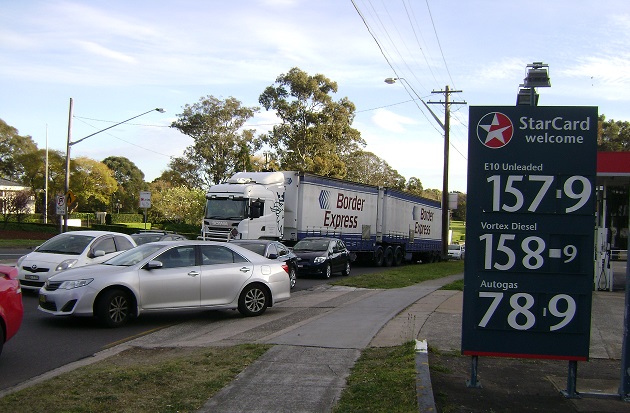
Caltex filling station at Carlingford Court, 27 Aug 2013
ABC TV Lateline interview with Caltex Managing Director Julian Segal
TICKY FULLERTON: You say that work on turning Kurnell into an import terminal is on schedule and on budget. But would that be from the investor’s point of view the one big item to watch, to make sure that over the next 18 months this actually does happen.
JULIAN SEGAL: It is one of the big items. There is no question about it. It is about re-building, re-balancing our supply chain altogether. It’s a big project. We are spending quite a bit of money on it and it’s critical to the success of Caltex in the future. So we are indeed much focussed on it. But it’s not the only area of focus.
Let’s have a look at the Caltex supply chain
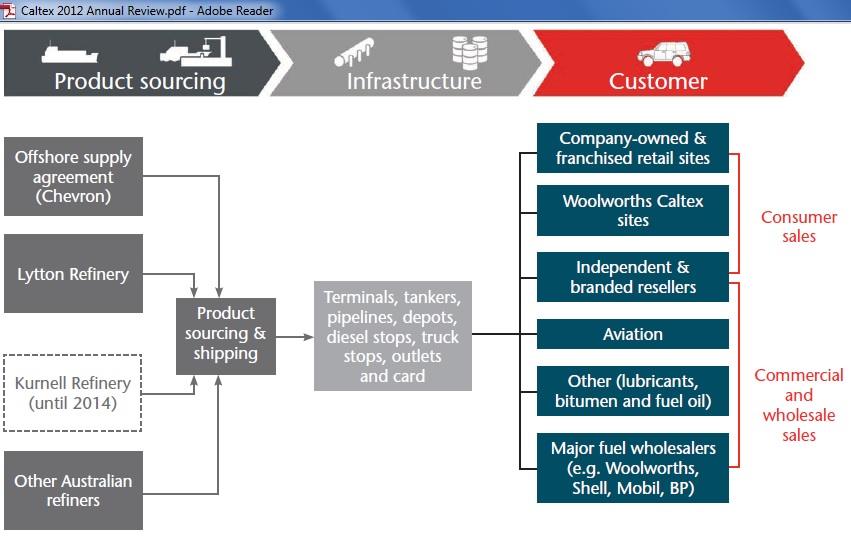
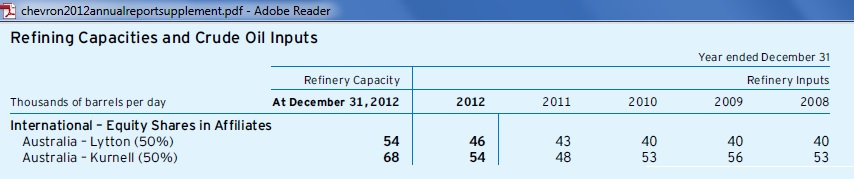
The equivalent of 2 x 54 = 108 kb/d of refinery inputs has to be replaced by fuel imports.
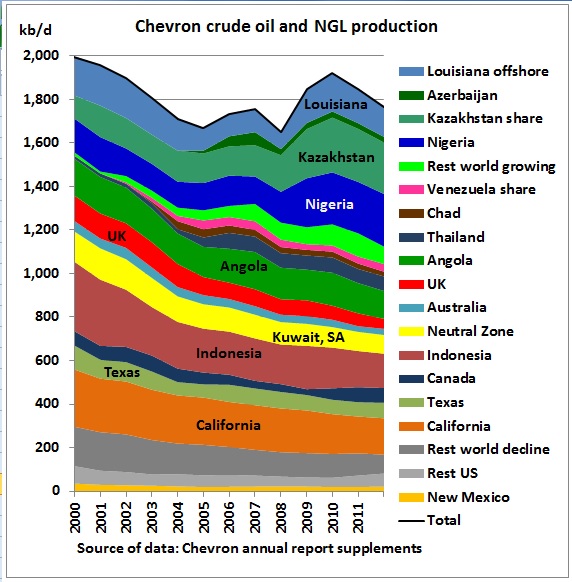
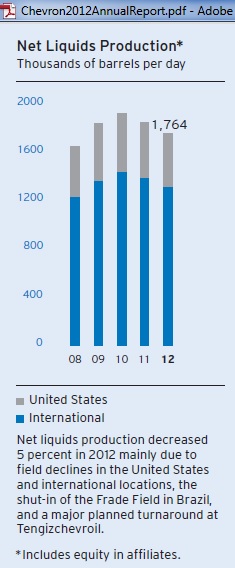
So how will this offshore supply agreement with Chevron work? From their annual report 2012 we can see their liquids production peaked in 2010:
We need to see that in the long term context:
Chevron’s crude oil and NGL production is again in decline, after a secondary peak in 2010, at -4.6% pa. How did that impact on sales?
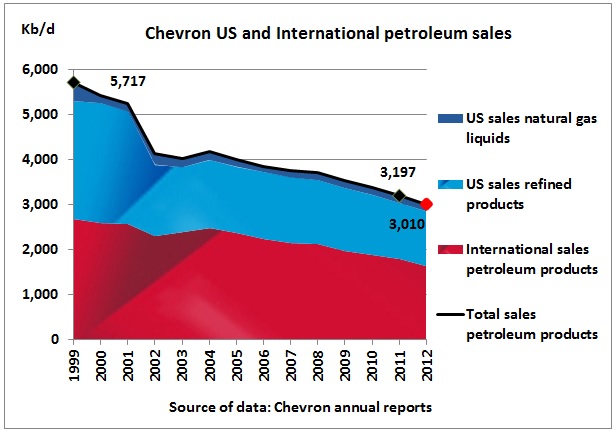
Chevron’s sales worldwide are in decline at between -4.2% and -5.8% in the last 4 years. Let’s see how this looks like for each product:
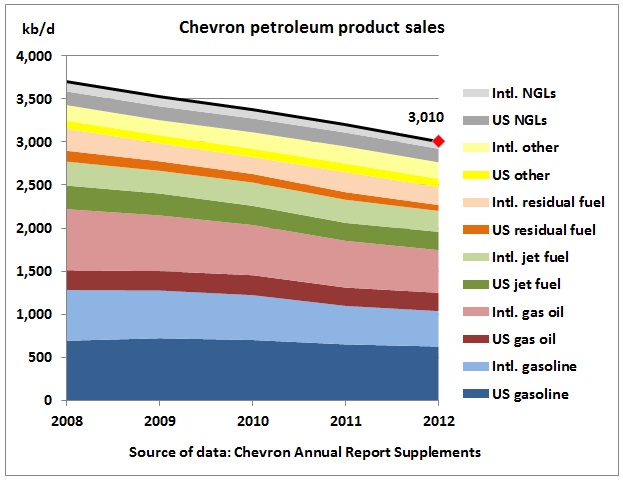
The sales declines are across all products between -3.1% (international jet fuels) and -11.6% (US residual fuel oil). Now we compare that with Caltex sales in Australia:
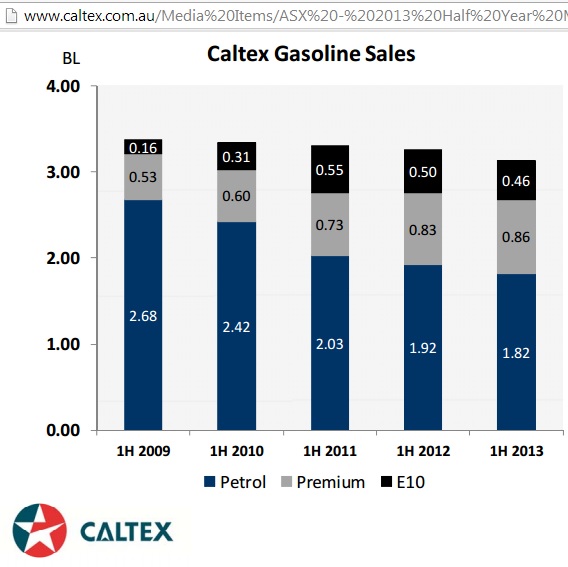
Gasoline sales have dropped by -3.4% in the last year
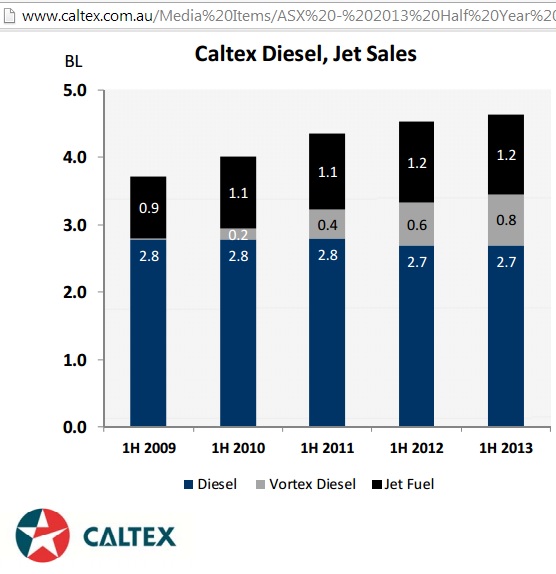
Diesel and jet fuel sales have been increasing by between 4.4 and 4.9% in the last years.
These 2 Caltex graphs are from the half year results presented to the media on 26/8/2013
Putting these 2 graphs together:
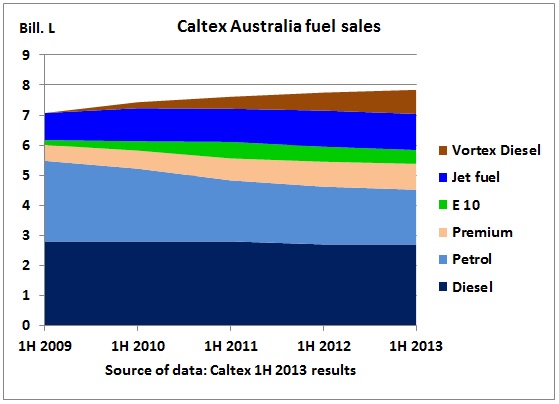
Increasing Diesel sales have offset declining gasoline sales.
The overall growth rate was 2.7 % pa
Summary
|
Annual changes in fuel sales Chevron and Caltex Australia
|
|||
|
Period
|
Gasoline sales | Diesel & jet fuel sales | |
| Caltex Australia | 2012-2013 |
-3.4%
|
4.4%
|
| Chevron US | 2008-2012 |
-4.4%
|
-3.9%
|
| Chevron International | 2008-2012 |
-7.5%
|
-6.3%
|
Caltex Australia’s recent drop in gasoline sales is still less than the corresponding decrease in the US and only half of international sales. So it’s heading in the right direction. But the growth of Caltex diesel sales in Australia is in contrast to decreases elsewhere. Fuel prices, especially for diesel, will have to increase if Australia wants to import fuels against international trends.
Media reports
Only one media report shows declining petrol sales:
Caltex flags buybacks after Kurnell closure
http://www.theaustralian.com.au/business/companies/caltex-flags-buybacks-after-kurnell-closure/story-fn91v9q3-1226704602516
http://www.theaustralian.com.au/business/companies/caltex-flags-buybacks-after-kurnell-closure/story-fn91v9q3-1226704602516
None of the other media reports have discovered Chevron’s underlying production and sales declines. These are some of the headlines
Shopper dockets put dent in Caltex result
http://www.smh.com.au/business/shopper-dockets-put-dent-in-caltex-result-20130826-2sm92.html
http://www.smh.com.au/business/shopper-dockets-put-dent-in-caltex-result-20130826-2sm92.html
Caltex has plenty of growth opportunities: Segal
http://www.afr.com/p/australia2-0/caltex_has_plenty_of_growth_opportunities_aJNLj9qggxbScGqDXkZ1AP
http://www.afr.com/p/australia2-0/caltex_has_plenty_of_growth_opportunities_aJNLj9qggxbScGqDXkZ1AP
Caltex provides upbeat long-term outlook
http://finance.ninemsn.com.au/newsbusiness/motley/8712525/caltex-provides-upbeat-long-term-outlook
http://finance.ninemsn.com.au/newsbusiness/motley/8712525/caltex-provides-upbeat-long-term-outlook
That is one of the reasons why peak oil is not an election issue.
3 Comments on "Chevron’s oil production, sales decline 5 %"
BillT on Tue, 10th Sep 2013 2:11 pm
Looks like the peak is becoming visible…
bobinget on Tue, 10th Sep 2013 3:47 pm
Chevron Just moved in tight oil and gas in Argentina.
This could be looked on as slight desperation, considering all the ultra deep water projects on tap.
Compare low budget low LT yield shale to high investment block-biuster or company-buster returns
from off shore.
BillT on Wed, 11th Sep 2013 3:49 am
What blockbuster offshore profits? You sound like you have investments in Chevron and the other dying oil giants. Have another glass of that cool aid and go back to sleep. The oil companies are desperate for suckers to keep buying their stocks so they can stay in business. ‘Growth’ is now buying out another company and adding their ‘reserves’ to yours so you can boast of ‘growth’ when all it is is consolidation of the dwindling existing reserves.