
Peak Oil is You

Donate Bitcoins ;-) or Paypal :-)


Page added on September 10, 2013

The Energy Return on Energy Invested of US Food Production

Lactic acid. It has a peculiar taste all its own, one that I’ve come to appreciate as, over the past few years, I’ve developed a taste for fermented foods and fermented vegetables in particular. The sharp tang of lactic acid is what gives many fermented foods their peculiar taste, and as I type this I happen to be enjoying a bit of fermented burdock root. Burdock is a wild plant, one that I gather from a nearby floodplain where several small organic farms make their home. Gathering the root is simple enough; one needs only a sturdy trowel, and with a bit of effort the roots of this plant, some as thick as my wrist, can be wrested from the Earth.
The process of fermenting vegetables involves immersing them in a brine to discourage the growth of most species of bacteria, while encouraging the growth of Leuconostoc and a few others that feed on sugars and starch while giving off lactic acid and small amounts of alcohol and other organic compounds as waste products. As the lactic acid builds up, pathogenic organisms are killed yielding a safe food that, thanks to bacterial action, is often more nutritious than the original vegetables were.
I make part of my livelihood from doing energy audits, and this fall when making a batch of fermented burdock I decided to figure out whether I’m investing more Calories of my own labor into the recipe than I get back as food Calories. This year my burdock recipe yielded about 5 pounds of fermented burdock root, which is about 1600 Calories worth of food. Gathering, chopping and brining the chopped roots required about 8 hours of labor overall, which I estimate to be worth about 830 Calories. Doing the math, I invest 830 Calories to get back 1600, which is a favorable, if modest, return on investment. Estimating a food’s energy return is one way of gauging its production efficiency, and this essay explores the energy return of the US food system to see whether its efficiency is headed in a favorable direction.
* * *
Energy return is a ratio that compares the energy output of a process with the energy inputs needed to power that process. Energy return is most commonly applied to measuring the efficiency of fuel production processes, and since food is fuel for the human body it makes perfect sense to apply the metric of energy return to the production, processing, distribution and consumption of food.
One method of calculating the energy return of food involves estimating the energy value of produced food, measured in Calories, in the numerator of the ratio and including the energy inputs, measured in Calories, of human labor in the denominator. This measures energy return from an ecological perspective much like I did above in my fermented burdock example, and offers a sense for the labor efficiency in food production. Anthropologists, among them Richard Lee and Marshall Sahlins, applied this approach to estimating the energy efficiency of food procurement of hunter-gatherer tribes through the 1960s and into the 1970s, and often recorded energy returns for these groups in the range of 5-10. This implies that for every Calorie of labor energy these people invested in the procurement of food, their efforts yielded 5-10 Calories of food to sustain them. These estimates suggest solidly positive returns and, if accurate, illustrate why these groups only had to work, on average, a few hours each day for their subsistence.
 Calculated against the energy value of labor inputs, the energy return of food produced and eaten in the United States is stunningly high, topping out around 90 within the last few years. What this means is that for every Calorie of labor energy that Americans invest in the production, processing, distribution and consumption of food, we get 90 Calories of food energy back. That’s a return on investment of nearly 9,000 percent! From a labor efficiency standpoint, modern industrial food systems annihilate those used by hunter-gatherers.
How can we be so efficient? The answer: machines. In modern industrial societies we use machines to multiply the value of our labor several-fold. Rather than using muscle power from a person to plow a field, we use a tractor which can do the work much faster. Rather than having human beings slicing and dicing animals in a meat cutting plant, we have robots do it far faster and more precisely. Rather than carry food long distances from where it’s produced to centers of consumer demand on the backs of laborers, we ship it in refrigerated rail cars, or 18 wheeled tractor-trailers. Industrial societies use vehicles, machinery and other technologically derived infrastructure in place of human and even animal labor, radically reducing the labor-intensity of food systems.
Just as human bodies must be fed so they can work, machines also require food in the form of industrial fuels like gasoline, diesel, propane, natural gas, and electricity. This realization leads us to another way of studying the energy return of food systems: by counting all energy inputs that feed the system rather than just those associated with human labor. When we do this, we see, as we might expect, a dramatically different trend in the energy return of the US food system. Whereas the energy return relative to labor is high and rising owing to the substitution of fuel-powered machines for labor, the energy return relative to all energy inputs is well below the break-even point of one and getting smaller. This means that where the US food system is very efficient with respect to the energy of human labor, it’s very inefficient with respect to energy overall and getting worse.
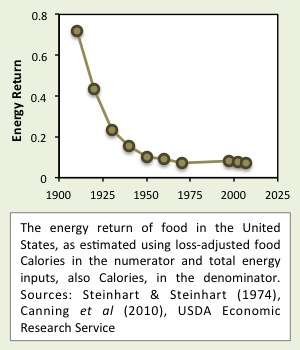 Over the last century, as the US food system mechanized and as Americans came to prefer more processed foods, the energy return of the US food system fell to the point where, as I articulate in my essay The Energy Cost of Food, it now takes 15-20 Calories of energy inputs to deliver one Calorie of food in the US once waste and spoilage are accounted for. That’s an investment of 15-20 Calories into the system to get 1 Calorie of food, a steeply negative return on investment.
While efficient with respect to labor, the US food system is anything but with respect to energy more generally. This leads to a big problem: the fuels that power machines that do the work of producing food are mostly nonrenewable. At some point their supplies will level off rather than continue increasing, and as demand outstrips supply their prices will rise and become more volatile. This is already happening in markets for crude oil and its refined products, and as I type this global oil prices are hovering over $100 per barrel. Because the production of food is so energy intensive, when fuel prices rise food prices will rise with them. If we want to sever the link between food and fuel prices, we must radically reduce the energy inputs needed to produce food.
* * *
Can we produce food in our modern era in a way that’s energy efficient enough to sever the link between the prices of food and fuel, both with respect to labor energy and total energy? Yes, we can, but not with our current industrial model. This model has gone much too far substituting mechanical labor for human labor; from tilling soil, to long-distance food transport, to tons of inputs at all stages of food supply chains, to mechanized food processing methods, there’s simply too much fuel demand in this model for it to yield enough efficiency gains to even approach an energy return near the break-even point of one.
What about ‘local foods’? Maybe. I do energy audits on farms as a profession, and have audited both direct and indirect energy use on a number of small farms in the northeast, including certified organic farms. These farms are held high by the local food crowd, but from an energy standpoint their operations are often less efficient than larger-scale conventional operations. Where it takes around 4 Calories of input energy to deliver a Calorie of fruit or vegetables on a typical, large-scale farm, it’s common for smaller farms to require 15 or even 20 Calories of input energy to accomplish the same feat. If local food embraces the small-scale industrial agricultural model used on so many of the farms I audit, the link between food prices and fuel prices would get stronger, not weaker.
Some small-scale operations are more efficient than others though. I recently audited a small, certified organic, pasture-based dairy operation that delivered fluid milk at an energy return of about 1.25, meaning that every 1 Calorie of energy the farmer invests in his operation he gets 1.25 Calories of fluid milk. That’s a small but at least positive return, and likely emerges from the fact his pastures require comparatively little inputs and mechanical maintenance once established. Perhaps vegetable farms that focus on perennial vegetables would fare better than those that grow annual crops? I’m hoping I’m asked to audit a perennial vegetable or fruit operation soon so I can find out.
* * *
I’m finishing this essay on a rainy afternoon in late fall, after spending a morning staring at spreadsheets, counting joules of energy as they flow through a small pasture-based livestock farm. Conventional wisdom says that plant-based foods are more energy efficient to produce than animal-based foods, but the unspoken assumption needed to make this true is that we compare a grain-based diet to a diet of animal-derived foods where the animals are fed grain and raised in confined feedlots. Even the most extreme vegetarians demand a diet more diverse than just grain, and once fruits and vegetables, which are about as energy intensive to produce as industrially-raised meat, are added to the mix things start to even out. Compare industrially raised vegetables with pasture raised meats and dairy, and suddenly I wonder if the animal-derived foods might win out in terms of energy efficiency. Time – and more data – will tell.
Although I sometimes gripe about my line of work, I do find it pleasing. The farms I’ve audited are starting to shed light for me on the energetic strengths and weaknesses of ‘local’. I’ve come to realize that there’s a lot of room for greater energy efficiency in small farm and livestock operations, and a lot of promise in local food more generally, although these efficiency gains will require some strategic decision making on the part of both producers and consumers. Producers will need to figure out how to replace machines with human and animal labor, and do this while keeping their prices competitive. Consumers will probably have to make some dietary shifts, although the direction of those shifts remains to be seen.
 Thinking back to my fermented burdock recipe, I spent some time accounting for the energy inputs aside from just my labor, and to my surprise it still yields a modestly positive energy return of 1.4 and a modest energy surplus. I feels good to know that even in our modern industrialized society it’s still possible to produce nourishing food without having to acquiesce to an energy loss. Perhaps the relationship between energy efficiency and food production exhibits a hormetic response, where at very small scales of operations – backyard gardens, wild harvesting, pasture-raised animals – positive energy returns are possible, while small commercial scales yield steeply negative returns that can only be moderated, not reversed, by the adoption of yet larger commercial scales?
I’m of the opinion that our understanding of the energy efficiency of food systems is riddled with bad assumptions, and the best remedy for this is data. I’m working with farmers in Vermont to piece together an understanding of how scale and management practices work together to deliver energy efficiency in food production, and I hope others are undertaking similar work elsewhere. Perhaps a time will come in the next five or ten years where the energetic consequences of ‘local’ and ‘organic’ will be clear, but as of today I can’t say they are. Perhaps we’ll soon know whether a plant-based diet really is more efficient, or whether that notion is little more than propaganda, a vegetarian myth, so to speak. Time will tell, and I suspect I’m not the only one eagerly awaiting the answers to these questions.
5 Comments on "The Energy Return on Energy Invested of US Food Production"
EdithCrowther on Tue, 10th Sep 2013 10:10 am
Thank you.
We all tend to think food grows on trees, unless we grow and make our own.
We also think the fuels used to grow it and transport it ad package it grow on trees.
So do why we keep cutting down forests then?!
Your approach and research are crucial, because everyone always wants “proof” of the obvious.
Sadly, I think the “proof” is going to strike us where it hurts whilst we are waiting for research to provide proof of the obvious. But quite a lot could be salvaged, thanks to people like you.
rollin on Tue, 10th Sep 2013 12:32 pm
Back in the 1800’s a small manually run farm (people, horse, oxen) was able to feed 10 to 20 families without fossil fuel input. Sometimes they used coal to make lime but that was about it, everything else was bio-energy. Transport was powered by animals and people, until the railroads came along. Even then, the energy input was low compared to today. Ice was used for cooling instead of a fossil fuel driven refrigerator.
Hunter-gatherers in a non-stressed environment could gather food at a rate much faster than farmers, so surplus was easy but limited by preservation techniques and wise use.
Today, we have lots of people sitting on their butts in concrete tombs while machines do the work at a high energy cost. We burn out the soil and add some inputs, toxins and such to keep up production rates. So send those out of work people to the farms and start growing some work animals. Get back to the smaller family farm with a few workers added in to produce your food. Our model for this today is the large home garden and the local farm market. We have a great model in the Amish and horses are still with us, because people like them so much. Not too sure about oxen.
China is running opposite to this, cities gaining 100,000 people per month and 10,000 cars. Sure their cars are more efficient but still more and more people want them.
Pay the local farmers more, especially if they provide non-toxic foods. Pay them direct for higher profits. Lets cut down on this soy-bean/corn/ wheat farms and get back to real healthy foods. Let’s move the farmers and farm workers up a notch in society and recognize them for their importance – if they modify their farms to be sustainable and not just fossil fuel energy eaters.
BillT on Tue, 10th Sep 2013 2:14 pm
They are fighting the corporate farms and will lose…wait and see. New regulations and new laws will shut them down.
DC on Tue, 10th Sep 2013 5:05 pm
Yes, corporate power is being used to shut down any form of non-corporate production. Monsanto being the poster boy for this, but puppet govts are in on the act too. All those stories about people being fined for growing food in on the lawns of their suburban shacks, all true. Farms being raided by gestapo-like squads of govt storm-troopers for selling raw milk-same bunch.
Anyone trying to buck the corporate-farm>corporate chemical\processing plat>diesel rig>Wall-mart\Costco model is either being charged with something, or finding the cost of doing business prohibitive.
The author needs to less on energy flows and costs, important as they are, and a lot more on the root cause of all those designed in-efficiencies. The inefficiencies he charts are a second order problem. And while important, he ignores the first order problem, global corporate control of food.
actioncjackson on Tue, 10th Sep 2013 6:45 pm
The fact that US (and many others) food production is centralized and depends entirely on oil powered machines should be one of the most disturbing phenomena concerning peak oil. To think that something as vital as food has come to be dependent upon something as non-essential to our survival as oil is mind boggling. The effects will be ghastly when the petro-food system becomes no longer sustainable.