
Peak Oil is You

Donate Bitcoins ;-) or Paypal :-)


Page added on September 4, 2013

Will Fewer Young Drivers Today Mean Lower Fuel Demand Tomorrow?
-
Driver’s licenses for those under 40 years of age are down in several large, developed countries, including the US. This is only partially explained by a weak economy.
-
If this shift in attitudes towards driving persists, future demand for both cars and fuel could be permanently reduced.
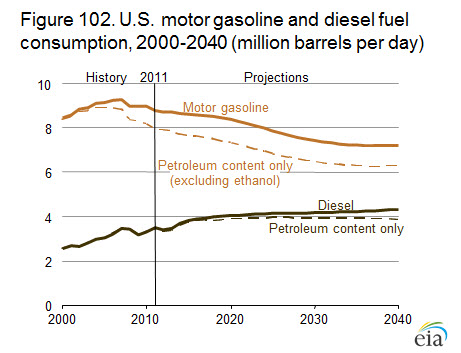
Prior to the Great Recession, US gasoline demand had grown by 1-2% per year, with few interruptions. Since the recession, it has been shrinking for reasons that don’t appear to be temporary. New cars are becoming more fuel-efficient, and Americans are consistently driving less than before the recession, as indicated in the latest statistics on vehicle miles traveled. To some extent this is an understandable response to gasoline prices that have remained significantly higher in real dollars than they were from 1982-2006. However, there may be other, deeper shifts underway. If a segment of younger Americans has not only delayed getting a driver’s license, but may never get one, then the decline in motor fuel demand is likelier to be permanent.
Once I started reading the survey results in the new study by the TRI’s Brandon Schoettle and Dr. Michael Sivak, I knew I also needed the context of their 2011 paper on “Recent Changes in the Age Composition of Drivers in 15 Countries.” That study showed that from 1983 to 2008 the number of licensed drivers in the US as a percentage of each age group up to 40 had dropped significantly, while the opposite was true for those over 50. (See chart below.) The authors found similar shifts in 7 other developed countries, including Canada, the UK, Germany and Japan, with a 2012 update indicating a further decline in US pre-40 licensing through 2010. Interestingly, Spain, Poland, Israel and several other countries exhibited increases in licensing among both younger and older drivers.
|
In their current paper, the authors used an online, non-random survey of 618 under-40 non-drivers to explore the reasons for their status. The top reasons their respondents gave for not having a driver’s license seemed mainly practical, rather than philosophical. Many of those under 30 reported being “too busy or not enough time to get a driver’s license”, or “able to get transportation from others.” The “cost of owning and maintaining a vehicle” was the second-most common reason among all respondents, and as the authors noted, that is consistent with the relatively high unemployment or full-time student status of this group–46% and 21%, respectively.
|
 |
Having grown up in a time and place where obtaining a driver’s license as close as possible to one’s 16th birthday was both a rite of passage and a practical necessity, this is that rare energy issue that’s hard for me even to relate to. Yet when I look at the above chart, with its mirror-image shifts, I’m struck by the similarity between recent under-40 driver’s license data and those for the cohorts born between the World Wars. Are the current license rates of Millennials and late-Gen-X’ers the anomaly, or will those of my Baby Boomer and early Generation X peers turn out to be uniquely high? Only the passage of time can clarify such questions.
While the authors stopped short of assigning cause and effect, it seems reasonable to conclude that at least part of what we’re seeing here is the result of the stubbornly persistent youth unemployment of a tepid recovery and the “New Normal” economy. A few years of much stronger economic growth might shrink the gap shown in Figure 1, by addressing the reasons that many of those surveyed gave for not having a driver’s license, particularly since only 6% of them reported they never learned to drive. Of course that doesn’t explain why more than a third of those in the 30-39 age group, who ought to be the most financially settled, indicated they planned never to get a license.
The survey’s results and their implications ought to be of great interest to producers of conventional and alternative fuels, established auto manufacturers, car rental firms, as well as transportation planners and policy makers. Even electric-vehicle startups like Tesla might wonder whether for a significant segment of their natural future market, the choice won’t be between an EV and a conventional car, but between a car and not driving at all. This is a trend that bears watching.
4 Comments on "Will Fewer Young Drivers Today Mean Lower Fuel Demand Tomorrow?"
BillT on Thu, 5th Sep 2013 6:21 am
The only direction the auto industry has in it’s future is down. Cars were a luxury only possible in large amounts because of cheap energy. Those days are over. If you recently bought a new car, it may be the last one you ever own.
DC on Thu, 5th Sep 2013 12:10 pm
Q/Driver’s licenses for those under 40 years of age are down in several large, developed countries, including the US. This is only partially explained by a weak economy.
ROFL! The denialism is strong in this one, yes. While it IS true that being forced to own and drive gas burners everywhere for even the most trivial of task does suck, our corporate over-lords have rebuilt our entire civilization for just that express purpose. Thus, avoiding using gas burners is while not impossible, for most all intents, it is.
This is a feature of ‘modern’ life-not a bug. Car-ownership has been made virtually mandatory by corporate govt fiat.
Notice all these articles share a common theme. Apparently its all ‘young people’ not driving. All denialists on this issue zoom in on how it must be all about how ‘enlightened’ young people are about cars.
Guess what else we can say about young people? ‘Youth’ employment and under-employment numbers are at near record highs across the OECD these days. And cars, next to a home, which a lot of young people ALSO cannot afford, are the second biggest waste of money after home mortgages.
However little the ‘young’ are driving,matters little since its just as likely all their older friends or family that can still afford gas-burners are driving all the youngers that can afford them the places they need to go. In my area, the traffic is constant, and its not because the economy is in good shape-its not. Demand drivers and induced demand keep the trash cans rolling no matter what the ‘economy’ is doing.
TIKIMAN on Thu, 5th Sep 2013 12:45 pm
It means they can’t afford it which also means they can’t buy other useless shit to get the economy going.
rollin on Thu, 5th Sep 2013 1:33 pm
There may be a small drop in petroleum burning, but there will definitely less crowded roads as this trend develops.