
Peak Oil is You

Donate Bitcoins ;-) or Paypal :-)


Page added on September 3, 2013

The black blood in the economic veins
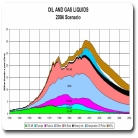
Nobody denies that there is a connection between economic growth and oil consumption. The clearest signal came in 2008-9 when the world economy crashed at the same time as oil production sank dramatically. If one is to describe this in a little more detail then it is not oil production itself that is decisive rather than that part of oil production that passes through the world’s refineries and then becomes transport fuel. Transportation of raw materials and components for manufacturing of goods, transportation of products to retail outlets and, finally, transport of customers to those outlets is the chain that gives economic growth. Therefore, it can be interesting to study what passes through refineries, where it is, and what refinery products are produced.
Each month, Global Data i London gives out a report, ”Refined Products Forecast”. The report costs $1,000 which is a lot for me, but by studying press releases and articles on the report one can grasp the main points.
The report that was issued on 29 August had the following title, “World Refinery Throughput to Witness Impressive Growth, Despite Economic Difficulties”. From the press release by Global Data:
“Despite the tough economic conditions still plaguing Europe, world refinery throughput will rise as global demand for gasoline, jet kerosene, gasoil and diesel products during Q3 2013 ramps up, according to the latest forecast from research and consulting firm GlobalData. The new report* states that demand for gasoline in Q3 2013 will increase by 325 mbd (thousand barrels per day) over Q2 figures, while gasoil and diesel demand will rise by 280 mbd over the prior quarter. Jet kerosene will also enjoy a 150-mbd quarter-on-quarter rise, while global refinery throughputs are expected to witness growth of 2.2 mmbd (million barrels per day) over Q2 2013 levels, as new atmospheric distillation capacity comes onstream in the Middle East, India and China. This increase will raise total global throughput to 77 mmbd – the highest level in at least five years. The global oil market is expected to continue its growth throughout 2014, with gasoline demand rising by a further 115 mbd over 2013 levels, and diesel and gasoil rising by 525 mbd.
Jeffrey Kerr, GlobalData’s Managing Analyst for Downstream Oil & Gas, says: “Despite the positive outlook, these figures will be limited by various underlying economic issues, not least of all the European recession. The slowdown in Chinese demand and the rapid decline in Indian demand are also contributing factors. The US is the only country showing any signs of pushing through its economic woes.” Jet kerosene can expect to witness a drop of 55 mbd over the course of 2014, says Kerr, thanks to a decrease in air travel caused by the recession and the Chinese economic slowdown, while refinery throughput will see a similar reduction of 57 mbd.
Kerr continues: “The key for the global economy moving forward is which of these trends are the strongest: the US moving higher or the rest of the world moving lower, and currently it seems that the refined products markets are supporting the US position.”
To get detailed information on various regions and a detailed analysis of trends one must buy the report. Nevertheless, this press release shows oil’s coupling to the economy. Of special interest is the prognosis for India. In other articles we can read that the economy in India is currently falling dramatically and in the press release above we see that consumption of refinery products is expected to decrease.
Global oil consumption must decrease. This can be primarily due to climate concerns that require us to reduce emissions but also Peak Oil means that oil production cannot increase. At the same time everyone wants growth. From the Global Data report we see the connection between transport and economic growth. Our alternative energy future should focus on this issue instead of alternative forms of electricity production. But by saying this I do not want to give the impression that alternative electricity production is not important.
Leave a Reply