
Peak Oil is You

Donate Bitcoins ;-) or Paypal :-)


Page added on July 22, 2013

The decline of an empire
Guest post by Alexander Ac
Given that City of Detroit has now officially filed for bankruptcy, it is worth to look at the bigger picture. Is the fate of once mighty city just a short pause on the way to further prosperity? Or is it rather a symptom of something bigger and more widespread regarding the future of a post-industrial society?
Without exaggeration, Detroit was once a symbol of “American Dream”, characterized by the highest per capita income in the entire country, growing population, industrialization, mass production, growing wealth, etc. The population reached almost 2 million people.
Now, Detroit is more the symbol of “American Nightmare”, with a declining population* increasing poverty and criminality, declining property value, declining public services, etc. Now the population is bellow 700 thousands people.
The period after the WW2 was characterized by an explosive growth of population and energy consumption, tremendous increases in productivity brought by cheap energy, globalization of trade, technological innovation, especially in fields of computers and communication, increasing quality of healthcare, and hopefully collective growth of population happiness.
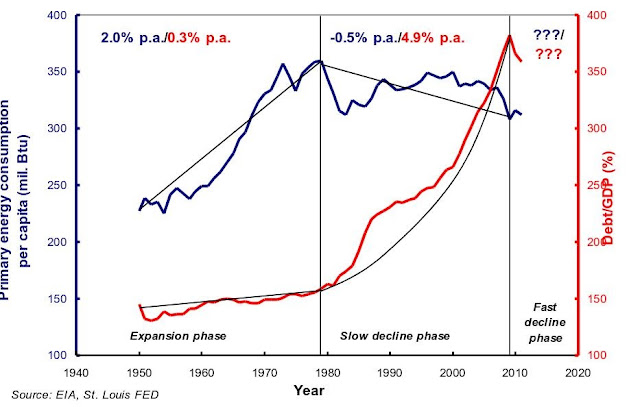
The same period can by also characterized by several fundamental trends, which probably explain a lot. Let’s look at the following graph:

Expansion phase (1950-1979)
This period can be broadly characterized by a rapid population growth, rapid total energy consumption per capita growth (2% p.a.), infrastructure construction, and relatively stable debt/GDP ratio (0.3% p.a.). We could talk about the “expansion phase”, from which most of the population benefited in terms of increasing quality of life. Increasing safety, better access to health care, better education and freedom of almost everything were a given facts of life. Even the environmental conditions might have improved in some or even most locations. And global warming was not of a serious concern at that time.
Slow decline phase (1979-2009)
This characterization of 30 years following the peak in per capita energy consumption might be surprising to many, but should not be really. Many of the great achievements of science and technology started to be slowly overrun by resource depletion. This trend was largely undetected, since increased level of debt masked the real price of the energy. We decided to pay less for prosperity (better call it consumption) today, in exchange for more tomorrow, assuming that happy days of cheap energy would return at some moment in the future. Human naivety is endless, as we can easily observe. But during the phase of exponential growth in the debt to GDP (almost 5% p.a.) and slowly declining per capita energy consumption (0.5% p.a.), many of the previously positive trends turned negative. Here is a list of just some of them:
- Growth in the income inequality between rich and poor
- Declining fertility growth rates
- Growth of the financial sector as the share of GDP
- Outsourcing of the energy intensive industrial jobs to foreign countries
- Increasingly negative trade balance
- Declining quality of education
- Increasing healthcare costs
- Declining added value of further debt
- Increasing oil dependency upon Middle East countries
- Ageing infrastructure (what you build during 10 dollars/barrel era is difficult to maintain or even expand with 100 dollars/barrel era)
Fast decline phase (2009-???)
These and others long-term negative trends ended up with a financial crisis in 2008-9, which turned out to be global. Debt to GDP ratio peaked in the US, and its decline started off what we might call “fast decline” phase. Close to zero Fed Funds Rate or “quantitative easing” policies are not going to change fundamental evolution of the US economy. There is no new “industrial revolution” behind the corner, no matter what “shale oil” or “shale gas” money loosing/climate catastrophe ignoring propaganda wants you to convince. We have plundered the cheap resources and now we have to face the consequences. If we are collectively wise enough, which is not happening yet, we might have a small change of avoiding WW3 in coming years and decades. Unfortunately, history seems to predict a different outcome.
* Keep in mind that under a global decline scenario people have nowhere to migrate, unlike in the case of local decline, such as for Detroit.
20 Comments on "The decline of an empire"
GregT on Mon, 22nd Jul 2013 11:16 pm
Maybe this is all part of the plan. Pump the market bubble up, pull out and let it burst.
Nothing like a good old depression to get folks to buy into yet another world wide war. There’s money to be made all around. A win win situation for the powers that be, one more time.
Plantagenet on Mon, 22nd Jul 2013 11:17 pm
The Federal debt in the USA has jumped by 4 trillion dollars since 2009, student loan debts have just hit a trillion, and borrowing by business is at an all time high due to the low interest rates and yet this plot shows the debt/GDP ration falling since 2009.
Methinks there is problem here with the math.
efarmer on Tue, 23rd Jul 2013 1:39 am
Well we all figure the tally of trillions in debt and it is real and imaginary in one take. America and the New World were a paradigm shift for our European founders in that we had boundless resources and land and few people. Plus we settled on a political experiment that was novel, and still could be. Let people print money for themselves in accordance with their ability to produce and create and pay it back, and then some. In farmland and resources versus present population demands we are in the catbird seat of the globe, in political leadership of what we really have to leverage, we are in the belly of the beast, one group of people convinced that acting like it is the 1950’s is a cure all and another political group in power acting like the cure for the 1930’s unionism and cure for company and corporate rule and social engineering is also a cure that yields better results. The biggest obstacle to America doing a segway to a new normal and healthier now is dropping out belief in history curing now and being pragmatic. But we court Civil War era inertia, and false belief in Government being a cure rather than a burden that is a necessary overhead. We have the talent and resources to simply vaporize our debt and the talent to do so very fast and effectively. We need a Congress that is not locked into what worked for their mentors or Dads or admired legislators to come to some agreement and do something new, with a large part of that of not getting in the way of a great country and working at staying out of the way. This includes not only religious persuasions, but beliefs in failed financial regimens like trickle down voodoo and government aid and subsidy and other proven dead technologies.
It is time for Congress to do two simple tasks, get out of the way, and legislate to stay there and see what the place they think they lead does when they don’t. I think it does just fine after it is sure they are no longer making it baffling, confusing, and impossible for a sane person to make a move based upon their dysfunctional nonsense.
BillT on Tue, 23rd Jul 2013 2:11 am
“…Aging infrastructure (what you build during 10 dollars/barrel era is difficult to maintain or even expand with 100 dollars/barrel era)…”
BINGO! The West was built on $10 oil … and the West is disintegrating as the infrastructure, including the financial one, is disintegrating at ever faster speeds under $100+ oil.
DMyers on Tue, 23rd Jul 2013 3:39 am
Note the variable used in this presentation: energy consumption/capita. This is the variable that counts and that tells the story. Richard C. Duncan focused on the same variable and drew the same conclusions 13 years ago in “The Peak of World Oil Production and the Road to the Olduvai Gorge”. http://www.dieoff.org/page224.htm. This particular ratio is the best formula we have for “standard of living”.
In terms of standard of living, we are in fast decline. It doesn’t take a genius or a Harvard grad to recognize that.
Plantagenet
The answer to your question may be that the decline in consumer debt (including real estate) relative to the prior boom cycle has not been offset by govt and student loan debt growth. I’d say the math is what it is. Total debt/GDP is in decline, in spite of the massive debt infusions.
Arthur on Tue, 23rd Jul 2013 4:28 am
DMyers, the oil production forecast in your dieoff link is too pessimistic. Additionally by 2020 the EU renewable energy target of 14% will probably be met. China has similar targets.
GregT on Tue, 23rd Jul 2013 5:06 am
Renewable and sustainable energy, comes from the Sun, and is utilized in the process of photosynthesis. All other forms of power generation are man made. They are not renewable, or sustainable beyond a few decades, or until we run out of fossil fuels. We live in a natural environment, with natural ecosystems. We are not in control of the planet earth, the planet earth is in control of us. The techie dream is nothing more than a future nightmare, for all ecosystems on the planet, as well as all human life on Earth. If we cannot get beyond our ignorance and egotistical attitudes, we are done, as a species on this planet.
Arthur on Tue, 23rd Jul 2013 5:17 am
http://i1.wp.com/cleantechnica.com/files/2013/02/renewable-energy-reserves.png
BillT on Tue, 23rd Jul 2013 5:28 am
Arthur,referral to techie sites is not convincing. About like referring an article on banking from a J.P.Morgan owned site.
You cannot seem to accept that the world is regressing and gaining speed. Tech is a product of energy surplus, not a maker of energy. The only other energy source not from the sun is the heat in the core of the earth and most of that is inaccessible.
Add to that that few really new technologies have been produced in the last 50+ years and you will see the decline. All that has been done is to ‘improve’ already existing technology and many of those are bumping up against natural laws and they too will start to regress.
GregT on Tue, 23rd Jul 2013 6:06 am
Not to mention the fact, that without living, natural, ecosystems, we would not even have oxygen to breath. Half of which currently is generated by phytoplankton in the oceans, and will die if we do not stop pumping CO2 into the atmosphere, soon.
Like I said above, we are not in control of the planet Earth, we are merely inhabitants. The Earth doesn’t particularly care if we survive or not. That is up to us. If we keep fucking around with the natural systems that keep us alive, by our sheer egotistical and ignorant attitudes, and keep believing the fallacy that we are somehow above nature, nature will remove us from the face of the planet, and she will not skip a beat, when we become extinct.
We have a serious choice to make, we either live within the laws of nature, and take care of the natural world, or we disappear when we destroy it. Our technologies are completely irrelevant, and are doing nothing more than expediting our own extinction.
DC on Tue, 23rd Jul 2013 7:36 am
The ‘good times’ for Detroit, aka the expansion phase, were ‘paid for’ (sort of), with resources from outside the empire. In this case, amerika was cashing in on its involvement in WW2. One can point to various technologies all you like, but like all empires in their expansion phase, the resources used for all the ‘growth’ come in from the outside, usually subsidized in form or another. The fact is, Detroit was never a ‘sustainable’ city(are any North American ones?).even during the ‘good’ times, debt was accumulated, and never paid off. All that growth was subsidized and was never paid for, that is to say, it was bought on credit. Now the bills have due so to speak, and there little left to show for it. Everyone cashed in and headed for the exit long ago, leaving the city, a shell.
But the core issue is that growth, at least the way we manage it, seldom, if ever pays for itself. Sometimes, if conditions are just right, the illusion of growth paying for itself can maintained, but only for a little while. Folks thinks the ponzi-scheme economic growth model is a recent thing, like Madoff invented it. It was alive and well all throughout Detroit’s rise, and fall.
Arthur on Tue, 23rd Jul 2013 8:08 am
In libertarian circles one regularly can hear proposels to dissolve the Union, like today:
http://www.lewrockwell.com/2013/07/michael-s-rozeff/the-us-is-a-failed-state/
It is the perfect way to get rid of Washington, of the empire, of 800+ foreign bases, of the military-industrial complex and last but not least, to get rid of the Lobby. The NSA, CIA, homeland security can be dismantled, the Constitution restored. If desired the Union can be restored on a much less centralized footing and with far less financial means. This new decentralized union could ally itself with the EU and Russia (alliance losely defined as white christian) and next sit around the table with China and hammer out a new security arrangement at the lowest possible armament level: no navies, no icbms, limited amount of troops.
Arthur on Tue, 23rd Jul 2013 8:32 am
Peter Schiff about the impending financial collapse:
http://www.lewrockwell.com/2013/07/no_author/2-thirds-of-americans-will-lose-everything/
An event like this could trigger the dissolution of the Union. Several states will declare independence, Texas probably among the first as well as others with the most resources.
BillT on Tue, 23rd Jul 2013 10:45 am
Arthur, when the US goes, Europe regresses to many different countries with all of the old problems and more new ones. Don’t be in a hurry to wish for it’s demise. Much as it is not helping the situation, it is keeping Europe afloat with bank loans from the Federal Reserve through American branches of European banks, to the tune of trillions of dollars. Everything is so intertwined these days that no one large country can fail without taking down the whole system.
rollin on Tue, 23rd Jul 2013 12:51 pm
Detroit was in trouble for more than fifty years. People and business escaped over a long period of time and the parts of the city became dysfunctional.
The auto industry is doing well, it just is not in Detroit.
As far as the greater US is concerned, it is much more likely that a North American Union will form than the US will disintegrate.
Arthur on Tue, 23rd Jul 2013 1:45 pm
Bill, I am not in a hurry with the demise of the empire, on the contrary, every year of peace and pre-collapse means another year of relatively smooth transition that is now in full swing in Europe. Holland for instance recently decided to build 10 GW wind covering ALL households in 10 years. The introduction of private solar is also well underway.
http://deepresource.wordpress.com/2013/07/22/revolution-in-the-dutch-northsea/
Many people misinterpret the EU, which in reality is a very thin layer over a collection of still largely independent countries. Some figures (last time I checked): 30,000 EU civil servants, ca. 1% GDP goes via Brussels, no army, no taxes. Open market for goods en persons, stronger countries compensating weaker ones in return for free access to markets, one currency, one commission, parliament, even an president nobody knows, no border controls. Space agency ESA, common aerospace company Airbus/EADS, Europol (police), a common agriculture and fishing policy, a supreme court. Probably I am forgetting something, but this is about it. Maybe some countries will withdraw, that is indeed possible and in the case of Britain even likely, but the rest, no. Not anytime soon. The stronger countries have advantage in one big common market, the weaker countries export a part of their labour force and receive support for infrastructure and other projects. Just have a look in Spain or Poland to see the remarkable effects of these subsidies. Spain has a high-velocity train network, in part thanks to Europe.
rollin on Tue, 23rd Jul 2013 3:31 pm
Economics 201
The national debt should be compared to the actual value of the property in the US, not to the GDP. That will determine how far debt can run.
Using real inflation (15 to 30 times since 1950’s depending upon the item) makes gasoline less expensive than it was in the 1950’s.
Since primary business left Detroit, look at the whole state. 1957 GSP of 22 billion, 2013 GSP of 413 billion. Not a failing economy, just a failing city.
Michigan’s economy is growing, sometimes quickly, but it never fully recovered from the previous recession in 2000.
http://www.mlive.com/business/index.ssf/2012/06/michigans_gdp_is_one_of_the_fa.html
noobtube on Tue, 23rd Jul 2013 5:55 pm
It’s funny how people say Detroit is in trouble.
At least Detroit is sitting in the midst of the largest reservoir of fresh water in the world.
What about the REAL cheap oil cities like Miami, Los Angeles, Houston/Dallas, Phoenix, and Las Vegas?
If Detroit is in trouble, what do you think will happen to these places?
Arthur on Tue, 23rd Jul 2013 6:28 pm
The problem is not so much the debt levels or Detroit, the problem is the future and promisses that cannot be kept, like pensions:
http://www.infowars.com/the-tip-of-the-iceberg-of-the-coming-retirement-crisis-that-will-shake-america-to-the-core/
DC on Tue, 23rd Jul 2013 6:33 pm
Ummm…noobtube, those cities *are* in trouble of there own, and they too, while have their day of reckoning, but not right now. Detroit’s problems have come to head now-that what the article deals with. Its not an article about those other cities present and future problems, but Detroit’s current ones. Im not really sure what you think sitting on the great lakes will do for Detroit. That place doesn’t have a freshwater problem, it has a economic\political\social problem. Unless you think Detroit will revert to a farming community to save itself?
Good luck with that. The great lakes themselves and Detroit itself is literally toxic from all those decades of unregulated capitalist car-manufacturing. So unless you think farming with contaminated water in heavy metal laced soil is a good idea, then all that freshwater isn’t going to help much. Its even less clear what all those other cities you list problems have to do with anything.