
Peak Oil is You

Donate Bitcoins ;-) or Paypal :-)


Page added on July 15, 2013

The punctuated collapse of the Roman Empire
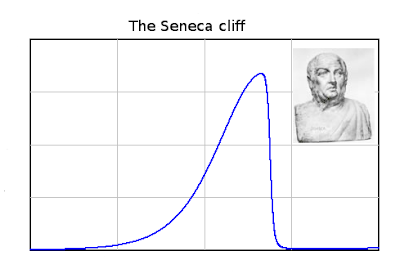
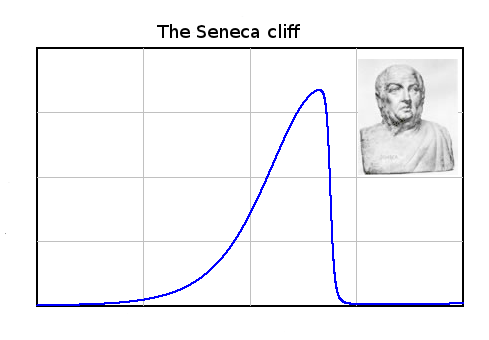

The idea of an impending collapse of our civilization is already bad enough in itself, but it has this little extra-twist that collapse may be given more speed by what I called the “Seneca Cliff,” from the words of the Roman Philosopher who had noted first that, “Fortune is slow, but ruin is rapid“. The concept of the Seneca Cliff seems to have gained some traction over the Web and many people have been discussing it. Recently, I found an interesting comment on this point by Jason Heppenstall on his blog “22 billion energy slaves”. He summarizes the debate as:
“In the fast-collapse camp are the likes of Dmitry Orlov (who bases his assessment on his experience of seeing the USSR implode) and Ugo Bardi, who expects a ‘Seneca’s Cliff’ dropoff. James Kunstler, Michael Ruppert and any number of others can probably also be added to the fast-collapse camp.
By comparison, the likes of John Michael Greer reckon we are in for a drawn-out era of terminal decline punctuated by serious crises which, at the time, will seem rather severe to all involved but which will give way to plateaux of relative stability, albeit at a lower level of energy throughput.”
Actually, the two camps may not be in such a radical disagreement with each other as they are described. The idea of the fast (or Seneca-like) collapse does not necessarily mean that collapse will be continuous or smooth. The model that describes the Seneca effect does give that kind of output, but models are – as usual – just approximations. The real world may follow the curve in a series of “bumps” that will give an impression of recovery to the people who will experience the painful descent period.
So, collapse may very well be “punctuated: a series of periods of temporary stability, separated by severe crashes. But it may still be much faster than the previous growth had been. I discussed this point already in my first post on the Seneca Effect, but let me return on this subject and let me consider one of the best known cases of societal collapse: that of the Roman Empire.
First of all: some qualitative considerations. Rome’s foundation goes back to 753 BC; the end of the Western Empire is usually taken as 476 AD, with the dethroning of the last Western Emperor, Romulus Augustus. Now, in between these two dates, a time span of more than 1200 years, the Empire peaked. When was that?
The answer depends on which parameter we are considering but it seems clear that, whatever choice we make, the peak was not midway – it was much later. The Empire was still strong and powerful during the 2nd century AD and we might take the age of Emperor Trajan as the peak (he died in 117 AD) as “peak empire.” We may also note that up to the time of Emperor Marcus Aurelius (who died in 180 AD), the empire didn’t show evident signs of weakness, so we could take the peak as occurring in mid or late 2nd century AD. In the end, the exact date doesn’t matter: the Empire took around 900 years to go from the foundation of Rome to the 2nd century peak. Then, it took just 400 years – probably less than that – for the Empire to wither and disappear. An asymmetric, Seneca-like collapse, indeed.
We also have some quantitative data on the Empire’s cycle. For instance, look at this image from Wikipedia.
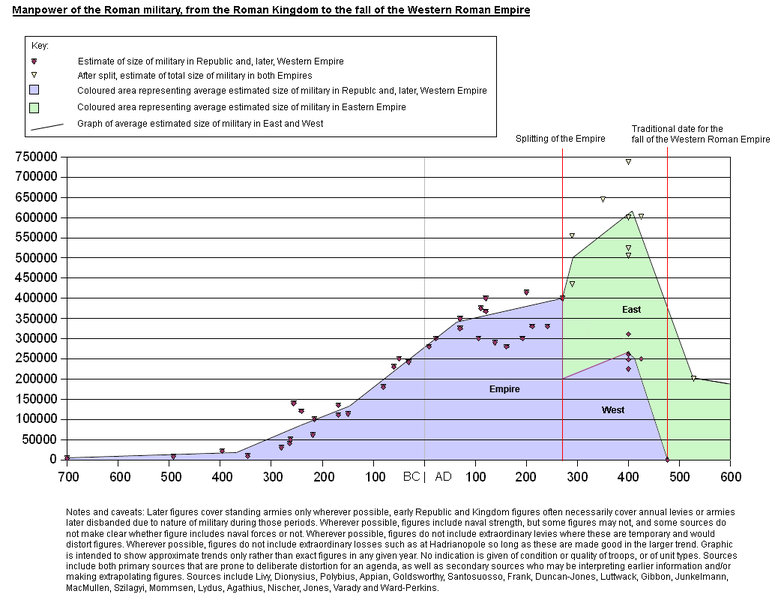
It shows the size of the Roman military over the Empire’s span of existence. WIth all the uncertainties involved, also this image shows a typical “Seneca” shape for both the Western and the Eastern parts of the Empire. Decline is faster than growth, indeed.
There are other indicators that we can consider about the collapse of the Roman Empire. In many cases, we don’t have sufficient data to say much, but in some, we can say that collapse was, indeed, abrupt. For instance, you can give a look to a well known image taken from Joseph Tainter’s book “The Collapse of Complex Societies”
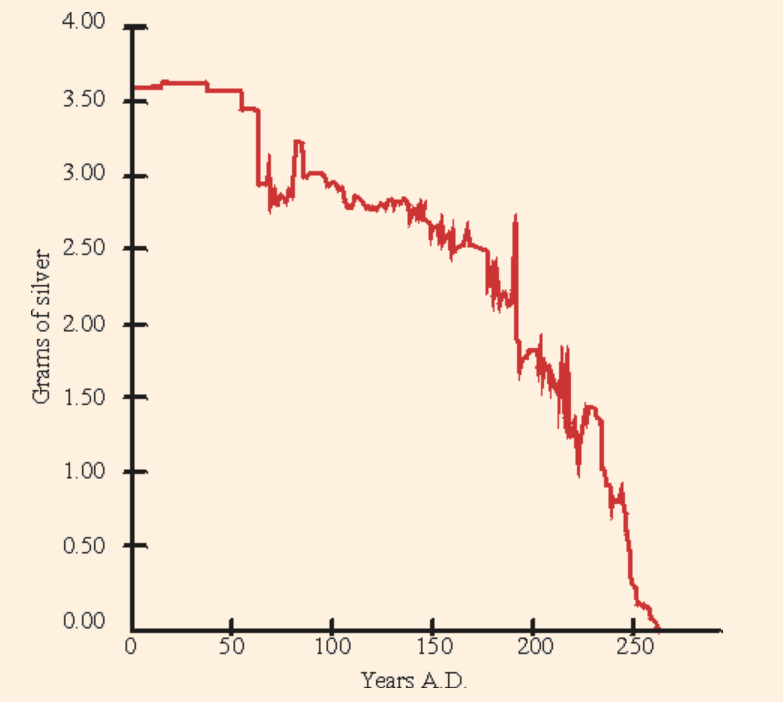
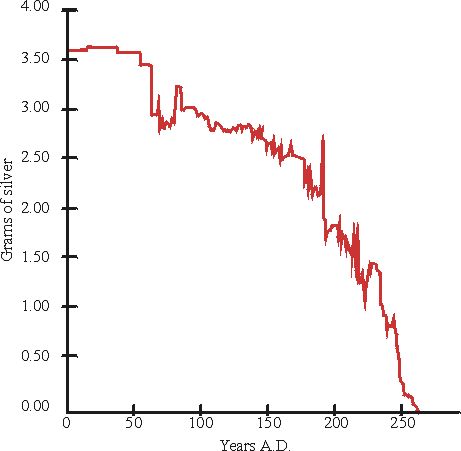
The figure shows the content of silver in the Roman “denarius” which by the 3rd century AD, had become pure copper. Note how the decline starts slow, but then goes on faster and faster. Seneca himself would have understood this phenomenon very well.
So, the Roman Empire seems to have been hit by a “Seneca collapse” and that tells us that the occurrence of this kind of rapid decline may be commonplace for the entities we call “civilizations” or “empires”.
It is also true, however, that the Roman collapse was far from being smooth. It went through periods of apparent stability, interrupted by periods of extremely fast descent. The chroniclers of the time described these periods of crisis, but none of them seem to have connected the dots: they never saw that each crisis was linked to the preceding one and leading to the next one. Punctuated collapse seemed to be invisible to the ancient Romans, just as it is for us, today.
5 Comments on "The punctuated collapse of the Roman Empire"
Plantagenet on Mon, 15th Jul 2013 8:06 pm
The Roman Empire did not “disappear” in 476 AD. The Eastern half of the Roman Empire continued on for almost another 900 years.
The “Seneca Cliff” may indeed exist, but the case for it isn’t helped by ignoring the existence of the eastern half of the Roman Empire.
Hugh Culliton on Mon, 15th Jul 2013 10:18 pm
Plant: even though the Byzantine Empire collapsed 900-odd years later, when it went down it followed a Seneca Cliff as well. I think the lesson is that regardless of how long an empire’s been in existence, when it starts to collapse, it goes fast. And no one wants to see it coming. It would be interesting to look for a modern measure comparable to the denarius-silver content. I wonder if the late-empire Romans ever tried an economic policy similar to QE?
BillT on Tue, 16th Jul 2013 3:15 am
History can be a guide, but not the road we will take. Their civilization did not require ‘just in time’ delivery from around the world every second of the day to exist. It did not require a fantastically complex and fragile electronic system to guide it’s armies or pay for trade, or to even pay the armies. It did not need rare earths to run it’s electronic world. I could go on and on of the differences that have to be taken into account. It simply ran out of wealthy countries to plunder. It would never have grown into an Empire if it had to survive only on the resources of what is now Italy.
No one can predict the future. I hope it is a long slow decline for my grand kids sake so they can adjust slowly to a world that does not promise ever better everything, but I also hope it collapses quickly so there is a world left for them to enjoy. I guess all I can do is wait and watch what happens. We get to experience a major event in the history of man, and possibly an almost extinction event.
DC on Tue, 16th Jul 2013 3:41 am
The Eastern Roman Empire, not ‘byzantine’, that is a fiction. They never referred to themselves as the Byzantine anything, they called themselves “Romans”, may have soldiered on for another 1000 years, but except for brief period right after the collapse of the west, it was mostly a downhill slide all the way. The Eastern Empire was on defensive almost from the start and began hemorrhaging territory not long after the western empire began its inglorious descent into the xtian dark ages itself.
IoW, the eastern empire was not very successful in the long run. All we can say about them is they at least managed to collapse more slowly than the west.
In any event, Prof Bardis point is, the West showed a more of his Seneca cliff-life collapse. If you want to talk about the East, then it would exhibit a much more gradual decline slope. Like Professor Bardi says;
Q/ The model that describes the Seneca effect does give that kind of output, but models are – as usual – just approximations. The real world may follow the curve in a series of “bumps” that will give an impression of recovery to the people who will experience the painful descent period.
So, for BillT, and for all of us really, I would say, hope for a Eastern Roman Empire type of decline, not a Western Empire one. Since we cant stop collapse, maybe if things go as well as we can hope for, we can at least get the collapse we find most the agreeable.
I do have one thing thats important to point out. Roman civilization was a highly complex organization entity. Its trade routes stretched thousands of miles and were as complex in there own way, as ours today. It is a common mistake we make today to assume, no computers etc=not complex. In fact, its that complexity is one of the reasons the collapse was so drawn out. The high degree of complexity was a ‘buffer of sorts. Just because energy and information flows were not as fast and organized differently from ours, does not mean the complex roman systems could endure as resources and funds needed to maintain them began to contract.
This is what we are seeing now in our time, the more things change you know……
RICHARD RALPH ROEHL on Tue, 16th Jul 2013 6:51 am
Yesssssssss… Rome may have collapsed, but humanity carried on. The scenario THIS time might be something much more dire. Think bigger than the collapse of empire. Think… EXTINCTION.