
Peak Oil is You

Donate Bitcoins ;-) or Paypal :-)


Page added on July 11, 2013

Stop shipping volatile oil by rail
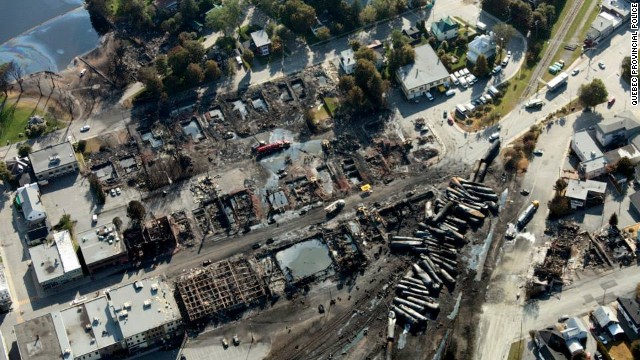
The tragedy of the train derailment in Lac-Megantic, Quebec, has brought home just how small our world has become. Oil that was drilled in North Dakota’s Bakken oil fields is loaded onto rail cars and passes through a small Canadian community and shatters their world in an instant. All my thoughts and best wishes go out to the families and emergency responders in the midst of this human and environmental catastrophe.
Everyone is touched by this man-made disaster — 20 killed, 30 missing — because so many communities have a rail line running right through the middle of town. Here in North Dakota, like all over the U.S. and Canada, towns grew up around the railroad lines. They brought people in to help settle the state and shipped the farm and manufacturing products to other parts of the world.
But the increase in the amount of volatile crude oil being transported by rail from North Dakota’s Bakken fields has brought a new and troubling set of problems to the debate about our continued dependency on fossil fuels, and particularly oil, as an energy source.
Railroad engineers did not have transporting oil in mind when they laid out the routes. They did not avoid population centers, rivers, or environmentally sensitive areas. They were only concerned with getting from Point A to Point B in the most efficient manner possible. In fact, trains carrying oil tanker cars run just two blocks from my office, right through the heart of Bismarck, North Dakota.
Rail is the most efficient way to move freight, and Sierra Club is a big fan of rail for transporting people and conventional freight. But moving extreme fossil fuels, like Bakken shale or Alberta tar sands, is a different story entirely.
These fuels are “extreme” because they are more toxic and more carbon intensive than conventional oil. They are also more dangerous to transport than conventional sources of oil. Production in the Bakken fields has increased nearly 10 times since 2011. To move all this crude, oil rail companies are running longer, heavier trains. And they are running them farther than ever before, bringing crude to refineries on the East, West and Gulf coasts.
The regulatory framework for train safety wasn’t designed for crude oil trains, and the rail and safety infrastructure is out of date and not up to the task. A state transportation safety spokesman in Maine this week said that the Lac-Magantic disaster is “on the same parallel as a tractor-trailer accident. It’s private commerce and we don’t get involved.” This catastrophe proves beyond any shadow of a doubt that the transportation of Bakken shale requires much more vigilant oversight.
It’s too early to draw conclusions from the ongoing catastrophe in Lac-Megantic, but there’s one simple lesson that we should not ignore. Bakken shale, tar sands, and other extreme fossil fuels threaten our towns and our communities. We can’t afford the additional cost, in safety or pollution that these fuels bring. And with growing efficiency and with renewable sources of energy, we don’t need them.
12 Comments on "Stop shipping volatile oil by rail"
Plantagenet on Thu, 11th Jul 2013 10:53 pm
Obama is tilting the government against permits for new oil pipelines. This inevitably leads to more oil transported by train, and huge profits for his wealthy crony, Warren Buffet, who controls all railroad traffic to the Bakken oil fields in North Dakota..
Thats how crony capitalism works!
James A. Hellams on Fri, 12th Jul 2013 12:19 am
To condemn the railroad industry, because of what happened in Quebec; is not the best possible way to approach the problem.
In regards, to shipping oil and gas by pipeline; there have been numerous stories over the years about oil and gas pipelines exploding and causing deaths and evacuations of whole neighborhoods and even towns. Pipelines are frequently severed during construction, or break apart from earthquakes.
Frequently, when a building collapses, and/or burns; the gas or oil pipes are ruptured; and the contents spew out causing an explosion that takes lives and property.
The main, and I think, the ultimate solution to the problem is to actually make more use of the trains.
Here, is what I mean.
Because all trackage can be electrified, the railroads can take advantage of multiple sources of energy; and can run trains without needing any any oil or gas energy to run the trains. Because of electrification, trains can run nonstop from coast to coast without burning one drop of oil or one cubic foot of gas for energy. Only the trains can do this.
Highway and aviation based transportation will not be able to free themselves from dependency on oil and gas for fuels.
In sum, if your goal is to minimize the use of the extreme fossil fuels of oil and gas, then you will need to make trains the prime movers of people and goods; and decrease as much as possible the reliance on aviation and highway transportation. There is no other way of doing this.
BillT on Fri, 12th Jul 2013 2:13 am
James, I agree that trains are the best way to move freight. I disagree with your statement that they can be run on oil/NG free sources of electric.
It takes the same amount of energy to move those thousand ton trains at speeds of 50-70 mph. Big trains existed only AFTER a concentrated form of energy was found, coal. Then oil (diesel). Then electric from oil.
That enough electric can be made from ‘renewables’ is a joke. Not possible. Not going to happen.
Yes, cars and trucks are going to disappear in the near future, but they will NOT be replaced by thousands of trains and millions of rail cars. They are just going to disappear. Only important things will be transported anywhere distant. If it is not made locally, you will not have it. Maybe by 2050 or sooner.
rollin on Fri, 12th Jul 2013 3:57 am
This author makes sweeping incorrect statements about the rail and safety infrastructure not being up to moving petroleum. All the safety procedures are in place. If they are followed disasters like the one at Lac Megantic would not happen. Railroads move huge amounts of highly hazardous chemicals every day and accidents are very rare.
As far as physical infrastructure, it is generally good to very good and is inspected on a frequent basis. Safety procedures need to be followed, management needs to stop pressuring maintenance an operation crews to push more product and set aside safety. Management needs to reward and encourage safety compliance.
James A. Hellams on Fri, 12th Jul 2013 9:24 am
In response to BillT, it does not take the same amount of energy to move freight by rail; as it does by highway or air. It takes much less energy to move freight by rail than by highway or air.
A modern train is capable of achieving 750 ton miles per gallon. This is weight in tons times miles per gallon. A two ton car would have to get 375 miles per gallon to equal the energy efficiency of a train! This same energy efficiency would apply to using electric power for rail. It would still make trains the most energy efficient means of using electric power on the planet.
A 40 ton truck getting 5 miles per gallon (if it could do this) would get 200 ton miles per gallon.
Rail is energy efficient; and will always be that way. The railroads use steel wheels on steel rail. The least rolling resistance on the planet.
Regarding the use of trains for passengers; trains are already very effective at this. There are trains in use, now, that are capable of speeds in excess of 300 miles per hour. In fact, a TGV train in France broke the world record speed for a train at 350 miles per hour!
Regarding the use of various forms of energy, electric power generation is not limited to oil and gas. Electric power can be generated from every source of energy known to humankind. The sources of energy can be: geothermal, wood, hydroelectric, nuclear, wind, solar, wave motion; and all other sources of energy known to humankind.
Arthur on Fri, 12th Jul 2013 10:09 am
“That enough electric can be made from ‘renewables’ is a joke. Not possible. Not going to happen.”
That’s your mantra you keep hammering on. But every year more solar energy hits the surface of the earth than all fossil fuel reserves combined. That alone invalidates your statement.
http://i1.wp.com/cleantechnica.com/files/2013/02/renewable-energy-reserves.png
The bottleneck is not the potential, the bottleneck is sufficient human awareness and timing.
James A. Hellams on Fri, 12th Jul 2013 2:45 pm
To get an idea about what I mean by electric power applied to rail transportation, here are three examples.
First, is the car I referred to. Using a car that gets 70 ton miles per gallon (35 miles per gallon in a two ton car), the thermal content of diesel fuel being 136,000 BTUs per gallon; and the energy of one watt of electric power (3 BTUs) The amount of electric power required to run the car one ton mile is 647 watts. This is ton miles per gallon divided into the thermal content of a gallon of diesel fuel. This, in turn, is divided by the thermal content of one watt of electric power. The result is the power needed to get one ton mile in a car.
For the truck getting 200 ton miles per gallon, the amount of electric power need for one ton mile (using the same thermal content of diesel and one watt of electric power) is 226 watts.
For the train getting 750 ton miles per gallon, the amount of electric power required would be 60 watts per ton mile.
Arthur, thanks for the link. I don’t see the invalidation of my statement; because, if you will note, I included solar as one of the energies used to generate electric power. Also, Arthur, thank you for the very impressive link. Bring on the solar power!
BillT on Fri, 12th Jul 2013 2:52 pm
Arthur, If it takes 6,000 gallons of diesel to move 1,000 tons 3,000 Km. (most efficient diesel locomotives of today) How many wind mills or solar panels is that? After all, it has to be constant for at least 50 hours and take into account line loss. If I did the math correctly, that is about 230,000 kWh or about 12 commercial wind towers (with transmission loss) dedicated for about 2 1/2 days.
The US moves abut 2 billion tons per year by freight and another 10 billion tons by truck. If my math is correct, that is about 120,000 wind towers operating at at least 33% efficiency, and throw in another 5% for down time, equals 126,000 towers. The US has about 6,000 today, TOTAL.
Now, at an average cost of $2M each, we only need to come up with $250B+ in the next few years to just run the freight trains and replace the trucks and diesel locomotives. Oops! We will have to make about a thousand new electric locomotives over the same time period. MORE electric. And to electrify the thousands of kilometers of unwired track … more money and time and energy use. And …
No, renewables will not replace oil. Maybe a small fraction but not enough to keep the 1st world in the 1st world.
James A. Hellams on Fri, 12th Jul 2013 3:38 pm
BillT:
Thanks for your comment.
You allude to something so near to my heart.
I have been campaigning for rail transportation for a long time. I saw the need to change the paradigm of our transportation system a long time, ago.
As early as the 1973 Arab oil embargo, which shut down much of our aviation and highway based transportation: I have been constantly campaigning for rail transportation, particularly electrified rail. However, no one wanted to listen to me.
Now, regrettably, 40 years later, it will take a lot more money to undo the damage that the aviation and highway interests have imposed on us. We could be fully prepared right now, for peak oil AT A MUCH CHEAPER PRICE!
Arthur on Fri, 12th Jul 2013 3:50 pm
James, I was refering to Bill.
Bill, you need 92k wind towers to generate 40% US electricity:
http://deepresource.wordpress.com/2013/02/10/land-use-footprint-of-wind-energy/
40% solar and 20% hydro could do the rest.
That’s an effort like putting a man on the moon, yet a little more usefull.
“$250B+”
That’s the amount Obama plans to spend on his nuke deterrent upgrade.
Arthur on Fri, 12th Jul 2013 3:53 pm
Excsuse me, correction…
– You need 92k wind turbines to keep all cars in the US roling.
– You need 150k wind turbines to generate 100% electricity.
Stephen Lawrence on Fri, 12th Jul 2013 4:42 pm
I agree with the author that the current rail safety regulations are not adequate for the new “volatile” freight cargoes now on rail. 73 cars of petroleum must equal the energy in one substantial bomb, and should be treated with similar respect. I would also like to add that the freight cars themsleves – frequently the “DOT-111” model – also must take a fair amount of blame, because of their relative lack of integity following an accident. Awkward, then, that there are thousands of these ticking time-bombs in circulation.