
Peak Oil is You

Donate Bitcoins ;-) or Paypal :-)


Page added on July 6, 2013

US Energy Transitions: 1776 to 2076

In 1776, Britain’s thirteen American colonies ran on a 100-percent renewable portfolio standard and a distributed (wood- and horse-based) energy economy.
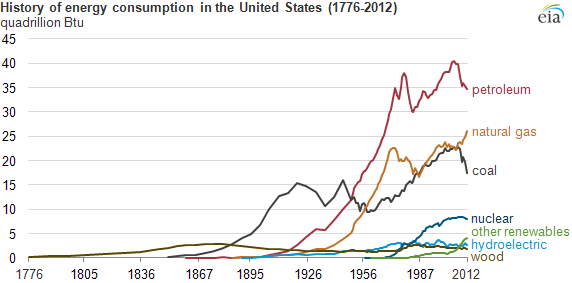
Today, as the EIA graph shows, natural gas is ascendant in the U.S. while coal is in decline and nuclear power has plateaued. Petroleum rules the world. Renewable energy survives as the small mammal beneath the dinosaurs’ feet.
Will abundant and cheap natural gas dominate the energy diet of late-21st-century Americans? Or will renewables confound the conventional wisdom and lead the energy mix sooner than anticipated?
Outside of the greentech echo chamber and inside the boardrooms of utilities, new U.S. energy is not solar power or electrochemical storage, but rather “unconventional” gas and oil — which means horizontal drilling, fracking, shale gas and tar sands. Vikram Rao, former CTO of Halliburton, called the shale gas supply “the most important energy event in the U.S. since the discovery of Alaskan oil.” This market upheaval sends a sobering message to any solar or energy storage or wind entrepreneur: you are competing with dirt-cheap natural gas.
Sean Ebert of energy investor Altira Group told me last year, “As much maligned as fracking is in the press, we [the U.S] are the envy of the world. When you’re talking about energy, you’re talking about competitive advantage of nations, and this is where we lead the world.”
Natural gas provides 21 percent of U.S. electricity right now and that will rise to 40 percent by 2035, according to consulting and construction giant Black & Veatch, water resource limitations aside. That forecast leaves renewables to fight over the remaining 60 percent in 2035. (All of the civilian U.S. nuclear fleet, 104 reactors producing approximately 100 gigawatts, will have aged out by then.)
But the transition that the EIA graph (and even Vaclav Smil) doesn’t account for is the rise of distributed generation (DG) and distributed intelligence at the edge of the grid.
More silicon (or GaN or SiC) at the edge of the grid, be it in IT, PV or power electronics, brings Moore’s law to the energy industry, replacing Westinghouse’s law. It allows the edge of the grid to realize its networked, efficient, and transactional potential. And it encourages innovation in an optimized and modern grid.
Factor in demand response, energy efficiency, energy storage, and microgrids, as well as cheaper solar and wind as further drivers to this transition to DG — and we are witnessing the erosion of the utility’s natural monopoly on power generation and the fall of a century-old business model. Utilities and regulators are just starting to confront these market dynamics.
While natural gas and coal still burn to make our electricity, it’s this shift to DG that heralds our independence from fossil fuels in the electricity sector.
Happy July 4th. Happy Independence Day.
8 Comments on "US Energy Transitions: 1776 to 2076"
BillT on Sat, 6th Jul 2013 2:58 am
Yes, but the fall of the old will not be replaced 1:1 with renewables. Maybe One new calorie/watt to 10 old eventually. Why? Money … the lack of it. NOTHING moves industrially without low cost money and lots of it. Factories cannot survive without a growing demand at a profitable price and as the serfs multiply and the middle class dies, there will be no customers to buy anything not a necessity. And electronics are NOT necessities.
Kenz300 on Sat, 6th Jul 2013 3:03 am
Water will be a limiting factor in future power plants….
Oil, coal and nuclear power plants require huge amounts of water to generate electricity.
Wind and solar require no water to produce electricity.
GregT on Sat, 6th Jul 2013 6:08 am
Wind and solar both require fossil fuel energy in their resource extraction, refinement, manufacturing, construction, and maintenance. As does the entire power grid required to deliver the electricity that they might produce. Therefore, they require vast amounts of water.
KenZ, please wake up! Your silly mantra is getting very old.
BillT on Sat, 6th Jul 2013 9:03 am
GregT, most of those who comment on here don’t look beyond their nose or think. They parrot what they pick up in 20 second sound bites or heard from their uneducated friends.
Of course ALL forms of ‘alternate’ energy originate in the ground, ALL of it. They have no concept of the amounts of anything that it takes to get something from ores to your hand. It takes an infrastructure built on, and maintained by, oil. When oil goes away, so will most of those supports. It may take a decade or two, but it WILL happen.
J-Gav on Sat, 6th Jul 2013 9:49 am
Put more silicon at the edge of the grid and Presto! you get a miraculous transition to DG … Don’t worry about pollution, the availability of investment capital or (as mentioned above), water. What a wonderful (fantasy) world – everything’s so easy!
Arthur on Sat, 6th Jul 2013 12:00 pm
“Yes, but the fall of the old will not be replaced 1:1 with renewables. Maybe One new calorie/watt to 10 old eventually. Why? Money … the lack of it.”
I think at least in Europe the electricity will be by and large replaced, plug-and-play (wind/solar/hydro storage) before 2030. Or something like 20-25% of the total energy peak, before depletion really starts to bite. Maybe a modest return to renewable energy production growth will be possible after the endless masses of childless old-aged non-productive baby boomers have stopped smoking for ever, in 20-30 years time.
BillT on Sat, 6th Jul 2013 2:02 pm
Arthur, I doubt that you will be right, but, for your sake, I hope so. About electric, I mean.
As for those old guys, they made possible what you have today. Don’t be so quick to want their exit. They still hold most of the wealth of the world.
When they go, so will most of what you like to think is the ‘permanent’ techie world you inhabit. In 20-30 years, most of us will be dead, not just the old Boomers. The world is a lot wider than tech and a lot more dependent on other things. Wait and see. Tech will not ‘save’ the world you know. It cannot.
Arthur on Sun, 7th Jul 2013 9:38 am
“As for those old guys, they made possible what you have today. Don’t be so quick to want their exit.”
I do not want anybody to go prematurely, certainly not the boomers, since I am one myself.
“When they go, so will most of what you like to think is the ‘permanent’ techie world you inhabit. In 20-30 years, most of us will be dead, not just the old Boomers. The world is a lot wider than tech and a lot more dependent on other things. Wait and see. Tech will not ‘save’ the world you know. It cannot.”
The methods are permanent, but not the fuel. Technology is the difference between cave man and modern man. Do not know about you, but I have zero interest in returning to the cave or your Philipines jungle. The attitude must be to evaluate what we can carry into the future and what not.