
Peak Oil is You

Donate Bitcoins ;-) or Paypal :-)


Page added on June 23, 2013

Tech Talk – Insecurity in the Middle East

The continuing conflict in Syria, and the slow spread of violence in the region around it continue to make it difficult to make accurate predictions about the future of oil exports from the region. Within Syria itself, production had fallen into decline about ten years ago, before the current struggle began. The precipitate drop over the last two years has, however, been much more dramatic. As Energy Export Databrowser noted from the BP statistic review, production fell by 49% last year.

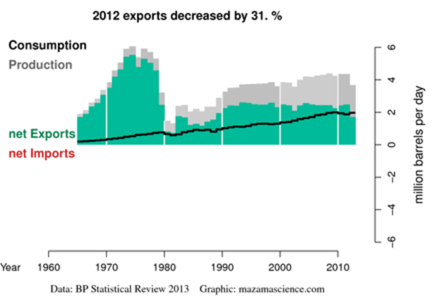
Oil imports into China are reported to have increased, perhaps because the Iranians have just agreed to buy a number of Chinese drilling rigs. Total exports are projected to fall to 1.3 mbd over the current Iranian fiscal year (which started in March). If Iran is having to store more of its oil in off-shore tankers, this may explain the fall in regional tanker availability over the past month.
In a recent post, I discussed my concern over the likelihood of Iraq being able to achieve the increased volumes of production within the time frame that their Central Government has suggested. However, as Leanan caught recently, Kurdish Iraq is moving more and more toward independent action in regards to their oil. From the Turkish side a pipeline will be allowed that can go to the border, but not cross it. Mysteriously, it will likely then fill over time with a flow of 1 mbd. Turkey is working with BP to develop the resources of Kurdish Iraq. In the interim, Turkish demand has stabilized to a greater degree than it has in its southern neighbors.
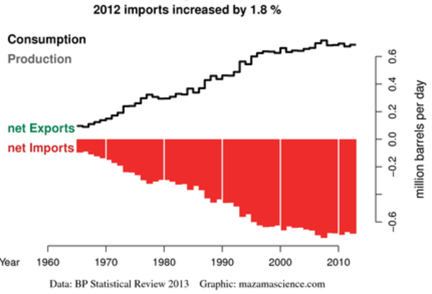
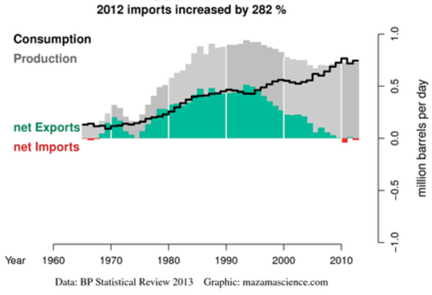
Unfortunately, as the level of violence continues to grow, one starts to get into an almost inevitable snowball effect and there is a consequent negative impact on much industry, likely including oil production. The most likely consequence will be a further fall in the regional export of oil, which has a follow-on consequence in that the customers who have lost this supply (Japan has given up all Iranian oil for example) must then go onto the world market to find an alternate source of supply.
As those sources become even scarcer than they are already, marginal amounts of oil become more critical to maintaining a global balance. But such supplies don’t become available at the drop of a hat.
It seems to be a drum that I beat perhaps a bit often, but it is a message that bears repeating. Without significant and ongoing investment in the more difficult regions of the world, funds to identify the necessary availability of resource, and then to drill in a timely manner, to prove the resource and start the process of turning it into a reserve, the oil balance cannot be sustained at a viable and acceptable price. It does not matter how glowing a set of reports are put out about how we can all relax because the world has plenty of oil in shale.
The largest of those resource sites is in Russia, where there may be as much as 75 billion barrels. But two things should be remembered. The first is that peak oil is reached, not when we run out of oil, but when we start producing less each year than in the previous. And the second is that getting much of the oil in the shale into the proven reserve category is going to take a fair amount of time, after which production rates, going from the results seen, for example, in the Bakken will decline at such a rate that a continued and expansive program of expensive drilling will be required to sustain production. And all this time the flow of oil from existing reservoirs will continue to fall.

3 Comments on "Tech Talk – Insecurity in the Middle East"
Plantagenet on Mon, 24th Jun 2013 2:42 am
The nutty claims that Obama is taking sides in the civil war in Syria because of oil are refuted by this article. There isn’t enough oil in Syria to make US intervention worthwhile.
The US intervention clearly isn’t because of oil and its not for democracy — basically there really isn’t any good reason for it all—.
BillT on Mon, 24th Jun 2013 3:58 am
Plant, if one wants to start a global war, it is the best place. Russia has a great interest in Syria and China has an interest in Iran which is tied to Syria. World War 3 could very easily start there this summer. If Russia delivered the weapons systems that they promised, the US will be checkmated and if Israel gets involved, the Russian missiles will rain down on Israel. The US may have gas rationing before September.
Arthur on Mon, 24th Jun 2013 8:42 am
Syria has nothing to do with oil directly. It is a geopolitical struggle, with SCO in the defensive and the west in the offensive. Syria is in the crosshairs of the west because it is allied with Iran, which is supported by SCO. But indirectly, it is about oil. Previously 2/3 of the oil came from the Gulf, today, with Russia and the US oil production increases it is probably less, lets guess: 50%. That is 40 million barrel a day. 1 barrel represents 8 manyear of work. So every day 320 million manyear of physical work are leaving the Gulf, or a permanent stream of work of 365*8*320 million = 934,400 million = 1000 billion = 1 trillion virtual slave labourers.
There are 7 billion people on the planet; lets estimate 5 billion adults. So the amount of energy leaving the Gulf equals the potential physical labour output of 200 times of humanity.
Staggering isn’t it.
This is what is really at stake here, not humanitarian motivations. But nobody here believed that anyway.