
Peak Oil is You

Donate Bitcoins ;-) or Paypal :-)


Page added on June 10, 2013

Low energy return on investment (EROI) need not limit oil sands extraction

This is a guest post by Adam Brandt, Assistant Professor from Stanford University, Department of Energy Resources Engineering.
1. Introduction
Low energetic returns (e.g., EROI, NER) from oil sands extraction and upgrading have been noted as a potential limit to the development of the oil sands as a substitute for depleting conventional oil resources (e.g., Herweyer and Gupta, 2008). In this article we will examine this claim from a variety of perspectives. Specifically, we will examine the following questions:
- Are the energetic returns from oil sands extraction lower than conventional oil?
- How have the energy returns from oil sands extraction varied over time?
- What energy sources are used in oil sands extraction, and what are the implications of this sourcing for net energy availability from the oil sands?
- Will low energy returns limit the net output of energy from the oil sands industry?
This article is based on the peer-reviewed journal article: Brandt A.R., J. Englander and S. Bharadwaj (2013). The energy efficiency of oil sands extraction: Energy return ratios from 1970 to 2010. Energy.
2. Are energy returns from oil sands extraction lower than conventional oil?
Previous works have calculated the energy returns from oil sands production using a variety of methods (Peter 2010; Herweyer and Gupta 2008; Rapier 2008; Peter 2012; DOE 2006). These studies estimate EROI from the oil sands at values ranging from 2.5 GJ/GJ to 7 GJ/GJ. Most of these estimates were generated quite simply, relying on a limited amount of data. Because of the different system boundaries used in each study, as well as other methodological differences, determining the exact reasons for variation in these estimates is challenging.
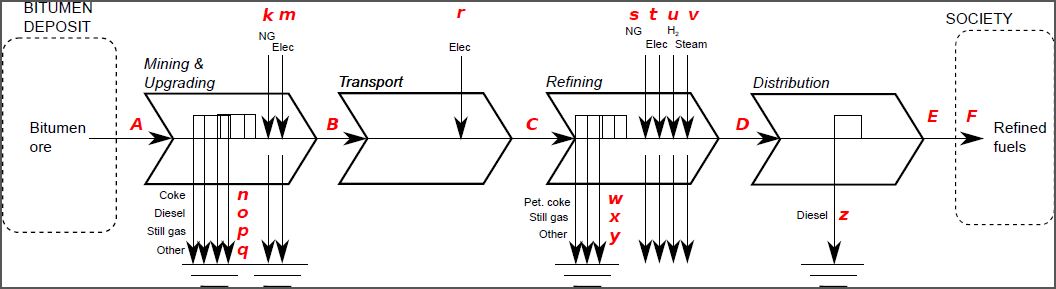
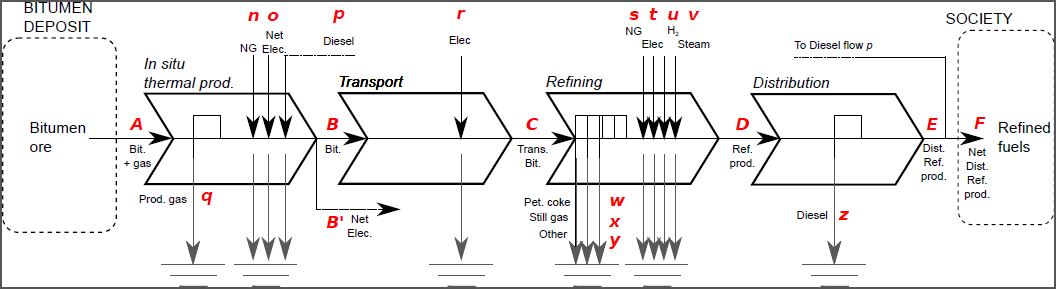
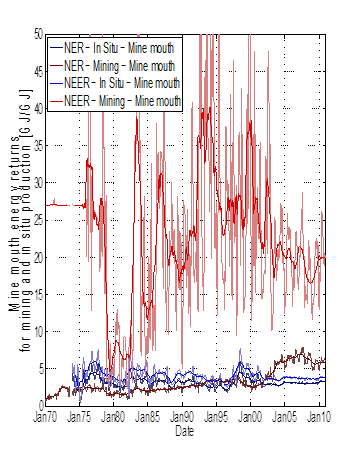
Our recent work (Brandt et al. 2013) utilized detailed energy production and consumption data reported by oil sands producers from 1970 to 2010 to examine trends in historical energy returns from oil sands extraction. The system diagram and flows considered are shown in Figures 1 and 2. Data are available on a monthly basis for most flows, with limited interpolation required in mining datasets, and some back-extrapolation required for in-situ energy intensities (see Brandt et al. (2013) for methodological details). The resulting energy inputs and outputs from mining and in situ production are shown in Figures 3 and 4. Mine mouth (e.g., extraction only, excluding refining) net energy returns (NER) for the entire industry were found to be 5.23 GJ/GJ in 2010. In situ NERs were approximately 3.5 to 4 GJ/GJ in 2010 while mining NERs were approximately 5.5 to 6 GJ/GJ.
Conventional oil EROI metrics commonly show energy returns of order 10-20 GJ/GJ (Gagnon 2009 et al.; Guilford et al., 2011; Dale et al. 2011). Therefore, oil sands projects exhibit demonstrably lower energy returns than conventional oil operations.
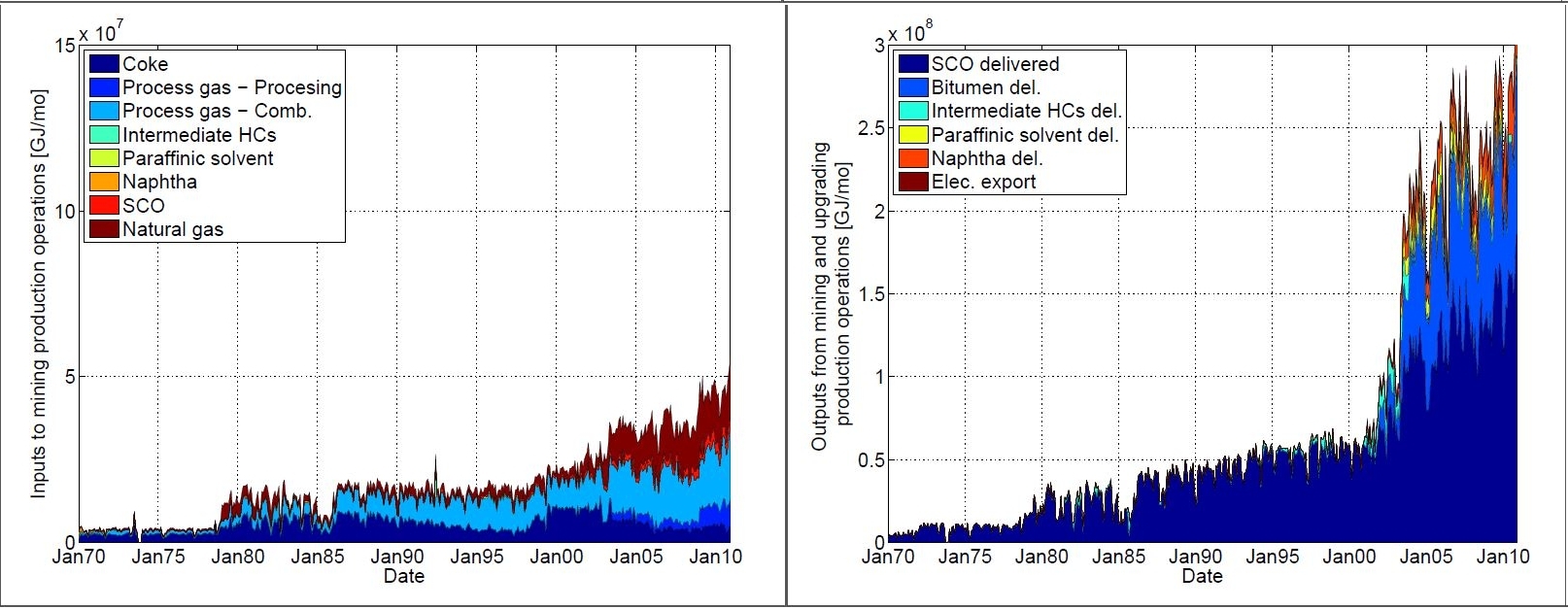
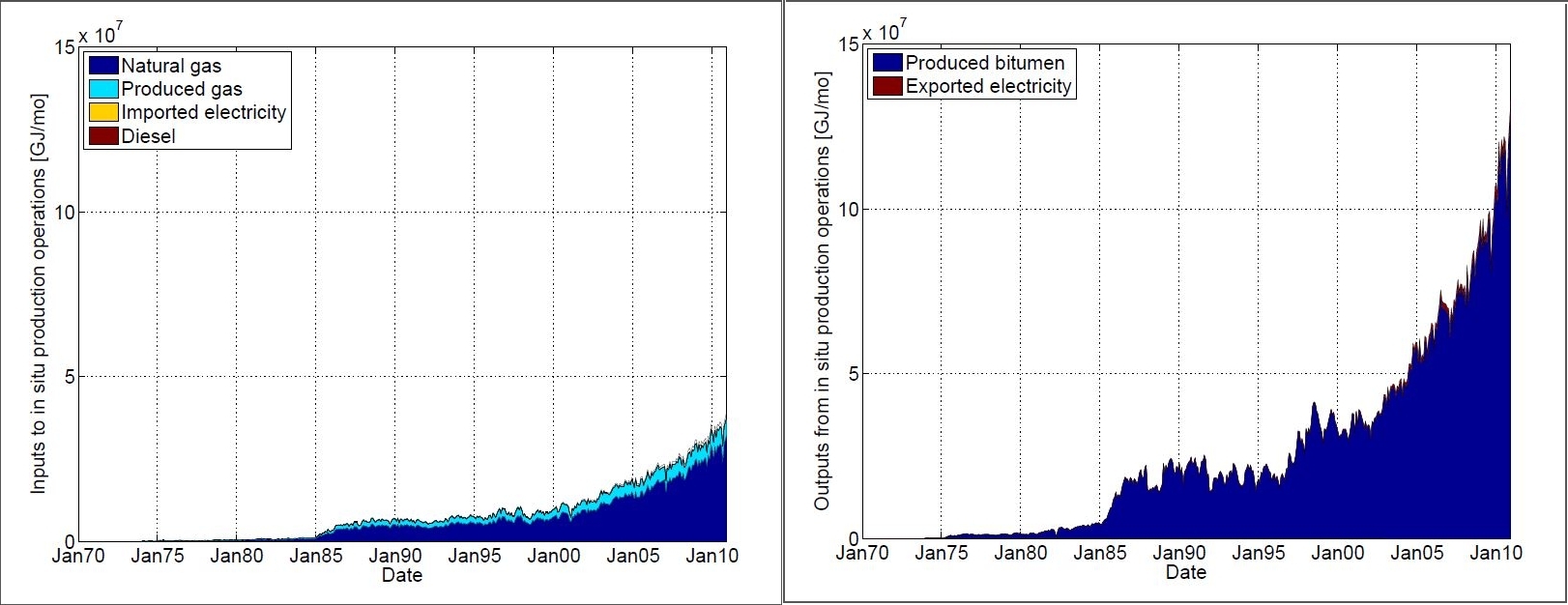
Net energy returns from mining and in situ operations (again, measured at a mine-mouth system boundary) have increased steadily over time, growing from 1.0 GJ/GJ in 1970 (entirely from the Suncor mining operation) to 2.95 GJ/GJ in 1990 and then to 5.23 GJ/GJ in 2010. As shown in Figure 5, significant improvements in mining energy returns have been realized.
The net energy returns reported above are just one metric to assess the energy returns from oil sands operations. Using the key provided in Figure 1 for mining operations (top), a mine-mouth NER compares the net output from the mining and upgrading operation to the total energy inputs into the mining and upgrading stage. Symbolically, this can be written as:

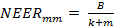
Measured in this way, the NEER from mining operations was approximately 20 GJ/GJ in 2010, significantly higher than the corresponding NER (see Figure 5).
5. Will low energy returns limit the output of net energy from the oil sands?
These data suggest that oil sands processes exist that have reasonably high energetic returns relative to external energy provided by other energy sectors. That is, relative to the amount of energy that they consumed from the rest of society (e.g., natural gas, imported diesel, and electricity), these processes produce a significant amount of net energy output. This is partly a result of historical development and geographic considerations: the oil sands mining operations developed in a remote and poorly-integrated part of Alberta, and therefore were designed to be largely energy self-sufficient. Importantly, these conclusions are not just limited to mining operations. In situ operations such as the Nexen Long Lake project produce steam using upgrader by-products (asphaltene residues).
Our results suggest that it is not realistic to expect oil sands extraction to be limited by their calls on natural gas and other resources. If natural gas becomes expensive, processes can be adopted to use byproducts of the processing of bitumen to fuel extraction (e.g., integrated operations). However, these integrated processes have implications for the amount of oil sands resource available (e.g., not all barrels able to be produced will be available as “net” barrels of output) and can have important climate implications (e.g., using coke for fueling bitumen separation or steam production is more GHG intensive than using natural gas).
4 Comments on "Low energy return on investment (EROI) need not limit oil sands extraction"
BillT on Mon, 10th Jun 2013 12:37 pm
“…Will low energy returns limit the output of net energy from the oil sands?…”
EROEI is EROEI, no matter where the Energy comes from. Energy is NOT free unless you are a plant in sunshine.
Desperation is driving these coverups into even more stupid ideas. NET energy is already shrinking as it takes more and more energy to get ANY form of energy today.
rollin on Mon, 10th Jun 2013 2:41 pm
At the mine-head is the key word here. Completely ignored is the energy needed to convert the tar to synthetic fuels, both heat and hydrogen as well as large facilities are needed for that. Also neglected are the transport diluents needed to thin the tar for pipeline transport to refineries. These diluents are condensates from gas wells as far away as Texas that must be piped north to Canada then piped back to the Midwest or Gulf for refining.
DC on Tue, 11th Jun 2013 12:16 am
The oil industry uses a rather crude method to mask LoW EROEI-subsidies. People are this time and age only consider net ‘profit’ in dollar terms. They simply cant conceive of things any other way. However, something can be both ‘profitable’ and a barely worth doing at the same time. Corn-Bio fools and the tar-sands are perfect examples. Another would be the foolish, and hideously expensive energy sink, the ‘hydrogen car’ to replace the dreadful gas-burning car. The dollar figures are so large every oneinvolved just assumes the venture must be worthwhile, or why else would ‘they’ keep sinking all those dollars(subsidies) into it.
Dmyers on Tue, 11th Jun 2013 12:30 am
Clearly, low energy invested and high energy returned makes for a high EROEI. The sources for these numbers should be viewed most critically. I’m especially interested in the exported electricity on the output side in this particular article. It certainly doesn’t seem anything like the other energy fuel sources listed with it.
Rollin is rollin’ with his comment at 2:41. One factor which seems to explain some variation in EROEI approximations is the point at which the energy returned is measured. In this instance, that point was selected to be the mine-head, which is far short of the final, human consumed product and represents only a fraction of the chain of energy inputs. And the energy alleged at this point can only be considered to be potential energy available from the fuel sources developed.
Presenting data from the mine-head, as here is done, should not be done without the complementary data from the final refinement. All input should be considered, even the energy necessary to produce the gas condensates employed in the process.