
Peak Oil is You

Donate Bitcoins ;-) or Paypal :-)


Page added on June 2, 2013

Tech Talk – Future Oil Production from Iraq: An Optimistic View

There is often quite a debate in the Peak Oil community over the difference between a reserve and a resource. Simplistically a resource is, for the sake of discussion, the amount of oil that is in the ground in a certain country, while the reserve is the amount of oil that can be both technically and economically recovered from that resource. The numbers can differ quite markedly, and the judgment as to whether a certain body is a reserve is finally made when a well is drilled down, and production (or not) begins.
Just having the reserve available is not, however, within the global discussion of Peak Oil, an adequate sufficiency. Because oil well flow declines over time, it is important that the rate of oil production from that reservoir, and the timeliness of its arrival within the supply chain, be considered. This is particularly true in discussions about the help that the reserve will provide in ensuring that there is an adequate supply available when the global demand needs it. Normally, as noted, the decisions about production are made on geologic and economic grounds, but it would be foolish not to recognize that there are other factors. Consider the case of Iraq. It is a common the assumption that Iraqi oil production will rise considerably, with some suggesting it will reach the levels currently only achieved by Russia and Saudi Arabia, although there are some who project it might even rise to as much as 13 mbd, given that there are contracts in place, which if fulfilled on time, would raise Iraqi production four-fold to 12 mbd by 2017.
In their Special Report on Iraq last year, the IEA noted that the country is already the world’s third-largest oil exporter, with the potential and intent to increase production much further. And, as the EIA notes, Iraq became the second largest oil producer in OPEC when it passed Iran at the end of last year.

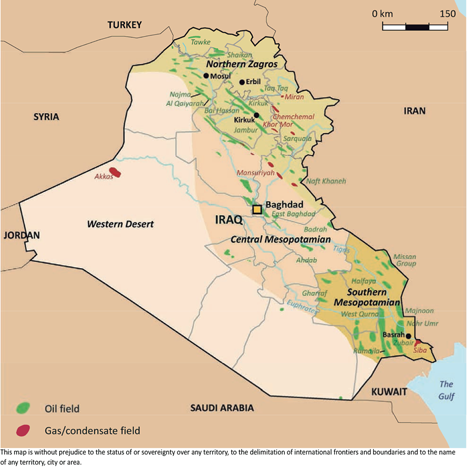
In recent times Euan Mearns has written of the potential for oil production in the Kurdish region in the north. In total this is estimated to hold around 4 billion barrels of oil, or around 17% of the national reserve. However, as exploration of the potential fields in Kurdistan continues, this estimate has been increased by the local government to a possible 45 billion barrels. Euan, for example, wrote about the development of the Shaikan oil field and the potential size of between 8 and 13.4 billion barrels that it showed in January 2012. Current plans are for production to reach 40,000 bpd “soon”, with production ramping up to 400,000 bpd. The Kurdistan Regional Government (KRG) see it playing a considerable role in achieving their target of 400 kbd this year, 1 mbd by 2015, and 2 mbd by 2019. The field is being developed by Gulf Keystone Petroleum.
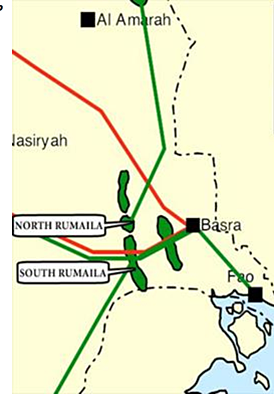
In the south, current production is centered around the Rumaila oil fields. BP has committed $2.85 billion toward improvements in Rumaila this year, with the intent of raising production from the current 1.4 mbd, through 1.45 mbd at the end of this year, up to 6 mbd by 2017. Three hundred new wells will be drilled in the field over the next five years, to meet the goal, with 150 of these being drilled in the second half of this year. BP operates the field in partnership with CNPC.
With the growing development of the Majnoon field, with an estimated reserve of 38 billion barrels, it might thus appear that the country is well on its way to meeting the projections that the contracts might suggest. However, there are many constraints on future production, including infrastructure and water availability, and I will discuss these and why they limit the IEA to an optimistic assessment that the country will produce 6 mbd by 2020, and only reach 8.3 mbd by 2035 in the next post.
6 Comments on "Tech Talk – Future Oil Production from Iraq: An Optimistic View"
MrEnergyCzar on Mon, 3rd Jun 2013 12:25 am
What ever happened to the view that they’d be producing 10-12 mb/day.. I recall that being said only a few years ago..
MrEnergyCzar
Plantagenet on Mon, 3rd Jun 2013 12:33 am
Even an additional 6-8 mbbls/day from Iraq will be darn good for the global economy.
BillT on Mon, 3rd Jun 2013 12:42 am
“… constraints on future production, including infrastructure and water availability …” And war…
Still counting the chickens before the eggs have even been laid. Iraq is involved in a civil war and will be for the foreseeable future. Nothing is certain in the Middle East.
Jeffrey J. Brown on Mon, 3rd Jun 2013 2:28 am
The EIA’s chart showing Iraq’s production and consumption is wrong regarding consumption.
Here is the consumption only chart for Iraq that has the correct values:
http://www.eia.gov/countries/img/charts_png/IZ_petcon_img.png
Here are some numbers and rates of change from 2008 to 2012 for Iraq’s production, consumption and net exports.
Production (P) – Consumption (C) = Net Exports, total petroleum liquids + other liquids (EIA):
2008: 2.39 -0.59 = 1.80 mbpd
ECI (P/C) = 4.1
2012: 3.00 – 0.88 = 2.12
ECI (P/C) = 3.4
2008 to 2012 Rates of Change:
P: +5.7%/year
C: +10%/year
NE: +4.0%/year
ECI: -4.7%/year
Even though net exports were up somewhat from 2008, based on the 2008 to 2012 data Iraq is actually trending toward zero net exports, because of the rapid increase in consumption (at an ECI ratio of 1.0, production = consumption and of course net exports = zero). In any case, based on the 2008 to 2012 rate of decline in the ECI ratio, Iraq would approach zero net exports in about 25 years.
For more info on the ECI concept (Export Capacity Index), you can search for: ASPO + Export Capacity Index.
Arthur on Mon, 3rd Jun 2013 9:04 am
Optimism?
http://www.dw.de/un-iraq-sectarian-violence-worst-in-years/a-16853048
Last month a staggering 1000 people were killed in interethnic violence. The fake country, a creation of a Winston C., is about to explode, like Syria. If the central government in Bagdad loses control, the dull oil pumpers can kiss their ‘optimistic views’ goodbye.
Arthur on Mon, 3rd Jun 2013 9:37 am
Prominent Anglo commentators from the left (Alexander Cockburn) to the right (Pat Buchanan) agree that the days of Sykes-Picot are over:
http://deepresource.wordpress.com/2013/05/28/the-end-of-sykes-picot/
After WW1 Lenin had revealed that in 1916 Britain, France and Russia had formally, on paper, agreed that Britain and France could take over the Middle-East from Turkey and that Russia could take over Istanbul.
Well, I am happy to inform Pat that this was already informally agreed upon at the eve of the Great War, the war that was masterminded by London with the aim of destroying Germany. And sidekicks like France and Russia could be bought into that coalition using Alsace-Lorraine and Istanbul/Bosporus as appetizers.
The central European powers and Turkey lost the war, thanks to the jews, who in 1917 already owned America, and who brought the US into the war as Britains third sidekick, in exchange for Palestine. Most of the present day borders in the ME resulted from the outcome of WW1, notably Iraq, Syria, Jordan and SA.
But the days of European imperialism are long gone and US imperialism is about to, leaving a huge power vacuum. And since mother nature abhors vacuums, something is going to fill that vacuum. And that is going to be Islam, in the Sunni and Shia variety, centered around Istanbul and Teheran resp.
And the development in the ME will function as a model for the rest of the world, taylored to the new reality of resource depletion. The days of globalism and progress are over and everybody falls back on the old positions, traditions and religions. The future is conservative if not fundamentalist archaic.