
Peak Oil is You

Donate Bitcoins ;-) or Paypal :-)


Page added on May 12, 2013

Tech Talk – The Dangers of Complacency

Perceptions based on perhaps too small a collection of information can lead into opinions that, on investigation, turn out to be incorrect. Just recently a couple of friends had mentioned that charities that they are associated with were seeing a decline in donations. I built this into a picture of the general public being less able to afford earlier levels of giving, perhaps because of the continued impact of higher costs of fuel. However, the perception is as a general statement, wrong, and (via the National Park Service from The Giving Institute) I learned that:
Americans gave more than $298.42 billion in 2011 to their favorite causes despite the economic conditions. Total giving was up 4 percent from $286.91 in 2010. This slight increase is reflective of recovering economic confidence.
The greatest portion of charitable giving, $217.79 billion, was given by individuals or household donors. Gifts from individuals represented 73 percent of all contributed dollars, similar to figures for 2010.
In the perception that is becoming increasingly prevalent on the future of energy supplies, and particularly on crude oil, the current adequacy of supply is projected forward to anticipate no problems with supply in the future. Peak oil is now suggested to occur not because the supply is limited, but because with the increasing use of renewable energy, demand will peak, and then decline. Bloomberg New Energy Finance founder Michael Liebreich is quoted as projecting that the growth in fossil fuel use will almost stop by 2030, while Citi Commodity Researchers are suggesting that the increases in prices will drive increases in efficiency that will bring a peak in oil demand “much sooner than the market expects.”
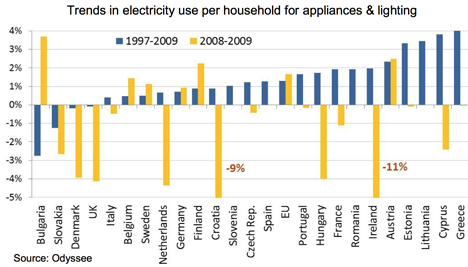
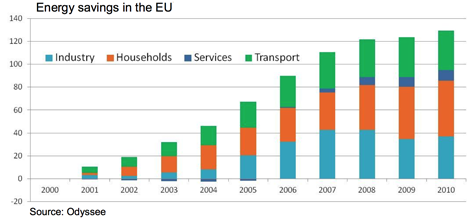
One of the problems in assessing the changes in efficiency over time is that when looking at the past decade, one has to recognize the significant impact of the recession. For example, the Odyssee project looked at energy use in Europe and clearly showed the impact of the recession on demand.
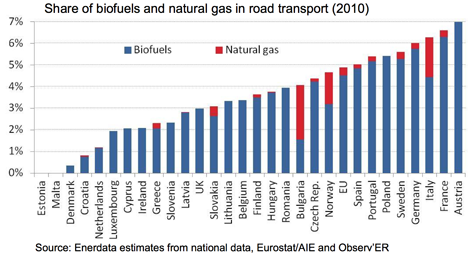
The fact that Clean Energy Fuels can list all 22 stations that added natural gas pumps along the “Natural Gas Highway” in the November-January period, this does not indicate a great rush to build that infrastructure. It is easier to change the local distributor networks, with companies such as Waste Management indicating that they will use CNG in 80 percent of their new trucks, than it is to see the rapid change of the longer distance haulers, and for passenger vehicles. A recent article in the Washington Post noted that only 20,381 vehicles ran on natural gas of the 14.5 million new cars and trucks sold last year. Further not only does a CNG vehicle cost more to purchase, it also has a lower range, although for some applications that may not be much of a handicap.
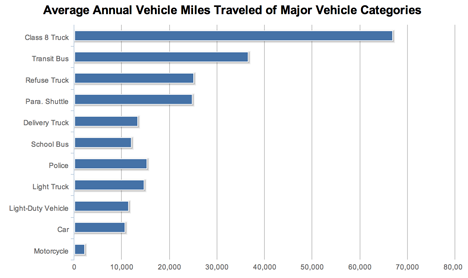

The question as to what will be available to meet that enhanced demand remains one of the great imponderables that folk seem, again, unwilling to face. Certainly with a steadily increasing demand, and the constraints on supply that these pages have continued to document over the years, it becomes very difficult to see how price stability can be maintained where demand exceeds supply at a given price. The problems that this will bring, particularly to those nations that now subsidize fuel, a policy that is unlikely to change in Asia, are likely to be major. Yet for countries such as India, which last year spent the allocated fuel subsidy budget for the year by the end of July, the political costs of change remain very high and could well remain in place until the financial burden becomes intolerable.
Unfortunately, with the current complacency, at that point it will then be too late to start searching for alternate answers.
2 Comments on "Tech Talk – The Dangers of Complacency"
BillT on Mon, 13th May 2013 12:56 am
More bullshit disguised as facts..lol
First, if giving was up, it was the wealthy dodging taxes not the average J6P. That amount would mean that every person in the US gave an average of $1,000 or $4,000 for a family of 4. Right! And unemployment is 22% and 47 plus million are in the soup lines … so, where did this number come from? The same place they all come from … and it is no surprise that they have a bad odor.
No matter how much they SAY the economy is improving, reality is that it is in a depression, headed for a Great Depression. There is a point where the bullshit doesn’t work anymore and we are about there.
All of this is based on a lot of what-ifs and maybes. Nothing firm or real. A lot of bubbles and techie dreams. No one can project next month let alone next year or ten years. Too many black swans.
Harquebus on Mon, 13th May 2013 4:28 am
A load of rubbish. The cost of renewables will rise exponentially as the availability of oil declines. No oil, no renewables.