
Peak Oil is You
Donate Bitcoins ;-) or Paypal :-)


Page added on February 16, 2013

Is the Dollar Dying? Why US Currency Is in Danger
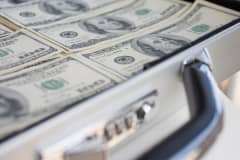
The U.S dollar is shrinking as a percentage of the world’s currency supply, raising concerns that the greenback is about to see its long run as the world’s premier denomination come to an end.
When compared to its peers, the dollar has drifted to a 15-year low, according to the International Monetary Fund, indicating that more countries are willing to use other currencies to do business.
While the American currency still reigns supreme — it constitutes $3.72 trillion, or 62 percent, of the $6 trillion in allocated foreign exchange holdings by the world’s central banks — the Japanese yen, Swiss franc and what the IMF classifies as “other currencies” such as the Chinese yuan are gaining.
“Generally speaking, it is not believed by the vast majority that the American dollar will be overthrown,” Dick Bove, vice president of equity research at Rafferty Capital Markets, said in a note. “But it will be, and this defrocking may occur in as short a period as five to 10 years.”
Bove uses several metrics to make his point, focusing on the dollar as a percentage of total world money supply.That total has plunged from nearly 90 percent in 1952 to closer to 15 percent now. He also notes that the Chinese yuan, the yen and the euro each have a greater share of that total.
“To the degree that China succeeds in increasing its market share of the world’s currency market, the United States is the loser,” Bove said. “For years, I have been arguing that the move of the Chinese makes perfect sense from their point-of-view but no sense for the Americans.”
For a country with a budget deficit in excess of $1 trillion a year, the consequences of losing standing as the world’s reserve currency would be dire.
If the dollar loses status as the world’s most reliable currency the United States will lose the right to print money to pay its debt. It will be forced to pay this debt,” Bove said. “The ratings agencies are already arguing that the government’s debt may be too highly rated. Plus, the United States Congress, in both its houses, as well as the president are demonstrating a total lack of fiscal credibility.”
Bove is not the only one sounding the reserve currency alarm, though the issue has fallen off the front pages as hopes for a sustained U.S. recovery have taken hold and the stock market has surged to near-record highs.
But the looming battle over budget sequestration in Washington could revive long-standing fears of fiscal stability.
“If (dollars) no longer offer the safety that investors have come to expect, they will not function as the stable collateral required by bank funding markets,” Barry Eichengreen, a professor at the University of California, Berkley, warned in a Financial Times commentary late last year. “They will not be regarded as an attractive form in which to hold international reserves. And they will not be seen as a convenient vehicle for merchandise transactions.”
To be sure, the markets at this point are not acting like the dollar is in severe trouble. The greenback has maintained its position as a general safe haven in times of trouble.
“Longer term, of course, countries are going to diversify away from the dollar if they can. There are more favorable investment opportunities out there if you can catch yield,” said Christopher Vecchio, currency analyst at DailyFX, a trading firm. “Despite the increase in risk to the U.S. dollar and Treasury, investors still feel safest at home.”
But the Federal Reserve’s successive quantitative easing programs, which have created $3 trillion in new greenbacks, continue to spur worry over the dollar’s status.
“The No. 1 security issue we have as a nation is the preservation of the U.S. dollar as the world’s reserve currency,” said Michael Pento, president of Pento Portfolio Strategies. “It’s a thousand times more important than a nuclear bomb being tested by North Korea. It’s a thousand times more important that we keep the dollar as the world’s reserve currency, and yet we are doing everything to abuse that status.”
The dollar’s seemingly precarious status is why Pento remains bullish on gold and believes the dollar’s demise as the premier reserve currency could end even sooner than Bove predicts — perhaps by 2015.
“Five to 10 years — that would be an outlier,” he said. “I would say 2015, 2016, that would be the time when it becomes a particularly salient issue. When we’re spending 30 to 50 percent of our revenue on debt service payments, we enter into a bond market crisis. The dollar starts to drop along with bond prices. That would set off the whole thing.”
6 Comments on "Is the Dollar Dying? Why US Currency Is in Danger"
BillT on Sat, 16th Feb 2013 2:00 pm
At least this report is fairly accurate, even if it is a MSM source. The Chinese are accelerating their spending of Charmin dollars all over the world, exchanging them for things of value: Oil fields, minerals, corporations, land, food, etc. They stopped loaning them to the Us years ago and are decreasing their holdings of bonds.
When they get enough gold, I think, and I have been reading, that they will go to a gold backed Renminbi. At that point, the game will be over for the dollar and gold will be the new/old basis of value. The dollar will then be worth less than Charmin.
WW3 will be won on the financial battlefield, I suspect. And the Chinese are way out in front.
GregT on Sat, 16th Feb 2013 5:29 pm
“The U.S dollar is shrinking as a percentage of the world’s currency supply”
Ben could always print more……………………:0
J-Gav on Sat, 16th Feb 2013 5:55 pm
Someone has said it’s time to start investing (for the lucky ones who can)in things that hurt if you drop ’em on your foot. That does not include paper, even if George Washington’s portrait is on it.
J-Gav on Sat, 16th Feb 2013 6:25 pm
Also wanted to comment on your post, BillT. You are more than correct when you say that China is buying gold hand over fist. So is Russia. Other countries are repatriating theirs from the US, where they had it stashed (Germany, among others). Turkey is using it to buy fossil fuels from Iran. So there’s a definite shift in that direction.
However, from there to say the Renmenbi will become the new gold-backed international currency to replace the dollar doesn’t necessarily follow, at least not right away (5-10 years?)and even then probably not for very long.
Why? Let’s look back to what happened in 1971 when Nixon took the dollar off the gold-standard. Viet-Nam was draining the American treasury and countries started getting the jitters about how sound the financial situation really was … and so they began sending their dollars back across the Atlantic in exchange for gold. Three Fort Knoxes would’ve been needed so – out with the gold standard, in with the petro-dollar.
Apart from the likelihood that there just isn’t enough gold to go around (it doesn’t actually go around that much, it’s hoarded), whoever tries to base international trade on it would soon find themselves in a similar situation.
Under intense scrutiny from countries dealing in, say, Renminbi, some of the really crappy loans their banks have been making for years would come to the fore. Building entire cities where nobody lives, etc. Investors once again getting the heebie-jeebies and voilà: take yer Renminbi and give us the gold!
It’s all quite complex and it’s hard to put a time-line on it but I wouldn’t bet on any reserve currency based on gold being a game-changer for very long.
Kenjamkov on Sun, 17th Feb 2013 2:45 am
Just an aside here: $600 trillion in derivatives, $6 trillion in World GDP. Makes you think don’t it…
As soon as the bond bubble bursts, you’ll see a move by China to financially ally the BRIC (Brazil, Russia, India, China) nations with a common gold-backed currency. Then all the other nations will have to follow suit or financially crumble.
The World is in a financial war (WW3) at this moment, but we have not yet seen too many casualties. Greece was an early one.
BillT on Sun, 17th Feb 2013 3:28 am
J-Gav, we are moving into a world of contracting GDP, not growing. The world’s gold will be more than enough to back currencies when the growth ends and contraction begins. There will be no need for more gold to keep up with growth as there will be no growth, just a form of barter.