
Peak Oil is You

Donate Bitcoins ;-) or Paypal :-)


Page added on January 12, 2013

Germany’s Bad Energy Choices Leading into Cul de Sac?
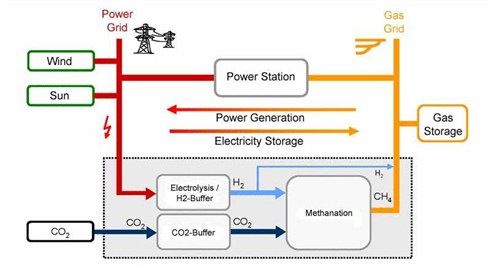
Big wind and big solar are hopelessly intermittent and unreliable forms of energy production. But Germany has rashly committed itself to supplying 40% of its power from the intermittent unreliables by 2020. As a result of this giant leap of faith, German energy planners are scrambling for ways to convert big wind and big solar energy to more reliable forms of energy that can be stored, and used whenever needed.
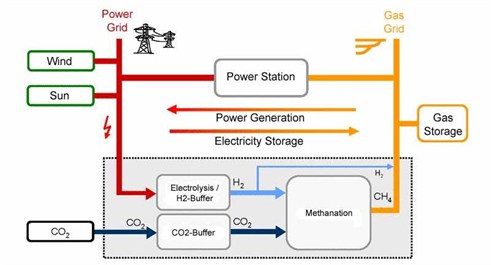
As seen in the diagram above, a new €3.3 million project aims to produce methane from wind and solar generated electricity, using alkaline electrolyser stacks.
Once the hydrogen has been produced it passes through a methanisation process. The resulting methane can be injected directly into the natural gas grid, thus allowing for renewable energy storage on a timescale of months or more. The gas contributes to decarbonising the grid, and can be used for electricity generation or to fuel natural gas vehicles. _FuelCellToday
Here is more information about an earlier, preliminary research project to prove the concept:
The Centre for Solar Research Baden-Württemberg (ZSW) has inaugurated a research facility to convert solar power to methane. The methane is then added to the natural gas grid.
The project uses solar power to electrolyse water in a pressurised alkaline electrolyser, producing hydrogen and oxygen. The hydrogen gas then undergoes methanation, and with the facility able to produce up to 300 cubic meters of renewable methane per day, it is the largest of its type in the world. _FuelCellToday
More information from ZSW (in German)
Needless to say, the concentration of CO2 in the Earth’s atmosphere is vanishingly small (0.04%) — making atmospheric CO2 far too rare and expensive as a CO2 source, for an industrial-scale project. This being the case, it is clear that the project will have to use concentrated CO2 effluent from a hydrocarbon-burning power plant, cement plant, or other industrial scale plant.
And as it happens, Germany is burning much more coal lately, as a result of its impulsive decision to shut down its nuclear power plants. All of which brings up a very good question: “If Germans want to produce methane from CO2 and H2 from the electrolysis of water, why not use nuclear power as your source of electricity?” Nuclear power is cheaper, more reliable, and more potentially abundant than the intermittent unreliables — big wind and big solar.
Perhaps the answer to the question is that the Germans are not actually serious about all of this, but are merely posturing for the energy and environmental media — and for green oriented voters and power blocs.
That would be a shame. Germany is in dire need of competent people who are willing to take a serious approach to present and future electrical power needs.
Today’s bad choices by German leaders will have the effect of limiting possible good choices in the future. Germany is being painted into a corner, led into a cul de sac, by faux environmental greens who have been given too much power across the EU.
The green ideology is doing for Germany and the EU what the communist ideology did for the former USSR.
22 Comments on "Germany’s Bad Energy Choices Leading into Cul de Sac?"
BillT on Sat, 12th Jan 2013 2:36 am
Nuclear power is a net loss as is all ‘clean’ energy sources. We have been lied to by the nuclear industry since day one. There are thousands of tons of spent uranium laying around the world that will require maintenance (money) for the next 1,000+ years. Long after the plants are gone, the deadly waste will remain.
Using wind/solar to make alternate, low energy fuel is another pile of bullshit by corporations. I thought the Germans were an intelligent people? I think they are a stupid as Americans if they believe this BS.
M_B_S on Sat, 12th Jan 2013 7:11 am
Green is the only choice we have.
We must accept mother natures laws.
We must live with Gaia not against her.
We are Gaia.
Nuclear energy use is useful only in space.
We cannot take our sun with us into deep space but their heavy waste.
M_B_S
Andrew DeWit on Sat, 12th Jan 2013 7:39 am
Better warn the US military that its aggressive renewable programmes are all crazy. They’re not stressing gas nor mini-nukes for their bases. And that’s not because they’re anti-nuke. Rather, they want America to lead the green revolution, and are willing to fight with conventional-energy shills, like Senators Inhofe and McCain.
dorlomin on Sat, 12th Jan 2013 8:22 am
“Big wind” seriously.
adamc18 on Sat, 12th Jan 2013 9:50 am
Floating wind turbines driving air compressors. Use the power to alter the buoyancy of the big flotation chamber which has the wind turbine on top. When the grid requires electricity just release the vacuum/compressed air (not sure which!) through a turbine/generator from the chamber. Am I missing the greatest patenting opportunity in history or would it just not work?
cephalotus on Sat, 12th Jan 2013 10:50 am
From my German point of view cost and risk of nuclear energy is to high. Costs of new nucloear plants are much higher than using wind or PV and the old ones are to risky to operate longer than needed.
Going nuclear was a very costly experiment that failed. The only hope that remains is that we can get out of it before a serious accident will happen.
UK plans a new nuclear program.
US has cheap natural gas and a strategy based on cheap fossil energy.
Let’s compare those three countries in 20 years. We will be able to learn from each other…
ken nohe on Sat, 12th Jan 2013 11:25 am
Big wind and big solar are NOT hopelessly. But they are also not a good replacement for power plants.
A modern electric grid is a complex system with very specific requirements. A basic concept is “base load” and “peak load”. Base load generation capacity must be provided 24h a day and peak load when needed. Usually mid morning and early evening, Also more in Summer or Winter depending on latitude. Wind and solar do not fit either with base load nor with peak load and it is a major problem. It means that the energy must be stocked and consequently mostly lost with horrendous consequences on costs. Which is the main reason why these “new” energies will always have difficulties to compete.
There is a solution but it is also very costly: A distributed system where most of the energy is produced and consumed locally. You can have electricity at night with such a system, albeit expensive, but a smelter will not produce much steel with sun panels on the roof!
Worse, experience shows that wind turbines last less than half the original estimate of 20 years in Europe with dramatic consequences on cost. And that’s on land. At sea, the conditions are so severe that their lifetime will be even shorter. We have the technology to built these turbines but not yet to make them competitive, even remotely.
The Germans have made a technological bet which unfortunately may well follow the path of legislation in California concerning “electric” cars 20 years later.
Arthur on Sat, 12th Jan 2013 11:59 am
Here refs to studies about net return of wind energy:
http://www.wind-works.org/articles/EnergyBalanceofWindTurbines.html
On average a windturbine has an eroi of 20, or higher for suitable locations. Bill, could you provide any basis for your claim that wind has a negative net energy balance?
Ken, do you have links to support the idea that modern turbines last only ten years? I can point to functioning windmills in Holland of 400 years old.lol I guess that older turbines could be written off prematurely because technology develops so fast. I have a Windows NT machine on my attic that no doubt will work if switched on, yet I never will. Obsolete, slow technology. Also, windenergy will be competitive… since in the long term there will be nothing to compete with. Forget about frictionless continuity into a renewable society. Supply will not be garanteed. What is needed is a smart grid (installed in Europe by 2020) which enables a supplier to limit consumption, even to zero if necessary, as well as the European Supergrid, which will use mountain bassins in the Alps, Norway and Spitsbergen as Europe’s battery pack.
John on Sat, 12th Jan 2013 1:11 pm
The Germans are not being painted into a corner, they are connecting their grid to Norway to use pumped storage to deal with intermittency of wind and solar. They are expanding their Grid with 2500 km of new high voltage power line from North to South, and they are exploring many other options.
There are 2 benefits in what they are doing; 1 they are reducing imported gas and oil, and perhaps even coal.
2 The marginal cost of running wind turbines and solar power is very low, in the long term it will lead to a competitive edge for their society
BillT on Sat, 12th Jan 2013 2:36 pm
Arthur, no study has been done on a TOTAL energy cost for a turbine or a PV system because it would prove my statement. Have you ever been to a large quarry/mine? Refinery? Steel foundry? Manufacturing facility? I have, All of them. I worked in most of them at one point in my long life.
I know the energy needed to make one small part of an ore crusher, to move it from foundry to machine shop to assembly to replacement and recycle of the worn out part in a few years. I know that that part alone took the energy to run a small town of 50,000 for 2 hours Just to melt the steel scrap and ores to pouring temperature. Those ores and scrap came from several parts of the world by freighter, train and trucks. The part would go to the machine shop to be ground to specifications and hauled to the refinery where it would replace a worn out one that could be cut up and recycled, replacing maybe 1/4 of the needed materials for a new part.
No, ‘renewables’ will only last as long as the current equipment/machines last. When oil is gone they will also disappear. A wooden windmill is not modern one. That’s like comparing a kite to a jet plane in tech and materials.
ken nohe on Sat, 12th Jan 2013 2:50 pm
Yes Arthur, it is a report from the UK government stating that the reliability of the current generation of turbines is low and their expected lifetime will be closer to 10 years than the 20 calculated for the investment.
If your reference for wind energy is Kinderdijk windmills, you will certainly get very reliable machines to grind your cereals but very little electricity! Current wind turbines are high-tech machines using composites and high performance generators very close to the best we can do. They pick up little wind and efficiently transform it into electricity. They are also fragile. They are noisy and you’ll need 1,000+ 1MW units to generate what one nuclear plant produce. That’s a lot of investment. I though it was a good thing when they started installing a few hundreds near Palm Spring 20 years ago but now that they dot the hills all over the Mojave, I’m less sure. As I explained in my previous post, I do not believe that this particular energy has much of a future. Beyond a few % of installed capacity, it destabilize the whole grid, so much so that in Japan, the utilities currently refuse to connect to new facilities. So much for the “future”, sorry!
ken nohe on Sat, 12th Jan 2013 3:03 pm
Here is a rather complete report on wind energy in the UK. (You can find very good ones in other European countries but they tend to be in more “exotic” Nordic dialects.
PB-onshore-wind-energy-UK
Kenz300 on Sat, 12th Jan 2013 4:43 pm
Climate change is real….
It is time to stop building any more coal fired power plants.
The price of oil, coal and nuclear keep rising and causing environmental damage.
The price of wind and solar keeps dropping.
Easy choice.
BillT on Sun, 13th Jan 2013 2:04 am
Kenz, read the above comments please … and stop parroting something that you read years ago. We’re telling you that wind and solar is not going to help.
Arthur on Sun, 13th Jan 2013 10:08 am
Ken, that keyword PB-onshore-wind-energy-UK leads to a 36 page pdf… Skimmed through it, but no reference to 10 year technical lifespan of wind turbines. Page number?
BillT on Sun, 13th Jan 2013 11:18 am
Arthur, logic tells you that anything requiring high tech methods and materials will not last long. Each one of those windmills requires huge amounts of energy to exist and huge amounts of materials to make. Then they require a sophisticated, expensive distribution and storage system to actually get energy to place that are not windmill practical. Ditto PV systems. Those are why ‘renewables’ will not save or even begin to save today’s standard of living in the Western countries.
Arthur on Sun, 13th Jan 2013 12:27 pm
Nobody is talking about saving present day standards into the future. The debate is where are we going to invest scarce money and energy resource in, in order to get the best results for the future. Your strategy, no future, is maybe suitable for a 69 year old, but not for younger people. I know we are all going to take a dive, maybe billions are going to die, I do not know, but the question remains, how are we going to save a core of humanity/civilization into the future? The question is, which technology? You reject all hightech, I only reject hightech with a high energy footprint. I reject (in the long run) cars, global trade, planes, central heating. The future is solar panels on every roof, wind turbine next to each village, like this:
http://deepresource.wordpress.com/2012/12/30/wilpoldsried-makes-millions-from-renewables/
Communication, education and entertainment via 3watt tablets, 15 watt thermo-wired clothing, 10 watt led lighting, life in the northern hemisphere in hibernate mode during the winter, like in Siberia now.
In my view this is a realistic achievable future, based on currently available technology and resources.
To put it in a catchphrase: carbon fuel is out, data is going to be the central ‘commodity’ of the future.
No Marco Polo with camels/horses travelling for years to bring a text message from the pope to the Chinese emperor, or thundering A380/Dreamliner bringing letters, but a simple near zero energy http request to achieve the same result. No poor old Crimean babushkas sitting all day next to a road with a basket of handpicked mushrooms waiting for a random customer, but instead put it on the internet, which offers total market transparancy and efficiency. That is the future. Near free abandunt data, steering and handling scarce resources.
BillT on Sun, 13th Jan 2013 2:35 pm
Arthur, age makes no difference. I probably have another 20 years or more. I do have grand kids that will have to live in that future world. I don’t pretend that life will be anywhere near today’s for western countries. We are on a decline that will not stop this century. No ‘alternates’ are going to make a real difference in the last half of this century. I don’t see Mother Nature letting us continue that long. Who cares how many windmills are where when there is no food or drinkable water? Solar panels and windmills require materials from all around the world. Not going to happen when globalization ends. The higher the tech, the quicker it will fail. You have lived in the exception not the norm. We are leaving a 300 year hydrocarbon bubble. Sorry. There is no replacement this time.
BTW: Data will end when cheap energy ends. The internet came and it will go as all other tech ‘miracles’ have. If governments don’t cut it off sooner, lack of energy to support it will. I don’t see an internet in 2050. You cannot see beyond your own prejudices/hopes. Do as you will and we will see what happens. But tech is NOT the answer. When the ocean is dead, oxygen levels are low and most land is not able to produce food of any kind, tech will be the last thing you will think about.
Arthur on Sun, 13th Jan 2013 3:02 pm
Let’s agree to disagree.
Ed on Sun, 13th Jan 2013 4:46 pm
Great debate. Thank you Arthur and BillT. You may be right BillT in the very long term but that’s not an excuse for not trying in the short term. I would rather try and fail than not try at all. On that basis, I’m with Arthur.
DC on Sun, 13th Jan 2013 4:47 pm
Ummm guys, this is an AL Fin article. The PO equivalent of the World News Weekly. A shill for the status-quo. Never get upset by anything that appears on it, its not worth our time. Its pretty clear Germany is in the fossil-fuel globalists x-hairs right now, because they are the only major industrial nation to pursue this. They dont mind so much is micro nations like Denmark have a lot of wind power, because most amerikans couldnt locate Denmark on a map if you gave them one and drew a circle on it. Germany however, is a world leader in industry and engineering, and there move from ‘big’ nuclear and towards wind\solar is a little harder for them to sweep under the rung. And being Germany, they are pretty efficient about doing what they set out to do. This is course contrasts hugely with us N.A.’s, whose preffered MO is to either study things to death, or failing that, pretend they no longer exist.
Success would be a highly visible sign that you can turn down the fossil-fuel dependency a notch or two and still have a good life. That message is the oness paying for AL FINS website dont want getting out.
Its really quite simple you see…
Arthur on Sun, 13th Jan 2013 9:03 pm
Ken says: “Yes Arthur, it is a report from the UK government stating that the reliability of the current generation of turbines is low and their expected lifetime will be closer to 10 years than the 20 calculated for the investment.”
I gave that some thought but I find that hard to believe, considering that Boeing 747s can have a life span of 35 years of nearly continuous operation. Where a wind turbine wing merely needs to endure average wind speeds of 6 m/s and needs to carry its own weight only, plane wings have to carry additionaly heavy motors and endure wind speeds of 800 kmh = ca. 250 m/s, including turbulence. The fact is that in reality we yet have to wait for reliable data to come in concerning wind turbines, but I would say that if a Boeing can operate for 35+ years, a windturbine should be able to top that.